Categories
English English language Etymology Expression Grammar Linguistics Phrase origin Politics Usage Word origin

Hear Pat on Iowa Public Radio

She’ll be on Talk of Iowa today from 10 to 11 AM Central time (11 to 12 Eastern) to discuss the English language and take questions from callers. A University of Iowa professor will join Pat to discuss how Watergate changed our language and our culture.

Check out our books about the English language


Categories
English English language Etymology Grammar Linguistics Usage Word origin

Making sense

Q: Your posting about “make sure” has a raised a question in my mind. We seem to use “make” differently. We can say, “I made sure my students thought about that.” But we have to say, “I made my students think about that.” Why is it that we can use “thought” in the first example, but we have to use “think” in the second?

A: The verb “make” and the verbal phrase “make sure” illustrate two different grammatical constructions.

When used in this sense, “make sure” can be followed by verbs in any form, but “make” alone is always followed by a verb in the infinitive.

This explains why your second sentence has the past tense of “make” followed by an object (“my students”) plus an infinitive (“think”).

The Oxford English Dictionary says the verb “make” here means “to cause (a person or thing) to do something.”

This use of “make,” as the OED notes, is seen in such familiar constructions as “don’t make me laugh,” “to make (one’s) mouth water,” and “to make (one) think.”

When “make” is used this way, the second verb remains in the infinitive, even when “make” shifts from tense to tense: “we made them think” … “we will make them think” … “we would have made them think,” and so on.

That’s why you never see a construction like “we made them thought.” And that’s why this use of “make” is grammatically different from “make sure,” which doesn’t lock in the form or tense of the verb (or verbs) that follow.

In your first sentence, the verbal phrase “made sure” is followed by a clause: “my students thought about that.”

As the OED says, this sense of “make sure” means “to make something certain as a fact … to preclude risk of error; to ascertain,” and it can be followed either by a clause or by “of.”

But unlike the use of “make” we described above, “make sure” can be followed by verbs in any tense. The form isn’t set in stone.

There are many possible constructions: “I make sure my students think about that” … “I’ll make sure my students will think about that”… “I made sure my students would think about that” … and so on.

The verb “make,” meaning to construct something, first showed up in early Old English in the writings of Alfred the Great, King of the West Saxons and Anglo-Saxons, according to the Oxford English Dictionary.

Although the OED has several Old English citations, John Ayto’s Dictionary of Word Origins says “make” wasn’t a particularly common verb in Anglo-Saxon times.

Ayto writes that gewyrcan, the Old English ancestor of the modern word “work,” was “the most usual way of expressing the notion ‘make.’ ”

It wasn’t until the Middle English period (from the late 12th to the late 15th centuries) that the use of “make” became common, according to the Dictionary of Word Origins.

Check out our books about the English language

Categories
English English language Etymology Grammar Linguistics Usage Word origin

Noun entities

Q: One of my pet peeves is the use of a verb in place of a noun, a practice I often see in the NY Times. Examples: a letter to the editor refers to somebody’s “physical or mental dissolve” … a book review speaks of “a good read” … a secret revelation in a movie is called “the reveal.” You’ll probably tell me that this use of “reveal” dates back to the Elizabethan era. If so, I’ll take your word for it, but it still sounds illiterate to me.

A: The use of “dissolve” to mean a mental or physical decline is a new one on us. But as you probably know, the use of “dissolve” as a noun is common in cinematography. In show biz, a “dissolve” is a sequence in which one scene fades out as the next fades in.

The noun “dissolve” in the motion picture sense, first recorded in 1918, was adapted from a similar use of the verb in 1912. The original verb, from the Latin dissolvere, first appeared in the 14th century.

We’ve found only isolated examples of the noun “dissolve” used as in that letter to the editor. But it’s not an inappropriate metaphor—aging as the Great Dissolve. (It seems better than “dissolution,” which implies a moral disintegration as well.)

At any rate, this practice of adapting verbs for use as nouns is nothing new. For example, we wrote blog entries last year on the nouns “remit” and “hit,” both derived from the earlier verbs.

We’ve also written a more general blog entry on the process, known as “conversion,” whereby one part of speech begins functioning as another:

In that post, we gave several examples of nouns adapted from earlier verbs, as in “a winning run,” “a long walk,” “a constant worry,” “take a call,” “a vicious attack.”

We might have added “a good read,” a usage you ask about. This is an example of a noun that was adapted from the verb a very long time ago, subsequently fell out of use, and finally was reinvented centuries later.

Let’s start with the verb. As we’ve said before on our blog, to “read” once meant more than to peruse written words.

According to the Oxford English Dictionary and other sources, the Old English verb rædan originally meant many other things besides “to scan or study writing.”

It also meant to consider, interpret, discern, guess, discover, expound the meaning (of a riddle, say, or an omen), and so on.

The noun “read,” derived from the verb, also dates back to Old English (ræde). In its earliest uses, the OED says, it meant “an act of reading aloud” or “a lesson,” a usage that survived into the 1300s and then became obsolete.

Half a millennium later, in the 19th century, another noun “read” came into being: “an act of reading or perusing written matter; a spell of reading,” in the words of the OED.

Oxford’s earliest example is from a novel by William Makepeace Thackeray, The History of Samuel Titmarsh and the Great Hoggarty Diamond (1838): “When I arrived and took … my first read of the newspaper.”

Charles Darwin used the same noun in a letter written in 1862: “I have just finished, after several reads, your paper.”

Such usages led to a similar sense of the word, described in the OED as “something for reading (usually with modifying word, as good, bad, etc., indicating its value as a source of entertainment or information).”

The word was used this way in a British literary magazine, John o’ London’s Weekly, in 1961: “My Friend Sandy can be hugely recommended … as a pleasantly light, bright sophisticated read.”

Another example the OED cites is also from the British press. It appeared in The Independent on Sunday in 2002: “This is an authentic, funny, edgy read.”

So “read” was used in that Times book review in a familiar and well-established sense. It’s recognized in standard dictionaries as well as the OED.

You also mention the noun “reveal,” which does indeed date from the Elizabethan era. When first recorded in the late 1500s, it meant “an act of revealing something; a revelation; a disclosure; an unveiling,” the OED says.

This meaning is still seen today. For example, the OED cites this passage from an essay William Goldman wrote in 1997 about his screenplay for the movie Maverick:

“This is how the concluding moments read in rehearsal, starting with the reveal of the spade ace as the next card.” (We’ve expanded the citation to provide more context.)

But the sense of “reveal” that you’re talking about is somewhat different. The OED describes this noun as a term in broadcasting and advertising to mean “a final revelation of something previously kept from an audience, a participant in a programme, etc.”

The earliest citation in the OED is from Allen Funt’s book Eavesdropper at Large (1952): “This is the process we call ‘the reveal’—the point, toward the end of each candid portrait, where we reveal to the subject what we’ve been doing.”

Funt was the creator of TV’s Candid Camera, which he originated on radio in the 1940s as Candid Microphone. This 1975 OED citation, from the New York Times, is another reference to him:

“But now the final coup, Allen’s trademark—the ‘reveal.’ ‘Madame, did you know that at this moment you are on nationwide TV?’ ”

We’ll give one more example, from Gwendolyn A. Foster’s Class-passing: Social Mobility in Film and Popular Culture (2005):

“After a barrage of commercials, we are presented with what the show describes as ‘the reveal,’ the first view of her face.”

Check out our books about the English language

Categories
English English language Etymology Grammar Linguistics Religion Usage Word origin

Hear Pat live today on WNYC

She’ll be on the Leonard Lopate Show around 1:20 PM Eastern time to discuss the English language and take questions from callers. Today’s topic: inspired by a puff of white smoke from the Vatican, Pat will discuss communicating through smoke signals. If you miss the program, you can listen to it on Pat’s WNYC page.

Categories
English English language Etymology Linguistics Usage Word origin

A blizzard of etymology

Q: I read the other day that the term “blizzard” was first used in Estherville, Iowa. I grew up in northern Iowa, not far from Estherville, and experienced my share of blizzards, but I’d never heard this. Is it true?

A: Several towns in the upper Midwest—Marshall, Minnesota; Sturgis and Vermillion, South Dakota; and Spencer and Estherville, Iowa—have been mentioned over the years as the source of the word “blizzard.”

As a Midwesterner who’s experienced stormy winters, you won’t be surprised to hear this. But did the word really originate in your neck of the woods?

Well, Estherville can indeed take credit for the first use of “blizzard” in reference to a severe snowstorm, but the term had been around for dozens of years in another sense.

Allen Walker Read, a Columbia University etymologist and lexicographer who died in 2002, wrote two papers in the journal American Speech about his efforts to track down the roots of the word “blizzard.”

In an article published in February 1928, Read says the earliest example of the usage he found was from the April 23, 1870, issue of the Northern Vindicator, a newspaper in Estherville serving Emmet County in northwest Iowa. (Someone should write an article about the names of small-town newspapers.)

That issue of the Vindicator debunked a “glowing account” in another newspaper, the Algona Upper Des Moines, that an Emmet County resident was endangered by a severe storm that had struck the Midwest on March 14-16, 1870:

“Campbell has had too much experience with northwestern ‘blizards’ to be caught in such a trap, in order to make sensational paragraphs for the Upper Des Moines.”

A week later, on April 30, 1870, the Vindicator spelled “blizzard” with a double “z.” Under the headline “Man Frozen at Okoboji, Iowa,” an article says:

“Dr. Ballard who has just returned from a visit to the unfortunate victim of the March ‘blizzard’ reports that his patient is rapidly improving.”

In both of these articles, the word is enclosed in quotation marks, suggesting that the usage was relatively new or considered colloquial.

A couple of weeks later, in its May 14, 1870, issue, the newspaper endorsed a proposal to rename a local baseball team as “the Northern Blizzards”:

“We confess to a certain liking for it, because it is at once startling, curious and peculiarly suggestive of the furious and all victorious tempests which are experienced in this northwestern clime.”

Read notes in American Speech that O. C. Bates, the editor of the Northern Vindicator in 1870, had a fondness for coining new words, including “weatherist,” “baseballism,” and “lollygagging.”

Did he coin “blizzard”? From the available evidence, it’s likely that he either coined it or popularized it.

Read cites several 19th-century reports that suggest the term may have been in use in Estherville before the Northern Vindicator published it.

One account, for example, says the term “blizzard” was coined by a local character in Estherville who was known as Lightning Ellis and “was given to drollery and quaint expressions.”

In a February 1930 article in American Speech, Read discounts reports that the term originated elsewhere in the Midwest or even in Texas. He cites the reports as examples of “what legendary material can … grow up around a word.”

As for the earlier incarnation of “blizzard,” the term showed up for the first time in the Virginia Literary Museum, a weekly journal published at the University of Virginia.

Robley Dunglison, a co-editor of the journal, included it in a list of Americanisms published in 1829: “Blizzard, a violent blow, perhaps from blitz (German: lightning).”

Davy Crockett, in his 1834 memoir, An Account of Colonel Crockett’s Tour to the North and Down East, used the term figuratively to mean a burst of speech:

“A gentleman at dinner asked me for a toast; and supposing he meant to have some fun at my expense, I concluded to go ahead, and give him and his likes a blizzard.”

Is the English word derived from the German blitz, as Dunglison and others have suggested?

The Oxford English Dictionary apparently thinks not. It doesn’t mention blitz and debunks speculation that the French blesser (to wound) may be the source.

The OED suggests instead that “blizzard” is “probably more or less onomatopoeic; suggestive words are blow, blast, blister, bluster.”

Oxford defines the term in its original sense as “a sharp blow or knock; a shot. Also fig. U.S.”

In his February 1930 article, Read notes the appearance of the word “blizz” in a weather sense in a May 31, 1770, entry in the diary of Col. Landon Carter: “At last a mighty blizz of rain.” He cites this usage as a “semantic shift in the very process of making.”

In the same article Read notes examples of the surname “Blizzard” (or “Blizard”) dating back to the mid-17th century. In 1658, one citation reports, “a Capt. Charles Blizard left this country for Antigua.”

However, Read seems skeptical about the relevance of the surname “to the semantics of the content word blizzard.”

Did the original sense of “blizzard” as a sharp blow or a shot lead to the use of the word to mean a severe storm?

The Merriam-Webster New Book of Word History notes the early evolution of the term and concludes:

“From a shotgun blast to a verbal blast to a wintry blast would seem to be a reasonable enough development, but we cannot demonstrate it.”

We can’t prove it either, but we think that’s a reasonable explanation.

And while we’re on the subject of extreme-weather terms coined in Iowa, here’s another one: “derecho.”

As we wrote on our blog last August, it was created by a University of Iowa professor in the late 19th century to describe a variety of severe thunderstorm.

Check out our books about the English language

Categories
English English language Etymology Grammar Linguistics Phrase origin Usage

Make sure you’re sure

Q: A friend of mine, a Stevie Wonder fan, has a “Make Sure You’re Sure” ringtone on his cell. After listening to it a few hundred times, the phrase “make sure” started to sound funny to me. Is it proper English?

A: The phrase “make sure” is a fine old usage dating back to the 16th century, and Stevie Wonder is using it properly in that song, part of the score and soundtrack he composed for the 1991 Spike Lee movie Jungle Fever.

In its earliest usage, according to the Oxford English Dictionary, the phrase  meant “to make something certain as an end or result … to preclude risk of failure.”

The OED’s earliest example in writing is from Cardinal William Allen’s A Defence and Declaration of the Catholike Churches Doctrine, Touching Purgatory (1565):

“And therefore to make sure, I humbly submit my selfe, to the iudgement of suche [as] … are made the lawful pastors of our soules.”

Here are some more OED citations:

1698: “To make sure, he made another Shot at her.” (From a description of a tiger hunt in John Fryer’s A New Account of East-India and Persia.)

1891: “It is difficult to make sure of finding the birds.” (From Chambers’s Journal.)

The phrase is still used in that sense. But “make sure of” is also used to mean “to act so as to be certain of getting or winning; to secure,” as the OED says.

Oxford has citations ranging from the 17th to the 19th centuries. The earliest is from a letter written in 1673 by Sir William Temple: “A Peace … cannot fail us here provided we make sure of Spain.”

The phrase can also be followed by a clause, as in this example from Frances Eliza Millett Notley’s novel The Power of the Hand (1888): “That fellow rode up to the house to make sure Tristram was away.”

In another practice dating from the 19th century, the OED says “make sure” is used loosely to mean “to feel certain, be convinced.”

This citation is from Frederick C. Selous’s Travel and Adventure in South-east Africa (1893): “I made sure I should get finer specimens later on.”

Stevie Wonder uses it in this looser sense, and we’ll end with a few lines of his lyrics:

Well the night is young
And the stars are out
And your eyes are all aglow
And you say you feel
Ways you’ve never felt
But are you sure, make sure you’re sure
.

Check out our books about the English language

Categories
English English language Etymology Grammar Linguistics Usage Word origin

You better believe it

Q: I’m Australian, and an American friend often says things like “I better not forget it” instead of “I’d better not forget it.” Is this correct? Is it a case of US usage differing from UK/Australian usage?

A: The idiomatic phrase “had better” (as in “I had better study” or “We’d better go”) is a venerable usage with roots far back in Old English.

The shortened form “better” (as in “I better study” or “We better go”) dates from the 1830s and is used informally in both British and American English.

In fact, Fowler’s Modern English Usage (rev. 3rd ed.) says it’s not unheard of in your neck of the woods: “In practice this use of an unsupported better is much more common in North America, Australia, and NZ than in Britain.”

Using “better” by itself is fine except in formal English. “In a wide range of informal circumstances (but never in formal contexts) the had or ’d can be dispensed with,” Fowler’s says.

Merriam-Webster’s Dictionary of English Usage calls “had better” a standard English idiom and agrees with Fowler’s that “better,” when used alone in this sense, “is not found in very formal surroundings.”

The Oxford English Dictionary’s earliest citation for the construction without “had” is from a pseudonymous letter to a newspaper by “Major Jack Downing”:

“My clothes had got so shabby, I thought I better hire out a few days and get slicked up a little.” (The letter was published in a book in 1834 but was written in 1831.)

The OED says the abbreviated usage originated in the US, and labels it a colloquialism. But Merriam-Webster’s Collegiate Dictionary (11th ed.) lists it without reservations.

The Merriam-Webster’s editors give the example “you better hurry,” and says “better” in this sense is a “verbal auxiliary.”

It should be noted that even the full phrase, “had better,” was criticized by some in the 19th century on the ground that it was illogical and couldn’t be parsed.

An 1897 issue of the Ohio Educational Monthly says many teachers found “had better” and other idioms “very difficult to dispose of grammatically.”

“Because some teachers do not understand how to dispose of them, they teach that they are incorrect,” the monthly adds. “They insist upon changing ‘had better’ to ‘would better.’ ”

In other words, the schoolmasters condemned what they couldn’t understand, and offered a replacement that was even harder to justify.

Even the poet Robert Browning disgraced himself here. In early editions of his dramatic poem Pippa Passes, first published in 1841, the final scene has the line “I had better not.” In later editions, Browning changed the line to “I would better not.”

According to William J. Rolfe and Heloise E. Hersey, who edited an 1886 edition of Select Poems of Robert Browning, the poet took a dislike to “the good old English form ‘had better.’ ”

Why? Because he mistook the “I’d” in “I’d better” as a contraction of “I would” instead of “I had.”

Browning once explained in a letter that he was repudiating “the slovenly I had for I’d, instead of the proper I would,” on the advice of his friend Walter Savage Landor, who hotly criticized many well-known English idioms.

As Rolfe and Hersey write in a footnote: “This is essentially the familiar grammar-monger’s objection to had better, had rather, had as lief, etc., that they ‘cannot be parsed’—which is true of many another well-established idiom, and merely shows that the ‘parsers’ have something yet to learn.”

A look at the history of “had better” helps to illuminate its meaning.

The idiom was first recorded in writing in the 10th century, according to the OED.

The original form was “were better,” and it was used with object (or, more properly at that time, dative) pronouns: “him,” “me,” “us,” and so on.

As the OED explains, the phrase me were betere meant “it would be more advantageous for me,” and him wære betere meant “it would be better for him.”

The OED’s earliest example in writing is from a collection known as the Blickling Homilies (971): “Him wære betere thæt he næfre geboren nære.” (“Better it were for him never to have been born.”)

During the Middle English period, the pronouns began changing into the nominative (“he were better,” “I were better,” etc).

And finally, beginning in the 16th century, “were better” gave way to the modern “had better.” As the OED says, “I had better = I should have or hold it better, to do, etc.”

Oxford’s earliest example is from Nicholas Udall’s Thersytes, a farce that some scholars date to 1537: “They had better haue sette me an errande at Rome.”

The OED also cites this line from a letter written by Sir John Harington in the early 1600s: “Who livethe for ease had better live awaie [from Court].”

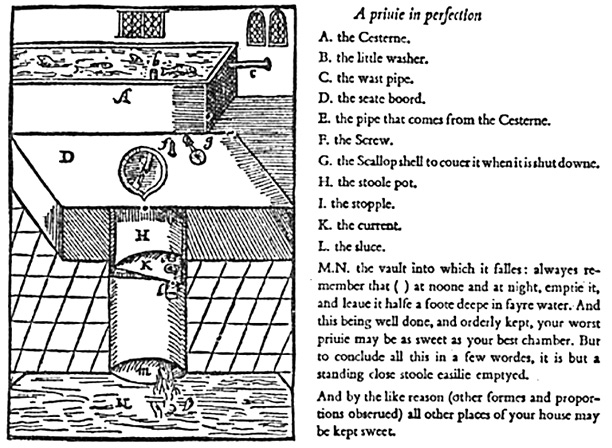
Historical note: Harington was a courtier to Elizabeth I, and one of his claims to fame is that he designed Britain’s first flushable toilet, which he installed in his manor house in Somerset. He included an image in a work he wrote on the subject.

Check out our books about the English language

Categories
English English language Etymology Grammar Linguistics Usage Word origin

Invasion of the brainworms

Q: During the college football bowls, an advertiser proclaimed that “by the end of this game, you or your company can have its own [x].” That sentence is now a worm in my brain. Should “its” have been “your”? Help!

A: When a compound subject is joined by “or” or “nor,” the verb agrees with the part that’s closer (“Cookies or cake is fine” … “Cake or cookies are fine”).

The same is true of any accompanying possessive pronoun (“Cookies or cake has its uses” … “Cake or cookies have their uses”). Take your cue from the part of the subject that’s nearer the verb.

But correct or not, this rule of subject-verb agreement can lead to extremely awkward sentences.

If the problem is that one part of the subject is singular and the other plural (as in the examples above), it often pays to put the plural part last: “Cake or cookies have their uses.”

This solution won’t give anybody a brainworm, because despite the “or” there’s a notion of plurality in that kind of sentence.

To use another example, it may be correct to write, “Neither they nor she has paid her tab.” But it sounds better to turn the subject around: “Neither she nor they have paid their tab.”

The problem isn’t as easy to fix when a compound consists of a “you” and an “it.” Technically, that advertiser was correct: “By the end of this game, you or your company can have its own [x].” But ouch!

And turning the subject around doesn’t help: “your company or you can have your own [x].” Ouch again!

Any sentence that leaves a worm in your brain should be recast, even if it’s written by the rules. There’s always a better way.

For example, the advertiser could have said, “ By the end of this game, you or your company can have an all new, one-of-a kind [x].”

Speaking of brainworms, you don’t hear the usage much nowadays, except in zoology, where the term “brainworm” refers to a parasitic roundworm that infects the brains of deer, moose, and other large hoofed animals.

However, the term has been used figuratively since the early 1600s to describe an imaginative worm infecting the brain, according to citations in the Oxford English Dictionary.

Here’s an example from Antiquity Revived, a 1693 religious tract: “Which undutiful and turbulent Allegation has not seldom created such a restless Brain-worm in the noddles of the multitude.”

The latest OED citation for the figurative use is from Musicophilia: Tales of Music and the Brain, a 2007 book in which Oliver Sacks discusses the earworms set off by movie, TV, and advertising music:

“This is not coincidental, for such music is designed, in the terms of the music industry, to ‘hook’ the listener, to be ‘catchy’ or ‘sticky,’ to bore its way, like an earwig, into the ear or mind; hence the term ‘earworms’—though one might be inclined to call them ‘brainworms’ instead.”

We hope this helps you get rid of that brainworm of yours.

Check out our books about the English language

Categories
English English language Etymology Grammar Linguistics Spelling Usage Word origin

Why “won’t” isn’t “willn’t”

Q: I was having a conversation with one of my co-workers about “won’t” and grabbed my office copy of Woe Is I to resolve the issue, only to find (or fail to find) that the use of this word is not explained in the book. Can you render an opinion as to its acceptability?

A: “Won’t” is a perfectly acceptable contraction of “will” and “not.” However, it’s an odd bird that’s been condemned at times for not looking quite like other contractions.

Merriam-Webster’s Dictionary of English Usage describes it as “one of the most irregular looking of the negative contractions that came into popular use during the 17th century.” Others include “don’t,” “han’t,” “shan’t,” and “an’t” (an early form of “ain’t”).

Why, you may ask, do we contract “will” and “not” as “won’t” instead of “willn’t”? Here’s Merriam-Webster’s explanation:

“Won’t was shortened from early wonnot, which in turn was formed from woll (or wol), a variant form of will, and not.”

The M-W editors give early examples of “won’t” from several Restoration comedies, beginning with Thomas Shadwell’s The Sullen Lovers (1668): “No, no, that won’t do.” 

By the way, the verb “will” has been spelled all sorts of ways since first showing up as wyllan around 1,000 in Aelfric’s Grammar, an Old English introduction to Latin grammar.

The Oxford English Dictionary has many Middle English examples of the wole or wol spelling dating back to the 1200s.

So etymologically, there’s a case to be made for contracting “will” and “not” as “won’t.” Nevertheless, some language commentators have grumbled about the usage.

Joseph Addison, for example, complained in a 1711 issue of the Spectator that “won’t” and other contractions had “untuned our language, and clogged it with consonants.”

“Won’t,” in particular, “seems to have been under something of a cloud, as far as the right-thinkers were concerned, for more than a century afterward,” Merriam-Webster’s says.

“This did not, of course, interfere with its employment,” the usage guide adds.

It was popular enough, M-W says, “to enjoy the distinction of being damned in the same breadth as ain’t in an address delivered before Newburyport (Mass.) Female High School in December 1846.”

Both “won’t” and “ain’t” were condemned by the Newburyport speaker as “absolutely vulgar.”

“How won’t eventually escaped the odium that still clings to ain’t is a mystery,” M-W Usage says, “but today it is entirely acceptable.”

Of course a few sticklers still feel that all contractions aren’t quite quite. Well, we beg to differ. As we’ve written on the blog, contractions are impeccably good English.

Check out our books about the English language

Categories
English English language Etymology Expression Linguistics Phrase origin Usage Word origin

Zero-sum games

Q: I see references to both “zero-sum games” and “zero-sum gains” on the Internet. Which is correct?

A: The term “zero sum” is widely misunderstood as meaning that nobody wins—or perhaps that nobody loses. In fact it means quite the opposite.

In any competitive situation, one side can’t win unless the other loses. “Zero-sum” means that when the losses are subtracted from the gains, the sum is zero.

The adjective “zero-sum” originated in the field of game theory in the mid-1940s, and it’s still commonly used to modify the word “game.” But “zero-sum” is also used to modify all kinds of nouns and to describe a wide variety of situations.

It would be inappropriate, however, to use it in the phrase “zero-sum gain.” That’s because “zero-sum” implies an equal balance between gain and loss.

We suspect that people are simply misunderstanding the phrase and hearing “gain” instead of “game.”

You’re right, though, that there’s a lot of zero-sum gaining on the Web. We got nearly 200,000 hits when we googled “zero-sum gain.” But we had nearly ten times as many hits for “zero-sum game.”

In game theory, as the Oxford English Dictionary explains, the adjective “zero-sum” is “applied to a game in which the sum of the winnings of all the players is always zero.”

In other words, the losses offset the gains, and the sum of losses and gains is zero.

But “zero-sum” is also used, the OED explains, to denote “any situation in which advantage to one participant necessarily leads to disadvantage to one or more of the others.”

So, for example, in “zero-sum diplomacy,” both sides can’t be winners.

The adjective was first used, according to OED citations, in John Von Neumann and Oskar Morgenstern’s book Theory of Games and Economic Behavior (1944):

“An important viewpoint in classifying games is this: Is the sum of all payments received by all players (at the end of the game) always zero; or is this not the case? … We shall call games of the first mentioned type zero-sum games.”

Here are a few more of the quotations cited in the OED:

“Perhaps the contestants in most important games nowadays (from labour disputes … to international diplomacy) too readily regard their games as zero-sum.” (From Stafford Beer’s book Decision and Control, 1966.)

“Everybody can win. Manufacturing is not a zero-sum game.” (A quote by L. B. Archer, from Gordon Wills and Ronald Yearsley’s Handbook of Management Technology, 1967.)

“C. Wright Mills … used a zero-sum conception of power (i.e., the more one person had the less was available to others).” (From the Times Literary Supplement, 1971.)

“We live in a zero-sum world.” (From the former BBC magazine The Listener, 1983.)

Check out our books about the English language

Categories
English English language Etymology Linguistics Usage Word origin

A noun for being upside down

Q: Why is there no word that describes the state of being upside down?

A: There’s a hyphenated word that may be what you’re looking for. It’s a noun, “upside-downism” (what else?), and the Oxford English Dictionary has exactly one citation for its use.

The word appeared in a book called The Oxonian in Iceland (1861), a travel book by Frederick Metcalfe about a trip taken in the summer of 1860.

We’ll expand the OED citation to provide some context. Here’s Metcalfe, describing a horseback ride through a volcanic region known as a “hraun” (Icelandic for “lava”):

“It was a ruin indeed, the abomination of desolation; as if the elements of some earlier world had melted with fervent heat; and as they cooled had burst asunder and been hurled by the Demons of Misrule and Upside-downism into a disjointed maze of confusion worse confounded.”

(Makes the eruption sound like a moral failing on the part of the volcano, doesn’t it?)

The OED doesn’t define “upside-downism,” but it describes it as a derivative of “upside down,” which has had an appropriately topsy-turvy history since it entered English in the 1300s.

For many centuries, “upside down” was exclusively an adverb (as in “turned upside down”). The adjective, usually hyphenated (as in “upside-down cake”), came along in the
mid-19th century.

When originally recorded, the Middle English adverb was up so doun (or up swa doun in northern dialects), and it apparently meant something like “up as if down.”

It first appeared in writing around 1340 in a Northumbrian religious poem, The Pricke of Conscience, which the OED attributes to the Oxford-educated mystic and hermit Richard Rolle:

“Tharfor it es ryght and resoune, / That they be turned up-swa-doune.” (We’ve converted the letter thorn to “th” throughout.)

The term appeared in another 14th-century poem, a verse rendition of The Seven Sages of Rome, an ancient Eastern collection of tales found in many languages and probably about 2,500 years old.

Here’s the couplet: “The cradel and the child thai found / Up so doun upon the ground.”

As the OED says, “The use of so is peculiar, the only appropriate sense being that of ‘as if.’ ”

At any rate, the “so” eventually disappeared. The OED explains that the compound was “frequently reduced to upsa-, upse-, and subsequently altered to upset and upside down, in the endeavour to make the phrase more intelligible.”

During the 15th and 16th centuries there were many versions of the term, including “opsadoun,” “upsedoun,” “up set doune,” “upset downe,” “upsydowne,” “vpsyde downe,” and others.

By the early 17th century, the modern spelling “upside down” had become established.

You didn’t ask, but the playful interjection “upsy-daisy,” which we’ve written about on our blog, is no relation—apart from the presence of “up.”

Check out our books about the English language

Categories
English English language Etymology Grammar Linguistics Usage Word origin

“Like” minded

Q: During the apocalyptic talk about the Mayan calendar, I wrote, “Planet Earth will not blow up like Krypton or be smashed by Planet X.” Is “like” OK here? (Krypton, the home planet of Superman, blew up just after little Kal-el left.)

A: The passage you wrote is fine as it is. In the sentence “Planet Earth will not blow up like Krypton or be smashed by Planet X,” the words “like” and “by” are prepositions. The underlined parts, “like Krypton” and “by Planet X,” are prepositional phrases.

This represents the traditionally correct use of “like”—as a preposition. The problem you’re thinking of is the use of “like” as a conjunction, a usage many sticklers frown on.

“Like” is used as a conjunction when it introduces a clause, as in “like Krypton did.” (A clause, you probably know, contains a verb and its subject.) A stickler would insist on “as” instead: “as Krypton did” (or “as did Krypton”).

However, the English in your original example is impeccable, even if you regard the verb “did” as implied but not expressed.

But what if you had included the verb (“like Krypton did”)? Here we part company with the sticklers, because even then we’d give you a passing grade.

You’re not writing elevated, formal prose. And as we’ve said before on our blog, the use of “like” as a conjunction is no crime in less than formal writing.

In fact, it represents a return to the past, before the 19th-century prohibition against the conjunctive “like” came along. And you don’t have to take our word for it.

Here’s what Merriam-Webster’s Collegiate Dictionary (11th ed.) has to say in a usage note:

“Like has been used as a conjunction since the 14th century. In the 14th, 15th, and 16th centuries it was used in serious literature, but not often; in the 17th and 18th centuries it grew more frequent but less literary. It became markedly more frequent in literary use again in the 19th century.”

It wasn’t until the mid-19th century, according to Merriam-Webster’s, that the usage came under fire. The dictionary’s conclusion:

“There is no doubt that, after 600 years of use, conjunctive like is firmly established. It has been used by many prestigious literary figures of the past, though perhaps not in their most elevated works; in modern use it may be found in literature, journalism, and scholarly writing. While the present objection to it is perhaps more heated than rational, someone writing in a formal prose style may well prefer to use as, as if, such as, or an entirely different construction instead.”

By the way, you might like to see a posting of ours about the use of “like” for “such as.” (Yes, it’s OK.)

And if you’re still “like”-minded, you might look at an article that Pat wrote for the New York Times Magazine about the use of “like” to quote or paraphrase people, as in “She’s like, what unusual taste you have.”

Check out our books about the English language

Categories
English English language Etymology Linguistics Usage Word origin

Lex appeal: Does size matter?

Q: How many words do most native English speakers know? Do Brits know more than Americans? How many do language mavens know? How about Shakespeare, Samuel Johnson, etc.? And what about age or educational level?

A: We’re afraid this will disappoint you. Many of your questions are impossible to answer. And even if we could contrive numbers for you, they wouldn’t be very meaningful.

We had a post on our blog a few years ago about the difficulty of counting words and comparing the lexicons of different languages.

The linguists Robert P. Stockwell and Donka Minkova, who discuss this in their book English Words: History and Structure (2001), write:

“A question which everyone wonders about, and often asks of instructors, is ‘How many words does English have?’ And even more commonly, ‘How many words does the typical educated person know, approximately?’ There are no verifiable answers to these questions.”

They do say that Shakespeare is known to have used about 30,000 different words in his plays, and that “a really well-educated adult” may have a vocabulary of up to 100,000 words—“but this is a wildly unverifiable estimate.”

As for the size of the lexicon, they conclude: “Nobody knows how many words English has.”

The linguist David Crystal said more or less the same thing in a 1987 article in the journal English Today:

 “How many words are there in English? And how many of these words does a native speaker know? These apparently simple little questions turn out to be surprisingly complicated. In answer to the first, estimates have been given ranging from half a million to over 2 million. In answer to the second, the estimates have been as low as 10,000 and over ten times that number.”

We can tell you that the biggest English dictionaries have about half a million words, but that’s no help because dictionaries are selective.

The editors at Oxford Dictionaries Online and Merriam-Webster’s Online discuss the difficulties of counting the number of words in English.

The principal problem in coming up with a number is which words to count. Are “do” and “does” two separate words? How about “doing,” “doer,” “don’t,” and “undo”? What about “cat” and “cats,” not to mention “catlike,” “catty,” and “anti-cat”?

That 30,000-word estimate for Shakespeare, as Stockwell and Minkova say, would drop to “about 21,000 if you count play, plays, playing, played as a single word,” and do the same in similar cases.

Do features like prefixes (“anti-,” “re-,” “un-,” etc.) and suffixes (“-ly,” “-er,” “-ing”) swell the number of possible words we count? Is a word with two meanings (say, “cleave”) counted as one word or two? Should we count symbols, acronyms, initialisms, spelled-out numbers? The questions go on and on.

We’ve also found varying statements about the number of words the average person knows or uses.

In their book Theory of Language (1999), the linguists Steven Weisler and Slavoljub P. Milekic estimate that “an average-educated English-speaking adult knows more than 50,000 words.”

But they say a person’s “lexical capacity” is larger. As current events and new technology create the need for new language, the authors write, “English-speakers are free to make up new words and to create new uses of existing words at the spur of the moment.”

You ask about age and educational level and how they affect vocabulary. Here’s what the British language writer Michael Quinion says on his website World Wide Words:

“It’s common to see figures for vocabulary quoted such as 10,000-12,000 words for a 16-year-old, and 20,000-25,000 for a college graduate. These seem not to have much research to back them up.”

So much for vocabulary size. But how many of those tens of thousands of words do we actually use? According to the Collins Corpus, an analytical database of English, “around 90% of English speech and writing is made up of approximately 3,500 words.”

That doesn’t sound like a lot, but let’s call it a day. We’ve run out of our daily quota of words.

Check out our books about the English language

Categories
English English language Etymology Grammar Linguistics Usage

“By” lines

Q: The Hunter College Reading/Writing Center has this example of a preposition used to show manner: By doing it yourself, you save time. I’m confused. Can you explain what “by doing it yourself” is doing there?

A: “By” and other prepositions are often used with “-ing” words to form phrases that are in effect adverbial—they tell how or in what manner.

In the sentence “He supports himself by teaching,” for example, the phrase “by teaching” tells how or in what manner he supports himself.

And in the sentence “By frowning, he showed his impatience,” the phrase “by frowning” tells how or in what manner he showed his impatience.

Your sentence—“By doing it yourself, you save time”—is a similar example. How do you save time? By doing it yourself.

Those prepositional phrases (“by teaching,” “by frowning,” “by doing it yourself”) are all adverbial because they serve to modify verbs (“supports,” “showed,” “save”).

The Oxford English Dictionary says this use of “by” is especially common in the phrases “begin by” and “end by,” followed by a gerund. (A gerund is a verb form that ends in “-ing” and acts as a noun, so it’s frequently the object of a preposition.)

We found a good illustration in Dorothy Dymond’s An Introduction to Medieval History (1929):

“The barbarians began by imitating the Roman Empire, and they ended by making a group of nations. They began by accepting Christianity, and they ended by making the medieval papacy.”

When a gerund is the object of a preposition (“by teaching,” “upon waking,” “after going,” “in creating,” “without looking,” and so on), the resulting prepositional phrase has an adverbial function because it tells how or in what manner.

This might be a good place to mention that not all verb forms ending in “-ing” are gerunds. Some are participles.

The traditional wisdom is that a gerund acts like a noun. So it can be the subject or object of a verb (“fishing is his passion” … “he loves fishing”), or the object of a preposition (“after fishing he cleans his catch”).

And traditionally, an “-ing” participle is used in a progressive tense (“he is fishing”), as an adjective (“he’s a fishing fool”), after conjunctions (“while fishing, he whistles”), and in some subordinate phrases (“fishing in the lake, he caught cold”).

But today many grammarians don’t make those distinctions in terminology with “-ing” words.

As we’ve written before on our blog, Geoffrey Pullum and Rodney Huddleston, authors of The Cambridge Grammar of the English Language, prefer the term “gerund-participle.”

Check out our books about the English language

Categories
English English language Etymology Grammar Linguistics Usage Word origin

Is “to” part of the infinitive?

Q: In your recent article for Smithsonian magazine, you defend the split infinitive by saying “to” isn’t actually part of the infinitive. Huh? Says who? Not any standard – or even nonstandard – grammar book or authority I’ve ever seen, heard of, or read. Here’s the standard definition of an infinitive, from Warriner’s English Grammar and Composition: “An infinitive is a verbal consisting of to followed by the verb.”

A: Sorry, but you’ve been misled, and the late John Warriner, a teacher and textbook author, was misinformed, as we’ll explain. His is absolutely NOT the “standard” definition of an infinitive.

The infinitive is the uninflected or basic form of a verb, and “to” is not part of it. When “to” appears with an infinitive, it is generally referred to as an “infinitive marker” or “infinitive particle”; it is not part of the verb and is not always used.

“To” is not there, for example, when the infinitive is used with modal verbs (sometimes called modal auxiliaries or secondary auxiliaries). The modal verbs are “can,” “could,” “may,” “might,” “shall,” “should,” “will,” “would,” and “must.”

Examples, “I must go,” “he should read,” “they can eat,” and so on. In modal constructions, infinitives (”go,” “read,” and “eat” in the examples) do not require “to.”

You don’t have to take our word for this. We can cite a great many authorities. Here are only a few.

(1) Fowler’s Modern English Usage (rev. 3rd ed.), edited by the language scholar and lexicographer R. W. Burchfield, likewise describes two uses of the infinitive: (a) “the to-infinitive,” in which “to” is described as a “particle,” and (b) “the bare or simple or plain infinitive.”

The bare infinitive, Fowler’s says, “is often optionally used after the verbs dare, help, and need.” (Examples of infinitives used this way would be, “Does he dare go?” “We helped them move,” “You need not come.” Here, “go,” “move,” and “come” are infinitives.)

Fowler’s adds: “But its use after modal verbs (can, may, must, shall, etc.) and after comparatives and superlatives (better, had better, best, had best, rather than, etc.) is much more significant.” (For example, in constructions like “we had better eat,” and “rather than eat later,” the verb “eat” is an infinitive.)

Fowler’s also mentions these other common uses of the bare infinitive:

(a) At the head of a clause, as in “Try as I might, I couldn’t … etc.” Here, “try” is an infinitive.

(b) After “let” plus its object, as in “Let him enjoy his ignorance.” Here, “enjoy” is an infinitive.

(c) After “is” and “was,” as in “All they want to do is hide in the kitchen.” Here, “hide” is an infinitive.

(d) After “why” and “why not,” as in “Why not ask Robert?” Here, “ask” is an infinitive.

Some other sources:

(2) The Cambridge Grammar of the English Language says the infinitive (as well as the imperative and the subjunctive) “consists simply of the lexical base, the plain base without any suffix or other modification.” (Examples of imperative and subjunctive forms of “run,” respectively would be: “Run as fast as you can!” and “I suggest you run.”)

The Cambridge Grammar, written by the linguists Geoffrey Pullum and Rodney Huddleston, goes on to explain that the marker “to” is “not part of the verb.”

 “The traditional practice for citation of verbs is to cite them with the infinitival marker to, as in ‘to be,’ ‘to take,’ and so on,” Cambridge continues. “That is an unsatisfactory convention, because the to is not part of the verb itself.”

The word “to” here “is not a (morphological) prefix but a quite separate (syntactic) word,” Pullum and Huddleston say, adding:

“This is evident from the fact that it can stand alone in elliptical constructions (as in I haven’t read it yet, but I hope to shortly), need not be repeated in coordination (as seen in I want to go out and get some exercise), and can be separated from the verb by an adverb, as seen in the so-called ‘split infinitive construction,’ I’m trying to gradually improve my game.”

(3) The Oxford English Grammar, written by the linguist Sidney Greenbaum, says the infinitive “has two major uses: (a) bare infinitive (without to) follows a modal auxiliary, [as in] ‘I must write that message’; (b) to-infinitive is the main verb in infinitive clauses [as in] ‘I’d like to write something on process theology.’ ”

Even dictionaries don’t use Warriner’s definition. Witness:

(4) The American Heritage Dictionary of the English Language (5th ed.), definition of “infinitive”: “A verb form that functions as a substantive while retaining certain verbal characteristics, such as modification by adverbs, and that in English may be preceded by to, as in To go willingly is to show strength or We want him to work harder, or may also occur without to, as in She had them read the letter or We may finish today.”

(5) Merriam-Webster’s International, Unabridged Third Edition, definition of “infinitive”: “an infinite verb form normally identical in English with the first person singular that performs certain functions of a noun and at the same time displays certain characteristics (as association with objects and adverbial modifiers) of a verb and is used with to (as in ‘to err is human’; ‘I asked him to go’) except with auxiliary and certain other verbs (as in ‘he can see’; ‘let me go’; ‘no one saw him leave’).

(6 ) The Oxford English Dictionary has an extensive discussion of the historical development of “to” with the infinitive in Old and Middle English. Later it has this: “The simple infinitive, without to, remains: 1. after the auxiliaries of tense, mood, periphrasis, shall, will; may, can; do; and the quasi-auxiliaries, must, (and sometimes) need, dare: 2. after some vbs. of causing, etc.; make, bid, let, have, in sense B. 15a; 3. after some vbs. of perception, see, hear, feel, and some tenses of know, observe, notice, perceive, etc., in sense B. 15b; 4. after had liefer, rather, better, sooner, as lief, as soon, as good, as well, etc.: see have v. 21, rather adv. 8d, and the other words.

“The infinitive with to may be dependent on an adj., a n., or a vb., or it may stand independently. To an adj. it stands in adverbial relation: ready to fight = ready for fighting; to a n. it stands in adjectival or sometimes adverbial relation: a day to remember = a memorable day; to a vb. it may stand in an adverbial or substantival relation: to proceed to work = to proceed to working; to like to work = to like working.”

When this preposition was first used in English as an infinitive marker (tó in Old English), it did have a prepositional flavor. “I prepared to eat” sounded to the medieval ear something like “I prepared for eating”; “he fails to think” sounded something like “he fails in thinking”; “we strive to please” sounded something like “we strive toward pleasing.” As the OED says, “it expressed motion, direction, inclination, purpose, etc., toward the act or condition expressed by the infinitive; as in ‘he came to help (i.e. to the help of) his friends,’ … ‘he prepared to depart (i.e. for departure).’ ”

There once was a sense of motion, of moving toward accomplishing something (represented by the infinitive), if that makes any sense.

But as the OED says: “in process of time this obvious sense of the prep. became weakened and generalized, so that tó became at last the ordinary link expressing any prepositional relation in which an infinitive stands to a preceding verb, adjective, or substantive.” [Here the italicized tó represents the Old English word.]

As we’ve written on our blog, a great many people misunderstand infinitives because they aren’t familiar with their many uses.

In that post, we cite the clause “I saw her fall,” with the verb “fall” in the infinitive. In English, this is a very common pattern: one verb followed by a second in the infinitive. It’s often the case when the first verb is one involving sensory perception (“see,” “feel,” “hear”).

Here are a few examples of the kinds of verbs that are often paired with infinitives (the infinitives are underlined):

“I helped her walk” … “They saw us go” … “We felt it move” … “He heard her cry” … “You need not worry” … “Dare we ask?” … “I would rather die” … “We will let it rest” … “Let there be light.”

In addition, the auxiliary “do” is often used with an infinitive to form a question: “Do you smoke?” … “Did they drive?”

And as we’ve said, the modal auxiliary verbs (“can,” “may,” “must,” etc.) take infinitives as their complements: “She may smoke” [or “May she smoke?”] … “We must leave” [or “Must we leave?”].

In all of these cases, the second verb is in the infinitive. But many people don’t recognize these verb forms as infinitives because they expect infinitives to be preceded by “to.” As you can see, that’s often not the case.

Help support the Grammarphobia Blog with your donation. And check out our books about the English language and more.

Subscribe to the blog by email

Enter your email address to subscribe to the blog by email. If you’re a subscriber and not getting posts, please subscribe again.

Categories
English English language Etymology Linguistics Usage Word origin

Meteoric language

Q: I’m putting together a planetarium exhibition on meteorites. My background documents often say pieces of a meteorite were “recovered” after falling to earth. Can we “recover” something we never had? I’d appreciate your help.

A: We checked all the many meanings of “recover” in the Oxford English Dictionary, and when used in reference to physical objects, it generally means to regain or reacquire something lost.

An old meaning of the verb “cover,” now obsolete, was to get or acquire. And the original, 14th-century meaning of “recover” (literally, “cover again”) was to win back ground lost in battle.

But etymology aside, astronomers and geologists use the word in a different sense. They quite routinely use “recover,” “recovered,” and “recovery” in writing about meteorite fragments found on earth, even though nobody had physical possession of them beforehand.

Though this use of “recover” might seem questionable, at least in the strictly literal sense of the word, we think it’s perfectly reasonable in a scientific context, like an exhibition at a planetarium.

As it happens, the OED does recognize “recover” as a technical term in astronomy. But it has a more celestial meaning than the earthbound one we’re talking about. It refers only to the observation of objects in space.

The OED defines this “recover” as meaning “to observe (an astronomical object, esp. a periodic comet) following an extended period during which it has not been visible or observed.”

The OED’s first citation for this sense of the word is from a 1901 issue of a scientific journal, Monthly Notices of the Royal Astronomical Society: “Professor Howe … recovered the comet on May 27, after its perihelion passage.”

This more recent citation is from a 2006 issue of the Guardian: “The dim comet was lost again until … it was recovered tracing a 5.4 year orbit about the Sun.”

But we think you’re safe using “recover” in reference to meteorites that have fallen to earth. Though the OED hasn’t yet recorded this sense of the word, scientists routinely use it that way, which is a pretty good argument in its favor.

For example, we found this example in a 1977 issue of the British magazine New Scientist:

“Analysis of the photographs suggested the fall of several kilogrammes of meteorites at a point some 150 km east of Edmonton. … A 2.1-kg freshly fallen meteorite was recovered only 500 metres from the predicted impact point.”

Scientists use “recover” even when the meteorites weren’t seen falling beforehand. That’s the case in this passage from Paul W. Hodge’s book Meteorite Craters and Impact Structures of the Earth (1994):

“The Haviland crater itself was not discovered until about 1925, when H. H. Nininger visited the Kimberley farm to recover the meteorites.”

Finally, Robert T. Dodd’s book Meteorites: A Petrologic-chemical Synthesis (1981) has this note about the naming of meteorites:

“A newly fallen or newly discovered meteorite is named for a locality or permanent geographic feature that is near its point of recovery. … The many meteorites recovered from Antarctica raise a serious problem of terminology.”

Check out our books about the English language

Categories
English English language Etymology Grammar Linguistics Usage Word origin

“Want” adds

Q: Why do we say or write things like “I want to thank you for your wonderful lecture the other night” or “I wanted to let you know that the blouse you like is in stock again”? I find myself doing it when I’m in a business situation. What’s with this “want” business?

A: In our opinion, starting a statement like that with “I want to …” (or the even more deferential “I just want to …”) is an example of tentativeness or excessive politeness.

We’ve written on our blog about a similar mannerism, the use of “I would like …” (or “I’d like …”) instead of “I want ….”

As we said in that May 18, 2009, post, people tell a waiter “I would like the braised sirloin tips with artichoke hearts” because it sounds more indirect, hence more polite and less demanding, than “I want the braised sirloin tips with artichoke hearts.”

Some grammarians use the term “tentative volition” to describe this less demanding way of demanding something.

The Cambridge Grammar of the English Language discusses the use of “would” in a sentence like “I would like to see him tomorrow” (vs. “I want to see him tomorrow”).

The authors, Rodney Huddleston and Geoffrey K. Pullum, say that “would” often “introduces a rather vague element of tentativeness, diffidence, extra politeness, or the like.”

Huddleston and Pullum go on to describe “would like” as “more or less a fixed phrase, contrasting as a whole with want.”

We think people insert things like “I wanted to …” and “I’d like to …” in sentences when they’re nervous, overly deferential, addressing someone of importance (such as a valued customer), or unsure of their own authority.

There’s nothing grammatically wrong in all this. It’s more of a psycholinguistic issue.

Etymologically, to “want” something is to lack it, the meaning of the word when it entered English in the early 1200s, according to the Oxford English Dictionary.

The sense of desiring something “is a secondary extension” of the original meaning, according to John Ayto’s Dictionary of Word Origins.

English adapted “want” from the Old Norse vanta (to be lacking), but Ayto says the ultimate source is the prehistoric Germanic root wan- (lacking), which is also the source of the English word “wane.”

The adjective “wanton” is another relative. As Ayto explains: “Someone who is wanton is etymologically ‘lacking in proper upbringing or discipline.’ ”

Check out our books about the English language

Categories
English English language Etymology Expression Grammar Linguistics Phrase origin Usage Word origin

Where is “put” in “stay put”?

Q: My daughter was in the Northeast during the recent snowstorm and I asked her if she was planning to stay put. That got me to thinking: where is put?

A: The Oxford English Dictionary describes “stay put” as a colloquialism that originated in the US in the mid-19th century.

The OED defines the verbal phrase as meaning “to remain where or as placed; to remain fixed or steady; also fig. (of persons, etc.).”

The earliest published reference in the dictionary is from the Sept. 23, 1843, issue of the New Mirror, a weekly journal in New York: “And now we have put her in black and white, where she will ‘stay put.’ ”

The usage apparently raised eyebrows in its early days. John Russell Bartlett, in his Dictionary of Americanisms (1848), describes it as a “vulgar expression”—that is, a common one.

In Haunted Hearts, an 1864 novel by Maria Susanna Cummins, the expression refers to a thing: “This curl sticks right out straight; couldn’t you put this pin in for me, so that it would stay put?”

James Russell Lowell, uses it to refer to a person in his 1871 essay collection My Study Windows: “He has a prodigious talent, to use our Yankee phrase, of staying put.”

Where, you ask, is put?

The OED doesn’t explain the origin of the usage, and we couldn’t find an explanation in any of our usual language references.

But there may be a clue in Oxford’s definition of the phrase: “to remain where or as placed.”

If we had to guess, we’d say the verbal phrase originally meant something like “to stay where someone or something is put,” or “to stay where one puts oneself.”

However, an idiomatic expression like “stay put” doesn’t necessarily have to make sense, as we’ve mentioned several times on the blog, including in a posting a couple of years ago. In other words, there may be no “where” there.

The word “put,” by the way, is one of the commonest English verbs, but its source is uncertain, according to John Ayto’s Dictionary of Word Origins.

Ayto says it goes back to an Old English word, putian, “never actually recorded but inferred from the verbal noun putung ‘instigation,’ but where that comes from is not known.”

He speculates that putung “was presumably related to Old English potian ‘push, thrust,’ whose Middle English descendant pote formed the basis of Modern English potter.” (Think of that, next time you find yourself pottering in the garden.)

In case you’re curious, the golfing term “putt” as well as the track-and-field term “shot put” are descended from that same uncertain source.

Check out our books about the English language

Categories
English English language Etymology Grammar Linguistics Usage Word origin

Look, readers!

Q: I’ve noticed a lot of television commentators starting their comments with the word “look.” Is this something new? What’s the grammatical term to describe this?

A: What you’re describing is an idiomatic use of “look” that’s intended to get someone’s attention. And it’s nothing new. The Oxford English Dictionary says “look” has been “used to bespeak attention” for more than a thousand years.

The verb “look” is used here in the imperative—that is, as a command. But it isn’t meant literally (to direct one’s sight). Here it’s used figuratively in the same way English speakers have also used “see,” “behold,” and “lo.”

According to Oxford, the word often appears as part of a phrase, “look you,” meaning “mind this,” which “in representations of vulgar speech” is written as “look’ee.”

Another such phrase, “look here,” is described as “a brusque mode of address prefacing an order, expostulation, reprimand, etc.” This phrase is often written as “look-a-here” or, in regional American usage, “looky.”

The OED has many examples of all of these attention-getting usages. The earliest is from the Benedictine monk and scholar Ælfric of Eynsham, who used loca nu (Old English for “look now” or “behold”) around the year 1000.

And the usage has been common ever since. Many of the OED’s citations are from written speech in plays, stories, or novels.

In the early 1600s, Shakespeare used “looke you” and “looke thee heere” in two of his plays. Later in the century, the Duke of Buckingham, George Villiers, used “look you now” and “look you, Sir” several times in his play The Rehearsal (1672).

In the early 18th century, Richard Steele used similar constructions in his writings in the Tatler: “Look ye, said I, I must not rashly give my Judgment” (1709), and “Look’ee, Jack, I have heard thee sometimes talk like an Oracle” (1710).

Charles Dickens used such phrases in at least two of his novels: “Now, look here my man … I’ll have no feelings here” (Great Expectations, 1861); and “Now, lookee here, my dear” (Our Mutual Friend, 1865).

American examples are plentiful too. This OED citation is from Mark Twain’s The Adventures of Tom Sawyer (1876): “look-a-here—maybe that whack done for him!”

The use of “look” by itself is more familiar to us today, as in these 20th-century examples:

“Look, my Bill doesn’t include any blanket condemnation of unofficial strikes” (from the former BBC journal The Listener, 1949).

“Look, we don’t have to sit here. We could go down to the beach” (from George Sims’s novel Hunters Point, 1973).

So the commentators you mention are merely continuing a long tradition. People who constantly begin sentences with “Look” can get on one’s nerves. But an occasional example here or there isn’t out of line.

Note: We had a posting on the blog a couple of years ago about the use of “look” as a quasi-transitive verb in an expression like “Never look a gift horse in the mouth.” 

Check out our books about the English language

Categories
English English language Etymology Grammar Linguistics Usage

The grayness of they-ness

[Note: An updated post on this subject was published on May 22, 2017.]

Q: I insist that my college students refer to a singular noun (e.g., “student”) with a singular pronoun (e.g., “he” or “she”). They may use “they,” “their,” and “them” only with plural nouns, such as “students.” However, the professor in charge of our Writing Center disagrees. Please help me be sure I am giving my students the correct advice.

A: You’re technically right. But as far as common usage goes, there’s some room for dispute. What’s acceptable may depend on the kind of writing the students are doing and the audience they’re writing for.

What’s indisputably true is that anyone who uses “they,” “them,” or “their” to refer to an indefinite someone is using English that’s considered informal, at least as of today. (Stay tuned for further developments.)

In formal English, these are third-person plural pronouns. And students in any writing program should be aware of that.

We’ve written about this subject in a column in the New York Times Magazine. We’ve also discussed it many times on our blog, including postings in May and August of 2011.

Historically, there’s a case to be made for using “they” and company as indefinite singulars. People used them that way centuries ago without getting their knuckles rapped. But for the past 200 years or so, they’ve generally been considered plural.

This is a usage that’s in transition. In the meantime, anyone who wants to be grammatically as well as politically correct without resorting to “he/she” or some variant can always recast the sentence and make the antecedent plural.

Instead of “Every parent loves his or her (or their) child,” make it “All parents love their children.”

The American Heritage Dictionary of the English Language (5th ed.) labels “they” as a “usage problem” when “used to refer to the one previously mentioned or implied, especially as a substitute for generic he.”

The dictionary gives this sentence as an example: “Every person has rights under the law, but they don’t always know them.”

American Heritage explains further in an extensive usage note, which we’ll break up into paragraphs to make it easier to read:

“The use of an ostensibly plural pronoun such as they, them, themselves, or their with a singular antecedent dates back at least to 1300, and over the years such constructions have been used by many admired writers, including William Makepeace Thackeray (‘A person can’t help their birth’), George Bernard Shaw (‘To do a person in means to kill them’), and Anne Morrow Lindbergh (‘When you love someone you do not love them all the time’).

“The practice is so widespread both in print and in speech that it generally passes unnoticed. Forms of they are useful as gender-neutral substitutes for generic he and for coordinate forms like his/her or his or her (which can sound clumsy, especially when repeated frequently).

“Nevertheless, many people avoid using forms of they with a singular antecedent out of respect for traditional pronoun agreement. Most of the Usage Panel still upholds the practice of traditional pronoun agreement, but in decreasing numbers.

“In our 1996 survey, 80 percent rejected the use of they in the sentence A person at that level should not have to keep track of the hours they put in. In 2008, however, only 62 percent of the Panel still held this view, and by 2011, just 55 percent disapproved of the sentence Each student must have their pencil sharpened.

“Moreover, in 2008, a majority of the Panel accepted the use of they with antecedents such as anyone and everyone, pronouns that are grammatically singular but carry a plural meaning. Some 56 percent accepted the sentence If anyone calls, tell them I can’t come to the phone, and 59 percent accepted Everyone returned to their seats.

“The trend, then, is clear. Writers who choose to use they with a singular antecedent should rest assured that they are in good company—even if a fair number of traditionalists still wince at the usage.

“For those who wish to adhere to the traditional rule, one good solution is to recast the sentence in the plural: People at that level should not have to keep track of the hours they put in.”

Check out our books about the English language

Categories
English English language Etymology Linguistics Phrase origin Usage Word origin

English lit or British lit?

Q: Which is correct: English literature or British literature? I studied “English literature” during my schooldays in England. We read the works of authors and poets born in England, Wales, and Scotland. “British literature” sounds strange to me.

A: This is a somewhat sensitive subject, one that seems to change along with ideas about national identity.

When the two of us were in college, in the 1960s and ’70s, the term “English literature” loosely meant works by writers from the British Isles (a term not popular in the Republic of Ireland).

The problem with “English” is that it can refer either to the people of England or to the language, which is spoken in many other nations.

That makes the term “English literature” a little ambiguous. It could mean works written in English, or works written by English authors.

Today, “English literature” is often defined simply as literature written in the English language.

“British literature,” on the other hand, usually refers to works by authors from the United Kingdom (comprising England, Scotland, Wales, and Northern Ireland), and sometimes from the Republic of Ireland.

The choice of terms can be difficult. A case in point is the five-volume Oxford Encyclopedia of British Literature, which includes entries for authors and works from the UK and the Republic of Ireland, an independent nation.

The editor in chief, David Scott Kastan, says in the preface that the choice of an adjective for the title was “vexing,” and explains why “British” was chosen instead of “English”:

“ ‘English’ would either limit the field too narrowly (that is, by restricting the focus to the writers of England) or not enough (that is, by opening it up to all writers writing in English),” Kastan writes.

The adjective “British,” he says, “accurately if sometimes uneasily accommodates the Welsh and Scottish entries. The Irish entries less comfortably fit under the rubric.”

So the term “British literature,” Kastan writes, “is admittedly a compromise,” and is intended “largely as a geographical rather than a political term.”

Consequently, Irish writers like Seamus Heaney, Jonathan Swift, James Joyce, William Butler Yeats, and others are included in the encyclopedia as writers “participating in and substantially contributing to a common linguistic and cultural history with writers who with greater terminological precision are labeled ‘British.’ ”

As we hinted above, you’ll find that opinions on such terminology often differ. It’s been our experience, for example, that some people from England resent being referred to as “British” and insist on being called “English.” And we’ve heard from some Scots who don’t care to be referred to as “British” either.

We will leave all that for them to sort out. Meanwhile, a little etymology might be in order.

The short version of the story is that the word “English” is Germanic in origin and “British” is from Latin or Celtic or both.

“English” and “England” are derived from an ancient and long dead noun, Engle, according to the Oxford English Dictionary.

Engle was used in early Old English as a collective plural. It referred both to the Angles—a Germanic tribe that invaded Roman-occupied Britain in the fifth century and settled the region north of the Thames—and to the people of England.

The Angles were originally from Angeln, a region now known as Schleswig and located in northern Germany and southern Denmark.

The words “British” and “Britain” are derived from Latin by way of Celtic (or vice versa), and can trace their roots to the Roman occupation or even further back. The occupation extended into the southern part of what is now Scotland and lasted from the first through the fifth centuries.

“Britain” is from the classical Latin adjective Britannus, which the OED says is “perhaps ultimately [from] the Celtic base of Welsh pryd,” meaning “countenance, image, beauty, form.” (The Old Welsh for “Britain” was Priten.) 

Why, you’re probably asking, can’t we be more precise about the ultimate origin of  “British” and “Britain”? Did their ancestors come into Old English from Latin or from Celtic? Here’s what the OED has to say on the subject:

“At the time of contact with the Anglo-Saxons, south-eastern Britain was heavily Romanized and bilingualism with Latin must have been common. Therefore, although post-classical Latin Brittus (as well as classical Latin Britto and Brittannus ) appears ultimately to have a Celtic base …, it is unclear whether Latin or British forms (or both) were borrowed into Old English.”

The name “Britain” has been used since the Old English period, the OED says, “to denote the geographical area comprising England, Wales, and Scotland, with their dependencies (more fully called Great Britain).” More recently, the term is “also used for the British state or empire as a whole.”

We mentioned the term “British Isles” above, so let’s not keep it dangling.

It’s defined in the OED as “a group of islands, including Britain, Ireland (Northern Ireland and the Republic of Ireland), the Isle of Man, the Hebrides, the Orkney Islands, the Shetland Islands, the Scilly Isles, and the Channel Islands, lying off the coast of northwestern Europe, from which they are separated by the North Sea and the English Channel.”

The OED says the phrase “British Isles” is “generally regarded as a geographical or territorial description, rather than as one which designates a political entity.” The term, the OED adds, “is deprecated by some speakers in the Republic of Ireland.”

Check out our books about the English language

Categories
English English language Etymology Grammar Linguistics Phrase origin Politics Usage Word origin

Hear Pat live today on WNYC

She’ll be on the Leonard Lopate Show around 1:20 PM Eastern time to discuss the English language and take questions from callers. Today’s topic: the language of Watergate, 40 years later. If you miss the program, you can listen to it on Pat’s WNYC page.

Categories
English English language Etymology Grammar Linguistics Phrase origin Usage Word origin

Meantime, back at the ranch

Q: Since when has “meantime” become acceptable by itself? I’ve heard several news commentators begin sentences with “Meantime” instead of “In the meantime” or “Meanwhile.” I’ve also seen “meantime” instead of “meanwhile” on news tickers. I was taught in high school that this is incorrect. What happened?

A: The words “meantime” and “meanwhile” have identical meanings and can be used interchangeably, but most of the time we use them for different purposes.

Both are nouns as well as adverbs. When used as adverbs they appear alone, but when used as nouns they’re part of an adverbial phrase beginning “in the …” or “for the ….”

So all of these sentences are correct:

(1) “In the meantime, Herbie did his laundry.” (Here, “meantime” is a noun.)

(2) “In the meanwhile, Herbie did his laundry.” (Here, “meanwhile” is a noun.)

(3) “Meantime, Herbie did his laundry.” (“Meantime” is an adverb here.)

(4) “Meanwhile, Herbie did his laundry.” (“Meanwhile” is an adverb here.)

However, most people use #1 and #4 much more often than #2 and #3. For most of us, the preference is to use the noun “meantime” in the adverbial phrase (#1) and to use “meanwhile” when we want a stand-alone adverb (#4).

While those are the customary idiomatic usages, it’s not incorrect to go the other way—to use “meantime” all by itself and “meanwhile” as part of a phrase (“in the meanwhile,” “for the meanwhile”).

We’re not alone in saying this, by the way. Merriam-Webster’s Dictionary of English Usage comments: “The evidence shows that meantime and meanwhile have been used interchangeably as nouns since the 14th century and as adverbs since the 16th century.” (And that, we might add, is as long as they’ve been in the language.)

“The general observation that meantime is now the more common noun and meanwhile the more common adverb is undoubtedly true,” M-W continues, “but the adverb meantime and the noun meanwhile have been in continuous use for hundreds of year, and their use in current English is not rare.”

The usage guide’s advice: “There is no need to make a point of avoiding such usage.”

Another authority, R. W. Burchfield, writes in Fowler’s Modern English Usage (rev. 3rd ed.): “The phrases in the meantime and in the meanwhile are still to some extent interchangeable, though the former is the more usual.”

As we said above, the definitions of “meantime” and “meanwhile” are identical.

The nouns mean “the time intervening between one particular period or event and another,” the OED says, while the adverbs mean “during the intervening time between one particular period or event and another; while or until a particular event occurs; at the same time; for the present.”

Their parallel histories are interesting to trace. Both words originally showed up as parts of longer phrases.

In its earliest uses, “meantime” was part of the phrase “in the meantime,” which the OED defines as “during or within the time intervening between a particular period or event and a subsequent one; while or until a (specified) period or event occurs.”

OED citations for the phrase date back to 1340, and it appears (as “in the mene tyme”) in a circa 1384 edition of the Wycliffe Bible.

This modern example is from Muriel Spark’s novel A Far Cry From Kensington (1988): “We thought … we would soon have to find another job. In the meantime we got on with the job we had.”

“For the meantime” was first recorded in 1480 (as “for the mene tyme”), and means “so long as a period of (intervening) time lasts; for the interim,” the OED says.

The OED’s most recent example is from a 1990 issue of the journal Modern Railways: “For the meantime he has a tremendous task, compounded by the managerial and organisational changes racking BR as it attempts to meld the Sectors and production.”

But “meantime” has been used as a stand-alone adverb since the late 16th century. Oxford’s earliest example is from Christopher Marlowe’s play Edward II, written sometime before 1593: “Mean time my lord of Penbrooke and my selfe Will to Newcastell heere, and gather head.”

The dictionary’s examples continue into modern times. The most recent is from BBC Top Gear Magazine (1999): “Ferrari is readying a fully convertible version of the fab 360 Modena…. Meantime, the 360 comes with a removable-panel sunshine roof option.”

Like “meantime,” the noun “meanwhile” first appeared as part of a phrase: “in the meanwhile” (dating to before 1375) and “for the meanwhile” (circa 1390).

This modern example is from a 1986 issue of the Daily Telegraph (London): “In the meanwhile, the Government is effectively admitting that state spending is out of control.”

And this one is from a 1993 novel, Will Self’s My Idea of Fun: “I didn’t know who or where to turn to. So for the meanwhile I continued with my ritualised observances.”

But like you, most people are more comfortable with “meanwhile” used solo as an adverb, a usage first recorded (as “mene whyle”) in 1440.

This elegant example is from D. H. Lawrence’s novel The Rainbow (1915): “Meanwhile the brook slid on coldly, chuckling to itself.”

And here’s one from F. Scott Fitzgerald’s novel Tender Is the Night (1934): “He … took a small beer on the terrace of the station buffet, meanwhile watching the little bug crawl down the eighty-degree slope of the hill.”

As you can see from all the examples, sometimes these adverbs and adverbial phrases appear at the beginning of sentences and sometimes later; sometimes they’re set off by commas and sometimes they’re not.

We can’t sign off without mentioning the phrase “meanwhile, back at the ranch,” which the OED says was “originally used in western stories and films, introducing a subsidiary plot; now chiefly humorous and in extended use.”

In Oxford’s earliest example, the phrase is in its infancy and lacks the word “back.” It’s from a classic of the genre, Zane Grey’s novel Riders of the Purple Sage (1912):

“Meantime, at the ranch, when Judkins’s news had sent Venters on the trail of the rustlers, Jane Withersteen led the injured man to her house.”

Fowler’s says the complete phrase (“Meanwhile, back at the ranch”) originally appeared as a subtitle in silent Western films and was later “promoted from caption to voice-over.”

The OED’s first published example of the complete phrase is from a 1940 issue of the Oakland Tribune: “Meanwhile, back at the ranch, Sandy’s dog, Pat, began to whine.”

Check out our books about the English language

Categories
English English language Etymology Linguistics Phrase origin Usage

Quote magnets

Q: I enjoyed hearing Pat discuss quote magnets last month on WNYC. I have a favorite Mark Twain quote, and I’d like to know whether it’s genuine: “If you always tell the truth, you don’t have to remember anything.”

A: We can’t find any evidence that Mark Twain ever wrote this. We can’t find it in any of his works, and the Internet websites that say he wrote it don’t say where.

If you can’t look something up to verify it at the source, it’s probably not true. And as Pat said on that WNYC program, Twain never said a lot of the things attributed to him.

In fact, Twain is a good example of a quotation magnet, a term coined by Fred Shapiro, author of The Yale Book of Quotations, for people often credited with saying things they never said.

When a quote is catchy but of unknown or obscure origin, it tends to attach itself to some famous person, like Twain, Churchill, George Bernard Shaw, Lincoln, or Dorothy Parker.

In an article in the July-August 2011 issue of the Yale Alumni Magazine, Shapiro calls Twain “the great American quotation magnet” because “any folksy or mildly satiric line tends to be pinned on him.”

The quote you mention is found in many different versions and has been attributed to more than one person, which leads us to think that it should be chalked up to that great fount of platitudes, Anonymous.

We found an early version—“If you always tell the truth, you will never have to fix up excuses”—among a list of anonymous “Ironical Ifs” printed in the Bay City (Michigan) Times-Press on Nov. 19, 1898. The same list was reprinted the following year in the Muskegon (Michigan) Chronicle.

Twain was alive and kicking then and was wildly popular. If those newspapers had been quoting him, they no doubt would have said so.

Over the years, the quotation morphed into many different forms. One version showed up in an African-American newspaper, the Negro Star, of Wichita, Kansas, on Feb. 8, 1952.

In an opinion column devoted to the importance of accuracy, the writer, Ruth Taylor, quoted “a machinist friend” of hers as saying, “If you always tell the truth, then you never have to remember what you said before.”

Similar versions of the quote have been posthumously attributed to Sam Rayburn, the longtime Speaker of the House of Representatives, who died in 1961.

According to a United Press International dispatch that ran in the Chicago Tribune in July 1967, Rayburn “was fond of saying: ‘If you always tell the truth, you never have to remember what you said.’ ”

And in 1978, the Washingtonian magazine quoted Rayburn as saying, “Son, always tell the truth. Then you’ll never have to remember what you said the last time.”

George McGovern apparently made a similar observation. In a New Yorker article in May 1972, when McGovern was running for president, Shirley MacLaine is quoted as saying that McGovern “never gets tired.”

“I asked him how he did it,” MacLaine says, “and he told me that the secret is telling the truth. If you always tell the truth you don’t have to use up energy trying to remember what you said in other places.”

Yet another version appears in David Mamet’s play Glengarry Glen Ross (1982). In Act Two, the character Roma is giving advice on how to talk to the police: “Always tell the truth. It’s the easiest thing to remember.”

Yet other versions appear on the Internet, some attributed to Twain, some to Rayburn, and some to “legend.” Versions differ, to the effect that if you tell the truth, you won’t have to remember “your words,” or “what you said,” or “your lies.”

As for Twain, he did write, “When in doubt, tell the truth,” according to The Yale Book of Quotations. The quote is from Following the Equator, chapter 2, “Pudd’nhead Wilson’s New Calendar” (1897).

If Twain was the “great American quotation magnet,” then Churchill was the great British one. The tendency for wisecracks to attach themselves to Churchill is so common that it’s been given a name of its own: “Churchillian drift.”

As Pat mentioned on the program, Lady Astor supposedly told Churchill at a dinner party, “If I were married to you, I’d put poison in your coffee.” Churchill’s alleged reply: “If I were married to you, I’d drink it.”

According to legend that exchange took place in the 1920s, but Shapiro has traced it to a joke line from a 1900 edition of The Chicago Tribune.

Similarly, there’s no truth to the old story about someone who wanted to “fix” one of Churchill’s sentences because it ended with a preposition.

There are many versions of what Churchill is supposed to have written in a marginal note. The most common: “This is the sort of English up with which I will not put.”

While we’re at it, Churchill never described Britain and the United States as “two nations divided by a common language.” We’ve written about these last two legends in our book about language myths, Origins of the Specious.

Check out our books about the English language

Categories
English English language Etymology Linguistics Pronunciation Spelling Usage Word origin

What kind of abbreviation is K-9?

Q: I’m curious about the term “K-9” that appears on the doors of LAPD patrol cars that carry dogs. Is there a proper term for this type of word shortening?

A: “K-9” is obviously an abbreviation, because it’s a short form of a longer word, “canine.” But what kind of abbreviation is it?

Two common kinds of abbreviations are the “acronym” and the “initialism,” which differ in the way they’re spoken.

Since acronyms are pronounced as words and initialisms are pronounced as letters, it would appear that “K-9” could be either one. It sounds just like “canine,” and just like the individual characters “K” and 9.”

But in our opinion, it’s technically neither acronym nor initialism.

An acronym, as we’ve written on our blog, is a word formed from elements of a longer word or phrase. But “canine” doesn’t include a “K” or a “9.”

And an initialism, as we’ve also written, is a series of letters formed from a longer word of phrase. But again, “K” and “9” aren’t part of the unabbreviated word.

We seem to be in a special category here. The “K” and the “9” merely echo sounds found in the word “canine” but don’t stand for anything resembling the longer word.

We’ve at times come across the term “pseudo-acronym,” and “K-9” might be one of those.

No dictionaries that we’ve found define “pseudo-acronym,” and there are conflicting definitions on websites. Here’s one from a paper on acronyms published by the US Department of Homeland Security:

“Pseudo-acronym: A catchall for variations and embellishments, such as creating an acronym from other acronyms (IT Acquisition Center—ITAC) or mixing abbreviations and acronyms (deoxyribonucleic acid—DNA) and ignoring words in a series just to make a pronounceable word (Princeton University Institute for the Science and Technology of Materials–PRISM), or pronouncing vowels that are not there (Guantanamo—GTMO, pronounced Gitmo) to coin a word.”

So, according to Homeland Security, you’d be on safe ground if you called “K-9” a pseudo-acronym. It’s definitely a variation or embellishment, and certainly the canines themselves won’t object.

By the way, we usually see “K-9” with a hyphen, but not always. The Los Angeles Police Department, for example, hyphenates the term on patrol cars, but usually drops the hyphen on the home page of its canine unit.

The Oxford English Dictionary doesn’t have an entry for “K-9,” but it includes the term in a citation for the noun “superintelligence.”

A Sept. 7, 1950, article in the Olean (NY) Times Herald uses the term in describing military dogs: “Super-intelligence, willingness and reliability under gunfire are requirements for the K-9 Corps.”

We found a similar use of the term in the New York Times. A Jan. 31, 1943, article describes a demonstration at the Westminster Kennel Club’s dog show “by members of the K-9 Corps—dogs now at work with the Army and Coast Guard.”

The Army’s War Dog Program, started by the Quartermaster Corps on March 13, 1942, was popularly referred to as the “K-9 Corps.”

The K-9 Corps undoubtedly helped popularize the term, though the usage was around long before the War Dog Program began.

A search of Google Books, for example, found an 1876 issue of Hallberger’s Illustrated Magazine that refers to “the various ways of rendering ‘Canine Castle,’ such as ‘K-nine Castle,’ and, better still, ‘K.9 Castle.’ ”

(Canine Castle was a kennel in London owned by Bill George, a celebrated 19th-century breeder of bulldogs.)

Check out our books about the English language

Categories
English English language Etymology Grammar Linguistics Phrase origin Usage

More about caring less

[Note: This post was updated on March 19, 2021.]

Q: How did “I could care less” (US) and “I couldn’t care less” (UK) come to mean the same thing? Is the American version a shortened form of something like “See if I could care less”? (I’m an emeritus professor of education at a British university.)

A: “I could care less,” which we’ve written about before on our blog, is an extremely common idiom—almost a cliché—even though many English speakers strenuously deplore it. And it wasn’t first recorded in the US, as we’ll show later.

The Oxford English Dictionary describes “could care less” as a US colloquialism dating from the 1960s that means the same thing as “couldn’t care less” but omits the negative element. However, earlier examples have been spotted in Canadian and Australian newspapers of the 1940s.

The earliest example reported so far is from an article published in the Ottawa Evening Citizen, July 20, 1948:

“The idea is that because their frost comes earlier (if it does) the Gatineau goers are a more rugged, tougher breed than people who stick around in Ottawa. I could care less!” (Sightings were reported in separate, nearly simultaneous postings to the ADS-L, the mailing list of the American Dialect Society, by Ben Zimmer and Garson O’Toole on March 9, 2021.)

And your hosts at Grammarphobia found several examples in a letter written in February 1949 in Australia. Here are some excerpts from the letter, which was read in divorce court testimony in Perth:

“I did love you with all the passion and love that is possible of a man (if you can call me a man in your idea) and now I could care less.”  … “But at the present time I could care less.” … “I don’t care how you take it, I could care less.” … “I’m writing how I feel and I could car [sic] less. Goodnight Zoe and goodbye if you wish it—I could care less.” (The Mirror, Perth, June 28, 1952.)

The news article examines a case tried in 1950 in which a woman who lived near Melbourne and taught English was granted a divorce on grounds of desertion. The February 1949 letter, which her husband wrote after he’d left her, was entered into evidence.

In the 1950s and ’60s, published uses of “could care less” became more common. Here are two from the mid-’50s:

“He received the most indifferent treatment which a government department can hand out. He hasn’t heard from the department since. Apparently they could care less.” (The Chilliwack Progress, Chilliwack, B.C,  Jan. 6, 1954; the finding was first reported by Mark Liberman on the Language Log.)

“The National League clubs have always shied from pitching left-handers against the Dodgers, but Casey Stengel could care less about the Dodgers’ reputation for beating southpaws.” (The Washington Post, Sep. 25, 1955; the sighting was first reported by Ben Zimmer.)

This example, which we found in a 1960 issue of the Sourdough Crock, published by the California Folklore Society, shows just how familiar “could care less” had become by then:

“Dear Uncle Flabby: I get sick and tired of hearing people say, ‘I could care less,’ which doesn’t mean what they mean to mean at all. If they would only stop and think about it, they would know that what they are trying to say is, ‘I couldn’t care less,’ which means ‘I don’t care at all.’ ” (The comment appears in a column by the pseudonymous Flabby Van Boring.)

Here’s another California sighting from the same year: “People who ordinarily could care less about a symphony orchestra have been known to see him [Leonard Bernstein], if only out of curiosity. While they are there, they are exposed to music at its best.” (An article about a New York Philharmonic concert in San Diego, published in the Coronado Eagle and Journal, Sept. 8, 1960.)

The OED’s earliest citation is from a 1966 issue of the Seattle Post-Intelligencer: “My husband is a lethargic, indecisive guy who drifts along from day to day. If a bill doesn’t get paid he could care less.”

We quoted so many earlier examples only to show that “could care less” was more widespread, both geographically and sociologically, than has been assumed.

But here we’d like to speculate a bit about its origins, if you don’t mind.

This common idiomatic phrase—amounting to a negative statement without a negative element—might have grown from an earlier usage in which the negation comes before the phrase. This earlier usage, which is quite literal, appears in both British and American writing.

In this mid-19th-century example, for instance, the negative “few” appears before the “could care less” part: “Few men in the diocese could care less who are the lucky recipients of Church gifts.” From an article in The Times by “S. G. O.” (the Rev. Lord Sydney Godolphin Osborne), London, July 30, 1862.

And in this American example, the negation is implied by an “if” used conditionally: “As to profits, if our farmers could care less for the comforts of themselves and their families … they could now with their present facilities, no doubt double their incomes.” From a letter by the poet John Greenleaf Whittier, published in The Caledonian (St. Johnsbury, Vt.), July 18, 1889, and widely reprinted.

Later examples are plentiful: “no man could care less” (1900); “few could care less” (1915); “no one could care less” (1917); “nobody could care less” (1925); “neither of them could care less” (1954); “I don’t believe they could care less” (1955), and so on.

Perhaps it’s not much of a jump from “nobody could care less” to “they could care less.” Just a thought. 

As for the fuller version of the phrase, “couldn’t (or could not) care less,” it apparently dates from the early 1940s.

The earliest example we know of was also found by the intrepid Ben Zimmer. It’s from a story, “The Coup of Mr. Marsland Faille,” by Marcel Wallenstein, printed in the Kansas City Star, Jan. 25, 1942:

“ ‘Why, Mr. Pennington, I think you’re funny.’ ‘I mean it. You see, I’ve lost.’ ‘Have you?’ she said, and poured herself another drink. ‘Yes, I have.’ ‘I couldn’t care less,’ responded Miss Mond lightly.”

The usage, both contracted and uncontracted, began showing up with great frequency in the later 1940s, in both the US and the UK.

The OED’s earliest example for either form—contracted or not—is the title of a book, I Couldn’t Care Less (1946), by the English air transport pilot Anthony Phelps. We found one from the same year in an American newspaper: “the mayor’s campaign fund to preserve the G. O. P. in city hall is being given the bird by a number of city employees who couldn’t care less.” (The Indianapolis Times, March 21, 1946.)

You aren’t alone in suggesting that “I could care less” may be a shortened  form of something like “See if I could care less.” The usage has been discussed to death by academic linguists, and theories abound.

Some have analyzed the abbreviated idiom as deliberately ironic or sarcastic. Yet others disagree, pointing out that even if it did begin sarcastically, it’s certainly not sarcastic anymore.

And as the linguist Arika Okrent has written, the “could care less” / “couldn’t care less” partnership isn’t unique. Think of “you know squat” (which really means “you don’t know squat”),  and “that’ll teach you to mess with me” (meaning “that’ll teach you not to mess with me”).

Whatever its origins, we see nothing wrong with using “I could care less” as long as the user is aware that many fussbudgets still view it as an atrocity—or, as Steven Pinker has called it, “an alleged atrocity.”

Check out our books about the English language

Categories
English English language Etymology Grammar Linguistics Usage

Hear Pat live today on WNYC

She’ll be on the Leonard Lopate Show around 1:20 PM Eastern time to discuss the English language and take questions from callers. Today’s topic: quote magnets, people who are often credited with saying things they never said. If you miss the program, you can listen to it on Pat’s WNYC page.

Categories
English English language Expression Grammar Language Linguistics Usage Writing

Uppity language

Q: What’s up with “up”? Why is it used in so many phrases where it’s not necessary or doesn’t appear to add any information? Examples: “rise up” … “shut up” … “set up” … “clean up” … “give up” … and so on.

A: This is an interesting topic, and a much bigger one than you might think. In fact, you’ve opened (or “opened up”) a Pandora’s box here.

Let us say right away that we don’t agree that “up” is redundant when used in phrasal verbs like “shut up,” “clean up,” “give up,” and many others.

On the contrary, it often enhances verbs, not merely by adding emphasis but by contributing specific kinds of information. Telling someone to “shut” a door, for example, isn’t the same telling someone him to “shut up.”

As you probably know, “up” is an adverb as well as a preposition.

In phrasal verbs it’s an adverb, and it can have any number of functions.

The Oxford English Dictionary says it can mean “so as to raise a thing from the place in which it is lying, placed, or fixed.” This sense of “up” is illustrated in such familiar phrasal verbs as “take up,” “pick up,” “raise up,” and “lift up.”

Or it can add the sense of “from below the level of the earth, water, etc., to the surface,” as Oxford says. We see this sense of “up” in phrases like “dig up,” “grub up,” and “turn up” (as in turning earth with a spade).

“Up” can add the notion of “upon one’s feet from a recumbent or reclining posture; spec. out of bed,” the OED notes, or “so as to rise from a sitting, stooping, or kneeling posture and assume an erect attitude.”

This gives us such familiar phrases as “get up,” “sit up,” “rise up,” “stand up,” “help up,” and “leap up,” as well as the old expression “knock up,” meaning to wake someone by rapping on the door.

Figurative uses of the adverb are many and varied. For example, the OED says, “up” can mean “so as to sever or separate, esp. into many parts, fragments, or pieces.” We see this sense in “break up,” “cut up,” “chop up,” “tear up,” and so on.

And, Oxford says, “up” can imply “to or towards a state of completion or finality,” a sense that frequently serves “merely to emphasize the import of the verb.”

Consequently we have phrases like “eat up,” “sold up,” “done up,” and “swallow up.” (Certainly we could say simply that the whale swallowed Jonah, but how much more evocative to say it swallowed him up!)

In the sense of “denoting progress to or towards an end,” the OED says, we have phrase like “buy up,” “finish up,” “dry up,” “heal up,” “clear up,” “beat up,” “pay up,” “firm up,” and others.

Frequently, the OED says, “up” is used with verbs that have to do with “cleaning, putting in order, or fixing in place.”

Thus we have “clean up,” “polish up,” “brush up,” “do up,” “fix up,” “dress up,” “fit up,” “make up,” “rig up,” “trip up,” and a verb we’ve written about on our blog, “redd up.”

When used with some verbs, “up” can mean “by way of summation or enumeration,” the OED says. We see this in phrases like “add up,” “count up,” “reckon up,” “total up,” “sum up,” and “weigh up.”

In addition, “up” can mean “into a close or compact form or condition; so as to be confined or secured.” This usage is found in “truss up,” “bind up,” “bundle up,” “fold up,” “tie up,” “gird up,” “huddle up,” and “draw up.”

Yet another sense, “into a closed or enclosed state; so as to be shut or restrained,” is evident in phrase like “close up,” “shut up,” “dam up,” “pen up,” “pent up,” “nail up,” “seal up,” and so on.

“Up” can also mean “so as to bring together,” as the OED notes. We see this in “knit up,” “gather up,” “stitch up,” and others. And it can imply “toward,” as in “come up,” “bring up,” and “ride up.”

It can also mean something like “to completion,” as “fill up,” “top up,” “cloud up,” and other phrases.

In a post earlier this year, we wrote that there are many idiomatic phrases in which an uppity stickler might say the adverb is unnecessary: “face up,” “meet up,” “divide up,” “hurry up,” and others.

But as we said then, “There’s a fine line between an emphatic use and a redundancy.” And sometimes an apparent redundancy adds just the right emphasis.

Help support the Grammarphobia Blog with your donation.
And check out our books about the English language.

Categories
English English language Etymology Grammar Linguistics Usage Word origin

Winsome evangelism

Q: I’ve noticed that preachers on television and the radio are using “winsome” in a new way—capable of winning people over to Christ. As a curmudgeon, especially about words, I find this new usage highly annoying. Have you encountered it?

A: We hadn’t noticed it before, but “winsome” does seem be used in evangelical circles to mean capable of spreading the Gospel and winning converts to Christ. This usage isn’t all that new, however.

Winsome Evangelism is the title of a book published in 1973 by Ponder W. Gilliland, the author of Witnessing to Win and other books about “multiplying discipleship”—that is, training people to spread the Gospel and gain converts.

Some evangelicals even use a play on words: be winsome to win some (or words to that effect). And many of them use “winsome” itself with a double meaning—one must be pleasant and gracious (that is, winsome) to win some souls.

Are you right to be annoyed by this evangelical usage? Well, it’s not standard English. Dictionaries recognize the first meaning (pleasant and gracious), but not the second (capable of winning).

However, we’re not annoyed. We like a clever play on words. And in this case the usage can even be defended on etymological grounds, if we go back far enough.

Let’s begin by being clear about one thing: the “win” in the adjective “winsome” is not derived from the verb “win”—or vice versa.

The two words—“win” and “winsome—have had separate family trees ever since they entered English. Despite a common prehistoric ancestor, “winsome” has never had anything to do with winning.

“Winsome” entered the language many centuries ago, when it was spelled wynsum. It’s found in Beowulf, which the Chambers Dictionary of Etymology dates to about 725.

In Old English and Middle English, “winsome” meant pleasant, delightful, kindly, or gracious, according to the Oxford English Dictionary.

But in general, the word’s modern meaning, which emerged in the 1600s, is pleasing or attractive in one’s appearance, character, disposition, or manners.

“Winsome” is derived from an extremely old noun, originally spelled wyn and later “win,” that first showed up in Beowulf with the meaning of pleasure or delight. (The suffix “-some” is used to create adjectives from nouns.)

That old noun is long dead now, but it survived into the 17th century, when it appeared in benedictory phrases like “God give thee win,” according to OED citations.

This defunct noun came into English from old Germanic sources. Its English relatives include “wish” and “wine,” an obsolete word for a friend or protector (it’s unrelated to the drink, and was an element in old names like Eadwine, now Edwin).

In Old English, wyn was also a word element in poetical compounds such as wynland (pleasant land) and wynbeam (tree of joy).

And the element wyn showed up briefly as a separate adjective in Middle English, where the OED says it appeared only in verse and meant delightful or pleasant.

As for the familiar verb “win” (to obtain, succeed, overcome, or gain a victory), it has a quite different history. It’s also Germanic in origin, and was first recorded in Old English (as wynnan) in the 800s.

Originally, to “win” was to work or labor, but it also meant to strive, contend, or fight, the OED says. Most of the modern meanings—to seize or obtain, to be victorious, to overcome an adversary, and others—emerged in the 12th through 14th centuries.

As we’ve said, “winsome” has never had anything to do with winning on a literal level. However, the verb “win” has had a touch of winsomeness.

In the 14th century, the OED says, the verb developed a new meaning: “to overcome the unwillingness or indifference of.”

The new sense, Oxford explains, was used “with various shades of meaning: to attract, allure, entice; to prevail upon, persuade, induce; to gain the affection or allegiance of; to bring over to one’s side, party, or cause, to convert.” (Note the mention of “convert”!)

This meaning of the verb “win” gave us the adjective “winning” in the late 16th century. It originally meant persuasive, the OED explains, but now means alluring or attractive. Not so very dissimilar from “winsome,” is it?

Here’s an example from Benjamin H. Malkin’s 1809 translation of Alain-René Lesage’s Adventures of Gil Blas: “You have very winning ways with you; you make me do just whatever you please.”

And this later example comes from Mark Twain’s A Tramp Abroad (1880): “There is a friendly something about the German character which is very winning.”

Taking all this into account, one would think that there has to be a connection between the adjective “winning” (from the verb “win”) and the adjective “winsome” (from the noun “win,” meaning pleasure or delight). And in fact there is, as we hinted above.

The American Heritage Dictionary of Indo-European Roots (2nd ed.) says the prehistoric ancestor of the verb “win” and of the “win” in “winsome” are the same—a root that’s been reconstructed as wen-.

This root also gave us “wish,” as we mentioned, as well as “wont” (custom or habit), “wean” (originally to accustom or train), and “ween” (an archaic verb meaning think or hope, which survives today in the adjective “overweening”).

American Heritage defines this root as meaning to desire or strive for, and the OED adds another definition: to love. All in all, a winning combination.

Check out our books about the English language

Categories
English English language Etymology Linguistics Usage Word origin

Nose piece

Q: Why isn’t there a word that by itself means blow the nose? This is such a common act that there ought to be one word to take the place of three. You agree? I suggest “honk.”

A: There is such a word, or at least there was (and it wasn’t “honk”). The unlovely word “snot” was once a verb meaning to blow one’s nose. Really!

The verb “snot,” according to the Oxford English Dictionary, was derived from the noun, which has roots in old Germanic languages.

In the early 1400s, when the noun was first recorded, it meant both “the burnt part of a candle-wick” and “the mucus of the nose.”

What’s the connection here? As John Ayto writes in the Dictionary of Word Origins, there was “possibly a perceived resemblance between an extinguished candlewick and a piece of nasal mucus.” His words, not ours.

The verb “snot,” the OED informs us, was first recorded in English at about the same time as the noun. When it originally appeared, it meant “to snuff (a candle),” Oxford says. So to “snot” a candle meant to put it out.

In the 1500s, according to the OED, the verb was first recorded with the other meaning—“to blow or clear (the nose).” So to “snot” one’s nose was to blow it.

The earliest use in writing for the nasal meaning comes from a 1576 translation of Giovanni della Casa’s Il Galateo, a treatise on manners:

 “They spare not to snot their sniueld noses vppon them.” (The word written as “sniueld” is “sniveled”; to “snivel” originally meant to run at the nose.)

The OED also has two 17th-century citations from old dictionaries.

This one is from an Italian-English dictionary dated 1611: “Smozzicare … to snot ones nose.” And this is from a French-English dictionary dated 1632: “To snot (or blow) his nose, se moucher le nez.”

Sometimes the nose-blowing was involuntary, if this 1653 example, from a translation of Rabelais’s Gargantua and Pantagruel, is any indication: “Then he … sneezed and snotted himself.”

Since the subject is noses, you might be interested in knowing that many English words that start with “sn-” have something to do with the nose, and in the languages they came from, they probably echoed the sound of air passing noisily through the nostrils.

Words thought to have imitative or onomatopoeic origins include “snot,” “snore,” “snort,” “snout,” “schnoz,” “sneeze,” “snoot,” “snooty” (in the sense of looking down one’s nose), and the 20th-century word “snorkel” for a breathing tube. Also “snuff” and “snuffle,” “sniff” and “sniffle,” and the aforementioned “snivel.”

As we’ve written before on our blog, words like these have origins in prehistoric Germanic roots that are believed to echo nasal sounds and are associated with breathing, blowing, or sneezing.

We can’t end this treatise on nose-blowing without mentioning that old snot joke from childhood. Pat’s version: “I thought it was a booger, but it’s snot.” Stewart’s: “It looks like mucus, but it’s snot.”

And here’s an even sillier version we found online: “Don’t kiss your honey when your nose is runny. You may think it’s funny but it’s snot.”  

Check out our books about the English language

Categories
English English language Etymology Grammar Linguistics Spelling Usage

Equatorial currents

Q: When did “Ecuadoran” become “Ecuadorian”? Why do we need “Ecuadorian”? It sounds illiterate, Bushlike.

A: We’re sorry to be the bearers of bad news, but we checked half a dozen dictionaries and none of them consider “Ecuadoran” the preferred  English adjective or noun for Ecuador and its citizens.

Most of the dictionaries list “Ecuadorian” as the standard noun and adjective. The most common alternative given is the spelling variant “Ecuadorean.”

The two standard dictionaries we consult the most—The American Heritage Dictionary of the English Language (5th ed.) and Merriam-Webster’s Collegiate Dictionary (11th ed.)—don’t include “Ecuadoran” as a variant. Neither does the Oxford English Dictionary.  

We could find only two standard dictionaries that consider “Ecuadoran” a variant spelling: the Collins English Dictionary and Webster’s New World College Dictionary (4th ed.).

In the OED’s entry for “Ecuadorian,” the earliest example of the adjective (defined as “of, belonging to, or characteristic of Ecuador”) is from an 1860 issue of The Journal of the Royal Geographical Society of London.

The earliest example of the noun (“a native or inhabitant of Ecuador”) is from an 1861 issue of the same journal.

Though the spellings do vary a bit in the OED’s earliest examples (“Equatorian,” “Ecuatoreans,” etc.), the number of syllables is consistent, and all entries end in either “-ian” or
“-ean.”

As the OED explains, the suffixes “-ian” and “-an” are used to form adjectives and nouns that convey the meaning “of or belonging to.” Some words have the extra letter (“Parisian,” “Bostonian,” “Italian”) and some use the shorter “-an” suffix (“American,” “Ohioan,” “Roman”).

Not surprisingly, the word ecuador is Spanish for “equator,” the imaginary circle that divides the earth into northern and southern hemispheres. And Ecuador is one of 14 countries through which the equator passes.

Check out our books about the English language

Categories
English English language Etymology Grammar Linguistics Phrase origin Usage

Why is a turkey leg a drumstick?

Q: I have a Thanksgiving question: Why is a turkey leg called a “drumstick”? Why not a “club” or a “bat” or a “bowling pin”?

A: You’re right. The leg of a turkey isn’t as long and skinny as a real drumstick. Even the bone alone isn’t quite like a drumstick—it has big knobs at each end instead of a single knob or padded head.

So calling this part of the bird a  “drumstick” seems to be stretching a metaphor. But why use a metaphor at all?

Etymologists think that people started calling this part of a fowl the  “drumstick” because the word “leg” wasn’t polite table talk in the 18th and 19th centuries.

Neither were the words “thigh” and “breast,” so discreet (OK, prudish) diners referred to them as “dark meat” and “white meat.”

Sometimes the breast of the turkey was referred to as—ahem—the “bosom.” And occasionally the term “upper joint” was used instead of “thigh,” and “lower joint” or “limb” instead of “leg.”

Yes, really. There actually was a time when “leg,” “breast,” and “thigh” were considered too coarse for the ears of ladies and unfit for mixed company.

The word “drumstick,” according to the Oxford English Dictionary, was first used in the mid-18th century  to mean “the lower joint of the leg of a dressed fowl.”

The OED’s earliest citation is from Samuel Foote’s play The Mayor of Garret (1764): “She always helps me herself to the tough drumsticks of turkies.”

Our fellow word maven Hugh Rawson recently discussed
dinner-table euphemisms like these on the Cambridge Dictionaries Online blog.

As he writes, “By the end of the eighteenth century, drumstick was being used by the authors of cookbooks, and it eventually was lumped in with other dinner-table euphemisms.”

Rawson cites a lecture, “The Laws of Disorder,” by the Unitarian minister and speaker Thomas Starr King, who died in 1864: “There are so many that love white meat, so many that can eat nothing but dark meat, two that prefer a wing, two that lie in wait for drumsticks.”

Such terms, particularly in America, made table talk easier for everyone, Rawson explains: “Polite guests at American tables knew that asking a poultry-serving hostess for white meat instead of ‘breast meat,’ dark meat instead of a ‘thigh’ and a drumstick in place of a ‘leg’ saved embarrassment all around.”

The 19th-century British novelist and naval captain Frederick Marryat pokes fun at this kind of squeamishness in Peter Simple (1834). In one episode, Rawson points out, the novel’s hero describes a dinner party on the island of Barbados.

“It was my fate to sit opposite a fine turkey, and I asked my partner if I should have the pleasure of helping her to a piece of breast. She looked at me very indignantly, and said ‘Curse your impudence, sar, I wonder where you larn your manners. Sar, I take a lily turkey bosom, if you please. Talk of breast to a lady, sar! – really quite horrid.’ ”

The OED cites another example from Marryat’s works as an example of “limb” as a euphemism for “leg,” a usage it describes as “now only (esp. U.S.) in mock-modest or prudish use.”

In his book A Diary in America: With Remarks on Its Institutions (1839), Marryat says a young American woman told him that “leg” was not used before ladies; the polite term was “limb.” She added: “I am not so particular as some people are, for I know those who always say limb of a table, or limb of a piano-forte.”

That example, like several others from the OED, seems to have been used with humorous intent.

For example, Oliver Wendell Holmes, in his novel Elsie Venner (1861), has this bit of dinner-table conversation: “A bit of the wing, Roxy, or the—under limb?”

And John S. Farmer, in his Slang and Its Analogues, Past and Present (1885), uses this illustration: “Between you’n me, red stockings ain’t becomin’ to all—ahem—limbs.”

Euphemistic language has proven itself useful, not just at the dinner table. It comes in handy for swearing, too.

We’ve written before on our blog about euphemistic oaths like “doggone it,” and “gosh a’mighty,” milder substitutes for “God damn it” and “God almighty.”

Help support the Grammarphobia Blog with your donation.
And check out 
our books about the English language.

Categories
English language Etymology Grammar Linguistics Phrase origin

Did you early vote?

Q: President Obama “early voted,” or that’s how he put it, rather than “voted early.” And he’s not the only one. A distinction without a difference? Or do we have a new, and rather awkward, phrasal verb crafted out of the noun phrase “early voting”?

A: As you’ve noticed, President Obama isn’t the only person to say he “early voted” after casting a ballot well ahead of the big day. The verb phrase to “early vote” (past tense “early voted”) was all over the airwaves this fall.

As a contributor to the American Dialect Society’s mailing list recently noted, the MSNBC commentator “Rachel Maddow used the verb ‘to early-vote’ and the past participle ‘early-voted’ many times in the week leading up to the election.”

But this wasn’t the first election cycle for the verb “early vote.” The subject came up in the fall of 2008 as well.

Back then the linguist Arnold Zwicky, writing on both the Language Log and the ADS list, commented on usages like “We early voted Friday” and “Thousands line up to early vote.”

Zwicky also noted a few instances of “to absentee vote” (as in “You can also absentee vote this week”) as well as some for “to advance vote.”

What goes on here?

“These formations look to me not like an unusual placement of the modifiers ‘early’ and ‘absentee,’ ” Zwicky wrote in 2008, “but rather like back-formations” from noun phrases like “early voting,” “early voter,” “absentee voting,” and “absentee voter.”

(A back-formation is a new term formed by dropping part of an old one.)

Zwicky explains why he thinks the verb “early vote” makes sense: “There’s a clear advantage to having such a unit, since ‘vote early’ could refer to voting early on election day, while ‘early vote’ refers specifically to institutionalized procedures for voting before election day.”

We agree with Zwicky about the origin of to “early vote”— that it’s a back-formation from the nouns “early voting” and “early voter.”

Since writing about “early vote,” Zwicky has written about similar formations, which he calls “two-part back-formed verbs.”

In a 2009 post on his own blog, he gave dozens of examples, some familiar and some more recent, including “to gay marry” (from “gay marriage”); “to spellbind” (from “spellbinding”); “to bartend” (from “bartender”); “to fence-sit” (from “fence-sitting”); “to air-condition” (from “air-conditioner”); “to offshore drill” (from “offshore drilling”); “to substitute teach” (from “substitute teacher”), and others.

Check out our books about the English language

Categories
English language Etymology Grammar Linguistics Pronunciation Punctuation Slang Spelling Usage

Pat in NY Times on Web. 3 furor

Read Pat’s review in this Sunday’s New York Times Book Review on the furor over Webster’s Third New International Dictionary. She’s reviewing The Story of Ain’t: America, Its Language, and the Most Controversial Dictionary Ever Published, by David Skinner.

Check out our books about the English language

Categories
English language Etymology Linguistics Usage

A transformative vision?

Q: This book title makes me uncomfortable: Obama’s America: A Transformative Vision of Our National Identity. I associate “transformative” with mutation, not necessarily in a good way, and “transformational” with improvements. I wonder what the experts say.

A: The words “transformative” and “transformational” have slightly different meanings, according to some of the dictionaries we consulted, though not in the way you think.

The Oxford English Dictionary and Merriam-Webster’s Collegiate Dictionary (11th ed.) recognize a difference, but The American Heritage Dictionary of the English Language (5th ed.) regards the two words as synonyms.

With lexicographers divided, it’s not surprising that many people use these words interchangeably. So it’s probably not worth lying awake nights trying to remember which is which.

The OED and Merriam-Webster’s say something that has the power to transform is “transformative” while something that’s simply concerned with or characterized by transformation is “transformational.” A couple of examples might help:

● “Sheila’s trip to Rome was transformative, since she left home a shrinking violet and came back a confident woman.”

● “The garden is in a transformational stage, halfway between wilderness and civilized landscape.”

More to the point, though, neither word should be interpreted as exclusively positive or negative.

These adjectives—like “transform,” the word they come from—merely have to do with change, and change can be for better or for worse. A magic spell, for instance, might transform a subject into a frog or a prince.

Ian Refkowitz used “transformative” in a positive sense when he subtitled his book A Transformative Vision of Our National Identity.

To quote from the book, Refkowitz discusses whether President Obama can succeed in “transforming our national identity,” so that America’s “many ethnic groups can truly become one people.”

The verb that’s at the bottom of all this change, “transform,” comes from the Latin transformare, which is composed of the prefix trans– (through) and formare (to form). In Latin, the noun forma means “form.”

The verb was first recorded in English in about 1340, according to the OED. It means to change, whether in form, character, condition, function, or nature.

The noun “transformation” came along in the 1400s and generally means “the action of transforming or fact of being transformed,” the OED says.

As for the adjectives, “transformative” means “having the faculty of transforming; fitted or tending to transform.” But the lesser-used “transformational” merely means “of or pertaining to transformation.”

Of the two, “transformative” is the older, and was first recorded in the late 17th century, according to the OED.

The dictionary’s earliest citation is from John Flavell’s religious tract The Fountain of Life Opened (1673): “The light of Christ is powerfully transformative of its subjects.”

“Transformational,” which came along in the late 19th century, is often used in a technical sense.

It was first recorded, the OED says, in an 1894 article in a London literary magazine, the Athenæum: “The distinction between ‘combinational’ and ‘transformational’ theories of experience.”

However, no more citations for “transformational” appear in the OED until the mid-1950s, when the term became identified with Noam Chomsky and his work in theoretical linguistics.

In 1955, the OED says, Chomsky used the term “Transformational Analysis” in the title of his Ph.D dissertation.

The adjective has since become well-known among linguists and others interested in what’s become known as “transformational” grammar, a theory about how the brain processes language.

Among the OED’s citations for “transformational” is this one from the New York Times in 1965: “Transformational grammar grew in part from M.I.T. computer experiments to produce mechanical translations of foreign languages.”

A related adverb, “transformationally,” is also used in linguistics, as in this OED citation from the journal Dædalus:

“If the interrogative sentence ‘Are the men here?’ is derived transformationally from the phrase structure underlying the declarative sentence ‘The men are here,’ it would seem to imply that a speaker first thinks of the declarative sentence and then transforms it into the interrogative form.”

Of course, “transformational” is also used by non-linguists. And a cursory survey of the usage in Google shows that many people who do use “transformational” generally use it in the “transformative” sense—that is, not merely having to do with transformation, but able to bring it about.

Check out our books about the English language