Categories
English English language Etymology Expression Language Phrase origin Usage Word origin Writing

Stewardess and other -ess words

Q: How did English, a fundamentally nongendered language, get the word “stewardess,” a gendered term that’s now being replaced in our gender-sensitive era by the unisex “flight attendant”? What’s wrong with using “steward” for both sexes?

A: We’ll have more to say later about the old practice of adding “-ess” to nouns to feminize them. As we’ve written before on the blog, the current trend is in the other direction.

Modern English tends to favor the original, gender-free nouns for occupations—words like “mayor,” “author,” “sculptor,” and “poet” in place of “mayoress,” “authoress,” “sculptress,” “poetess,” and so on.

But first let’s look at “stewardess,” which is probably a much older word than you think.

It first appeared in writing in 1631 to mean a female steward (that is, a caretaker of some kind), and it was used for hundreds of years in caretaking, managerial, or administrative senses.

Only in later use did “stewardess” come to mean a female attendant on a ship (a sense first recorded in 1834), a train (1855), or a plane (1930).

“Stewardess” was of course derived from the gender-free noun “steward,” which is very old.

The Oxford English Dictionary dates written evidence of “steward” (stigweard in Old English) back to 955 or earlier, and notes that it was created within English, not derived from other sources.

“The first element is most probably Old English stig,” which means “a house or some part of a house,” Oxford says, noting that the Old English stigwita meant “house-dweller.”

In its earliest uses, the word meant someone who manages the domestic affairs of a household, and it later took on more official and administrative meanings in business, government, and the church.

The femininized “stewardess,” defined in the OED as “a female who performs the duties of a steward,” was first recorded in The Spanish Bawd, James Mabbe’s 1631 translation of a “tragicke-comedy” by Fernando de Rojas:

“O variable fortune … thou Ministresse and high Stewardesse of all temporal happinesse.”

We might be tempted to attribute that example to rhyme alone. But we found two more appearances of “stewardesse” in a religious work that was probably written in 1631 or earlier and was published in 1632.

These come from Henry Hawkins’s biography of a saint, The History of S. Elizabeth Daughter of the King of Hungary. Because Elizabeth gave her fortune to the poor, the author refers to her as God’s “trusty Stewardesse &; faithfull Dispensatress of his goods” and “this incomparable Stewardesse of Christ.”

Until the early 19th century, “stewardess” continued to be used in the various ways “steward” was used for a man. For example, the OED cites an 1827 usage by Thomas Carlyle in German Romance: “She was his … Castle-Stewardess.” (The book is an anthology of German romances, and the example is from an explanatory footnote by Carlyle.)

But as the old uses of “stewardess” died away, a new one developed. People began using “stewardess” in the 1830s to mean (like “steward” before it) a woman working aboard a ship.

The OED defines this use of “stewardess” as “a female attendant on a ship whose duty it is to wait on the women passengers.”

The earliest example we’ve found is from an 1834 news article about a shipwreck that left only six people alive, a passenger named Goulding and five crew members:

“Mr. Goulding and the stewardess floated ashore upon the quarter deck.” (From the Oct. 16, 1834, issue of a New York newspaper, the Mercury.)

The OED’s earliest citation is a bit later: “Mrs. F. and I were the only ladies on board; and there was no stewardess” (from Harriet Martineau’s book Society in America, 1837).

The use of the word in rail travel came along a couple of decades later. We found this example in a news account of a train wreck:

“A train hand, named Miller, had his leg broken above the ankle, and seemed much injured. Margaret, the stewardess of the train, was likewise bruised.” (From the Daily Express of Petersburg, Va., Oct. 30, 1855.)

Soon afterward, on July 29, 1858, a travel article in the Wheeling Daily Intelligencer in West Virginia noted that on the Petersburg & Weldon Railway, a “stewardess travels with each train to wait on the lady passengers—serve ice water to them—hold their babies and other baggage occasionally.” (Note the reference to “babies and other baggage”!)

The earliest example we’ve found of “stewardess” meaning an aircraft attendant appeared in the New York Times on July 20, 1930. The reporter describes firsthand his experience aboard a flight from San Francisco to Chicago:

“And then there is Miss Inez Keller, stewardess or rather traveling hostess. The Boeing system has solved the problem of looking after the passengers by putting girls on all the liners.”

Later that year, an Australian newspaper ran this item: “A successful trial flight was made with the finest and largest passenger air liners in the world, each having luxurious accommodation for 38 passengers, with smoking saloon two pilots, steward and stewardess.” (From the Western Herald, Nov. 18, 1930.)

The OED’s first example appeared the following year in a photo caption published in United Airlines News (Aug. 5, 1931): “Uniformed stewardesses employed on the Chicago-San Diego divisions of United. The picture shows the original group of stewardesses employed.”

Oxford defines the newest sense of “stewardess” this way: “A female attendant on a passenger aircraft who attends to the needs and comfort of the passengers.” It adds that the word also means “a similar attendant on other kinds of passenger transport.”

This brings us to the larger subject—the use of the suffix “-ess” to form what the OED calls “nouns denoting female persons or animals.”

The ancestral source of “-ess,” according to etymologists, is the Greek -ισσα (-issa in our alphabet), which passed into Late Latin (-issa), then on into the Romance languages, including French (-esse).

In the Middle Ages, according to OED citations, English adopted many French words with their feminine endings already attached, including “countess” (perhaps before 1160), “hostess” (circa 1290), “abbess” (c. 1300), “lioness” (1300s), “mistress” (c. 1330), “arbitress” (1340), “enchantress” (c. 1374), “devouress” (1382), “sorceress” (c. 1384), “duchess” (c. 1385), “princess” (c. 1385), “conqueress” (before 1400), and “paintress” (c. 1450).

Some other English words, though not borrowed wholly from French, were modeled after the French pattern, like “adulteress” (before 1382) and “authoress” (1478).

And in imitation of such words, “-ess” endings were added to a few native words of Germanic origin, forming “murderess” (c. 1200); “goddess” (some time before 1387), and obsolete formations like “dwelleress” and “sleeresse” (“slayer” + “-ess”), both formed before 1382.

As the OED explains, writers of the 1500s and later centuries “very freely” invented words ending in “-ess,” but “many of these are now obsolete or little used, the tendency of modern usage being to treat the agent-nouns [ending] in –er, and the nouns indicating profession or occupation, as of common gender, unless there be some special reason to the contrary.”

Some of the dusty antiques include “martyress” (possibly 1473), “doctress” (1549), “buildress” (1569), “widowess” (1596), “creditress” (1608), “gardeneress” (before 1645), “tailoress” (1654), “farmeress” (1672), “vinteress” (1681), “auditress” (1667), “philosophess” (1668), “professoress” (1744), “chiefess” (1778), “editress” (1799), and “writeress” (1822).

Still seen, though rapidly going out of fashion, are “hostess” (c. 1290), “authoress” (1478), “poetess” (1531), “heiress” (1656), and “sculptress” (1662).

Of the few such occupational words that are still widely used, perhaps the most common are “actress” (1586) and “waitress” (c. 1595). These “-tress” endings, the OED says, “have in most cases been suggested by, and may be regarded as virtual adaptations of, the corresponding French words [ending] in -trice.

In conclusion, “stewardess” was created at a time—in the 1600s—when English writers created all sorts of what the OED calls “feminine derivatives expressing sex.” It was also a time when educated English speakers regarded their native tongue as inferior to French and Latin, the gendered languages that were the lingua franca of nobles, clergy, and scholars.

Now “stewardess,” like so many of those feminized nouns, is rapidly becoming obsolete. But unlike the others, it hasn’t been replaced by a unisex “steward.”

Why? We don’t know the answer. But for whatever reason, as “stewardess” has fallen out of favor it’s taken “steward” down with it—at least in reference to air travel.

The usual replacement, “flight attendant,” showed up in the late 1940s, and passed “stewardess” in popularity in the late 1990s, according to Google’s Ngram Viewer.

The earliest example we’ve found for “flight attendant” is from the Jan. 26, 1947, issue of the Santa Cruz, Calif., Sentinel about a Hong Kong plane crash in which all four people were killed:

“The company listed those aboard as Capt. O. T. Weymouth, an American pilot, and a crew of three Filipinos, including Miss Lourdes Chuidian, flight attendant.”

Help support the Grammarphobia Blog with your donation.
And check out our books about the English language.

Subscribe to the Blog by email

Enter your email address to subscribe to the Blog by email. If you are an old subscriber and not getting posts, please subscribe again.

Categories
English English language Etymology Expression Language Phrase origin Usage Word origin Writing

Have a good one

Q: I’m a reporter at a local public radio station who answers questions from listeners. I wonder if you can help me reply to a man who asks if “have a good one” is specific to the Northwest. I’m pretty sure the answer to that is no. But when and where was the expression first used?

A: You’re right. The expression “have a good one” is not specific to the Northwest. Our searches of digitized newspapers trace it back to the early 1970s. The first examples we’ve found are from papers in New York, Colorado, and California. Now, it’s heard across the US.

Although “have a good one” is relatively new, similar expressions are much older. In fact, “have a good one” ultimately comes from the medieval version of “have a good day.”

The Oxford English Dictionary’s earliest example of “have a good day,” which we’ve expanded here, is from Layamon’s Brut, an early Middle English poem written sometime before 1200:

“And habbeð alle godne dæie, to niht ich wulle faren awæi” (“And have all a good day, for tonight I will go away”). In the citation, Vortiger, the treacherous steward for King Constance, bids goodbye to his knights, who are drinking at an inn.

The dictionary’s next citation is from Sir Degare, a medieval romance dated around 1330: “Haue god dai; i mot gon henne” (“Have a good day; I must go hence”).

And this later example is from John Dryden’s Fables, Ancient and Modern (1700), translations of classical and medieval poetry: “But fare well, and haue good daie.” The quote is from Dryden’s version of “The Knight’s Tale” in Geoffrey Chaucer’s The Canterbury Tales (circa 1386).

The OED defines the usage this way: “In imperative, used to wish someone a good, pleasant, etc., time or experience. Chiefly in phrases expressing good wishes on parting.” Until the 19th century, the dictionary says, the expression seems to have appeared only without the indefinite article “a.”

In the early 1800s, writers began using variations of the expression with the indefinite article, as in this example from Story of Jack Halyard, the Sailor Boy, an 1824 children’s book by the American writer William S. Cardell: “Go, Peter, by all means, and have a lively time with your mates.”

And here’s a variant from The Virginians, an 1859 historical novel by William Makepeace Thackeray: “ ‘Have a good time, Harry!’ and down goes George’s head on the pillow again.”

The first OED example for the original expression used with the indefinite article is from “Echo Hunt,” a hunting story by David Gray in the November 1902 issue of Century Magazine: “ ‘Good sport, Echo Hunt!’ she called. ‘Have a good day!’ ”

The dictionary’s earliest citation for the common variant “have a nice day” is from Loneliness, a 1915 novel by Robert Hugh Benson, an Anglican priest later ordained as a Roman Catholic:

“Ah! well. It can’t be helped. Have a nice day, my boy.” Benson died in 1914, a year before the novel was published as Loneliness in the UK and Loneliness? in the US.

In the mid-20th century, Oxford says, these expressions began showing up in US “commercial dealings, esp. in serving customers, as an expression of good wishes and general politeness.”

The dictionary specifically cites the business use of the variants “have a nice day” and later “have a good one,” and adds that the usage is ”sometimes perceived as insincere or shallow.”

The first commercial example in the OED is from the May 19, 1958, issue of Broadcasting magazine: “ ‘Have a happy day’ became his morning greeting to the staff. Now it greets telephone callers to the agency.” The reference is to the president of a Los Angeles ad agency.

The next example is from an ad in the June 3, 1965, New York Times: “Good morning. Today is the day you can start saving money on 914 toner. …. Have a nice day.” (The toner was apparently for the Xerox 914 photocopier.)

As for “have a good one,” the earliest written example we’ve found in our searches is from a personal ad in the Oct. 30, 1972, issue of the Columbia Daily Spectator, the student newspaper at Columbia University: “PRINCESS, Have a good one. With love, The Frog.”

The next is from the Nov. 6, 1975, issue of the Steamboat Pilot in Steamboat Springs, Colorado. Here a columnist bids farewell to readers before leaving on a Mexican vacation: “I won’t say goodbye, only ‘Hasta luego’ have a good one!”

The earliest commercial example we’ve seen for “have a good one” is from a Dec. 25, 1976, ad in the San Bernardino Sun in California: “All May Co stores closed today, Christmas. Have a good one.”

And this one appeared the following year in a holiday message by the Public Service Company of Colorado to the utility’s customers:

“Using energy efficiently will help you get the most for your energy dollar … and leave you more for the holidays! Have a good one!” (From the Nov. 17, 1977, Louisville Times in Boulder County, Colorado.)

A letter in the Feb. 28, 1985, issue of the Daily Kent Stater, the student paper at Kent State University in Ohio, uses the expressing in commenting about the campus bus service:

“At 7 every morning, I am greeted with a sleepy ‘Good morning,’ and every night it was either ‘Goodbye’ or ‘Have a good one.’ ”

Finally, as of now the OED’s only example for “have a good one” is from Radical Artifice: Writing Poetry in the Age of Media (1991), by Marjorie Perloff:

“After we land, the smiling flight attendants will surely tell us, yet again, to ‘Enjoy.’ Or, in a slightly more ambiguous version now in vogue, to ‘Have a good one.’ ”

[NOTE: On Oct. 20, 2018, a reader commented, “George Carlin hated the expression ‘Have a good one’ and would answer, ‘I already have a good one. Now I’m looking for a longer one.’ ”]

Help support the Grammarphobia Blog with your donation.
And check out our books about the English language.

Subscribe to the Blog by email

Enter your email address to subscribe to the Blog by email. If you are an old subscriber and not getting posts, please subscribe again.

Categories
English English language Etymology Expression Language Phrase origin Usage Word origin Writing

The ivied origins of ‘Ivy League’

Q: The Morrises say “Ivy League” comes from the 19th century, when a football league comprising four schools was  designated the “IV League.” This sounds too good to be true. As arbiters of usage, what say you?

A: The Morris Dictionary of Word and Phrase Origins (2d ed., 1988), written by William and Mary Morris, presents two theories about the origin of the phrase “Ivy League”—one that it describes as “the more widely accepted” and that we accept too, and one that it calls “fairly plausible” and that we consider an etymological myth.

Let’s look at the facts first. (We’ll discuss the myth briefly later on.)

The term “Ivy League” showed up in writing in the 1930s as a noun phrase for a group of eight long-established colleges and universities in the eastern US: Harvard, Yale, Princeton, Columbia, Cornell, Dartmouth, Brown, and the University of Pennsylvania. In early examples, the phrase was used figuratively for an unofficial sports league representing the colleges.

Most of the dictionaries we’ve consulted trace the usage to the ivy growing on older college buildings. The American Heritage Dictionary of the English Language (5th ed.), for example, explains it this way: “So called because of the ivy-covered older college buildings.”

In fact, the adjective “ivied” and the noun “ivy” were used much earlier to describe the walls of colleges and universities.

Here’s an “ivied” example from “A Reasonable Doubt,” a poem in the January 1888, issue of the Haverfordian, a literary magazine at Haverford College:

“When, from the ivied College Hall / The lights begin to glimmer, / And forth they stroll at even-fall / To watch the starlight shimmer.”

And this “ivy” example, from Red and Black, a 1919 novel by the American writer Grace S. Richmond, describes a country doctor as he prepares to leave for a college reunion:

“He had his ticket and a sleeper reservation—it was fifteen hours’ journey back to the old ivy-covered halls which had grown dearer in his memory with each succeeding year of his absence.”

The earliest known use of the phrase “ivy college,” according to The Yale Book of Quotations, is from an Oct. 14, 1933, football article by Stanley Woodward in the New York Tribune:

“A proportion of our eastern ivy colleges are meeting little fellows another Saturday before plunging into the strife and the turmoil.”

The first written example we’ve seen for “Ivy League” used in reference to the eight colleges is in the headline and text of a Feb. 7, 1935, Associated Press sports article that appeared in the Christian Science Monitor.

Headline: “Brown Seems To / Have Been Taken / Into ‘Ivy League.’ ” First paragraph: “The so-called ‘Ivy League’ which is in the process of formation among a group of the older eastern universities now seems to have welcomed Brown into the fold and automatically assumed the proportions of a ‘big eight.’ ”

All the examples for “Ivy League” in the Oxford English Dictionary from the 1930s and ’40s use the term in the sense of a sports league. But by the early 1950s, the citations show, the phrase was being used to identify the colleges collectively and to describe the characteristics of the group or the characteristics of its students and graduates.

Here are two OED examples for the new senses from J. D. Salinger’s novel Catcher in the Rye (1951): “My father wants me to go to Yale, or maybe Princeton, but I swear, I wouldn’t go to one of those Ivy League colleges” … “The jerk had one of those very phoney, Ivy League voices, one of those very tired, snobby voices.”

Although the eight colleges had competed against each other in various sports since the 19th century (some since the mid-1800s), it wasn’t until 1945 that their presidents signed the first Ivy Group Agreement, setting  academic, financial, and athletic standards for football teams. In 1954, the presidents voted to extend the agreement to all intercollegiate sports.

As for the myth you asked about, the Morrises cite a single Columbia College graduate as the source of the erroneous belief that the phrase “Ivy League” is derived from the use of a Roman numeral in the phrase “IV League” in reference to a 19th-century sports league that included four teams: Harvard, Yale, Columbia, and Princeton.

We haven’t found a single written example of “IV League” in newspapers and books from the 19th and early 20th centuries.

Representatives of the four schools did meet on Nov. 23, 1876, in Springfield, MA, and agreed on rules for football, according to Football, the American Game (1917), by the football historian Parke Hill Davis. Three of the schools formed The Intercollegiate Football Association, but Yale didn’t join.

Help support the Grammarphobia Blog with your donation.
And check out our books about the English language.

Subscribe to the Blog by email

Enter your email address to subscribe to the Blog by email. If you are an old subscriber and not getting posts, please subscribe again.

Categories
English English language Etymology Expression Grammar Language Phrase origin Usage Word origin Writing

‘Whatever’ or ‘what ever’?

Q: Is the one-word or two-word form correct here? Or are both correct? If not, which is preferred? And why? (1) Whatever happened to so-and-so? (2) What ever happened to so-and-so?

A: The compound words formed with the adverb “ever” were originally two separate words, though today they’re nearly always written as one: “whoever,” “however,” “wherever,” and so on.

But in the case of “what” + “ever,” you have a choice when asking a question. “Whatever” is more common, but “what ever” is also used to underscore the emphatic nature of “ever” (as in “What ever do you mean?” or “What ever could have happened?”).

Most standard dictionaries don’t include a separate entry for “what ever.” The few that do say “what ever” is more emphatic than “whatever.”

Oxford Dictionaries Online, for example, says “what ever” is “used for emphasis in questions, typically expressing surprise or confusion,” and it gives this example: “What ever did I do to deserve him?”

The online Macmillan Dictionary says the two-word version is “used for emphasizing a question, especially when you are surprised or upset,” and gives this example: “What ever gave you that idea?”

The American Heritage Dictionary of the English Language has no separate entry for “what ever,” but mentions it in a usage note in its entry for “whatever”:

“Both whatever and what ever may be used in sentences such as Whatever (or What ever) made her say that? … In adjectival uses, however, only the one-word form is used: Take whatever (not what ever) books you need.”

We mention “whatever” (also “whatsoever”) in a 2011 post we wrote about similar two- and three-word compounds. Among the other words we discuss are “albeit,” “heretofore,” “inasmuch,” “nevertheless,” “nonetheless,” and “notwithstanding.”

Most of the “ever” combinations came along during the Middle English period—roughly from the late 11th to the late 15th century, according to citations in the Oxford English Dictionary, an etymological dictionary based on historical evidence.

Although they started out as phrases, they’re now “usually” or “always” written as single words, depending on where you look in the OED.

As the dictionary explains, “ever” is used “following interrogative adjectives, adverbs, pronouns, and conjunctions (e.g. how, what, when, where, who, why), to intimate that the speaker has no idea of what the answer will be.”

So the “ever” in “whatever” lends emphasis to a question that could very well be asked with “what” alone. (In fact, “whatever” is sometimes called an emphatic interrogative pronoun.)

And the two-word “what ever,” which isolates and underscores the “ever” part of the compound, further accentuates the note of surprise, bewilderment, or disbelief.

The earliest “ever” compound, and the only one known to have existed in Old English, was the pronoun “whoever” (written hwa æfre), according to Oxford citations.

The others, along with the dates they first appeared, include the pronoun and adjective “whatever” (written “what euer,” early 1300s); the adverb “however” (“hou-euer,” c. 1380); the adverb and conjunction “whenever” (“whanne evere,” c. 1380), the adverb and conjunction “wherever” (“ware euere,” c. 1275); and the adverb “why ever” (1660), the only one still generally written as two words.

The OED’s earliest citation for “whatever” is from Cursor Mundi, an anonymous Middle English poem composed before 1325 and possibly as early as 1300: “But what euer he had in þouȝt” (“But whatever he had in thought”). Here the word is a pronoun introducing a clause.

Soon the compound was also being written as one word, as in this OED example: “Son, what may al this noys be … Whateuer sal it sygnyfy?” (From a manuscript of The Seuyn Sages that probably dates from around 1330.) Here the pronoun is interrogative.

The OED has many examples of both “whatever” and “what ever” over the centuries. And the two-word version is still around, as in this citation from Vanity Fair in November 2013: “What ever happened to style?”

“Whatever” is also used following a noun to mean something like “at all,” in which case it behaves like an adverb. The examples range from 1623 (“more withered and dry than … any other Tree whateuer”) to 1884 (“had no chance whatever”). In this usage, it’s always one word.

And as we all know, “whatever” is also used as an interjection in a sometimes dismissive way, as in “Yeah, whatever.”

Here’s how the OED defines this sense of the word: “Usually as a response, suggesting the speaker’s reluctance to engage or argue, and hence often implying passive acceptance or tacit acquiescence; also used more pointedly to express indifference, indecision, impatience, scepticism, etc.”

Oxford labels the usage colloquial and says it originated in the US. The dictionary’s earliest example is from a 1965 episode of the TV series Bewitched.

As fans of the sitcom will recall, Samantha’s mother, Endora, persisted in mispronouncing her son-in-law’s name. Here’s the exchange cited in the OED:

Endora. “Good morning, Derwood.”
Samantha. “Darrin.”
Endora. “Whatever.”

Help support the Grammarphobia Blog with your donation.
And check out our books about the English language.

Subscribe to the Blog by email

Enter your email address to subscribe to the Blog by email. If you are an old subscriber and not getting posts, please subscribe again.

Categories
English English language Etymology Expression Language Phrase origin Usage Word origin Writing

Double whammy

Q: This is from a recent hurricane headline in the News & Record, my local paper in Greensboro, NC: “Guilford County could see a double whammy from Florence.” So where does “double whammy” come from?

A: When “whammy” showed up in the late 1930s, it meant an evil spell or bad luck in sports slang. The term “double whammy,” a more powerful spell or misfortune, appeared in the early 1940s, followed by even more powerful whammies that were tripled and quadrupled.

The earliest example we’ve seen, cited in The Dickson Baseball Dictionary (3rd ed.), is from the February 1937 issue of the American Legion Monthly: “Nearly every player in the game engages in some little practice which he believes will bring him good luck or put the whammy on the other fellow.”

The Oxford English Dictionary’s earliest example, which is expanded here, cites The Kid From Tomkinsville (1940), the first book in John R. Tunis’s eight-novel series about the Brooklyn Dodgers:

“Interest round the field now centered in the Kid’s chances for a no-hit game, and already a low murmur rose as the stands saw inning after inning go past without a hit from the visiting club. On the bench everyone realized it too, but everyone kept discreetly quiet on account of the Whammy. Mustn’t put the Whammy on him!”

(Tunis’s book influenced several American writers, including Philip Roth, who mentions The Kid From Tomkinsville and its rookie pitcher Roy Tucker in his 1997 novel American Pastoral.)

By the way, here’s a description, cited in Paul Dickson’s baseball dictionary, of how a Cardinals trainer, Harrison J. Weaver, tried to put the whammy on a Yankee base runner.

“With right hand above the left, each fist clenched except for the pointing, hornlike index and little fingers, Weaver cast his whammy spell on Joe Gordon, the Yankee runner on second base.” (From The Gashouse Gang, 1945, by J. Roy Stockton.)

Al Capp’s use of “whammy” in his Li’l Abner comic strip helped popularize the usage. In 1951, he used both “whammy” and “double whammy” in the speech (or, rather, the speech balloons) of the zoot-suited hillbilly Evil-Eye Fleegle:

Evil-Eye Fleegle is th’ name, an’ th’ ‘whammy’ is my game. Mudder Nature endowed me wit’ eyes which can putrefy citizens t’ th’ spot! … There is th’ ‘single whammy’! That, friend, is th’ full, pure power o’ one o’ my evil eyes! It’s dynamite, friend, an’ I do not t’row it around lightly! … And, lastly—th’ ‘double whammy’—namely, th’ full power o’ both eyes—which I hopes I never hafta use.”

A couple of years after “whammy” first appeared in baseball as an evil spell, the term took on the more general sense of a problem or a misfortune. The earliest example in Green’s Dictionary of Slang is from Walter Winchell’s Dec. 4, 1939, On Broadway column: “Six hundred Westchester women put the whammy on those radio romances, calling them ‘insulting.’ ”

Standard dictionaries now define “whammy” as an evil spell, a serious setback, or a calamity, though it’s usually modified when used to mean a setback or a calamity, as in this example from Oxford Dictionaries Online: “Our economy suffered a triple whammy this year—we were hit by Sars, the Iraq war, and then the world economic downturn.”

As for “double whammy,” the most common of the modified phrases, the earliest example we’ve seen is from the Aug. 13, 1941, issue of the Oakland Tribune. Here’s an excerpt from an over-the-top interview with the boxing manager Wirt Ross, who is described by the paper’s sports editor as “the most lovable con man ever to come out of the hills”:

“ ‘I’ve been taking a course in hypnotism from the famous Professor Hoffmeister of Pennsylvania. … When I gave my big police dog the evil eye … he liked to collapse, went out and nearly got himself killed by the neighbor’s pet poodle pooch. Professor Hoffmeister says I don’t get the double whammy to put on human beings until Lesson 9.”

In the early 1950s, “double whammy” took on the modern meaning of a twofold blow or setback. The earliest example we’ve seen is from the Oct. 25, 1952, issue of the Indianapolis Recorder.

An article datelined Chicago describes how the manager and co-manager of the lightweight boxing titleholder Lauro Salas “had a double whammy on them. First, their fighter lost the lightweight championship of the world. Second, they lost nearly $800 to an unidentified gunman.”

And here’s an example from the Merriam-Webster Online Dictionary: “With the cold weather and the high cost of heating fuel, homeowners were hit with a double whammy this winter.”

Where does “whammy” ultimately come from? As Merriam-Webster explains, “The origin of whammy is not entirely certain, but it is assumed to have been created by combining wham (a solid blow) with the whimsical -y ending.”

Help support the Grammarphobia Blog with your donation.
And check out our books about the English language.

Subscribe to the Blog by email

Enter your email address to subscribe to the Blog by email. If you are an old subscriber and not getting posts, please subscribe again.

Categories
English English language Etymology Expression Language Phrase origin Usage Word origin Writing

Why tired writing is hackneyed

Q: You’ve used “hackneyed” several times on your blog to describe tired writing, but you haven’t discussed the origins of the word. Just curious.

A: The usage comes from “hackney,” an old term for a hired horse, one that was often overworked and worn out. The ultimate source, however, was probably a village that supplied horses in medieval England.

As the Oxford English Dictionary explains, “Probably < the name of Hackney, formerly a village in Middlesex (now a borough in London; 1198 as Hakeneia, 1236 as Hakeneye), probably with reference to supply of horses from the surrounding meadows.”

When the term first appeared in its equine sense, spelled hakeney in Middle English, it referred to a horse used for general-purpose riding, as distinct from hunting, racing, cavalry, and so on.

The OED’s first example, written mostly in Latin, is a 1299 entry in Household Accounts From Medieval England (1992), edited by the historian Christopher M. Woolgar:

“In expensis Lakoc cum uno hakeney conducto de Lond’ usque Canterbire pro tapetis cariandis” (“Expenses of Lakoc [an abbey in Wiltshire] for carrying tapestry by hackney from London to Canterbury”).

The first Oxford example for “hackney” as a horse for hire is from Piers Plowman (circa 1378), the allegorical poem by William Langland: “Ac hakeneyes hadde þei none bote hakeneyes to hyre” (“As for hackneys, they had none but hackneys for hire”).

In the late 16th century, the word “hackney” started being used adjectivally to describe an expression or a phrase made “stale or tired through indiscriminate use; overused; banal,” according to the OED.

The first OED example is from A Theological Discourse of the Lamb of God and His Enemies (1590), by the Anglican clergyman Richard Harvey, who refers to “a monstrous and a craftie antichristian practisser” relying on “hackney sillogismes.”

Meanwhile, writers began using “hackney” as a verb meaning to ride a horse. The earliest Oxford citation is from A New Tragicall Comedie of Apius & Virginia (1575), by R. B. (perhaps Richard Bower).

Here a befuddled character named Haphazard, though apparently speaking nonsense, uses the verb figuratively to foretell his execution:

“Hap was hyred to hackney in hempstrid, / In hazard he was of riding on beamestrid” (“Hap was hired to ride a hangman’s rope, / In hazard he was of riding astride a beam”).

The verb was soon being used, often in the passive, to mean to overuse or make too familiar. The OED cites Shakespeare’s Henry IV, Part 1 (1598): “So common hackneid in the eyes of men / So stale and cheape to vulgar companie.” (We’ve expanded the citation.)

In the 1600s, the dictionary says, “hackney coach” came to mean a “four-wheeled coach for hire.” Later, “hackney cab” and “hackney carriage” referred to horse-drawn and then motor-driven vehicles to carry passengers for a fee.

In the mid-1700s, people began using the term we use today—“hackneyed”—as an adjective to describe a phrase or subject “made trite, uninteresting, or commonplace through familiarity or overuse; stale, tired; banal,” the OED says.

The dictionary’s first example is from a comment by the critic William Warburton in a 1747 Shakespearean anthology he edited: “For the much-used hacknied metaphors being now very imperfectly known, great care is required not to act in this case temerariously.”

The most recent Oxford example is from Mortal Rituals (2013), Matt J. Rossano’s book about the survivors of a 1972 Uruguayan Air Force crash: “The hackneyed phrase there’s no ‘I’ in ‘team’ does have some truth to it.”

As for the short form “hack,” it evolved similarly. Here are the earliest OED dates for some of its senses: horse for hire (1571), driver of a hackney carriage (1661), hireling (1699), trite writing (1710), trite or dull (1759), journalistic drudge (1798), ride a horse (1800), writer of unoriginal work (1927).

Finally, we should mention that the modern “hackney horse” isn’t a worn-out horse for hire. It’s a high-stepping carriage horse popular in harness events. The Hackney Horse Society’s stud book has records for the breed dating back to 1755.

Help support the Grammarphobia Blog with your donation.
And check out our books about the English language.

Subscribe to the Blog by email

Enter your email address to subscribe to the Blog by email. If you are an old subscriber and not getting posts, please subscribe again.

Categories
English English language Etymology Expression Language Phrase origin Usage Word origin Writing

Lion of the season

Q: I am writing about an 1850 visit of the Premier of Nepal to London. Contemporaneous news accounts referred to him as the “lion of the season.” Perhaps you can enlighten me on the source of the phrase, so I can explain the meaning to readers.

A: When “lion” first showed up in Old English in the early 800s (spelled léa after the Latin leo), it referred to the large carnivorous quadruped with a tufted tail. But by the early 1700s the word was also being used to mean a celebrity.

The Oxford English Dictionary defines this figurative sense as a “person of note or celebrity who is much sought after.”

The earliest Oxford citation, which we’ve expanded here, is from “St. James’s Coffee-House,” a 1715 poem by Lady Mary Wortley Montague. In the passage, she refers to celebrity-watchers at the opera:

“The opera queens had finished half their faces / And city dames already taken their places; / Fops of all kinds, to see the Lion, run; / The beauties stay till the first act’s begun / And beaux step home to put fresh linen on.”

The next OED example is from a 1774 entry in the journals of the novelist Fanny Burney: “The present Lyon of the Times, according to the Author of the Placid man’s term, is Omy, the Native of Otaheite.”

(The celebrity here is Mai, a Pacific Islander who visited Britain, where he was known as Omai; Otaheite is an obsolete spelling of Tahiti; The Placid Man, a 1770 novel by Charles Jenner, uses “lion” literally and figuratively.)

The third Oxford citation is from an Aug. 1, 1815, letter by Harriet, Countess Granville, about the celebrities she met at a ball in Paris: “The King of Prussia is the only Royal lion.”

The dictionary doesn’t have any examples for “lion of the season.” The earliest we’ve seen is from an article, headlined “The Chinese Ambassador,” that appeared in the Times, the Sun, and several other British newspapers in December 1842.

The article in the Dec. 10, 1842, issue of the Sun, which cites the Times, begins “His Celestial Majesty proposes, we are told, sending an Ambassador to London,” and includes this sentence: “That he will be the lion of the season, the known hospitality and curiosity of our countrymen forbid us to doubt.”

The figurative use of “lion” to mean a celebrity is apparently derived from an earlier figurative sense of the plural “lions” as celebrated sights, a usage that first appeared in the late 16th century.

Oxford defines the early sense of “lions” as “things of note, celebrity, or curiosity (in a town, etc.); sights worth seeing.”

The earliest OED example is from Neuer Too Late, a 1590 collection of poetry and prose by Robert Greene: “Francesco was no other but a meere nouice, & that so newly, that to vse the old prouerb, he had scarce seene the lions.”

Interestingly, the dictionary says the figurative sense of “lions” as must-see sights comes from the practice of taking tourists to see literal lions.

“This use of the word is derived from the practice of taking visitors to see the lions which used to be kept in the Tower of London,” the dictionary says. The Tower housed a menagerie of wild animals from the 1200s to the 1800s.

In support of a connection between these figurative and literal senses of “lions,” the OED cites three examples that bridge the two usages, including this citation from The Lottery, a 1732 play by Henry Fielding:

“I must see all the Curiosities; the Tower, and the Lions, and Bedlam, and the Court, and the Opera.”

Help support the Grammarphobia Blog with your donation.
And check out our books about the English language.

Subscribe to the Blog by email

Enter your email address to subscribe to the Blog by email. If you are an old subscriber and not getting posts, please subscribe again.

Categories
English English language Etymology Expression Language Phrase origin Usage Word origin Writing

A fork in the road

Q: Your recent discussion of “forked tongue” prompts this question. The far eastern end of Long Island splits into the North Fork and South Fork, but shouldn’t that really be North Tine and South Tine?

A: It may seem a bit odd, but when a road or an island or a river splits in two—that is, when it “forks”—each direction is generally called a “fork,” not a “tine.”

The Merriam-Webster Online Dictionary defines the geographical sense of “fork” as “the place where something divides into branches” as well as “one of the branches into which something forks.”

This all began back in Anglo-Saxon times, when forca, the Old English spelling of the noun “fork,” was borrowed from furca, Latin for a two-pronged tool like a hay-fork or yoke.

The English word originally meant “an implement, chiefly agricultural, consisting of a long straight handle, furnished at the end with two or more prongs or tines, and used for carrying, digging, lifting, or throwing,” according to the Oxford English Dictionary.

The earliest OED example is from the Homilies of the Benedictine abbot Ælfric of Eynsham (circa 1000):

“Ða cwelleras … wið-ufan mid heora forcum hine ðydon.” (“The executioners … pierced him from above with their forks”). The passage, using the plural forcum, describes the death of St. Lawrence.

The original “pitchfork” (pic-forcken in early Middle English) appeared in Layamon’s Brut, a poem written sometime before 1200, according to the Middle English Dictionary, published by the University of Michigan.

Later, the OED says, “fork” was used for an object “having two (or more) branches,” such as a “stake, staff, or stick with a forked end.” These forks were for propping up a vine or tree (a use first recorded in 1389), or for resting a musket (1591) or a fishing rod (1726).

Interestingly, “fork” didn’t come to the table until four and a half centuries after its first appearance in English.

In this sense, the OED says, the word means “an instrument with two, three, or four prongs, used for holding the food while it is being cut, for conveying it to the mouth, and for other purposes at table or in cooking.”

The OED’s earliest mention is from a will recorded in 1463: “I beqwethe to Davn John Kertelynge my silvir forke for grene gyngour” (“I bequeath to Davin John Kerteling my silver fork for green ginger”). The document was first published in 1850 in Wills and Inventories From the Registers of the Commissary of Bury St. Edmunds, edited by Samuel Tymms.

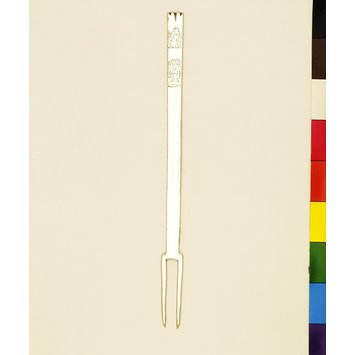
Early table forks, according to historians, generally had two prongs, as with this 17th-century English fork from the collection of the Victoria and Albert Museum. Even into the 19th century, illustrations of table scenes showed people eating with two-pronged forks, as in this 1830s print from the British Museum.

So it’s not surprising that a “fork” in its geographical sense meant something that split into two parts.

The OED doesn’t discuss the use of “fork” in reference to land bodies that divide (like Long Island, which splits into two peninsulas at Riverhead, NY).

This kind of “fork” originally meant the point where a river divides in two or where two rivers join, a sense first recorded in the late 17th century.

The earliest citation in the OED, dated 1692, refers to a location “in the forks of Gunpowder River,” a tidal inlet on Chesapeake Bay. (The quotation was printed in a 1906 issue of the Maryland Historical Magazine.)

In subsequent OED citations, “fork” is used both for the division and for each branch of a waterway: “the forke of the brooke” (circa 1700); “the big fork of said river” (1753); “the fork of the Nebraska” (now the Platte River, 1837); “the north and south forks” (1839); “the east fork of the Salmon River” (1877).

By the mid-19th century, these same usages were being applied to roads—the place where a roadway splits as well as each route taken.

Washington Irving, the OED says, was the first to use the phrase “a fork in the road,” in his Chronicles of Wolfert’s Roost (1855).

And a British travel writer and avid cyclist, Charles Howard, was the first known to use “fork” for a single branch of a road that “forks”:

“Here take the right hand fork” (from The Roads of England and Wales, 1883; the phrases “left hand fork” and “right hand fork” appear a dozen or more times in the book).

Although “fork” is now the usual term for each branch when a road, a waterway, or an island splits, the word “tine” does occasionally show up.

The OED has one example, from Two Trips to Gorilla Land and the Cataracts of the Congo, an 1876 book by the explorer Richard Francis Burton: “We reached a shallow fork, one tine of which … comes from the Congo Grande.”

More to the point, Wikipedia’s “North Fork (Long Island)” entry says: “At Riverhead proper, Long Island splits into two tines, hence the designations of The South Fork and The North Fork.” However, Wikipedia’s “South Fork” entry is “tine”-less. And none of the six standard dictionaries we’ve checked include this sense of “tine.”

Help support the Grammarphobia Blog with your donation.
And check out our books about the English language.

Subscribe to the Blog by email

Enter your email address to subscribe to the Blog by email. If you are an old subscriber and not getting posts, please subscribe again.

Categories
English English language Etymology Expression Grammar Language Linguistics Phrase origin Usage Word origin Writing

Me, myself, and I

Q: In the 1960s, I began noticing the use of “myself” as a cover for the inability of the speaker/writer to know whether “I” or “me” is correct. Can you predate that?

A: English speakers have been using “myself” in place of the common pronouns “I” and “me” since the Middle Ages, and the usage wasn’t questioned until the late 1800s, according to Merriam-Webster’s Dictionary of English Usage.

Critical language mavens argued that “myself’ (and other “-self” words) should be used only for emphasis (“Let me do it myself”) or reflexively—that is, to refer back to the subject (“She saw herself in the mirror”).

Alfred Ayres was apparently the first language writer to question the broader usage. In The Verbalist, his 1881 usage manual, Ayres criticizes the routine use of “myself” for “I”:

“This form of the personal pronoun is properly used in the nominative case only where increased emphasis is aimed at.”

Some modern usage writers still insist that “-self” pronouns should be used only emphatically or reflexively, but others accept their broader use as subjects and objects.

In Garner’s Modern English Usage (4th ed.), Bryan A. Garner objects to the wider usage, while in Fowler’s Dictionary of Modern English Usage (4th ed.), Jeremy Butterfield accepts it.

We believe that “myself” and company should primarily be used for emphasis or to refer back to the subject. And we suspect that some people fall back on “myself” when they’re unsure whether “I” or “me” would be grammatically correct.

However, there’s nothing grammatically wrong with using “myself” and other reflexive pronouns more expansively for euphony, style, rhythm, and so on. Respected writers have done just that for centuries, both before and after the language gurus raised objections.

This example is from a letter written on March 2, 1782, by the lexicographer Samuel Johnson: “Williams, and Desmoulins, and myself are very sickly.”

And here are some of the many other examples that Merriam-Webster has collected from writers who were undoubtedly aware of the proper uses of “I” and “me”:

“the pot I placed with Miss Williams, to be eaten by myself” (Samuel Johnson, letter, Jan. 9, 1758);

“both myself & my Wife must” (William Blake, letter, July 6, 1803);

“no one would feel more gratified by the chance of obtaining his observations on a work than myself” (Lord Byron, letter, Aug. 23, 1811);

“Mr. Rushworth could hardly be more impatient for the marriage than herself” (Jane Austen, Mansfield Park, 1814);

“it will require the combined efforts of Maggie, Providence, and myself” (Emily Dickinson, letter, April 1873);

“I will presume that Mr. Murray and myself can agree that for our purpose these counters are adequate” (T. S. Eliot, Selected Essays, 1932);

“with Dorothy Thompson and myself among the speakers” (Alexander Woollcott, letter, Nov. 11, 1940);

“which will reconcile Max Lerner with Felix Frankfurter and myself with God” (E. B. White, letter, Feb. 4, 1942);

“The Dewas party and myself got out at a desolate station” (E. M. Forster, The Hill of Devi, 1953);

“When writing an aria or an ensemble Chester Kallman and myself always find it helpful” (W. H. Auden, Times Literary Supplement, Nov. 2, 1967).

In those examples, “myself” is being used for “I” or “me” in three ways: (1) for “I” as the subject of a verb; (2) for “me” as the object of a verb; and (3) for “me” as the object of a preposition.

When “myself” is used as a subject, it’s usually accompanied by other pronouns or nouns, as in the Auden example above. However, the M-W usage guide notes that “myself” is sometimes used alone in poetry as the subject of a verb:

“Myself hath often heard them say” (Shakespeare, Titus Andronicus, 1594);

“My selfe am so neare drowning?” (Ben Johnson, Ode, 1601);

“Myself when young did eagerly frequent” (Edward FitzGerald, translation, Rubáiyát of Omar Khayyám, 1859);

“Somehow myself survived the night” (Emily Dickinson, poem, 1871).

The Cambridge Grammar of the English Language describes “-self” pronouns used expansively as “override reflexives”—that is, “reflexives that occur in place of a more usual non-reflexive in a restricted range of contexts where there is not the close structural relation between reflexive and antecedent that we find with basic reflexives.”

The authors, Rodney Huddleston and Geoffrey K. Pullum, say (as we do above) that the substitution of “myself” for “me” and “I” may sometimes be the result of uncertainty about the rules for using the two common pronouns.

“Much the most common override is 1st person myself,” Huddleston and Pullum write. “The reflexive avoids the choice between nominative and accusative me, and this may well favour its use in coordinate and comparative constructions, where there is divided usage and hence potential uncertainty for some speakers as to which is the ‘approved’ case.”

The use of override reflexives, especially “myself,” has been “the target of a good deal of prescriptive criticism,” the authors say, adding: “there can be no doubt, however, that it is well established.”

The M-W usage guide, which accepts the moderate use of “myself” for “I” and “me,” notes that the prescriptive criticism has often been contradictory, relying on such labels as “snobbish, unstylish, self-indulgent, self-conscious, old-fashioned, timorous, colloquial, informal, formal, nonstandard, incorrect, mistaken, literary, and unacceptable in formal written English.”

It’s hard to tell when people confused by “I” and “me” began using “myself” as a substitute. But it may have begun in the late 19th century, prompting those early complaints about the usage. Some of those adjectives used by critics (“nonstandard,” “incorrect,” “mistaken,” etc.) may have referred to the English of people with a shaky grasp of grammar.

As for the early etymology, all three of those first-person singular pronouns showed up in Anglo-Saxon times—“I” as the Old English ic, ih, or ich; “me” as mē or mec; “myself” as mē self. In the 12th century the ic spelling was shortened to and gradually began being capitalized in the 13th century, as we wrote in a 2011 post.

In Old English, spoken from roughly the 5th to the 12th centuries, “myself” was used  emphatically or reflexively. In Middle English, spoken from about the 12th to the 15th centuries, “myself” was also used as a subject of a verb, an object of a verb, and an object of a preposition.

Here’s an early example from the Oxford English Dictionary of “myself” used as the subject of a verb: “Sertes, my-selue schal him neuer telle” (“Certainly, myself shall never tell him”). It’s from The Romance of William of Palerne, a poem translated from French sometime between 1350 and 1375.

And this is an example of “myself” as the object of a verb: “Mine þralles i mire þeode me suluen þretiað” (“My servants and my people shall threaten myself”). From Layamon’s Brut, a poem written sometime before 1200.

Finally, here’s “myself” used as the object of a preposition: “Þe londes þat he has he holdes of mi-selue” (“The lands that he has he holds for myself”). Also from The Romance of William of Palerne.

Help support the Grammarphobia Blog with your donation.
And check out our books about the English language.

Subscribe to the Blog by email

Enter your email address to subscribe to the Blog by email. If you are an old subscriber and not getting posts, please subscribe again.

Categories
English English language Etymology Expression Language Phrase origin Usage Word origin Writing

All the feels

Q: Lately I’ve been seeing “all the feels” and similar phrases on social media, as in “This film gives me all the feels.” I’ve even seen it in movie reviews. Where does this come from?

A: Yes, the use of “feels” to mean deep feelings (as in “Casablanca gives me all the feels”) is definitely out there, and the usage is beginning to make it into standard dictionaries.

Oxford Dictionaries Online, in its US and UK editions, describes the usage as informal, as does Dictionary.com, which is largely an updated, online version of the Random House Unabridged Dictionary.

Oxford Dictionaries defines “feels” in this sense as “feelings of heightened emotion,” and gives several examples: “fans will undoubtedly get the feels when they see how things haven’t changed” … “I cried a ton because I had too many feels” … “I cry at everything, even the types of movies you wouldn’t expect to give you all the feels.”

The Merriam-Webster Online Dictionary doesn’t have an entry yet for “feels,” but it says the usage is on its radar.

In its “Words We’re Watching” feature, M-W traces the usage “back to a meme created in 2010 by a user on a German image site. The image in question features two embracing men along with the caption, ‘I Know That Feel Bro.’ ” (The  image  was on Krautchen, a now-defunct website.)

“The meme came to be used as a shorthand for expressing empathy, particularly between strangers online,” Merriam-Webster says, adding that “Internet memes are noted for their playful use of disjunctive grammar … so it is possible that feel was used in place of feeling for that same reason.”

The M-W article notes that “feel” already had “plenty of use as a noun, from meanings such as ‘sensation’ (the feel of old leather) to ‘a particular quality or atmosphere’ (an inn that has all the feel of a castle) to ‘an intuitive knowledge or ability’ (has a feel for woodworking).”

We’d add that the noun “feel” has been used since the 1400s to mean “feeling,” and the plural “feels” since the 1700s to mean “feelings,” but that old sense is different from the usage we’re discussing now: deep feelings one has about something, or that something gives one.

The M-W article cites several examples for “feels” used to mean deep feelings, including this one from the May 27, 2017, issue of Teen Vogue:

“If that tear-jerker has you feeling all the feels, just wait for this one: The finale also includes Spencer quoting the Winnie the Pooh line, ‘How lucky am I to have something that makes saying goodbye so hard?’ Sob.”

Merriam-Webster says its “Words We’re Watching” feature “talks about words we are increasingly seeing in use but that have not yet met our criteria for entry.”

Will “the feels” finally make it?

“Only time will tell if the feels will last long enough to warrant a new entry in the dictionary,” M-W says. “But for now, to quote Spencer, how lucky are we to have something that makes saying goodbye so hard?”

Interestingly, M-W here quotes Spencer Hastings, a character in the TV series Pretty Little Liars, rather than Winnie-the-Pooh. Probably because it’s doubtful that Pooh was the source.

The quotation doesn’t appear in any of A. A. Milne’s stories or the movies based on them, according to a Dec. 30, 2014, post on Pooh Misquoted. The website says the quote is a mangled version of a line in The Other Side of the Mountain, a 1975 movie about Jill Kinmont, a skier paralyzed in a 1955 slalom accident. We also couldn’t find the quote in our Pooh searches.

The earliest written example we’ve seen for “feels” to mean strong feelings is from a Jan. 23, 2012, contribution to the collaborative Urban Dictionary: “feel: Shortened version of ‘feeling,’ generally a strong emotional response. ‘This story gave me so many feels’ … ‘I know that feel, bro.’ ”

And here’s one a few months later from the Sept. 18, 2012, issue of the Stanford Daily News: “And let’s not forget the feels. This album might have them all—the melancholy, the awkwardness, the nervous anticipation, the blissed-out nighttime drives with the qtpi [cutie pie] of your dreams and the memories of summer.” (The reference is to I Can Hear the Heart Beating as One, a 1997 album by the indie rock band Yo La Tengo.)

The earliest example we’ve found for “all of the feels” is from the Sept. 12, 2013, issue of Miscellany News, Vassar’s student newspaper: “Everyone else arrives back on campus; Seniors report feeling ‘all of the feels’ and also ‘really sweaty and broke.’ ”

As you might expect, the word “feel” itself is quite old, dating back to Anglo-Saxon times.

When the verb “feel” showed up in Old English (as fēlan or a prefixed form, gefēlan), it had several meanings, including to sense heat, cold, pain, and so on, as well as to experience something, especially something unpleasant, according to the Oxford English Dictionary.

Here’s an early OED example, which we’ve expanded, from an Old English homily: “Þær næfre heaf ne geomorung ne gnornunge ne granunge bið gehyred, ðær ne bið næfre wite gesewen ne gefeled” (“there never be neither lamentation nor moaning nor groaning, there never be misery neither heard nor seen nor felt”). The final word, gefēled, is the past participle of gefēlan.

When the noun “feel” appeared in Middle English (spelled fele), it had several senses, but most of them are now obsolete. The early meaning that’s seen the most now is a feeling, impression, or sensation, as in “the feel of her hand” or “the feel of the business” or “the feel of a full stomach.”

The first OED citation is from The Buke of the Law of Armys (1456), the Scottish poet Gilbert Hay’s translation of Arbre des Batailles, a 14th-century book about war by the Benedictine prior Honoré Bonet:

“Ane evill carnale fele … the quhilk … dampnis thair saulis perpetualy” (“Any evil carnal feel … which … damns their souls perpetually”).

And this Oxford example for the plural “feels,” which we’ve expanded, is from an undated letter, believed written around 1746, by the English man of letters Horace Walpole:

“But here are no boys for me to send for—here I am, like Noah, just returned into the old world again, with all sorts of queer feels about me.” Walpole is describing his return as an adult to the Christopher Inn at Eton.

The dictionary’s entry for the noun “feel,” which was updated in September 2015, doesn’t include the use of “feels” to mean a deep emotion. But we imagine that the OED, like Merriam-Webster, has the new usage on its radar.

[Note, Sept. 2, 2018: A reader of the blog has pointed out the use of “feels” as a noun in Wild 90, an experimental movie that Norman Mailer directed, produced, and acted in. The movie, filmed in 1967 and released in 1968, has a character who says “You got no feels.” We think “feels” here is being used in the old sense of “feelings,” not the new of sense of “deep feelings” one has about something, or that something gives one.]

Help support the Grammarphobia Blog with your donation.
And check out our books about the English language.

Subscribe to the Blog by email

Enter your email address to subscribe to the Blog by email. If you are an old subscriber and not getting posts, please subscribe again.

Categories
English English language Etymology Expression Language Usage Word origin Writing

When ‘wood’ means ‘wooden’

Q: Are “wood” and “wooden” interchangeable?

A: The words “wood” and “wooden” can sometimes be used for each other, but we wouldn’t describe them as interchangeable.

When used adjectivally to describe something made out of the material from a tree, “wood” and “wooden” mean the same thing (as in “wood shutters” or “wooden shutters”).

But when used figuratively to describe something stiff, awkward, unnatural, or emotionless, only “wooden” will do (“wooden expression,” “wooden performance”).

Even when “wood” and “wooden” mean the same thing, we wouldn’t necessarily consider them interchangeable. The choice of one or the other often depends on rhythm, style, euphony, and so on.

If they were switched in these two passages, the iambic meter would be disrupted:

“Upon a wooden coffin we attend” (from Shakespeare’s King Henry VI, Part 1, believed written in 1591).

“the very sap of their wood-fewel burning on the fire” (from Milton’s Moscovia, an early work published posthumously in 1682).

Technically, “wooden” is an adjective while “wood” here is a noun used attributively—that is as an adjective. When a noun like “wood” is used adjectivally, it’s often referred to as an attributive noun, a noun adjunct, or a noun premodifier.

In general, adjectives are more flexible than attributive nouns. You can use an adjective as a simple premodifier (“blue scarf”), with an adverb like “too” or “very” (“a very blue scarf”), and as a comparative or superlative (“a bluer scarf”).

You can also use an attributive noun as a premodifier (“a wool pullover”), but it’s unidiomatic to use it with “too” or “very” (“a very wool pullover”) or as a comparative or superlative (“a more wool pullover”).

As for the attributive noun “wood,” it’s used only as a simple premodifier (“a wood floor”). It’s not used with “too” or “very,” or as a comparative or superlative.

However, the adjective “wooden” is quite flexible when used figuratively (“a wooden speech,” “a very wooden speech,” “a more wooden speech”).

Interestingly, the noun “wood” has been used since Anglo-Saxon times for the material that comes from trees, but it wasn’t used adjectivally (as either “wood” or “wooden”) until hundreds of years later.

So how did the Anglo-Saxons describe something composed of the substance that comes from the trunks, branches, and other parts of trees?

In Old English, the adjective describing a thing made of wood was tréowen, tríwen, or trýwen—from the noun tréow (“tree”) and the suffix -en (made of).

The Bosworth-Toller Anglo-Saxon Dictionary has this early example from Aelfric’s Grammar, an Old English introduction to Latin, written around 995: “ligneus, treowen.” (Ligneus is classical Latin for “wooden.”)

The Oxford English Dictionary has this example from Old English Leechdoms, a collection of medical texts written around 1000: “getrifula on treowenum mortere” (“grind in a wooden mortar”). Treowenum is the dative case of treowen. As the object of a preposition, treowenum mortere is dative.

Although this adjective is now obsolete in common usage, it survived until the late 19th century, spelled “treen” in Middle and Modern English, according to the OED. [See the update below.]

As for “wood,” it originally meant “tree” when it showed up in early Old English, spelled widu, wiodu, or wudu. The earliest Oxford example is from a Latin-Old English glossary dated around 725:

Pinus, furhwudu.” The Latin for “pine” is translated here by the Old English for “fir tree.”

The noun “wood” soon took on the sense of a “collection of trees growing more or less thickly together,” the OED says.

The dictionary’s first citation is an excerpt in Latin and Old English from Psalm 104:11 in the Vespasian Psalter, an illuminated manuscript that the British Library dates to the second quarter of the 700s:

Omnes bestiae silvarum, alle wilddeor wuda.” In modern English, “All the beasts of the wood.” (The full passage in the King James Version of the Bible reads: “They give drink to every beast of the field; the wild asses quench their thirst.”)

A century and a half later, the noun took on the additional sense of the “substance of which the roots, trunks, and branches of trees or shrubs consist,” the OED says.

The earliest example cited is from Pastoral Care, King Alfred’s late ninth-century translation of a sixth-century work by Pope Gregory:

“Se se ðe unwærlice ðone wuda hiewð, & sua his freond ofsliehð” (“He who carelessly hews the wood, and so slays his friend”).

The use of the attributive noun “wood” and the adjective “wooden” to describe something made of wood both showed up around the same time in the early 1500s.

The first OED appearance for the attributive noun is in a 1538 will registered in the city of York: “All wodde implementes.” (From John William Clay’s Testamenta Eboracensia: A Selection of Wills From the Registry at York, Vol. 6, 1902.)

The earliest Oxford example for the adjective is from Sir Thomas Eliot’s 1538 Latin-English dictionary: “Durateus, wodden.” The usual Latin for “wooden” is ligneus; the less common durateus comes from the Homeric Greek term for the Trojan horse, δουράτεος ἵππος (dourateos hippos, or “wooden horse”).

[Update, Aug. 23, 2018: A reader of the blog comments that “treen” still exists as a term in the field of collectible antiques. It refers to small household objects made of wood—spoons, cups, snuffboxes, shoehorns, and the like.]

[Update, Feb. 8, 2024: Another reader notes that “treen” is used more widely as a term for small, functional household articles made of wood, not just for such objects that are antiques.]

Help support the Grammarphobia Blog with your donation.
And check out our books about the English language.

Subscribe to the Blog by email

Enter your email address to subscribe to the Blog by email. If you are an old subscriber and not getting posts, please subscribe again.

Categories
English English language Etymology Expression Language Phrase origin Usage Word origin Writing

On dignity, with all due respect

Q: I keep seeing and hearing about people “treated with dignity.” Shouldn’t it be “respect”? While I can “respect” your “dignity,” I don’t “treat” you with it; it’s yours to have—not mine to confer.

A: Traditionally, “dignity” has meant the quality of being worthy, honorable, or esteemed, and traditionalists insist on using it that way.

As Bryan A. Garner writes in Garner’s Modern English Usage (4th ed.), “Dignity is a quality one possesses. It is not a synonym for respect, so it’s mangled in the phrase treat with dignity.”

However, Garner acknowledges that the “undignified phrase is spreading in American print sources.” We’d add that it’s seen in both the US and the UK, and that it isn’t particularly new.

We’ve found written examples for “treat with dignity” going back hundreds of years. Before we get to them, though, let’s look at how “dignity” is treated today.

Several standard dictionaries accept the use of “dignity” to mean a calm, serious, or formal manner, so to treat someone or something with dignity would mean to treat them calmly, seriously, or formally—that is, in a dignified manner.

The Merriam-Webster Online Dictionary, for example, says “dignity” can mean “formal reserve or seriousness of manner, appearance, or language” as well as “the quality or state of being worthy, honored, or esteemed.”

Merriam-Webster cites without comment (that is, as standard) several examples of the “undignified” usage criticized by Garner, including this one: “All people deserve to be treated with dignity and respect.”

Oxford Dictionaries Online, in its US and UK editions, defines “dignity” as a “composed or serious manner or style” as well as the “state or quality of being worthy of honor or respect” (“honor” is spelled “honour” in the British edition).

Oxford cites without comment six examples of “treat with dignity,” including this one, “We are committed to treating all persons under coalition control with dignity, respect and humanity.”

This sense of “dignity” isn’t quite the same as “respect,” which Oxford defines as “deep admiration for someone or something” or “regard for the feelings, wishes, rights, or traditions of others.”

In fact, “respect” often accompanies “dignity” in the usage you’re asking about, suggesting that writers feel each word contributes something to the expression.

How common is the usage today?

Here are the results of our searches in the News on the Web corpus, which tracks online newspapers, magazines, and broadcasters: “treated with respect,” 2,570 hits; “treated with dignity,” 1,299; “treated with dignity and respect,” 601; “treated with respect and dignity,” 321.

The usage seems to be especially common among health-care providers, as in these examples from the iWeb corpus, a database that follows nearly 95,000 English-language websites:

“Specialist healthcare professionals will make sure you are treated with dignity” … “Patients and their families have the right to be treated with dignity and respect” … “While in our care, patients are treated with dignity, respect and compassion” … “We work hard to ensure every patient receives proper treatment and is treated with dignity and respect” …  “It’s very important that the patient continues to be treated with dignity and they do not suffer.”

We suspect that “treat with dignity” is here to stay, and you’ll just have to get used to it. And as we’ve said, it’s been around for a long time. The two earliest examples we’ve found treat things, rather than people, with dignity.

The earliest is from an Aug. 13, 1736, letter in the Gentleman’s Magazine, commenting on a scholarly exchange of views in the London periodical about the Book of Job.

The author, who refers to himself as “Ignoto” (Latin for “Unknown”), says that in Job “a high philosophic Question is treated with Dignity, and the Decision given in great Majesty.”

(The lexicographer Samuel Johnson was a writer for the Gentleman’s Magazine. And some scholars believe Johnson’s 1755 dictionary may have influenced the author of our next citation.)

In an entry for the Roman historian Tacitus in Bibliotheca Classica (1788), a classical dictionary, the English classicist and lexicographer John Lemprière writes:

“Affairs of importance are treated with dignity, the secret causes of events and revolutions are investigated from their primeval source, and the historian every where shows his reader that he was a friend of public liberty.”

The next example appeared in the July 1792 issue of the Literary and Biographical Magazine and British Review (London). A dispatch from Paris during the French Revolution, dated June 22, 1792, reports on a letter written by the Marquis de Lafayette urging the French National Assembly to respect King Louis XVI:

“M. La Fayette concludes with exhorting the National Assembly to cause the King to be respected and treated with dignity.”

We found many written examples of the expression during the 19th and 20th centuries.

The Oxford English Dictionary, an etymological dictionary based on historical evidence, doesn’t mention the expression “treat with dignity,” but the OED entry for “dignity” hasn’t been fully updated since it was first published in 1896.

When the noun “dignity” appeared in English in the 13th century, Oxford says, it had three meanings: “The quality of being worthy or honourable” … “Honourable or high estate, position, or estimation” … “a high official or titular position.” The last sense, which has given us “dignitary,” is now archaic.

The earliest written example in the dictionary is from Ancrene Riwle, an anonymous guide for monastic women that probably dates from sometime before 1200:

“Nis naut edsene inhwich dignete ha is, hu hech is hire cunde” (“Nor is it easily seen of what dignity she [the soul] is, nor how noble is her nature”).

English borrowed the word from the Old French digneté, but the ultimate source is dignitātem, classical Latin for merit or worth, according to the OED.

Help support the Grammarphobia Blog with your donation.
And check out our books about the English language.

Subscribe to the Blog by email

Enter your email address to subscribe to the Blog by email. If you are an old subscriber and not getting posts, please subscribe again.

Categories
English English language Etymology Expression Language Phrase origin Usage Word origin Writing

How do you do?

Q: While enjoying old movies, I’ve noticed that one of the most common expressions is “How do you do?” Presumably, this was common in everyday speech as well. But no one, it seems, says that anymore—in film or out. Why the change?

A: It’s true that “How do you do?” has largely been replaced by newer “How” greetings: “How are you doing?” … “How are you?” … “How’s it going?” and so on.

These days, most of us don’t use “How do you do?” as the offhand, casual greeting it once was. We reserve it for formal introductions.

But all of these expressions are part of a long history of English pleasantries beginning with “how,” a tradition that got its start with “How do you?” in the Middle Ages.

Here the adverb “how” means “in what condition or state,” the Oxford English Dictionary says. And in this sense, “how” appears in “common phrases used in inquiring as to a person’s health.”

The original formula, dating at least as far back as the 1300s, was “how do” + pronoun (or name).

The OED‘s earliest example is from the Towneley Mystery Plays, dramatic depictions of biblical scenes that were probably first performed in the 1370s. (The only surviving manuscript is later, dating from sometime before 1460.)

This is the relevant line: “How do thay in Gessen, The Iues, can ye me say?” (“How do they in Goshen, the Jews, can you tell me?”)

In searches of early English databases, we’ve found many 15th, 16th, and 17th-century examples of this “how do” formula. Here’s a sampling (we’ll dispense with the question marks, since most aren’t complete sentences):

“how doth sir tristram” (1485); “how do ye mayster” (1499); “how doth my lady” (1560); “how doth my sonne” (1565); “how doest thou” (1548); “sir how do you” (1561); “how do ye to day” (1565);  “how dost thou” (1577); “How does all our friends in Lancashire” (1600); “how doeth my cousin” (1601); “how does thy mistrisse” (1608); “how do all our friends in Hampshire” (1693); “how does my lady” (1696).

In usages like that, “do” is the principal verb and its meaning is similar to “fare,” as in “How fare you?” But in the early 1600s another “do” crept into the formula, and “how do you” eventually became “how do you do,” with the first verb a mere auxiliary—as it would be in “How do you fare?”

The earliest example of “how do you do” that we’ve been able to find is from Thomas Middleton’s comic play No Wit/Help Like a Womans, which Middleton scholars say was written and first staged in 1611: “Gentlemen, Out-laws all, how do you do?” (OED examples are not as old, since the dictionary’s “how” entries are not yet fully updated.)

The next example we found appeared after a gap of 45 years. It’s from Richard Flecknoe’s The Diarium (1656), a diary in comic verse: “Visits I made me two or three, / With reverence not very comely, / And complements indeed as homely; / As for example; ‘How do you do?’ /’Well I thank ye, How do you?’ ”

(Note that the author regarded “how do you do” as a “homely” compliment, suggesting that it was already a familiar greeting even then.)

We’ve also found several examples from the 1690s of “how dost thou do,” a more formal version of “how do you do.” And by 1700, according to our searches, the “how do you do” form had begun to replace the older “how do you.”

As is often the case with well-entrenched salutations, both versions spawned many abbreviated forms.

The OED mentions “how-do-ye,” “how-d’ye,” and “how dee,” which eventually became—you guessed it—”howdy”! The spelling “how dee” (as in “How dee neighbour”) appeared around 1600, the OED says. The earliest “howdy” spelling we’ve found is from 1694.

(All this, by the way, sheds new light on Howdy Doody, the famous puppet whose name is a mashup of these greetings. In Elizabethan times, he might have been known as “How-d’ye Do-d’ye.”)

Besides “do,” the common “how” greetings” include forms of the verbs “be” and “go.”

The OED has these as its earliest examples: “how is it with you” (1480) and “how goes it” (1598). However, we found uses of “go” that are slightly earlier: “How goes it, Sirs?” (c. 1589) and “How goes the world with thee?” (1593).

But the specific expression “how are you” apparently didn’t become common, at least in writing, until the 1600s. The earliest definite use we’ve found is from an exchange in another Thomas Middleton play, Women, Beware Women (c. 1621): “How are you now, sir?” … “I feel a better ease, madam.”

We also found examples in a play called Matrimonial Trouble (1662), by Margaret Cavendish, Duchess of Newcastle. For instance, Sir William Lovewell says to Lady Hypocondria: “How are you, dear Wife? How do you feel your self now? How are you?”

Finally, as you might suspect, the more casual “how’s things” and “how’s tricks” came along in the first half of the 20th century. And while they may sound like American slang, they were first recorded in books by authors from Australia and New Zealand.

These are the earliest findings reported in the OED: “How’s things?” (Australia, 1926); “How are things?” (New Zealand, 1930); “How’s tricks?” (Australia, 1941); and a sighting of both, “How’s things? … How’s tricks with you?” (New Zealand, 1949).

By this time, of course, “How do you do” was no longer a casual “hello” but had developed into something more formal. We’ll conclude with a passage, headed “What to Say When Introduced,” from Emily Post’s Etiquette (1922):

“Best Society has only one phrase in acknowledgment of an introduction: ‘How do you do?’ It literally accepts no other. When Mr. Bachelor says, ‘Mrs. Worldly, may I present Mr. Struthers?’ Mrs. Worldly says, ‘How do you do?’ Struthers bows, and says nothing.”

When a reply is in order, however, it should NOT be “Charmed,” “Pleased to meet you,” or the like, she says. It should be a remark that can lead to conversation.

Help support the Grammarphobia Blog with your donation.
And check out our books about the English language.

Subscribe to the Blog by email

Enter your email address to subscribe to the Blog by email. If you are an old subscriber and not getting posts, please subscribe again.

Categories
English language Etymology Expression Language Phrase origin Usage Word origin Writing

Speaking with a forked tongue

Q: What is the origin of “to speak with a forked tongue”? Does the expression come from the snake that tricked Eve into eating the forbidden fruit?

A: The expression was probably inspired by the forked tongue of the serpent in the Garden of Eden. One of the earliest examples of the phrase “forked tongue” in the deceptive sense alludes to the passage in Genesis.

The image of a forked tongue has been used figuratively in English for hundreds of years to mean an intent to deceive. The earliest recorded example we’ve seen is from Magnificence, a morality play written around 1516 by the English poet John Skelton:

“Paint to a purpose good countenance I can, / And craftily can I grope how every man is minded; / My purpose is to spy and point every man; / My tongue is with favel [cunning] forked and tyned. / By Cloaked Collusion thus many one is beguiled.”

The earliest example we’ve found for the exact phrase “forked tongue” used this way suggests a serpentine origin, though not necessarily from the serpent in Genesis that tempts Eve to eat fruit from the Tree of the Knowledge of Good and Evil.

Here’s the passage from Poetasters, a 1601 comedy by Ben Jonson about versifiers who ape true poets:

“Are there no players here? no poet apes, / That come with basilisk’s eyes, whose forked tongues / Are steeped in venom, as their hearts in gall?” (A basilisk is a mythical serpent that can kill with a single glance.)

When Lancelot Andrewes, an Anglican bishop, used the phrase a few years later, he was clearly alluding to the forked tongue of the deceptive serpent in the Garden of Eden.

Andrewes, who may be best known for overseeing the King James Version of the Bible, used “forked tongue” twice in a June 8, 1606, sermon in Greenwich before King James I. Here’s one that mentions “in the beginning,” an allusion to Genesis:

“And so, the Devill hath his tongues. And he hath the art of cleaving. He shewed it in the beginning, when he made the Serpent, lingnam bisulcam, a forked tongue, to speake that, which was contrary to his knowledge and meaning.”

The full expression “to speak with a forked tongue” showed up in American English in the 19th century, according to our searches of digital archives.

The earliest example we’ve seen is from a March 23, 1829, letter by President Andrew Jackson addressed “To the Creek Indians”:

“You know I love my white and red children, and always speak straight, and not with a forked tongue; that I have always told you the truth.”

The letter, which urged the Creeks to move West, was part of  a plan by Jackson to move all Native Americans living east of the Mississippi to Oklahoma. Defiant Creeks were driven out of Alabama and Georgia in the Creek War of 1836.

Several language references suggest that “to speak with a forked tongue” is derived from expressions in American Indian languages.

However, we haven’t seen any written evidence from the 17th, 18th, or 19th centuries that Native Americans were using the full expression, either in English or in a native language.

Indians did apparently use the phrase “forked tongue” to mean deception as far back as the 1700s, but they could have picked up the term from English speakers, perhaps traders or missionaries relating the passage about Eve and the serpent in Genesis.

James Adair, an English trader and writer who lived among Native Americans in the Southeast in the mid-1700s, quotes a Chickasaw chief as using the phrase.

In this passage from The History of the American Indians, Adair’s 1775 account of Indian life, the Chickasaw tells a Muskogee emissary that without the help of the English, the French would set the Muskogee against one another, as they did with the Choctaw.

“Only for their brotherly help, the artful and covetous French, by the weight of presents and the skill of their forked tongues, would before now, have set you to war against each other, in the very same manner they have done by the Choktah.”

As for the Native American use of the full expression, the earliest example we’ve seen is fictional.

In “God and the Pagan,” a short story by W. A. Fraser in the July 1898 issue of McClure’s Magazine, a Blackfoot medicine man warns his people about a “paleface prophet who speaks with the forked tongue”—a priest seeking the release of a woman carried off in a raid.

When an actual American Indian is described in writing as using the expression in a native tongue, the translation is often questionable.

In Black Elk Speaks (1932), for example, John G. Neihardt puts these words into the mouth of Black Elk, an Oglala Sioux medicine man:

“But could we believe anything the Wasichus ever said to us? They spoke with forked tongues.” (Wašícu is a word in Lakota and Dakota Sioux for people of European descent.)

However, we question the authenticity of a book by an American poet who didn’t speak Sioux about a Sioux who didn’t speak English. (Although Neihardt was helped by Black Elk’s son, scholars say he took many liberties with the translation.)

In “Black Elk Speaks With Forked Tongue,” a 1989 study, G. Thomas Couser writes: “we see Black Elk not face to face, but through the gloss of a white man—a translation whose surface obscures Black Elk by reflecting the culture of his collaborator.”

(The study appeared as a chapter in Couser’s 1989 book Altered Egos: Authority in American Biography. An earlier version appeared in Studies in Autobiography, a 1988 collection edited by James Olney.)

Help support the Grammarphobia Blog with your donation.
And check out our books about the English language.

Subscribe to the Blog by email

Enter your email address to subscribe to the Blog by email. If you are an old subscriber and not getting posts, please subscribe again.

Categories
English English language Etymology Expression Grammar Language Linguistics Phrase origin Usage Word origin Writing

‘More’ or ‘-er’? ‘Most’ or ‘-est’?

Q: Is there a rule for when to use “more” and “most” to form comparatives and superlatives, and when to use “er” and “est”? Why do we have two ways to do this?

A: There’s no “rule” about using “more” and “most” versus “-er” and “-est” to express the comparative and superlative. But there are some common conventions.

With “most adjectives and adverbs of more than one syllable, and with all those of more than two syllables,” the Oxford English Dictionary says, “the normal mode” of forming the comparative and superlative is by using “more” and “most.”

A few one-syllable words (like “real,” “right,” “wrong,” and “just”) also normally form comparatives and superlatives with “more” and “most” instead of with “-er” and “-est” suffixes, according to the OED.

The dictionary adds that “more” is also sometimes used with words of one or two syllables that would normally have “-er” comparatives, like “busy,” “high,” “slow,” “true,” and so on. Why? Here’s how Oxford explains it:

“This form is often now used either for special emphasis or clearness, or to preserve a balance of phrase with other comparatives with ‘more,’ or to modify the whole predicate rather than the single adjective or adverb, especially when followed by than.”

So we might choose “much more humble” instead of “much humbler.” Or we might say “so-and-so’s voice was more quiet but no less threatening.” Or “that’s more true than false.” Or even “his feet are more big than ungainly.”

The OED offers additional details about the the use of the “-er” and “-est” suffixes with adjectives and adverbs.

In modern English, the dictionary says, “the comparatives in -er are almost restricted to adjectives of one or two syllables,” while longer adjectives as well as two-syllable adjectives not ending in “-ly” or “-y” form the comparative “by means of the adverb more.”

The same goes for the “-est” suffix, which is used similarly to form the superlative of adjectives (Oxford points to its “-er” comparative entry for the “present usage” of the “-est” superlative).

As for the use of “-er” and “-est” with adverbs, those that have the same form as corresponding adjectives (“hard,” “fast,” “close,” etc.) chiefly form the comparative and superlative with “-er” and “-est,” while adverbs that end in “-ly” form the comparative with “more” and the superlative with “most.”

There are quite a few exceptions, of course. For a more comprehensive guide to how the comparative and superlative are expressed in English today, check out Jeremy Butterfield’s entry for “-er and -est, more and most” in Fowler’s Dictionary of Modern English Usage (4th ed.).

How did we end up with two ways to express the comparative and superlative in English? In a 2008 post, we discuss the etymology of “more” and “most” as well as the history of the suffixes “-er” and “-est.”

As we say in that post, the “-er” and “-est” suffixes have been used to make comparisons since the earliest days of English, and it’s a practice handed down from ancient Indo-European.

The Old English endings were originally spelled differently than they are today: -ra for the comparative, and -ost (sometimes -est) for the superlative.

Taking the word “old” as an example, the Old English forms were eald (“old”), yldra (“older”), yldest (“oldest”). And taking “hard” as another, the forms were heard (“hard”), heardra (“harder”), heardost (“hardest”).

Meanwhile, there was another set of Old English words: micel (meaning “great” or “big”), mara (“more”), and maest (“most”).

While “more” and “most” (or their ancestors) were around since the earliest days of English, it wasn’t until the early 1200s that we began using them as adverbs to modify adjectives and other adverbs in order to form comparatives and superlatives—that is, to do the job of the “-er” and “-est” suffixes.

For a few centuries, usage was all over the place. In fact, it wasn’t uncommon for even one-syllable words to be used with “more” and “most,” according to The Origins and Development of the English Language, by Thomas Pyles and John Algeo. The authors cite the frequent use of phrases like “more near,” “more fast,” “most poor,” and “most foul.”

And multi-syllable words were once used with “-er” and “-est,” like “eminenter,” “impudentest,” and “beautifullest.”

Pyles and Algeo say there were even “a good many instances of double comparison, like more fittermore better, more fairer, most worst, most stillest, and (probably the best-known example) most unkindest.”

Help support the Grammarphobia Blog with your donation.
And check out our books about the English language.

Subscribe to the Blog by email

Enter your email address to subscribe to the Blog by email. If you are an old subscriber and not getting posts, please subscribe again.

Categories
English English language Etymology Expression Grammar Language Phrase origin Usage Word origin Writing

When ‘nor’ means ‘neither’

Q: Will you please address the use of “nor” in Shakespeare? Sometimes it differs from modern usage (“Of hot and cold, he was nor sad nor merry,” Antony & Cleopatra), and sometimes not (“He swore, had neither motion, guard, nor eye,” Hamlet).

A: You’ve spotted a construction that’s rare today—the poetic use of “nor” to mean “neither.”

This is sometimes seen in older poetry and drama, with “nor” replacing “neither” at the beginning of a series. So instead of writing “neither X nor Y,” a Shakespeare or a Dryden or a Pope might have written “nor X nor Y.”

As you noticed in Antony and Cleopatra (circa 1607) and Hamlet (c. 1600), Shakespeare might have used “nor” or “neither” at the beginning of a series—a choice undoubtedly determined by rhyme or reason.

The “nor” usage showed up in English writing around the beginning of the 16th century but is now rare, according to the Oxford English Dictionary. It’s usually found in the construction “nor — nor —” and is chiefly poetic, the dictionary says.

The earliest Oxford example is from Scotland, and the use is official rather than poetic:

“Nor ȝitt [yet] at the Sowth Loch nor yitt [yet] the North Loch.” (The phrase “nor yet” here means “and also not.” This passage, dated 1499-1500, was published in 1869 in Extracts From the Records of the Burgh of Edinburgh.)

All of the dictionary’s subsequent examples are from poetry or drama. Here’s a sampling, century by century.

1558: “Mischief close in keele doth growe, / Nor might of men can helpe, nor water floodes that on they throwe.” (From Thomas Phaer’s translation of Virgil’s Aeneid.)

1697: “Nor Bits nor Bridles can his Rage restrain.” (From John Dryden’s translation of Virgil’s Georgics.)

1726: “Now let our compact made / Be nor by signal nor by word betray’d.” (From Alexander Pope’s translation of Homer’s Odyssey.)

1800: “Nor shapes of men nor beasts we ken.” (From The Rime of the Ancient Mariner, by Samuel Taylor Coleridge.)

1913: “Nor God nor Daemon can undo the done, / Unsight the seen.” (From Thomas Hardy’s poem “To Meet, or Otherwise.”)

The most recent OED example is from Untitled Subjects (1969), a collection of poems by Richard Howard: “your only troth was plighted to Lady Laudanum, / to whom nor gout nor Paris could make you untrue.”

In a 2017 post, we discussed the use of the adverbs “neither” and “either” to introduce a series of more than two items, as in these examples from Shakespeare:

“You know neither me, yourselves nor any thing” (Coriolanus, c. 1605-08) … “Thou hast neither heate, affection, limbe, nor beautie” (Measure for Measure, c. 1604) … “They say there is divinity in odd numbers, either in nativity, chance, or death” (The Merry Wives of Windsor, c. 1597).

As we remarked in 2017, The Cambridge Grammar of the English Language says that “neither” and “either” can be used “in multiple as well as the more common binary coordination.”

There’s a similar explanation in the OED. It says that “following a word, phrase, or clause which is negated with neither,” the conjunction “nor” is “used before the second or further of two or more alternatives, normally to negate each.”

Help support the Grammarphobia Blog with your donation.
And check out our books about the English language.

Subscribe to the Blog by email

Enter your email address to subscribe to the Blog by email. If you are an old subscriber and not getting posts, please subscribe again.

Categories
English English language Etymology Expression Language Phrase origin Usage Word origin Writing

The El Niño problem

Q: Can you discuss the double-article problem that occurs when “the” is added to a phrase beginning with a definite article in another language? I am bothered to read or hear things like “The El Niño weather pattern is building.”

A: Technically, you’re right: “the” plus “El” does add up to “the the” when translated literally. But when a foreign phrase is established in English, the foreign article often isn’t translated literally—that is, interpreted as a separate instance of “the.”

In our opinion, “El Niño” has been assimilated and the Spanish term for the weather phenomenon can be used with an English definite article (as in “The El Niño weather pattern was blamed for the drought”). We’ll have more to say about this term later. First, a little background.

When a proper noun in a foreign language includes an article, the general practice is to use either the foreign article or “the,” but not both.

So in each set of examples below, you could use either version:

“They sang ‘La Marseillaise’ and marched to l’Arc de Triomphe” … “They sang the ‘Marseillaise’ and marched to the Arc de Triomphe.”

“La Costa Brava is our favorite region of Spain” … “The Costa Brava is our favorite region of Spain.”

“Don’t miss El Museo del Barrio” … “Don’t miss the Museo del Barrio.”

“We heard Die Meistersinger at Bayreuth” … “We heard the Meistersinger at Bayreuth.”

In cases like those, it would be redundant to use both the English and the foreign article (“the ‘La Marseillaise’ ” … “the Die Meistersinger,” and so on). This is because ordinarily the foreign article is interpreted as meaning “the,” even in an English context.

As The Chicago Manual of Style (17th ed.) says, “An initial the may be used if the definite article would appear in the original language.” Its examples include this one: “A history of the Comédie-Française has just appeared.”

There are exceptions, however, such as with the names of foreign newspapers. The Chicago Manual recommends that the foreign article should be retained if the newspaper’s name includes it.

The examples given include “El País” in Madrid, “Il Messagero” in Rome, “La Crónica de Hoy” in Mexico City, and “Al Akhbar” in Cairo. Each includes an article equivalent to “the.”

So, for instance, one would write, “He subscribes to Le Monde,” not “He subscribes to the Monde” (and definitely not “the Le Monde”).

And as we’ve said, a foreign article often isn’t treated as an actual article when a term of foreign origin becomes part of the English language. A few obvious examples are the Spanish names Los Angeles (literally, “the angels”) and Las Vegas (“the meadows”), and the French name for the game of lacrosse (“the stick”).

Despite their foreign derivations, and despite the literal meaning of los and las and la, these names have become thoroughly English and are used with English articles if an article is needed (“the Los Angeles Dodgers,” “the Las Vegas casino,” etc.).

We’re reminded of “the hoi polloi,” an expression that’s generally accepted by usage writers even though “hoi” represents “the.” The expression, whether two words or three, means “the masses” or “the common man” in English, and comes from οἱ πολλοί, classical Greek for “the many.”

As Bryan A. Garner writes in Garner’s Modern English Usage (4th ed.), “the three-word phrase has spread since about 1850, has become common, and ought to be accepted.”

Jeremy Butterfield, writing in the fourth edition of Fowler’s Modern English Usage, says “the hoi polloi” has “an impressive literary pedigree,” and leaving out the English article may be interpreted as “linguistic snobbery, misguided pedantry, or even unwholesome one-upmanship.”

Interestingly, the expression first showed up in English as “the οἱ πολλοὶ.” In a 1668 essay on dramatic poetry, John Dryden writes: “If by the people you understand the multitude, the οἱ πολλοὶ, it is no matter what they think; they are sometimes in the right, sometimes in the wrong: their judgment is a mere lottery.”

The first few examples for “hoi polloi” in the Oxford English Dictionary combine the English article with the original Greek phrase. The earliest OED citation for the Greek phrase written with the English alphabet also includes the English article.

In Gleanings in Europe by an American (1837), James Fenimore Cooper writes that a few great men lead every honorary institution “after which the oi polloi are enrolled as they can find interest.”

Getting back to the weather, we think “El Niño” has become so familiar in English that the foreign article has been absorbed into the name and has lost its separate sense of “the.”

We haven’t found much guidance on this issue, but judging from published examples, the “El” of “El Niño” is virtually never interpreted as a separate “the” in an English context. “El Niño” is treated as a phrasal noun for a weather phenomenon.

The New York Times’s stylebook is ambiguous on the subject, but it’s clear that Times editors don’t interpret “El” as “the.” We say this because Times articles have included phrases like “an El Niño,” “there was no El Niño,” “another El Niño,” “this new El Niño,” “a strong El Niño,” “the recent El Niño,” and “an El Niño year.”

If the Spanish article were being interpreted literally as “the,” those noun phrases would mean “a the Niño,” “there was no the Niño,” “another the Niño,” and so on. If there were any chance of such an interpretation, the editors would have omitted the foreign article (“a Niño,” “there was no Niño,” “another Niño”).

The OED, an etymological dictionary based on historical evidence, has several examples in which the Spanish article clearly isn’t being interpreted as a separate “the.” These include “the El Niño,” “the El Nino effect” and “the last five El Niños.” The dictionary doesn’t describe the examples as nonstandard or unusual in any way.

Oxford Dictionaries online, a standard dictionary, also cites many examples of the three-word expression without reservation: “the El Niño weather pattern” … “the El Niño phenomenon” … “the El Niño climatic conditions,” and so on.

Popular science publications, too, are willing to use English articles with these climate terms.

We’ve found examples in Scientific American of “the El Niño,” “the El Niño cycle,” “an El Niño,” “an El Niño event,” “the most recent El Niño,” “the last El Niño,” and “one of the strongest El Niños.”

And in Science magazine, you’ll find “the El Niño,” “an El Niño,” “this El Niño,” “the current El Niño,” “a strong El Niño event,” “the 1997–1998 El Niño,” and so on.

There’s less of this in academic journals, which tend to use “the El Niño Southern Oscillation” on first reference and “ENSO” on subsequent references. The longer technical name reflects the fact that El Niño results from an oscillation of atmospheric pressure in the tropical Pacific Ocean basin.

In Spanish, el niño means “the child.” The weather phenomenon is named for the Christ child, since its warmest sea surface temperatures off the South American coast are often recorded around Christmas.

Help support the Grammarphobia Blog with your donation.
And check out our books about the English language.

Subscribe to the Blog by email

Enter your email address to subscribe to the Blog by email. If you are an old subscriber and not getting posts, please subscribe again.

Categories
English English language Etymology Expression Language Phrase origin Usage Word origin Writing

An acid test—with real acid

Q: I see the phrase “acid test” often used during the World Cup competition in Russia to mean a crucial test for a team. Did it once refer to a test with real acid?

A: Not only did the phrase once mean a literal acid test—it still does, though the figurative sense is much more common.

When the term first showed up in writing in the mid-18th century, the Oxford English Dictionary says, it meant a “chemical test involving reaction with an acid.”

The dictionary’s earliest citation, which refers to boric acid, is from a 1759 essay by the English chemist Robert Dossie: “It has not the acid test of changing the colour of vegetable tinctures.”

However, the figurative use of the phrase to mean a crucial or conclusive test—such as the test facing a team at the World Cup—was inspired by the use of nitric acid to test gold for purity, according to the OED:

“The test for gold from which the figurative use developed typically involves making a mark on a touchstone with a piece of the metal in question and treating this mark with nitric acid, which dissolves other metals more readily than gold.”

As the dictionary explains, “The effect of the acid in dissolving the mark is compared with its effect on marks made by specimens of known gold content.”

Interestingly, the first Oxford example for “acid test” used to determine the purity of a precious metal refers to silver, not gold:

“The gentleman would then offer to bet $5 that the quarter was good, and would stand the acid test, which, as it was good silver [it] would of course do” (from the July 29, 1844, issue of a Philadelphia newspaper, the North American and Daily Advertiser).

The OED’s first gold example is from the Nov. 14, 1860, issue of a Wisconsin newspaper, the Monroe Sentinel: “The outside film of gold, though less than the two hundred thousandth part of an inch in thickness, is yet enough to cover up the base metal, and protect it from the usual acid test.”

However, we’ve found an earlier gold example in the Chemist, a London journal, in which the word “nitric” precedes “acid test.”

In an Aug. 15, 1850, letter, William Griffiths, a goldsmith in Dublin, reports an example of “the alloying of metals so that they should present the appearance of gold and be capable of being apportioned, so as not only to resist the nitric acid test but to deceive the most experienced as to color and weight.”

The first OED citation for the figurative sense is from the Nov. 18, 1854, Columbia Reporter, a Wisconsin paper: “Twenty-four years of service demonstrates his ability to stand the acid test, as Gibson’s Soap Polish has done for over thirty years.”

Here’s a more recent example from Spectacles, Lorgnettes, & Monocles, a 1989 book by D. C. Davidson: “Even an expert would hesitate to distinguish 9 carat from 12 and 14 carat gold without resorting to an acid test.”

As for today, the website of the Gemological Institute of America has a description of the touchstone acid test for gold. And you can find many acid-testing kits on Amazon.com.

We’ll end with a July 2, 2018, headline from the Northern Echo, a regional daily in the English town of Darlington.

“World Cup 2018: England about to face their acid test.” (England passed the test, beating Colombia to reach the quarterfinals.)

Help support the Grammarphobia Blog with your donation.
And check out our books about the English language.

Subscribe to the Blog by email

Enter your email address to subscribe to the Blog by email. If you are an old subscriber and not getting posts, please subscribe again.

Categories
English English language Etymology Expression Language Phrase origin Usage Word origin Writing

She’s gonna raise Cain

Q: I just came across an old joke (but new to me): “Adam and Eve were the world’s first troublemakers. They raised Cain.” Which makes me wonder about the origin of the expression “raise Cain.”

A: The verb “raise” in this expression originally meant to conjure up something like a spirit or demon, a usage that’s been around since the Middle Ages.

In the 19th century, this conjuring sense of “raise” inspired the use of the verb in various figurative phrases meaning to cause trouble.

One of them, to “raise Cain,” an American expression first recorded in the 1830s, would literally mean to summon the spirit of the biblical killer of Abel.

The literal use of “raise” in its conjuring sense first appeared in writing in the late 14th century.

In this sense, the Oxford English Dictionary says, it means “to cause (a spirit, demon, ghost, etc.) to appear, esp. by means of incantations; to conjure up.”

The dictionary’s earliest example is from “The Yeoman’s Tale,” part of Geoffrey Chaucer’s Canterbury Tales (circa 1386):

“I haue yow told ynowe / To reyse a feend al looke he neuere so rowe” (“I have told you enough to raise a fiend, look he never so fierce”).

Spirits “raised” in 15th-century writings included “deuils” (devils), “the devull,” and a “nygramansour” (necromancer or sorcerer). And in the 16th, 17th, and 18th centuries, they included ghosts, shades (apparitions), assorted dead notables, and “Grisly Spectres” (Milton, Paradise Regain’d, 1671).

In the 19th century, as we said, this sense of “raise” became figurative, which brings us around to Cain. To “raise the devil” or “raise Cain” came to mean, in the words of the OED, “to create a disturbance; to cause trouble, uproar, or confusion.”

The dictionary’s earliest example of “raise Cain” is coincidentally a version of that old joke about Adam and Eve:

“Why have we every reason to believe that Adam and Eve were both rowdies? Because … they both raised Cain.” (From a St. Louis newspaper, the Daily Pennant, May 2, 1840.)

However, we found a variation on the joke in a newspaper published two years earlier: “Why was Eve the first Sugar Planter? D’ye give it up? Because she raised Cain.” (From the Sangamo Journal/Illinois State Journal, April 7, 1838.)

If the phrase was familiar enough to be used in jokes and puns, “raise Cain” had obviously been around in common usage before those examples were published.

We’ll cite a handful of later 19th-century examples from the OED:

“They will feel that they have been raising Cain and breaking things” (from an 1841 collection of comic pieces, Short Patent Sermons, by “Dow, Junior,” the pen name of Elbridge Gerry Paige).

“Topsy would hold a perfect carnival of confusion … in short, as Miss Ophelia phrased it, ‘raising Cain’ generally” (from Harriet Beecher’s Stowe’s novel Uncle Tom’s Cabin, 1852).

“I expect Susy’s boys’ll be raising Cain round the house” (from Stowe’s novel Oldtown Folks, 1869).

“If I get the horrors, I’m a man that has lived rough, and I’ll raise Cain” (from Robert Louis Stevenson’s Treasure Island, 1883).

As for “raise the devil,” the OED’s earliest confirmed example is from 1841, but we found this slightly earlier usage in a Virginia newspaper:

“Wm. Colson came up, and says, ‘Don’t talk so loud, for there are a great many Albany people on board, and if they find out that I’m engaged in this business, they will raise the devil with me’ ” (from court testimony in a fraud case, published in the Richmond Enquirer, Nov. 3, 1840).

Other satanic specters were apt to be “raised” in the troublemaking sense. Some related expressions, and the earliest dates we’ve found, include “raise Ned” (1845, a euphemistic reference to the devil), “raise mischief” (1840, another euphemism for the devil), and “raise Hell” (1803).

On that last expression, the OED has this fascinating aside: “The slogan ‘Kansas should raise less corn and more hell’ is attributed to Mrs. Mary Ellen Lease (1853–1933) but proof is lacking.”

We’ll end with a musical rendition of “raise Cain.” It’s from Ella Fitzgerald’s recording of the 1932 song “I’ll Be Hard to Handle,” with music by Jerome Kern and lyrics by Bernard Dougall. Here are a couple of stanzas:

I’ll be hard to handle
I’m telling you plain
Just be a dear
And scram out of here
I’m gonna raise Cain.

I’ll be hard to handle
I’m no ball and chain
I’ll find some means
To call the Marines
I’m gonna raise Cain.

Help support the Grammarphobia Blog with your donation.
And check out our books about the English language.

Subscribe to the Blog by email

Enter your email address to subscribe to the Blog by email. If you are an old subscriber and not getting posts, please subscribe again.

Categories
English English language Etymology Expression Language Phrase origin Usage Word origin Writing

Going Berserk with a capital ‘B’

Q: I was reading an old Mary Roberts Rinehart mystery, The Circular Staircase, when my eyes fell upon this passage: “I had gone Berserk, I think. I leaned over the stair-rail and fired again.” Why is “Berserk” capitalized?

A: The word used to be capitalized in English because it was originally a proper noun. The “Berserks” were legendary Norse warriors who went into battle in a wild, murderous frenzy, according to Scandinavian mythology.

The novel you mention was published in 1908, over a century ago, and “berserk” was often capitalized in those days.

The word came into English as a noun in the early 19th century, but by the late 1800s, it had become an adjective, as it is in that quotation (“I had gone Berserk”).

English acquired “berserk” from Old Icelandic, where berserkr is a singular noun, berserker the plural, and berserk the accusative (the form used for a direct object), according to the Oxford English Dictionary.

Sir Walter Scott introduced the word into English in 1814 as “Berserkar,” the singular noun for the warrior, and “Berserkir,” the plural. (Later, Scott used “Berserkars” for the plural, and other 19th-century authors shortened these nouns to “Berserk” and “Berserks.”)

In an article summarizing the Eyrbyggja Saga, a 13th-century work in Old Icelandic, Scott describes the warriors this way:

“Berserkir, men who, by moral or physical excitation of some kind or other, were wont to work themselves into a state of frenzy, during which they achieved deeds passing human strength, and rushed, without sense of danger or feeling of pain, upon every species of danger that could be opposed to them.”

The article (published in the anthology Illustrations of Northern Antiquities, Vol. I) uses both the singular (“a haughty, fiery, and robust damsel, well qualified to captivate the heart of a Berserkar”) and the plural (“the two Berserkir”) several times.

The OED cites Gudbrand Vigfusson and Johan Fritzner, Old Norse and Old Icelandic scholars, as saying the original meaning of “berserk” was probably bear-shirt or bear-coat.

(In Old Icelandic and Old Norse, serkr means “coat” or “shirt”; it’s a cousin of an obsolete English word for a shirt, “sark.”)

Some etymologists have disagreed with this explanation, arguing that the ber– element in Icelandic was for “bare,” not “bear,” suggesting that the warriors went into battle without any armor, either bare-chested or wearing only their shirts.

Scott himself probably contributed to this belief. In his novel The Pirate (1822), he mentions “those ancient champions, those Berserkars,” and in a note to the 1831 edition explains that they were “so called from fighting without armour.”

We may never know which etymology is correct. What we do know is that the Berserks showed up in many of the medieval Icelandic and Norse narratives, from the 9th century onwards, that describe events in ancient Scandinavian mythology.

This line from a 9th-century Old Norse poem by Thornbjorn Hornklofi is one of the earliest known examples in writing: “Grenjuðu berserkir, guðr vas þeim á sinnum” (“Berserks bellowed; battle was under way for them”).

The OED defines the noun “berserk” as “a wild Norse warrior of great strength and ferocious courage, who fought on the battle-field with a frenzied fury known as the ‘berserker rage’; often a lawless bravo or freebooter.”

Today, Oxford adds, the word is used as an adjective meaning “frenzied, furiously or madly violent,” and it’s commonly found in the phrase “to go berserk.”

In addition to Scott, the OED cites a few other 19th-century authors who used long forms of the word: “Berserkers” (1837), “Berserkir-rage” (1839), and “bersarkar” (in the singular, 1861). Still later, the nouns “Berserk” and “Berserks” appeared.

The dictionary’s earliest use of the short form “berserk” is also its earliest use of the adjective. It’s from Charles Kingsley’s novel Yeast (1851): “Yelling, like Berserk fiends, among the frowning tombstones.”

Perhaps “berserk” was a household word with the Kingsleys. Charles’s younger brother, Henry Kingsley, used the adjective in his novel Silcote of Silcotes (1867): “With her kindly, uncontrollable vivacity, in the brisk winter air she became more ‘berserk’ as she went on.”

In many later appearances the adjective was still being capitalized, as in this OED example: “He … was filled with a Berserk rage and thirst for retribution.” (From James Hannington, First Bishop of Eastern Equatorial Africa, a biography written in 1886 by Edwin C. Dawson and published in 1887.)

In searches of historical newspaper databases, we found instances of “became Berserk” (1867) and “turn Berserk” (1877), but none with forms of the verb “go” until the 1890s.

The earliest example we’ve found (“going berserk”) is from the April 6, 1894, issue of the Aspen (CO) Daily Times:

“He never had the gold or diamond or colonial fever; instead of going berserk, he evidently preferred a frock coat and patent leathers.” (From an anonymous short story, “The Panic.” Though the story is credited to the London Illustrated News, we failed to find it there.)

The following year this example appeared in “The Child of Calamity,” a short story by Rudyard Kipling: “Then he went Berserk before our amazed eyes.”

(The story was published in March and April 1895 in several newspapers in Australia and the US. The Idler, a British magazine, published it under a different title, “My Sunday at Home,” in April 1895.)

We also found many uses of “go” plus “berserk” in newspapers published in the early 1900s. Note the differing capitalization styles:

“It would be dangerous to allow the smaller settlers to go berserk before the board, and meet the serried ranks of officialdom.” (The Sydney Morning Herald, Aug. 15, 1905.)

“We knew him as a dashing and fearless old campaigner, one who had gone Berserk many a time to rescue the gallant Lat Sahib he fought under.” (This passage appeared in another Australian newspaper, the Register, Adelaide, on Oct. 14, 1905. It’s from a serialized novel, Tales of Sahib Land, by the Anglo-Indian writer F. D’A. C. De L’Isle.)

We found many other pre-World War I examples illustrating the different capitalization styles, including “go Berserk” (1908), “went ‘berserk’ ” (1908), “went Berserk” (1909), and so on.

Even during WWI, some authors were still capitalizing the word, as in this OED example from Rudyard Kipling’s novel A Diversity of Creatures (1917):

“ ‘You went Berserk. I’ve read all about it in Hypatia.’ ” (Kipling is apparently referring to Charles Kingsley’s novel about Hypatia, a philosopher in Alexandria, Egypt, in the late 4th and early 5th centuries. We haven’t found “berserk” in the novel, though Kingsley uses it in at least two others.)

Before long, however, the adjective became established in its lowercase form. The OED cites this headline from the Nov. 10, 1940, issue of the Chicago Tribune: “America goes berserk.”

The article below the headline comments upon “The recent addition of the word ‘berserk,’ as a synonym for crackpot behaviour, to the slang of the young and untutored. … American stenographers … are telling one another not to be ‘berserk.’ ”

But “berserk” was not a slang or “untutored” usage, as we’ve seen. And for generations it has continued to be used—as an adjective, lowercased, and mostly with the verb “go”—as standard English.

It has even retained its sense of violent frenzy, though the violence is milder today that it was in the days of the Vikings.

In tribute to the old sagas, we’ll conclude with a passage from Henry Wadsworth Longfellow’s poem “The Skeleton in Armor” (1842):

Many a wassail-bout
Wore the long Winter out;
Often our midnight shout
   Set the cocks crowing,
As we the Berserk’s tale
Measured in cups of ale,
Draining the oaken pail,
   Filled to o’erflowing.

Help support the Grammarphobia Blog with your donation.
And check out our books about the English language.

Subscribe to the Blog by email

Enter your email address to subscribe to the Blog by email. If you are an old subscriber and not getting posts, please subscribe again.

Categories
English English language Etymology Expression Language Phrase origin Usage Word origin Writing

Are your ears burning?

Q: I wonder if “Are your ears burning?” is an expression that you may want to parse.

A: The expression is derived from an old belief that one’s ears can somehow sense that one is being talked about, even if the talking is going on at a distance.

The ears supposedly respond to such gossip by burning or glowing or ringing or some other physical change.

The Oxford Dictionary of English Idioms (3d ed., 2009), edited by John Ayto, says “someone’s ears are burning” means “someone is subconsciously aware of being talked about, especially in their absence.”

But The American Heritage Dictionary of Idioms (1997), written by Christine Ammer, defines “one’s ears are burning”  as being troubled by overhearing an actual conversation:

“Be disconcerted by what one hears, especially when one is being talked about.”

As far as we can tell, the belief that one’s ears can sense something said about one in absentia first showed up in the writings of the first-century Roman philosopher Pliny the Elder.

In Naturalis Historia (also known as Historia Naturalis), Pliny’s 37-volume encyclopedia of fact, myth, and speculation, he writes:

Quin et absentes tinnitu aurium præsentire sermones de se receptum est (“Those absent are warned by a ringing of the ears when they are being talked about,” from volume 28, chapter 5).

The first example of the usage we’ve seen in English is from Troilus and Criseyde, a Middle English poem written by Chaucer in the 1380s:

“And we shal speek of the somwhat, I trowe, / Whan thow art gon, to don thyn eris glowe” (“And when thou art gone, I trust, we shall speak of thee somewhat to make thine ears glow”).

The earliest example we’ve come across that specifically mentions burning is from Of the Burning of the Eares, a 16th-century poem by James Yates:

“That I doe credite give unto the saying old: / Which is, when as the eares doe burne, some thing on thee is told” (from The Castell of Courtesie, a 1582 collection of Yates’s poetry).

The first example we’ve seen for the version of the expression you cite (“Are your ears burning?”) is from the July 6, 1892, issue of Our Church Paper, a Lutheran weekly in New Market, VA.

The paper reprinted a letter from Japan to children in the states. The letter, apparently written by the father of the children, suggests that their ears may be burning because he’s been thinking of them:

“Well, children, are your ears burning today? Whether they are or not, I have been thinking about you a great deal. For I have read over again the letters that came from childish pens away across the sea, in order that I might answer some of the questions you have asked me.”

There have been many related superstitions, such as that the ringing of the right ear signifies you’re being praised, while the ringing of the left indicates you’re being criticized. Enough said. We’re up to our ears.

Let’s end with an example from Shakespeare of an actual conversation that’s overheard. In Much Ado About Nothing, believed written in the late 1590s, Beatrice’s ears burn when she overhears Hero and Ursula speaking of her:

What fire is in mine ears? Can this be true?
Stand I condemned for pride and scorn so much?
Contempt, farewell! and maiden pride, adieu!
No glory lives behind the back of such.

Help support the Grammarphobia Blog with your donation.
And check out our books about the English language.

Subscribe to the Blog by email

Enter your email address to subscribe to the Blog by email. If you are an old subscriber and not getting posts, please subscribe again.

Categories
English English language Etymology Expression Language Phrase origin Usage Word origin Writing

Roots of the grapevine

Q: I assume the word “grapevine” originally referred to a vine on which grapes grow. When did it come to mean a casual way of passing information along, as in the Motown song of the ’60s?

A: Yes, “grapevine” did originally refer to Vitis vinifera, the vine of the common grape. It first showed up in New England in the mid-17th century as two words.

The Oxford English Dictionary’s earliest citation, which we’ll expand here, is from a Jan. 19, 1654, entry in the town records of Providence, RI:

“five Acres of Low Land Layd out on the South side of the West River for Robert Pike to make Medow, bounded on the West End with a black Oak markt on 4. Sides, and on the East end on the lower side (that small slipe of low Land) by the grape Vines.”

The use of “grapevine” to mean an informal source of information began life in the mid-19th century as “grapevine telegraph,” according to the Random House Historical Dictionary of American Slang.

The slang dictionary defines the usage as “any informal or unofficial method of relaying important or interesting information, esp. by word of mouth,” or “the means by which gossip or rumor travels.”

When “grapevine telegraph” first appeared in the early 1850s, it referred to the transmission of questionable or outdated information.

The earliest examples we’ve found in searches of digitized newspaper databases are from two weeklies that were published on the same date—April 17, 1852—in different states.

This one is from the editorial page of the Freeman (Fremont, OH): “The following important dispatch was recived [sic] by the ‘Grape Vine’ telegraph—It came to hand just in time for this week’s ‘issoo,’ and the attentive ‘operator’ at Tiffin city has our thanks for his invaluable favor.”

What follows is an anonymous, satirical letter to the editor, full of outlandish misinformation about an election for township offices.

The second example published that day is from the Wabash Courier (Terre Haute, IN): “the aforesaid writer is awfully behind the times, a resident, perhaps, of some deep diggings where the sun never shines, and the inhabitants get their news by the grapevine telegraph. It would be no easy matter to ascertain the number of people badly fooled.”

The fact that the expression appeared on the same day in different states suggests that it was around much earlier in speech.

It shows up again a couple of months later, on June 30, 1852, in another Terre Haute weekly, the Wabash Express: “We suppose the information came from Maine and California (the Aroostook and Sierra Nevada,) by the mud turtle line, or the grapevine telegraph.”

And the July 17, 1852, issue of the Wabash Courier uses the phrase to introduce a mock letter from James Buchanan, then a former secretary of state and later a president, to Senator Lewis Cass of Michigan:

From the Pittsburgh Despatch. By the Grape Vine Telegraph line, in connection with Virginia Fence and Mason & Dixon’s Line, we have received the following interesting correspondence—far ‘ahead of the foremost,’ which we hasten to lay before our readers.”

(The word sleuth Barry Popik has found an earlier reprint of that passage in a New Jersey newspaper, the Trenton State Gazette, June 22, 1852. We haven’t been able to find the original Pittsburg Dispatch article.)

During the American Civil War, “grapevine telegraph” was used to describe doubtful information about the war that was passed along from mouth to mouth. Union supporters often used the phrase for what they considered Confederate propaganda, as in this example from the Jan. 8, 1862, Evansville (IN) Daily Journal:

“Some of those who are so very anxious that the South should have its rights, were very much elated at the news by grapevine Telegraph from Evansville via Phillipstown, to the effect that there had been a fight in Kentucky, in which the Federals were badly whipped, and were rushing into Evansville by the thousands, perfectly panic-struck.”

And this example comes from the June 12, 1862, Daily Alta California (San Francisco): “Yesterday the rebel grapevine telegraph was actively employed. It gave out oracularly that [Maj. Gen.] Sterling Price had crossed the Tennessee River near Florence, Ala., with 10,000 men, and was making his way to Nashville.”

The OED notes that the word “grapevine” was also used by itself during the war to mean a false or unfounded rumor or story. The dictionary cites a passage, which we’ve expanded, from “The Old Sergeant,” an 1863 poem by Forceythe Willson.

In the poem, a dying Union soldier imagines that he wasn’t really wounded at Shiloh and that his memory of being cut down is all in his mind: “It’s all a nightmare, all a humbug and a bore; / Just another foolish grape-vine—and it won’t come any more.”

Random House has a somewhat earlier example that uses both long and short versions of the expression:

“We get such ‘news’ in the army by what we call ‘grape vine,’ that is, ‘grape vine telegraph.’ It is not at all reliable.” (From an 1862 diary entry by James A. Connolly, first published in the Transactions of the Illinois State Historical Society, 1928. Connolly enlisted as a private in the Union Army and rose to the rank of lieutenant colonel.”

The next Oxford example is from a postwar article by Horace Carpenter, a former lieutenant in the Ninth Louisiana Battalion, about life at Johnson’s Island, a prison-of-war camp for Confederate officers in Lake Erie near Sandusky, OH. Here Carpenter discusses rumors of prisoner exchanges:

“The ‘grape-vine’ spoke to us of little else. The main feature of this prison telegraph was its complete unreliability. As I remember, it was never correct, even by accident.” (We’ve expanded the citation, from the March 1891 issue of the Century Illustrated Monthly Magazine.)

Today the word “grapevine” refers to the informal transmission of information that may or may not be true. As the OED explains, “Now in general use to indicate the route by which a rumour or a piece of information (often of a secret or private nature) is passed.”

The earliest Oxford example for this sense is from The Young Manhood of Studs Lonigan (1934), the second novel in James T. Farrell’s Studs Lonigan trilogy: “Down there at that express company they find out about everything a guy does. They got the best grapevine in the world.

Random House has an earlier example from John Brown’s Body, a 1928 poem by Stephen Vincent Benét: “And the grapevine whispered its message faster / Than a horse could gallop across a grave.”

In a 2009 post, we dismissed the notion that the usage ultimately comes from The Old Grapevine, a Greenwich Village tavern frequented by politicians, artists, and intellectuals.

We’ve found no evidence that the tavern was the source of the old usage, though it may have helped popularize it. We also haven’t seen evidence that the usage was inspired by hastily strung early telegraph wires that twisted like grapevines.

The expression “grapevine telegraph” showed up in the US as telegraph wires were spreading across the country. Samuel Morse sent his famous message, “What hath God wrought,” from Washington to Baltimore in 1844.

We suspect that the simple presence of telegraph wires inspired the figurative use of “grapevine telegraph” for the informal transmission of information. As Merriam-Webster Unabridged explains, the usage was “probably so called from the grapevine’s being thought of as a humble substitute for a telegraph line.”

A similar expression, “clothesline telegraph,” appeared during the Civil War. The March 22, 1862, Cambridge (MA) Chronicle describes Southern women who spread Confederate propaganda as “tattlers, and operators upon the clothesline telegraph, mischief makers.”

Similarly, the figurative expression “bush telegraph” showed up in the late 19th and “jungle telegraph” in the early 20th century.

In his 1901 autobiography Up From Slavery, Booker T. Washington writes that slaves on the plantation where he grew up used the “grapevine” expression for their whispered conversations about the war:

“Though I was a mere child during the preparation for the Civil War and during the war itself, I now recall the many late-at-night whispered discussions that I heard my mother and the other slaves on the plantation indulge in. These discussions showed that they understood the situation, and that they kept themselves informed of events by what was termed the ‘grape-vine’ telegraph.”

However, we haven’t seen any written wartime examples for “grapevine” or “grapevine telegraph” used to describe such slave discussions. And as we’ve said, “grapevine telegraph” was often used during the war in the sense of Confederate propaganda.

We’ll end with a few lines from Marvin Gaye’s version of “I Heard It Through the Grapevine,” the Motown song, written by Norman Whitfield and Barrett Strong, that was a hit in the 1960s for Gaye as well as Gladys Knight & the Pips:

You could have told me yourself
That you loved someone else
Instead I heard it through the grapevine
Not much longer would you be mine
Oh, I heard it through the grapevine
And I’m just about to lose my mind

Help support the Grammarphobia Blog with your donation.
And check out our books about the English language.

Subscribe to the Blog by email

Enter your email address to subscribe to the Blog by email. If you are an old subscriber and not getting posts, please subscribe again.

Categories
English English language Etymology Expression Language Phrase origin Politics Usage Word origin Writing

Backstage with ‘crisis actors’

Q: Thanks for answering my question about “false flag.” Now, who came up with the term “crisis actor”? I can’t believe what’s happening to the English language. This whole country has gone crazy. It makes you want to pull out your brain and give it a good shake.

A: Now that you’ve vented, let’s take a look at “crisis actor,” a relatively new term that’s being used to question the legitimacy of victims or survivors of mass shootings.

When the phrase first appeared in print 50 years ago, “crisis actor” was a term in political science that referred to a country in conflict.

The earliest example we’ve seen is from the Proceedings of the International Peace Research Association Second Conference: Poverty, Development and Peace (1968):

“McClelland argues that performance characteristics of crisis actors, both in crisis and non-crisis behavior, can be identified, and that phase characteristics of particular crises and of crises in general as one type of international behavior, can be distinguished.”

The reference is to a 1965 paper (“Systems Theory and Human Conflict”) by the political scientist Charles A. McClelland. Though he refers to countries in conflict as “actors” in “crisis,” he doesn’t actually use the phrase “crisis actor” or “crisis actors.”

The phrase took on a new sense a few months after the July 20, 2012, mass shooting inside a movie theater in Aurora, CO.

On Oct. 31, 2012, Visionbox, a nonprofit acting group in Denver, issued a press release announcing that it was offering actors to help shopping malls prepare for dealing with the victims of mass shootings:

“Visionbox Crisis Actors are trained in criminal and victim behavior, and bring intense realism to simulated mass casualty incidents in public places,” the press release says.

The release adds that the actors can “help first responders visualize life-saving procedures, and assist trainers in delivering superior hands-on crisis response training.”

However, the phrase was soon co-opted by people who questioned the official version of the Dec. 14, 2012, mass shooting at the Sandy Hook Elementary School in Newtown, CT.

The earliest written example we’ve seen for the new usage is in a Dec. 25, 2012, article on the Washington Examiner website that includes a “partial list of interesting questions being raised all over the internet” about Sandy Hook, including this one:

“Was the school part of the shooting spree an emergency response exercise using paid crisis actors funded by a grant from our federal government?” The article has a link to the Visionbox press release.

The now-deleted article, by Lori Stacey, was captured on the Internet Archive Wayback Machine and tracked down by the linguist Ben Zimmer.

“That tenuous chain of reasoning was enough for conspiracy theorists to begin imagining that Newtown was a staged event populated with ‘crisis actors,’ ” Zimmer wrote in a March 2, 2018, article in the Wall St. Journal.

Days before the Washington Examiner piece appeared, people were raising questions online about Sandy Hook, as Jason Koebler points out in a Feb. 22, 2018, article on the Motherboard website.

For example, James Tracy, a professor of communications at Florida Atlantic University, suggested in a Dec. 20, 2012, post on his Memory Hole Blog that the official Sandy Hook account was a “meticulously crafted façade” with a “made-for-television storyline.”

Tracy, who was later fired by the university, didn’t use the phrase “crisis actor” in that post but a Dec. 22 comment to it used the term “actors” in suggesting that the mass shooting was staged by broadcasting “gunshots and mayhem over the intercom system.”

The commenter, using the handle “andrew.w,” says such a broadcast “adds a bit of zing to what is essentially a drill and allows the actors and children to actually relate what they heard and did with a bit more reality.”

Enough. We’d better stop here or we’ll have to pull out our brains and give them a good shake.

Help support the Grammarphobia Blog with your donation.
And check out our books about the English language.

Subscribe to the Blog by email

Enter your email address to subscribe to the Blog by email. If you are an old subscriber and not getting posts, please subscribe again.

Categories
English English language Etymology Expression Language Phrase origin Usage Word origin Writing

Soul of discretion

Q: What is the origin of the phrase “soul of discretion”? Google just leads to its being an idiom, and I thought you might know how to dig more deeply.

A: When the word “soul” appeared in Anglo-Saxon times, it referred to the “essential principle or attribute of life,” according to the Oxford English Dictionary.

The OED has several early Old English examples, including this one from the Vespasian Psalter, an illuminated manuscript written in the 700s, with the Psalms in Latin and Old English:

“Conturbata sunt omnia ossa mea et anima mea turbata est ualde: gedroefed sindun all ban min & sawl min gedroefed is swiðe” (“All my bones are troubled, and my soul is troubled sorely,” Psalm 6:2).

In the late 1500s, the noun “soul” came to mean the personification of some admirable quality or thing.

The first Oxford example is from The First Part of Ieronimo, an anonymous play published in 1605 but probably written in the 1580s: “Prince Balthezer. … The very soule of true nobility.”

(The play, about a Spanish knight marshal, may have inspired, or been inspired by, the English playwright Thomas Kyd’s The Spanish Tragedy, believed written sometime in the 1580s.)

And here’s an example from Shakespeare’s Timon of Athens, possibly written sometime before 1610, perhaps with the playwright Thomas Middleton: “O he’s the very soule of Bounty.”

The OED also has an example of “soul” used in the exact sense you’re asking about, as the personification of discretion. It’s from You May Now Kill the Bride, a 2006 mystery by the American novelist Deborah Donnelly: “I haven’t always been the soul of discretion myself.”

However, the usage has been around for much longer. We found this example in Phyllis of Philistia, an 1895 romantic novel by the Irish writer Frank Frankfort Moore: “ ‘You are the soul of discretion, my beloved,’ said the husband.”

Help support the Grammarphobia Blog with your donation.
And check out our books about the English language.

Subscribe to the Blog by email

Enter your email address to subscribe to the Blog by email. If you are an old subscriber and not getting posts, please subscribe again.

Categories
English English language Etymology Expression Language Phrase origin Usage Word origin Writing

What about ‘whatnot’?

Q: For as long as I can remember, I’ve heard the phrase “what not” used much like “et cetera.” I’m curious about the etymology. I searched your archives but can’t find that you’ve written about it. Have you?

A: No, we haven’t written about it yet, so let’s remedy that now.

You may be surprised to hear this, but the term “whatnot” (it’s usually one word today) has been around for hundreds of years, dating back to the mid-1500s.

When the usage first appeared, as two words, it could mean “anything,” “everything,” “anything and everything,” or “all sorts of things,” according to the Oxford English Dictionary.

The earliest OED example is from The Comedye of Acolastus, John Palsgrave’s 1540 translation of a Latin carnival play written in 1529 by the Dutch writer Gulielmus Gnapheus:

“Excesse of fleshely pleasures … hath taken awaye all thynges … my goodes or substance, my name .i. my good name and fame, my frendes, my glory .i. my renoume or estimation, what not? .i. what thyng is it that she hath not taken from me?” (Palsgrave uses the abbreviation “.i.” for the Latin id est, or “that is,” usually rendered as  “i.e.”)

Today, according to the dictionary, “whatnot” is used as a “final item of an enumeration” and means “anything else, various things besides; ‘whatever you like to call it.’ ”

The first Oxford example for the term used as a final item in a series is from a Dec. 21, 1663, entry in the diary of Samuel Pepys: “The strange variety of people … bakers, brewers, butchers, draymen, and what not.”

Since the early 1800s, the OED says, the term has also been used for an “article of furniture consisting of an open stand with shelves one above another, for keeping or displaying various objects, as ornaments, curiosities, books, papers, etc.”

The dictionary’s first example of the term used for an open stand for bric-a-brac is from a Dec. 21, 1808, letter by Lady Sarah Spencer (later Baroness Lyttelton) to her brother, Bob, a 16-year-old midshipman in the Royal Navy and later Capt. Sir Robert Cavendish Spencer. Note her italics for “what-nots,” suggesting the usage was relatively new:

“There is a new and very handsome thick carpet put down in the old library; of course therefore we breakfasted in the drawing-room, while all the old chairs, tables, what-nots, and sofas were torn up by the roots to make room for the new-comer.” (We’ve expanded the OED citation.)

Help support the Grammarphobia Blog with your donation.
And check out our books about the English language.

Subscribe to the Blog by email

Enter your email address to subscribe to the Blog by email. If you are an old subscriber and not getting posts, please subscribe again.

Categories
English English language Etymology Expression Language Linguistics Phrase origin Slang Usage Word origin Writing

Wolf tickets for sale

Q: I recently heard a television commentator use the phrase “selling wolf tickets.” After research, I found both a Russian and an African-American Vernacular English source for somewhat related phrases. Did these evolve independently or is there evidence for cross pollination?

A: To “sell wolf tickets,” an expression that’s about 60 years old, is to oversell yourself—to spread boasts or threats that you can’t (or won’t) back up.

The usage was first recorded in writing in 1963, when sociologists noted its use by Black gang members in Chicago. The sociologists had reported it two years before in a speech, and it was undoubtedly used on the streets even earlier than that.

Some commentators have suggested that the expression comes from “to cry wolf” (to bluff or raise a false alarm). But a more likely theory is that the “wolf” here was originally “woof” and was intended to mean a bark without a bite.

In African-American Vernacular English, to “woof” has meant to bluff or challenge since at least as far back as 1930. In fact, the phrase has been recorded as “sell woof tickets” since the 1970s.

But as we said, the earliest written example we’ve found for the complete phrase is the “wolf” version; this may reflect the way “woof” was interpreted by white sociologists in the mid-20th century.

Let’s start with “woof” and come later to “sell wolf [or woof] tickets.”

The Dictionary of American Regional English defines the verb “woof,” used “chiefly” among Black speakers, as “to engage in behavior, esp speech, intended to impress, intimidate, or provoke; to bluff, kid.” DARE also mentions “woofer,” “woofing,” and other related words.

The dictionary’s earliest example of “woof” used in this way comes from a play written in 1930: “Stop woofing and pick a little tune there so that I can show Daisy somethin’.” (From Mule Bone, written in Black vernacular, by Zora Neale Hurston and Langston Hughes.)

In December 1934, the journal American Speech published a paper mentioning both “woof” and “woofer” as terms in Black college slang. Here are the examples:

“WOOF. To talk much and loudly and yet say little of consequence,” and “A WOOFER. Applied to one who talks constantly, loudly, and in a convincing manner, but who says very little.” (From “Negro Slang in Lincoln University,” a paper by Hugh Sebastian.)

The earliest published example we’ve found for “sell wolf tickets” is from a 1963 paper on the sociology of gang behavior, though an unpublished version dates from 1961. Here’s the relevant passage (“worker” is a social worker and “Commando” a gang leader):

“In a conflict situation, without a worker present, Commando would find it difficult not to ‘sell wolf tickets’ (i.e., challenge) to rival gang members and instigate conflict.”

The paper, “The Response of Gang Leaders to Status Threats: An Observation on Group Process and Delinquent Behavior,” by James F. Short, Jr. and Fred L. Strodtbeck, was published in the American Journal of Sociology in March 1963. This was a revised version of a paper (now lost) read on Sept. 1, 1961, at the annual meeting of the American Sociological Association.

In answer to an email query, Dr. Short told us that the same passage, with the phrase “sell wolf tickets,” probably appeared in the earlier, unpublished version that was delivered in 1961. “I cannot imagine that it was not in the earlier version,” he said.

Over the years, both “wolf tickets” and “woof tickets” have appeared, with variant spellings for “woof” and with “tickets” in singular as well as plural.

DARE, for example, says the phrase “woof ticket,” used “especially” among Black speakers, means a “lie, bluff, challenge.” Its earliest written use was recorded in 1971.

The scholar Geneva Smitherman, writing in the English Journal in February 1976, wrote: “ ‘Sellin woof [wolf] tickets’ (sometimes just plain ‘woofin’) refers to the kind of strong language which is purely idle boasting.” The bracketed and parenthetical additions are hers.

Time magazine also used both versions in its Aug. 20, 1979, issue: “ ‘To sell wolf tickets’ (pronounced wuf tickets) means to challenge somebody to a fight” (from “Outcry Over Wuff Tickets,” an article about Black English in the classroom).

And in 1982, an early rap group called Wuf Ticket briefly appeared on the singles charts.

A few years later, the linguist Carolyn G. Karhu said that “wolf ticket” (defined as an empty threat) and “selling wolf tickets” (making an empty threat) were terms used by prison inmates in Tennessee (American Speech, summer 1988).

But by the 1990s, these terms had apparently become passé in the language of the streets.

“ ‘Woof ticket’ is a somewhat dated phrase,” Betty Parham and Gerrie Ferris wrote in 1992 in the Atlanta Journal and Constitution. And “selling wolf tickets” was defined as “archaic Black slang” by Jack E. White, writing in Time magazine’s issue of Oct. 24, 1995.

So was this “woof” merely a Black pronunciation of “wolf”? The language columnist William Safire thought so. Commenting on the phrase “woof ticket,” he wrote, “Woof is a Black English pronunciation of ‘wolf’ ” (the New York Times Magazine, Nov. 5, 2000).

That assertion brought a response from Peter Jeffery, now a professor of medieval studies at the University of Notre Dame. His letter, later published in Safire’s book The Right Word in the Right Place at the Right Time (2004), objected to Safire’s explanation for “woof ticket.”

“The origin had nothing to do with ‘wolf,’ ” Jeffery wrote. “The metaphor was of a barking watchdog (‘woof, woof!’).”

Jeffery, who grew up in Brooklyn and heard the phrase as a youth, added: “By the 1970s, ‘woof ticket’ had disappeared from the speech of young Black Americans, though it may still be remembered among those are old enough.” He noted, “I’ve since heard that ‘woofin’ is still sometimes used among jazz musicians to describe the back-and-forth challenges between instrumental soloists.”

Well, old slang terms have a way of reviving, and that appears to be the case here.

Today the phrase is usually seen as “to sell wolf tickets,” and its meaning has become broader. It’s sometimes used to describe a hyped-up promotion or an inflated sales pitch—for a product or event that doesn’t live up to the hype.

By the way, we’ve found no connection with the use of the phrase in Russian slang, where “wolf ticket” (волчий билет or volchiy bilyet) refers to a document or other impediment that negatively affects someone, such as by making it impossible to get a specific job or enroll in a certain university.

[Updated on Dec. 10, 2018]

Help support the Grammarphobia Blog with your donation.
And check out our books about the English language.

Subscribe to the Blog by email

Enter your email address to subscribe to the Blog by email. If you are an old subscriber and not getting posts, please subscribe again.

Categories
English English language Etymology Expression Language Phrase origin Politics Usage Word origin Writing

The true history of false flags

Q: I simply don’t understand how “false flag” has come to mean (I guess) a staged tragedy to create sympathy for a group or to push an agenda such as outlawing automatic weapons. It supposedly relates back to pirate ships flying false flags, but that doesn’t seem parallel.

A: Yes, the term “false flag” conjures up images of pirates on the high seas, flying friendly colors to conceal their larcenous motives. However, we haven’t found any evidence that the phrase was ever used literally for a real flag on a real pirate ship.

In the 16th century, when the phrase first appeared in writing, it was strictly a figurative expression. It wasn’t used literally—to mean an actual flag—until almost 300 years later. And pirates weren’t mentioned.

“False flag” is one of those expressions that exist almost solely in figurative use. And its meaning hasn’t changed over the centuries.

In figurative contexts, the Oxford English Dictionary says, a “false flag” means “a deliberate misrepresentation of someone’s affiliation or motives; something used deliberately to misrepresent in this way.”

It first appeared, according to the OED, in a religious tract published in the mid-1500s: “Of this sort was Gardiner that abused K. Henry with a false flagge of religion, when he made hys booke of true obedience” (from Thomas Norton’s A Warning Agaynst the Dangerous Practises of Papistes, 1569).

At that time, the word “flag” itself was still new. The noun for a square or rectangular piece of cloth, varying in color and design and flown “as a standard, ensign or signal, and also for decoration or display,” first appeared in writing in 1530, the OED says.

The dictionary’s next example of “false flag” is also figurative, though the writer alludes to pirates. In a sermon published in 1689, George Halley called Roman Catholicism “a Religion that acts in disguise and masquerade, changes frequently its colours, and puts out a false Flag to conceal the Pyrate.”

Similar uses of “false flag,” mostly in political writing, have continued into the 21st century. This is the most recent one in the OED: “These are the true Tory colours, not the false flag of convenience he flies for the working poor” (from the Daily Mirror, London, 2008).

As we said, it wasn’t until the 19th century that “false flag” showed up in the literal sense, defined in the OED as “a flag used to disguise a ship by misrepresenting its nationality, allegiance, intent, etc.”

Here is Oxford’s earliest example: “The boarding officers must, in their discretion, decide, whether this be a true or false flag, and of the character of the vessel” (from a May 29, 1824, article in the Daily National Intelligencer, Washington, DC, that refers to searching merchant vessels sailing under foreign flags).

And here’s the OED’s most recent literal citation: “The Obama administration is urging global port authorities to be on the watch for Iranian shipping vessels flying false flags or sailing under fraudulent registrations” (from an Associated Press article that appeared in print and online on July 19 and 20, 2012).

As Oxford notes, the term “false flag” is also used adjectivally, as in “false flag operation” (first recorded in 1982) and “false flag provocation” (2002).

In this sense, the dictionary says, the term describes “an event or action (typically political or military in nature) secretly orchestrated by someone other than the person or organization that appears to be responsible for it.”

Here’s the OED’s latest citation: “Some of those who believe that the 7/7 London bombings were a ‘false flag’ operation by state forces rejects [sic] as fake all the state’s evidence” (from a British monthly, Fortean Times, May 23, 2011).

More recently, an April 3, 2018, article in the Los Angeles Times about the Parkland, FL, high school shootings says “conspiracy theorists deemed the incident itself a hoax, or false flag, something that’s further marred the aftermath of every major shooting, including at Sandy Hook Elementary.”

As in those examples, the phrase is often used by people who argue that widely publicized mass shootings, bombings, and so on are actually “false flags” or “false flag operations,” staged by the government or interest groups for political purposes.

Help support the Grammarphobia Blog with your donation.
And check out our books about the English language.

Subscribe to the Blog by email

Enter your email address to subscribe to the Blog by email. If you are an old subscriber and not getting posts, please subscribe again.

Categories
English English language Etymology Expression Language Phrase origin Usage Word origin Writing

The life of ‘lifestyle’

Q: The more student papers I read at my university, the more certain usages drive me crazy. For decades I have resisted “lifestyle.” As Alfonse, a professor, says in Don DeLillo’s novel White Noise, “Californians invented the concept of life-style. This alone warrants their doom.” I believe he’s right on the latter point, but what about the former?

A: You may have to blame the Germans, not the Californians, for the all-too-common “lifestyle”—or at least for its earliest and rather isolated appearance in English, according to the Oxford English Dictionary.

However, we have our own opinions about the origin of the contemporary term, which we’ll discuss later.

The word is “perhaps” modeled after the German Lebensstil, the OED says. The German word, which dates from 1849, is a compound of leben (“life”) and stil (“style”), Oxford explains.

The earliest known example in English appeared in 1915, when a British philosopher, reviewing a book written in German, translated Lebensstil as “life-style.” Here’s the passage, as cited in the OED:

“This spirit of expediency … excludes any possibility of peace or rest in unity with the universe. The author applies to it, as the ‘life-style’ of our age, the term Impressionism.” (From the January 1915 issue of the journal Mind, where Bernard Bosanquet reviews Emil Hammacher’s Hauptfragen der Modernen Kultur, which means “main questions of modern culture.”)

The German book, published a year earlier, has Lebensstil twice, in the phrases “der Lebensstil unseres Zeitalters” (“the lifestyle of our age”) and “den impressionistischen Lebensstil” (“the Impressionist lifestyle”).

The OED defines this use of “lifestyle” as “a style or way of living (associated with an individual person, a society, etc.); esp. the characteristic manner in which a person lives (or chooses to live) his or her life.”

It’s defined more briefly in Merriam Webster Unabridged—”the typical way of life of an individual, group, or culture”—and illustrated with the phrases “a healthy lifestyle” and “an alternative lifestyle.”

We haven’t found any earlier examples of the term, whether written as one word (“lifestyle”), two (“life style”), or hyphenated (“life-style”). And even after 1915, it didn’t catch on for several decades.

The term in this sense—a way of living—wasn’t sighted again until 1947 (the OED also has a 1946 example, but it’s for a different meaning, as we’ll explain later). Here’s the 1947 citation:

“While ostensibly setting about the freeing of the slaves, they became enslaved, and found in the wailing self-pity and crooning of the Negro the substitute for any life-style of their own” (from an article by Marshall McLuhan in the October 1947 issue of the Sewanee Review).

The term wasn’t recorded again, as far as we can tell, until the 1960s, when it became widely known.

The next OED citation is from the March 22, 1961, issue of the Guardian, London: “The mass-media … continually tell their audience what life-styles are ‘modern’ and ‘smart.’ ”

Today the word has become so common that many consider it trite. The New York Times Manual of Style and Usage (5th ed.) regards it as “shopworn.”

And, more to the point of your question, “lifestyle” has become associated with consumerism and conspicuous consumption. We might ponder the “lifestyle” of the Kardashians, but it would be jarring to write a college paper about the “lifestyle” of prisoners in the gulag.

Since the 1970s, the OED says, “lifestyle” has also been used as an adjective, describing something “designed to appeal to consumers by association with a lifestyle regarded as desirable, glamorous, or attractive.” Oxford uses examples like “lifestyle advertising,” “lifestyle brand,” and “lifestyle magazine.”

But we have some more thoughts on the origins of the noun that means a way of living.

Certainly the earliest “lifestyle” on record, that 1915 example, was modeled after the German Lebensstil; it was a direct translation.

However, we wonder whether the later use of the word in ordinary English wasn’t simply spontaneous. We say this for two reasons:

(1) That early appearance in a review of an obscure German book seems unlikely to have inspired either the isolated 1947 example or the surge in the use of “lifestyle” beginning in the 1960s.

(2) The concept itself—a way of living—dates from an earlier time, when it was commonly expressed as “style of living” or “style of life.” And it seems likely that those phrases inspired the shorter, catchier “lifestyle.”

We’ve found many examples of “style of living” from the late 18th century onward, and of “style of life” from the mid-19th-century. These phrases—meaning the same thing as the modern “lifestyle”—were and still are found on both sides of the Atlantic, though they’re not nearly as common as they once were.

For instance, here are some early uses of the older of the two phrases, “style of living”:

1784: “You can conceive nothing so charming as the Grecian women!—nothing so interesting as their style of living!” (From More Ways Than One, a comic play by Hannah Cowley.)

1785: “In a few years she resumed her equipage, and recommenced her usual style of living, with as much or rather more splendor than ever.” (A Philosophical, Historical, and Moral Essay on Old Maids, by William Hayley.)

1785: “This [Switzerland] is not a cheap country. … In some respects my style of living is enlarged by the increase of my relative importance, an obscure bachelor in England, the master of a considerable house at Lausanne.” (From a letter written on March 21 by Edward Gibbon to Lord Sheffield.)

1793: “His style of living is not equal to his fortune; and I have heard of several instances of his attention to petty economy.” (Evenings at Home, Vol. III, a collection of children’s pieces by Anna Laetitia Barbauld and John Aikin.)

1794: “ ‘Our notions are somewhat enlarged since those days,’ said M. Quesnel;—‘what was then thought a decent style of living would not now be endured.’ ” (The Mysteries of Udolpho, a novel by Ann Radcliffe.)

1797: “In food little luxury seems to have been known, till James I, who had resided nineteen years in England, set the example of a higher style of living.” (A History of Scotland, by John Pinkerton.)

By the mid-19th century, “style of living” was so familiar a phrase in British and American literature that some writers were overusing it (as they would later overuse “lifestyle”).

For instance, in Six Lectures Addressed to the Working Classes (1849), the Scottish minister William G. Blaikie writes: “It is very desirable that the working classes stood higher in the esteem of the community, and enjoyed a more comfortable style of living.”  Later he goes on to use phrase six times on a single page—”a very wretched style of living” … “a thirst for a higher style of living” … “the Irish style of living” … “the desire of improving his style of living,” and so on.

If those authors were writing today, our bet is that they’d use “lifestyle” instead.

A search of Google Ngram Viewer, which tracks words and phrases in millions of books, shows that “lifestyle” sprang to life in the mid-1960s and spiked sharply, just when “style of living” and “style of life” dropped away. You might almost say that “lifestyle” replaced them

So we suspect that the “lifestyle” that vaulted into use in the mid-20th century was a product of those earlier phrases, not of Lebensstil.

Before we go, we should mention a very different meaning of “lifestyle” that’s much less common and not known to the average reader.

In the psychology of Alfred Adler, the OED explains, it means “a pattern of reactions and behaviour that is established in childhood and remains characteristic of an individual.”

This technical meaning of “lifestyle” came into English in 1929 from Lebensstil, the OED says. The German word used as a psychological term, Oxford says, was first recorded in “1928 or earlier.”

The OED‘s earliest English example is from Adler’s Problems of Neurosis, which he wrote in English and published in 1929: “This fragment of memory records the two typical motives of the main life-style.”

The 1946 example we mentioned above, which the OED cites for the other sense of “lifestyle,” belongs in this category, in our opinion. The author, George Orwell, used the word in the Adlerian sense to mean a pattern of behavior:

“True to his life-style, Koestler was … promptly arrested and interned by the Daladier Government.” (From Critical Essays.)

Help support the Grammarphobia Blog with your donation.
And check out our books about the English language.

Subscribe to the Blog by email

Enter your email address to subscribe to the Blog by email. If you are an old subscriber and not getting posts, please subscribe again.

Categories
English English language Etymology Expression Language Phrase origin Usage Word origin Writing

Betwixt and between

Q: Where am I when I’m “betwixt and between,” and how did I get there?

A: You’re neither here nor there. To answer the second part of your question, we’ll have to go back to Anglo-Saxon times.

When the individual words appeared in Old English (“betwixt” as betweox and “between” as betweonum), they were synonyms. And they still mean the same thing, though the old-fashioned “betwixt” now conveys an air of antiquity when used alone.

Both words are derived from prehistoric Germanic compounds—reconstructed as bi-twiska and bi-twihna—meaning “at the middle point of two,” according to the American Heritage Dictionary of Indo-European Roots.

The earliest example for “between” in the Oxford English Dictionary (with be and tweonum separated) is from Beowulf, an epic poem that may have been written as early as 725. We’ve expanded the citation to give readers a better sense of the Anglo-Saxon writing:

“ðær wæs Beowulfes mærðo mæned; monig oft gecwæð þætte suðne norð be sæm tweonum ofer eormengrund oþer nænig under swegles begong selra nære rondhæbbendra, rices wyrðra.”

(“There was the glory of Beowulf hailed; it was oft said by many that nowhere south or north between the two seas, nowhere over the whole sweep of earth under the boundless heavens, was there ever one worthier to bear a shield or rule a kingdom.”)

The earliest OED example for “betwixt” is more down to earth. It’s in an Anglo-Saxon land charter, dated 931, from the reign of King Æðelstan: “betweox ða twégen wegas burh ðone leá” (“the meadow betwixt the two roads of the town”).

It took hundreds of years for the two words to come together in the expression “betwixt and between,” which the OED defines as “in an intermediate or middling position; neither one thing nor the other.” Merriam-Webster Unabridged defines it as “in a midway position” or “neither one thing nor the other.”

The first Oxford citation for the expression, described as colloquial and dialectal, is from Newton Forst, an 1832 seafaring novel by Frederick Marryat: “[He] took the lease of a house in a betwixt and between fashionable street.”

We’ll end with an earlier example that we found in The Children of Thespis (1786), a satirical poem by Anthony Pasquin (pseudonym of the English writer John Williams):

So beckon’d by Hope, yet by Hope so oft cheated
For ever contending, yet ever defeated;
Too eccentric to make a sound mathematician;
Too proud for attendance, too vain to beseech,
Too poor to be happy, too candid to preach:
Thus he swims in a strange indeterminate mean,
Neither hallow’d nor damn’d, but betwixt and between.

Help support the Grammarphobia Blog with your donation.
And check out our books about the English language.

Subscribe to the Blog by email

Enter your email address to subscribe to the Blog by email. If you are an old subscriber and not getting posts, please subscribe again.

Categories
English language Etymology Expression Language Phrase origin Usage Word origin Writing

Why is a beeline straight?

Q: Why does the term “beeline” refer to a straight line even though bees zigzag from flower to flower?

A: The noun “beeline,” the Oxford English Dictionary explains, refers to “a straight line between two points on the earth’s surface, such as a bee was supposed instinctively to take in returning to its hive.”

The earliest example for the usage in the OED has a squirrel acting beelike: “The squirrel took a bee line, and reached the ground six feet ahead” (from the Nov. 24, 1830, issue of the Massachusetts Spy).

Researchers have confirmed that bees generally head straight to their hives after collecting nectar and pollen. However, the researchers have debated about whether the bees navigate by using the sun, a mental map, or a combination of both.

Recent research supports the mental map theory. That’s the conclusion of a study entitled “Way-Finding in Displaced Clock-Shifted Bees Proves Bees Use a Cognitive Map” (PNAS, the journal of the National Academy of Sciences, June 2, 2014).

The authors of the study, James F. Cheeseman et al., describe how anesthetized bees were too disoriented to use the sun for navigation but still managed to return accurately and quickly to their hive.

“This result rules out the sun-referenced home-vector hypothesis, further strengthening the now extensive evidence for a metric cognitive map in bees,” the study concludes.

Some beekeepers believe “beeline” refers to the path that bees take from the hive to the source of nectar and pollen, but all the standard dictionaries we’ve seen accept the OED explanation that the term refers to the path of the returning bees.

However, bees do indeed often take a straight path from their hive to a source of nutrition—helped by nectar-laden returnees. When bees return with nectar and pollen, they do a waggle dance to let the rest of the hive know where to find the good stuff.

In “The Flight Paths of Honeybees Recruited by the Waggle Dance,” a paper in the May 2005 issue of the journal Nature, the authors J. R. Riley et al. say that “the dancer generates a specific, coded message that describes the direction and distance from the hive of a new food source.”

We couldn’t find a good place above to insert the OED’s exhaustive, one-sentence definition of “bee,” so we’ll end with it:

“A well-known insect, or rather genus of insects, of the Hymenopterous order, living in societies composed of one queen, or perfect female, a small number of males or ‘drones,’ and an indefinite number of undeveloped females or ‘neuters’ (which are the workers), all having four wings; they collect nectar and pollen, and produce wax and also honey, which they store up for food in the winter.”

Help support the Grammarphobia Blog with your donation.
And check out our books about the English language.

Subscribe to the Blog by email

Enter your email address to subscribe to the Blog by email. If you are an old subscriber and not getting posts, please subscribe again.

Categories
English English language Etymology Expression Language Linguistics Phrase origin Usage Word origin Writing

Umpteen hyperbolic numerals

Q: What’s the story behind such fanciful numbers as “umpteen,” “zillion,” “jillion,” and “gazillion”?

A: When precision doesn’t matter, and exaggeration is allowed, it’s useful to have whimsical alternatives for large numbers. The linguist Stephen Chrisomalis calls these inventions “indefinite hyperbolic numerals.”

In fact, the earliest known examples we’ve seen for “umpteen” and “zillion” were discovered a couple of years ago by Chrisomalis, a linguistic anthropologist at Wayne State University.

In “Umpteen Reflections on Indefinite Hyperbolic Numerals,” a paper published in the February 2016 issue of the journal American Speech, Chrisomalis cites this 19th-century New Zealand example of “umpteen”:

“They are like you and me, and never trot round with a credit balance of more than about umteen pence.” (From an article in the Christchurch Press, Sept. 14, 1878.)

And here’s an American example with “umpteen,” spelled the usual way and used to mean a large number, not an indefinite small one:

“Increase acreage ‘umpteen’ per cent.” (From an article about wheat crop forecasts in a Minneapolis trade journal, Northwestern Miller, July 21, 1882.)

Chrisomalis’s first example for “zillion” is from a satirical article in a California newspaper: “They’re going to bring ’em over here—zillions of ’em.” (Oakland Tribune, Dec. 12, 1916.)

The Oxford English Dictionary hasn’t yet caught up to these early sightings. Its oldest example of “zillion” is from 1944, and its first “umpteen” sighting is from 1918.

Chrisomalis says indefinite hyperbolic numerals like these emerged “principally in the period from 1880 to 1930, frequently in American contexts.”

His research suggests that “zillion” probably comes from African-American speech. It’s now “the most common indefinite hyperbolic numeral in English,” he says.

“Umpteen,” although first recorded in New Zealand in the 1870s, became a common American usage by the 1890s, according to Chrisomalis. (The similar-sounding “umpty,” recorded in both Australia and the US in 1886, represented a vague number rather than a large one.)

Here are some of the other hyperbolic words the author discusses, along with the earliest dates he’s found and possible origins:

“forty-leven” (1839), a combination of “forty” and “eleven,” was “associated with white, well-educated Northeastern writers of a Unitarian or Universalist bent”;

“squillion” (1878), US, associated with children’s speech;

“steen” (1882), now obsolete American college slang, modeled after “sixteen” but without that meaning;

“skillion” (1923), first recorded in Canada as a variant of “squillion” that quickly became more popular;

“jillion” (1926), associated with cowboy speech in rural and small-town Texas and surrounding Plains states;

From the 1930s onward, prefixes like “ba-” and “ga-” were added to “zillion” and “jillion” to make them seem even bigger: “bazillion” (1939), “umptillion” (1948), “kazillion” (1969), “gazillion” (1974), “bajillion” (1990).

Chrisomalis differentiates between hyperbolic numerals and what are known as “hyperbolic quantifiers,” words like “scads,” “oodles,” “heaps,” “wads,” and “slew.”

He also notes that even a definite number can be used hyperbolically, as in “I’ve told you a hundred times.” (The French, he points out, use the actual number 36, trente-six, hyperbolically to mean a large number. A Frenchman might say, “I’ve told you 36 times.”)

However, unlike definite numbers, “zillion” and “umpteen” can never have a literal meaning. And words like that, Chrisomalis writes, are “cross-linguistic” rarities—that is, they’re rare in other languages.

Two exceptions he points to are from the 1970s or later: “Spanish tropecientos (from tropel ‘mob, heap, mass’ + cientos ‘hundreds’) and Italian fantastilione (from fantastico+ ilione).”

English speakers, however, keep inventing new humongous numbers. In his paper Chrisomalis shares a few, including this one from Ian Frazier’s short story “The Killion” (New Yorker, Sept. 6, 1982):

“The killion, as every mathematician knows, is a number so big that it kills you.”

We’ll end with some definite, non-hyperbolic numerals. Here are the current meanings of some “-illion” words that are for real:

  • million = one thousand thousands
  • billion = one thousand millions
  • trillion = one thousand billions
  • quadrillion = one thousand trillions
  • quintillion = one thousand quadrillions

From there, the numbers proceed to such stratospheric levels that we get nosebleeds just thinking about them.

Help support the Grammarphobia Blog with your donation.
And check out our books about the English language.

Subscribe to the Blog by email

Enter your email address to subscribe to the Blog by email. If you are an old subscriber and not getting posts, please subscribe again.

Categories
English English language Etymology Expression Language Phrase origin Usage Word origin Writing

Are you out of it?

Q: I was reading The Ladies of Lyndon, a 1923 novel by Margaret Kennedy, when my eyes fell upon the expression “out of it” used to mean isolated or not part of things. I’m surprised that the usage is that old. It sounds so contemporary.

A: Yes, the use of “out of it” to mean isolated or rejected is that old. In fact, it’s even older. Here’s the story.

When the expression “to be out of it” showed up in English writing in the early 19th century, it meant something a bit different—“not involved or included in an action or event,” according to the Oxford English Dictionary.

The dictionary’s earliest example is from a Dec. 8, 1830, letter by the Anglo-Irish novelist Maria Edgeworth: “Poor Davies Gilbert to whom the place was in every way unsuited is well out of it. I hope he thinks so.” (Gilbert, a Cornish engineer, was succeeded by the Duke of Sussex as president of the Royal Society.)

In the late 19th century, the OED says, the expression came to mean “removed or distant from the centre or heart of something; isolated; uninformed.”

The earliest Oxford citation for this sense is from the June 18, 1884, issue of the Pall Mall Gazette: “Indeed, ‘C’ Troop … has been rather ‘out of it’ in the matter of field service.”

And that’s how the fictional James Clewer, an English artist who travels to Paris to paint, uses it in the 1923 passage that got your attention:

“I used to think that it would be different if I got away and went to Paris. But it wasn’t. Paris was all right for working in. I learnt a lot. But I felt just as out of it there as here.”

In the mid-20th century, the usage took on its contemporary slang sense of “confused, stupefied, or unconscious, esp. after consuming drink or drugs; (also) unable to think or react properly as a result of being tired,” according to the OED.

The dictionary includes a questionable early example that its editors say “appears to have a somewhat different meaning,” though we’ll let you decide for yourself: “One who is extremely happy is on cloud 88 or out of it” (from a 1959 issue of the journal American Speech).

The next Oxford citation, from a 1963 issue of American Speech, clearly uses the expression in the modern slang sense: “Drunk: soused, out of it, stoned, bombed.”

Help support the Grammarphobia Blog with your donation.
And check out our books about the English language.

Subscribe to the Blog by email

Enter your email address to subscribe to the Blog by email. If you are an old subscriber and not getting posts, please subscribe again.

Categories
English English language Etymology Expression Language Phrase origin Usage Word origin Writing

General Tso’s chicken

Q: I love General Tso’s chicken, but it leaves me hungry to learn more about this general and why my favorite Chinese dish is named for him.

A: The 19th-century general is known in China for his military, not his culinary, accomplishments. He helped the Qing dynasty win a civil war that lasted 14 years and cost millions of lives.

The general (Tso Tsung-t’ang in the old Wade-Giles system of transcribing Mandarin and Zuo Zongtang in the modern Pinyin system) came from Hunan, the home province of Peng Chang-kuei, the chef who created and named an early version of the dish in the 1950s in Taiwan.

Peng, a caterer for the Nationalist Chinese government, fled to Taiwan after the Nationalists were defeated by Mao Zedong’s Communists in 1949, according to the food writer William Grimes.

In Peng’s Dec. 2, 2016, obituary in the New York Times, Grimes says the chef created the dish for a visit “by Adm. Arthur W. Radford, chairman of the Joint Chiefs of Staff, during the Taiwan Strait crisis of 1955,” and “on the spur of the moment, he assigned it the name of a Hunanese general, Zuo Zongtang.”

In a Feb. 4, 2007, article in the New York Times Magazine, the British food writer Fuchsia Dunlop quotes Peng as saying the original dish was a sour, salty version of the sweet, tangy, deep-fried dish familiar to Americans.

“Originally the flavors of the dish were typically Hunanese—heavy, sour, hot and salty,” he said in a 2004 interview in Taiwan with Dunlop, author of Revolutionary Chinese Cookbook, a 2009 collection of Hunan recipes.

In the early 1970s, several Chinese chefs introduced Americanized versions of Peng’s original dish at New York restaurants, including Wen Dah Tai at Uncle Tai’s Hunan Yuan, the city’s first Hunan restaurant, and Tsung Ting Wang at Hunan.

In 1973, Peng joined them in New York at Uncle Peng’s Hunan Yuan. “The original General Tso’s chicken was Hunanese in taste and made without sugar,” Peng told Dunlop. “But when I began cooking for non-Hunanese people in the United States, I altered the recipe.”

The earliest written reference we’ve seen for the Americanized dish is from a review of Peng’s Manhattan restaurant by Mimi Sheraton in the March 18, 1977, issue of the New York Times: “General Tso’s chicken was a stir‐fried masterpiece, sizzling hot both in flavor and temperature.”

As for Peng, he returned to Taiwan in the late ’80s and opened the first in a chain of Peng Yuan restaurants there.

Like many Americanized Chinese dishes popular in the US, the General Tso’s chicken you love was unknown in China until recently, according to Grimes, a former restaurant critic at the Times and the author of Appetite City: A Culinary History of New York (2009).

Help support the Grammarphobia Blog with your donation.
And check out our books about the English language.

Subscribe to the Blog by email

Enter your email address to subscribe to the Blog by email. If you are an old subscriber and not getting posts, please subscribe again.

Categories
English English language Etymology Expression Language Usage Word origin Writing

In the hopper

Q: I’ve lived all my life in Greater Boston, where “in the hopper” means “in the toilet.” How did the expression come to mean “in progress” elsewhere in the country?

A: The word “hopper” has had many senses, both literal and figurative, since it showed up in the mid-13th century as a term for a grasshopper or similar hopping insect.

As the Oxford English Dictionary explains, the noun has been used for “a locust or grasshopper, a saltatorial beetle as the turnip flea, a saltatorial homopterous insect as a froth-hopper, a flea, the cheese-hopper or maggot of the cheese-fly.”

(A “saltatorial” insect is a leaper; the Homoptera are plant-feeding insects like aphids and cicadas.)

The earliest OED example is from a Middle English version of Exodus, dated around 1250:

“And so dede, and on wind cam fro westen, and ðo opperes nam, and warpes ouer in-to ðe se” (“And so [the Lord] did, and a western wind took away the locusts and blew them out into the sea”). We’ve expanded the citation from Exodus 10:19.

More than a century later, the term came to mean a receptacle, shaped like an inverted pyramid or cone, through which grain passed into a mill to be ground. The OED says the “hopper” was “so called because it had originally a hopping or shaking motion.”

The dictionary’s earliest citation, which we’ve expanded, is from “The Reeve’s Tale” in Chaucer’s Canterbury Tales (circa 1390):

“Yet saw I neuere by my fader kyn, / How þt the hoper wagges til and fra” (“Yet I never saw, on my family’s honor, how the hopper shakes to and fro”). The “reeve” in the tale is the manager of an estate.

In the 18th century, Oxford says, the use of “hopper” widened to include “similar contrivances for feeding any material to a machine, and, generally, to articles resembling a mill hopper in shape or use.”

The first OED citation for this sense is from Commercium Philosophico-Technicum, a 1763 book by William Lewis about using science to improve art, commerce, and manufacturing:

“The space included between the pipes, at their lower end, under the bason, is a kind of hopper.”

Jumping ahead a century, American politicians began using the word “hopper” in the late 1800s for a box in which proposed bills were dropped for consideration by a legislative body.

The OED, an etymological dictionary, doesn’t include this sense, but its “hopper” entries haven’t been fully updated.

Merriam-Webster Unabridged, a standard dictionary, says one meaning of the term is “a box usually on the desk of the clerk or other official of a legislative body into which a proposed bill is dropped.”

The earliest example we’ve seen for the political usage is from the March 3, 1889, issue of the Indianapolis Journal, which uses grinding-mill terminology in reference to a hopper in the Indiana legislature.

An article in the paper says the governor’s “veto-mill stopped grinding yesterday for want of grist” when he rejected the final bill approved by the legislature. But it adds that the grinder “is in excellent order for another run” and all the Democratic majority has to do “is throw a few more longeared bills in the hopper.”

In the 20th century, the phrase “in the hopper” took on the expanded sense of “in progress” or “under consideration.” The first example we’ve found in searches of newspaper and magazine databases appeared during World War II.

A Nov. 29, 1943, article from the Catholic News Service noted that millions of Americans in the military would be spending Christmas away from home, but “parents need not fear that their loved ones will be lonesome or neglected, for USO has plans in the hopper which would delight the folks back home.”

The usage caught on after the war. An article in the October 1951 issue of the Vassar Alumnae Magazine, for example, mentions several foiled efforts to encroach on national parks, and warns that there “are numerous similar detrimental proposals in the hopper.”

(A similar figurative expression, “in the pipeline,” showed up at the end of World War II. A Sept. 7, 1945, article in the Times, London, refers to “purchases of all goods in the pipeline or in storage.”)

When the two of us hear “in the hopper” used figuratively now, it’s always in the sense of “in progress” or “under consideration.” We don’t recall ever hearing the expression used in the sense of “in the toilet.” (Pat grew up in the Midwest and Stewart in the Northeast.)

However, the Dictionary of American Regional English says “toilet” is indeed a meaning of “hopper,” especially in the Northeast. And the earliest of several DARE citations is a 1957 report from your home state, Massachusetts:

“The maid on our floor [at college], complaining about the strict new housekeeper [said], ‘She won’t even let us use the word ‘hopper’ anymore. We’re supposed to say ‘closet bowl.’ ”

Help support the Grammarphobia Blog with your donation.
And check out our books about the English language.

Subscribe to the Blog by email

Enter your email address to subscribe to the Blog by email. If you are an old subscriber and not getting posts, please subscribe again.

Categories
English English language Etymology Expression Language Phrase origin Usage Word origin Writing

Why piece + meal = piecemeal

Q: Does the word “piecemeal” have anything to do with eating? I know that “piece” is used to describe the equivalent of eating a sandwich over the sink, as in “I’m not eating dinner. I’m just piecing.”

A: “Piecemeal” is an interesting word. Etymologically it means “by piece measure.”

But not many people realize this, since it’s the last remaining example in English of a word formed with the obsolete suffix “-meal,” according to John Ayto’s Dictionary of Word Origins.

And as we’ll explain later, both parts of the word have connections with eating.

In Old and Middle English, the suffix “-meal” (which meant a “measure”) was used to form compound adverbs. Long-dead examples include “fingermeal” and “footmeal,” units of measure about equal to the breadth of a finger or the length of a person’s foot.

Today we might use the phrase “piece by piece” as a synonym for “piecemeal.” As the Oxford English Dictionary explains, the adverbial equivalent in modern English for those old “-meal” compounds would be “the formula ‘— by —,’ with repetition of the noun.”

In fact, “footmeal,” which existed only in Old English (as fotmælum), was not just a unit of measure but also meant “step by step” or “bit by bit,” Oxford says.

The compound adverb “piecemeal” was formed in Middle English when the “-meal” suffix was added to the noun “piece” (a part or portion), which had come into English from French about 1230.

The adverb was first recorded in the Chronicle of Robert of Gloucester, which was written around 1300: “Folc to drou þat traytour, ech lime pece mele” (“Men drew [dismembered] the traitor, each limb piecemeal”).

In the late 16th century, English writers began using “piecemeal” as an adjective to mean consisting of or done in pieces.

The earliest OED example for the adjective is from Sir Philip Sidney’s Arcadia, a prose romance he was working on when he died in 1586: “He did with a broken peece-meale speach … remember the mishaps of his youth.”

Now for the eating connections. That old “-meal” suffix is related to the word we use to mean a repast.

In Old and Middle English, the noun “meal,” derived from Germanic, meant not only a measure but a time or an occasion. It no longer exists with those general meanings, but survives in a particular sense—an occasion for eating.

The sense of “meal” as an occasion for eating emerged in early Old English. The OED defines the usage as “a customary or social occasion of taking food, esp. at a more or less fixed time of day, as breakfast, dinner, etc.”

The earliest known example is from Pastoral Care, King Alfred’s ninth-century translation of a sixth-century work by Pope Gregory:

“Ne fæst se no Gode ac him selfum, se þe ðæt nyle ðearfum sellan ðæt he ðonne on mæle læfð, ac wile hit healdan eft to oðrum mæle, ðæt he eft mæge his wambe gefyllan” (“He fasts not for God but for himself, who will not give the poor what he leaves of his meal, but wishes to keep it for another meal, to fill his belly with it afterwards.”)

Very soon, “meal” was used more widely in Old English to mean the food itself.

Jumping ahead a millennium or so, someone without the time or inclination to eat an actual meal might “piece” instead—that is, nibble casually or eat small pieces of this or that.

Merriam-Webster Unabridged says the verb “piece” is “chiefly dialectal” and means “to eat between meals” or “nibble at snacks.”

M-W gives an example from Eudora Welty’s short story “Why I Live at the P.O.” (1941): “there he was, piecing on the ham.”

As far as we can tell, no other standard dictionaries have entries for this sense of the verb “piece.” Wordnet, an electronic word database, says it means to “eat intermittently” or “take small bites of,” as in “He pieced at the sandwich all morning.”

The usage is more common in books devoted to slang or regionalisms, where it was recorded at least as far back as mid-19th century America.

The earliest example we’ve found is from John Russell Bartlett’s Dictionary of Americanisms (2nd ed., 1859), where the usage is traced to Pennsylvania:

“TO PIECE. To eat pieces of bread and butter, to eat between meals. ‘He has n’t eaten much dinner, because he’s been a piecin’ on’t all the mornin’.’ Pennsylvania.”

The word is also discussed in a review of Bartlett’s dictionary, entitled “Americanisms,” in the April 1861 issue of Blackwood’s Edinburgh Magazine. In commenting on verbs formed from familiar nouns, the review writes: “ ‘To piece,’ is to take an irregular snack between meals.”

The verb is also recorded in Slang and Its Analogues Past and Present (1902), by John S. Farmer and W. E. Henley, which defines “to piece” (or “to eat a piece”) as colloquial American English for “to eat between meals.”

Pat recalls the usage as extremely common in Iowa, where she grew up. It often meant to pick at leftovers, as in “Long after Thanksgiving, they were still piecing on the turkey.”

Help support the Grammarphobia Blog with your donation.
And check out our books about the English language.

Subscribe to the Blog by email

Enter your email address to subscribe to the Blog by email. If you are an old subscriber and not getting posts, please subscribe again.