Categories
English English language Etymology Expression Phrase origin Usage Word origin Writing

A last-ditch attempt

Q: Does the expression “last ditch” come from trench warfare during World War I?

A: It does indeed come from the excavated defensive positions used in warfare, but the fighting that inspired the phrase “last ditch” took place hundreds of years before World War I.

The usage can be traced back to William of Orange’s vow to fight to the death in the 17th century rather than see the Dutch Republic conquered by invading French and British forces.

William, the Dutch stadtholder, or steward, was the son of the previous stadtholder and Princess Mary, daughter of King Charles I of Britain. He later became King William III of Britain.

On July 5, 1672, an envoy from Charles II, then the ruling British monarch, met with William in southern Holland and offered to make him sovereign prince of Holland if he surrendered to the British and French.

If he refused, the envoy said, William would witness the death of the Dutch Republic.

The Oxford English Dictionary cites two versions of  William’s reply. The first is in Jure Divino, a 1706 poem by Daniel Defoe, but we prefer this one, written sometime before 1715, from Bishop Burnet’s History of His Own Time:

“There was a sure way never to see it lost, and that was to die in the last ditch.” (Burnet was a philosopher, historian, and Anglican bishop of Salisbury.)

The OED defines the noun phrase “last ditch” as “the innermost or only remaining defensive entrenchment, the last line of defence; often fig. and in figurative contexts.”

The dictionary defines the expression “to die in the last ditch” as “to die still fighting to defend something, to resist to the last.”

When the adjective “last-ditch” showed up in the late 19th century, according to the Oxford, it described “fighting, resistance, or opposition to the very last; maintained to the end.”

The first OED citation for the adjective is from Personal Memoirs of P. H. Sheridan, General, United States Army (1888):

“It was said … the French intended to die to the last man before giving up that city. But this proved all fudge, as is usual with these ‘last ditch’ promises.”

In the 20th century, the adjective came to describe something done “at the last minute in an attempt to avert disaster; resulting from desperation.”

The earliest OED example for this new sense is from Death in the Desert: The Fifty Years’ War for the Great Southwest (1935), by Paul I. Wellman:

“It was a last-ditch law, dictated by the fear which death from the north had engendered in every Mexican heart.”

Help support the Grammarphobia Blog with your donation
And check out our books about the English language.

Categories
English English language Etymology Expression Phrase origin Usage Word origin Writing

Locked and loaded

Q: I’ve been thinking about “locked and loaded” since President Trump used it last week to warn North Korea. Why is it “locked and loaded” when the logic of it is “loaded and locked”? Where did this begin?

A: We think “locked and loaded” makes sense, especially when used literally on the firing range. But like many expressions, it’s strayed quite a bit when used figuratively.

We’ve seen a couple of early examples, one from the late 1700s and the other from the early 1800s, of “locked and loaded” used to describe firearms, but the expression may have been used in different ways.

In the first example, it apparently refers to a flintlock musket, loaded with ball and powder, and with its firing mechanism at half-cock, or locked.

Why was “locked” mentioned before “loaded”? Probably because the cock, or hammer, was locked first to prevent an accidental discharge while the weapon was being loaded from the muzzle, or open end, of the barrel.

To fire a flintlock weapon, the hammer must be at full cock when the trigger is pulled. The cock holds a piece of flint that strikes the steel frizzen, creating a spark that falls into the pan, igniting powder and causing the weapon to fire, as in this illustration.

The earliest written example we’ve seen for “locked and loaded” is from a document in the archives of the New Brunswick Historical Society. It describes a dispute on Aug. 6 and 7, 1793, over the possession of a house and lot in what was then the British colony of Nova Scotia.

When a disputant “brought in two musquets and justice Hubbard asked him if the guns were well locked and loaded,” according to the document, he replied, “One of them is.” We assume “well locked” here meant “safely locked.”

The Wiktionary contributor who tracked down the 1793 example has suggested to us that “locked and loaded” may ultimately come from the language of gun crews on British warships. However, he hasn’t found evidence to support this.

It’s unclear in the second example whether “locked and loaded” is being used for a half-cocked or fully cocked pistol. In Lord Roldan, an 1836 novel by the Scottish writer Allan Cunningham, Davie Gellock, a young man posing as a commissioned officer, is asked to show his commission:

“Davie, snatching a pistol from his pocket, and cocking it at the same moment; ‘There is my commission, steel mounted, inlaid with gold, locked and loaded.’ ”

The next example we’ve seen, from a July 20, 1940, US War Department training manual for the M1 rifle, makes clear that the safety should be set, or locked, before the M1 is loaded.

“The instructor, after announcing the range and the position to be used, commands: 1. With dummy cartridges, lock and load; 2. Ready on the right; 3. Ready on the left; 4. Ready on the firing line; 5. Cease firing; 6. Unload. At the first command the rifles are locked and loaded. At the fourth command the safety on all rifles is set in the forward position. When the target is exposed, pupils take position rapidly and simulate firing 16 rounds, reloading from the belt.” (The M1 safety is off when set in the forward position, and on when pulled back.)

The Oxford English Dictionary defines “to lock and load” as “to prepare a firearm for firing by pulling back and ‘locking’ the bolt and loading the ammunition (frequently in imperative, as an order).”

The dictionary’s earliest example, from the Nov. 19, 1940, issue of the New York Times, uses the expression in the imperative: “Lieut. Col. Joseph T. Hart, range officer, boomed through his microphone, ‘Lock and Load.’ ”

The OED says the expression has also been used figuratively as “to ready oneself for action or confrontation.” The first figurative example is from the September 1990 issue of Snow Boarder: “He was locked and loaded in the starting gate, completely focused and obviously amped for his final run.”

Although “locked and Loaded” is the usual expression now, we’ve also found quite a few older examples for “loaded and locked,” as in this one from a Feb. 18, 1912, article in the Dallas Morning News about a rifle shoot: “Competitor stands at the order of trail, piece loaded and locked.”

And here’s one from the Sept. 15, 1911, article in the Philadelphia Inquirer about a rifle match in Essington, PA: “The men were to take their rifles and carry them at the position of trail arms, loaded and locked.”

But as we said at the beginning, we think the expression “locked and loaded” makes sense, especially on the firing line.

By the way, a linguist would refer to two words paired together in an idiomatic expression (like “locked and loaded,” “fish and chips,” “quick and dirty”) as a binomial pair or an irreversible binomial, as we say in a 2016 post.

Many factors determine the choice of which word comes first in the pair, such as meaning, rhythm, chronology, length, and vowel position.

We think “locked” comes before “loaded” because of chronology or rhythm, but a reader of the blog suggests that it’s because a word pronounced with the tongue in front often comes before one with the tongue in back.

We’ll end with a definition of the term from Soldier Talk, Frank A. Hailey’s 1982 book about military language:

Lock and load. A firing range command for soldiers to place safety levers of weapons in the ‘save’ position and load ammunition. Soldiers frequently used the expression when in a group and a brawl or confrontation was imminent.”

[Note: This post was updated on Aug. 16, 2017.]

Help support the Grammarphobia Blog with your donation
And check out our books about the English language.

Categories
English English language Etymology Expression Phrase origin Usage Word origin Writing

An uncommon courtesy

Q: “Courtesy” as a verb? This is from a local Fox News employee in Austin, TX: “We would courtesy you.”

A: It’s not just Fox News in Austin. We’ve found many examples of the identical wording from broadcasters around the country in offering people credit for using their online videos.

Here’s a request by an assignment editor at KTLA News in Los Angeles for consent to use a rock-climbing video on Facebook:

“I am writing to request permission to use your video ‘The Dawn Wall Push Day 08’ in our newscast. we would courtesy you.”

And here’s a request from NY1 News in New York City on a website about Yaks: “We are seeking permission to use this video during a news piece on Yak Meat. We would courtesy you of course.”

This example on Twitter is from a sports producer at a Fox station in Oakland, CA: “Can we use your Mark Davis sound on air and social media. We would courtesy you.”

Finally, the ESPN assignment desk added this comment to a YouTube video of someone doing a backflip over water on a modified snowmobile:

“ESPN would like permission to use this video on our TV and web platforms. We would courtesy you if approved.”

A media executive who reads our blog informs us that “courtesy you” is shorthand in the media business for “provide you with a courtesy credit.” As he explains, a courtesy credit in television “is one that is not contractually mandated, as when material is licensed for a fee (say, from Getty Images).”

“Sometimes a credit will read ‘by courtesy of’ in connection with licensed material for stylistic reasons, as when a producer wants to emphasize that the material was used in a friendly manner,” he says. “But generally, a ‘courtesy credit’ is one which a producer or broadcaster has no obligation to provide.”

In programming covered by one of the guilds, such as the Screen Actors, Directors, or Writers Guilds, there are explicit crediting provisions, he says. But for “non-guild programming (much of ‘non-scripted’ basic cable), credits are more discretionary: there are certain credits established by contract (executive producers, for instance or high-level talent) which must be included on a program, and certain credits established simply by custom (production or network personnel), which are considered expendable.”

“Since non-tabloid news programming frequently has a policy of not paying sources, the courtesy credit is provided in lieu of compensation, as an inducement to provide the material,” he writes.  “Without seeing the actual licenses, this latter arrangement is how I’d interpret all the examples cited in your post. And, since for any contract to be valid, it must contain the phrase ‘for good and valuable consideration, receipt of which is hereby acknowledged,’ the ‘valuable consideration’ offered and received here is publicity. Which, for some people, is priceless.”

The media use of “courtesy” as a verb meaning to provide a courtesy credit hasn’t made its way into the 10 standard dictionaries we regularly consult or the Oxford English Dictionary, an etymological dictionary based on historical evidence.

Interestingly, the word “courtesy” has occasionally been used over the centuries as a verb meaning to bow before a superior. (The word in this sense was later shortened to “curtsy.”)

Here’s an example from The History of Sir Charles Grandison, a 1753 novel by Samuel Richardson: “Beauchamp, in a graceful manner, bowed on her hand: She courtesied to him with an air of dignity and esteem.”

In fact, we’ve found several recent examples, including a reader comment last month on the website of the Sunday Express that criticized Theresa May, the British Prime Minister, for curtsying before Queen Elizabeth II:

May courtesied? Disgraceful. No human is superior to another, certainly not by an accident of birth.”

As it turns out, “courtesy” (and “curtsy”) is related to “courtesan,” “cohort,” and “court,” according to John Ayto’s Dictionary of Word Origins. All are ultimately derived from cohors, classical Latin for an enclosed yard. [Update: we wrote more extensively on the history and the various meanings of “court” in 2020.]

“By extension it came to stand for those assembled in such a yard—a crowd of attendants or company of soldiers; hence the meaning of cohort familiar today,” Ayto writes.

He traces the judicial sense of “court” to “an early association of Old French cort [a judicial tribunal] with Latin curia [a legal tribunal or sovereign’s assembly].”

[Note: This post was updated on Feb. 26, 2020.]

Help support the Grammarphobia Blog with your donation
And check out our books about the English language.

Categories
English English language Etymology Expression Grammar Phrase origin Usage Word origin Writing

Either or neither of three?

Q: I was under the impression that “either”/”neither” constructions are used with only two alternatives. But I often see them with three or more. Am I too restrictive?

A: Yes, you’re too restrictive. “Either” and “neither” usually refer to only two things, but not always.

When “either” showed up in Old English as ǽghwæðer (also contracted as ǽgðer), it meant “each of two.” And when “neither” showed up in Old English as nauðer (næþer in early Middle English), it meant “none of two.”

Yes, there’s clearly an etymological two-ness about the terms. And as we’ve said, that’s the way “either” and “neither” are generally used.

However, writers haven’t been confined by etymology when the terms are used to introduce a series, as in these examples from Shakespeare:

“They say there is divinity in odd numbers, either in nativity, chance, or death” (from The Merry Wives of Windsor, circa 1597).

“You know neither me, yourselves nor any thing” (from Coriolanus, c. 1605-08).

If Shakespeare’s not good enough for you, how about Samuel Johnson? His biographer, James Boswell, quotes the great lexicographer as saying “neither tea, nor coffee, nor lemonade, nor anything whatever.”

The Cambridge Grammar of the English Language notes that the duality of “either” and “neither” is weakened when they’re used as conjunctions to introduce a series.

The authors, Rodney Huddleston and Geoffrey K. Pullum, say the two terms can be used “in multiple as well as the more common binary coordination.”

Huddleston and Pullum give these examples: “either Kim, Pat, or Alex” and “neither kind, handsome, nor rich.”

Standard dictionaries generally accept the use of “either” or “neither” to introduce a series of more than two items.

Merriam-Webster Unabridged, for example, says “either” can be used “before two or more coordinate words, phrases, or clauses joined usually by or.” It defines “neither” as “not one of two or more.”

However, dictionaries say “either” and “neither” refer to only two alternatives when used as an adjective (“I’ll take either flavor, vanilla or chocolate”) or a pronoun (“Neither [of them] for me”).

We gave examples above of Shakespeare’s use of “either” and “neither” with more than two items. We’ll end with an example from Hamlet (c. 1600), in which he overdoes the usage to emphasize the pedantry of Polonius:

“The best actors in the world, either for tragedy, comedy, history, pastoral, pastoral-comical, historical-pastoral, tragical-historical, tragical-comical-historical-pastoral, scene individable, or poem unlimited.”

Help support the Grammarphobia Blog with your donation
And check out our books about the English language.

Categories
English English language Etymology Expression Phrase origin Usage Word origin Writing

She Who Must Be Obeyed

Q: If someone referred to as “She Who Must Be Obeyed” becomes the object of a preposition, should it be “She” or “Her”?

A: We’d treat the noun phrase “She Who Must Be Obeyed” as any other noun. We’d use it as a subject or an object, just as we’d use “Queen Victoria,” “Catherine the Great,” or “Aunt Hilda.”

George Bernard Shaw, for example, uses it as an object in his 1911 play Getting Married. When asked whether he’s staying for breakfast, Hotchkiss replies: “How do I know? Is my destiny any longer in my own hands? Go: ask She Who Must Be Obeyed.”

The Oxford English Dictionary describes “She-Who-Must-Be-Obeyed” (it uses hyphens) as a colloquial, usually mildly depreciative noun for “a strong-willed or domineering woman, esp. a wife or female partner.”

The earliest example in the OED (from H. Rider Haggard’s 1887 novel She) uses the noun phrase as a subject. Here it refers to a powerful queen: “ ‘She-who-must-be-obeyed’ commands thy presence, my Baboon.”

Oxford also cites a TV script by John Mortimer, who uses it as an object in an episode of Rumpole of the Bailey that was aired in 1978, the year the British series had its debut.

In the script, Horace Rumpole says, “Hoping to turn a bob or two which won’t be immediately grabbed by the taxman, or my clerk Henry, or by She Who Must Be Obeyed.”

(Hilda Rumpole, the barrister’s wife, is often referred to as “She Who Must Be Obeyed,” not only throughout Mortimer’s TV scripts, but in the short stories and books that followed.)

The noun phrase is also an object in the most recent OED citation, from the Nov. 18, 2007, issue of the Sunday Mail in Brisbane, Australia:

“The groom [was] wearing his future mother-in-law’s corsage. He had picked up the flowers but didn’t realise the beautiful buttonhole was meant for she-who-must-be-obeyed.” (In British English, a “buttonhole” can be a “boutonnière.”)

Help support the Grammarphobia Blog with your donation
And check out our books about the English language.

Categories
English English language Etymology Expression Phrase origin Sports Usage Word origin Writing

Hit right on the screws

Q: After a fielding play, a baseball announcer recently said the batter “hit it right on the screws, but the first baseman snared it.” This caused me to wonder about targeting phrases like “on the screws,” “on the nose,” and “on the button.” How old are these and how did they develop?

A: “Hit on the screws” or “hit right on the screws” originated as a golfing expression in the mid-20th century, according to our searches of digitized books and newspapers.

The earliest example we’ve seen is from The Driver Book (1963), by Sam Snead: “The clubhead zings through the impact area just a fraction of an inch above the ground and this enables you to hit the ball right on the screws—smack in the center of the clubface—even though half of the ball was resting above the clubface at address.”

Why “on the screws”? The golf-club maker Hireko says on its website that the term originated when woods, the long-distance clubs, were still made from wood.

“To protect the wood against repeated impacts with the ball, wooden woods were equipped with face inserts made from many different materials. To keep the insert in place, some were fastened with ‘screws’ which were located in a small area in the center of the face (as pictured).”

(The heads of woods were generally made of wood until the late 1980s, but most are now made of titanium, steel, or various composites.)

The use of the expression in baseball showed up in the 1970s. The earliest baseball example we’ve found is a comment by Reggie Jackson in the Sept. 15, 1977, issue of the New York Times:

“The night before, I met George Steinbrenner in P. J. Clarke’s and he told me I’d win the next game with a home run. He also picked up my tab, so that’s another 30 dollars in the package. I hit the ball on the screws and I knew it was gone.”

(Jackson met the Yankee owner at the bar on the eve of hitting a 400-foot home run in the ninth inning of what had been a scoreless game with the Boston Red Sox.)

The Dickson Baseball Dictionary (3rd ed.) says “on the screws” describes “a hard-hit ball, esp. one that is batted solidly and squarely.”

We haven’t found the expression in any standard dictionary or in the Oxford English Dictionary, an etymological dictionary based on historical evidence. However, the online collaborative reference Wiktionary has this definition for “hit the ball on the screws”:

“To hit the ball even center with measured force, often resulting in a loud crack of the bat. A slumping batter might be comforted by ‘hitting the ball on the screws’ when not getting a hit. Taken from golf terminology, going back to an era when persimmon woods were used that had a face insert that was affixed by screws.”

As for those other targeting phrases you asked about, “on the nose” and “on the button,” the first one showed up first, according to citations in the OED.

The dictionary defines “on the nose” as meaning “exactly on target; precisely on time; to the point.”

The earliest Oxford citation (from the May 20, 1883, issue of Sporting Life) has a baseball for the target: “He hit the ball fairly on the nose, sending it clear to the right field fence.”

(The OED notes an obsolete 17th-century use of “on the nose” to mean immediately before or on the eve of. It also includes “on the nose” as both an Australian slang term meaning offensive or smelly and a vintner’s term for the aroma of a wine, as in “chocolaty on the nose.”)

As for “on the button,” the dictionary defines it as a colloquial expression meaning “on target, at exactly the right moment; exactly (right), precisely.”

The dictionary’s first example is from The Front Page, a 1928 Broadway comedy by Ben Hecht and Charles MacArthur, set in the Chicago newspaper world.

When Hildy Johnson, star reporter of the Herald Examiner, tosses an empty hip flask out the window of the press room at the Criminal Courts Building, a voice in the yard below yells out and Hildy responds, “On the button!”

The OED also has a 1921 boxing citation for the noun “button” used by itself to mean “point of the chin,” and this punchy 1936 example from P. G. Wodehouse’s 1936 novel Laughing Gas:

“He soaked him on the button, don’t you know.”

[Note: This post was updated on Aug. 6, 2017.]

Help support the Grammarphobia Blog with your donation
And check out our books about the English language.
Categories
English English language Etymology Expression Phrase origin Usage Word origin Writing

Sense and synthesis

Q: I have long used “keyboard grabber” for the person who organizes the creative, smart, or silly ideas generated at a meeting of hand-waving academics or lawyers. But I heard only derision when I used the term recently and had zero hits when I googled it. What term can you recommend for this concept?

A: It’s a good thing you’re looking for an alternative, since “keyboard grabber” brings to mind “keyboard capturing,” which usually refers to the covert recording of computer keystrokes by hackers. The term is also called “keystroke logging” and “keylogging.”

What should one call the person who organizes the clutter of silly, smart, and creative ideas from a meeting of academics or lawyers?

Terms such as “arranger,” “coordinator,” “developer,” “facilitator,” “orchestrator,” and “organizer” would do, but they lack a certain je ne sais quoi, while éminence grise may have too much of it.

Our choice would be “synthesizer,” which can refer to someone who organizes ideas, as well as to the electronic keyboard instrument that combines simple wave forms into complex sounds. Both could be described as “keyboard grabbers,” we suppose.

When the word “synthesizer” showed up in the mid-19th century, it meant someone or something that synthesizes, or combines things into a complex whole.

The earliest example in the Oxford English Dictionary is from the January-April, 1869, issue of the Contemporary Review:

“Then for the next ten, twenty, or more years, the competent synthesizer, designer, prescriber, writer, statesman, theorist, is found.” We’ve expanded the citation.

In the 20th century, the term came to mean “one of various types of instrument for generating and combining signals of different frequencies; esp. a computerized instrument used to create music electronically.”

The first OED example is from the 1909 supplement to The Century Dictionary and Cyclopedia: “Synthesizer, in acoustics, an instrument for the production of complex tones of predetermined composition.”

The term “synthesizer” is derived from the earlier verb “synthesize” (1830) and noun “synthesis” (1611).

All three terms ultimately come from the classical Latin synthesis (a collection, a set of dishes, a medicinal combination, or a suit of clothes), and the Greek sunthesis, a combination or a putting together.

Help support the Grammarphobia Blog with your donation
And check out our books about the English language.

Categories
English English language Etymology Expression Phrase origin Usage Word origin Writing

Henry the Fifth or Henry Five?

Q: I recently saw Kenneth Branagh on the Stephen Colbert show. When Shakespeare’s Henry V came up, Colbert referred to it as “Henry Five,” Branagh as “Henry the Fifth.” Are both correct?

A: The customary way to pronounce Henry V is “Henry the Fifth,” though some people think it’s creative or cute to say “Henry Five,” while others who say it that way may perhaps be unfamiliar with the usual pronunciation.

We suspect that Colbert was being cute. A creative example would be Dancing Henry Five, the title of a mixed-media work in which the choreographer-writer-director David Gordon deconstructed and reconstructed Shakespeare’s play.

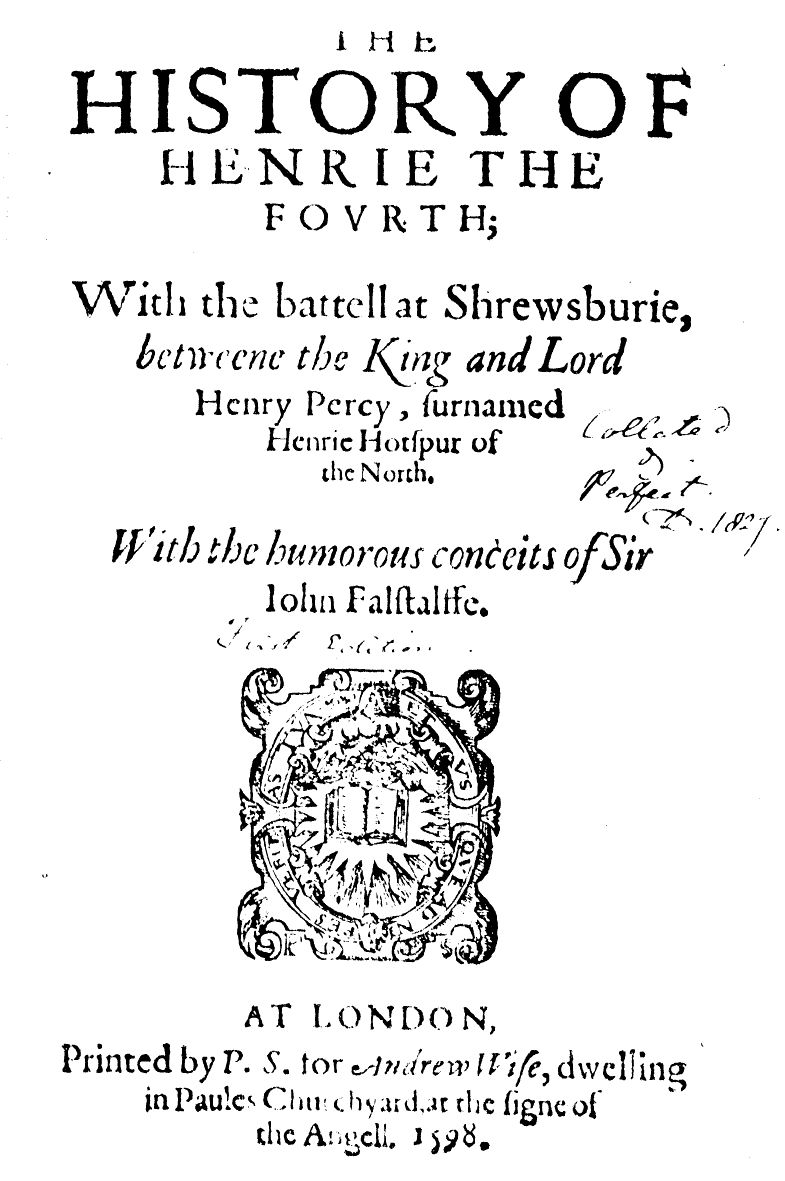
Shakespeare apparently pronounced it “Henry the Fifth” (or, rather, “Henry the Fift,” as the name was written on the title page of the 1600 quarto of the play). The earliest texts of Shakespeare’s plays were printed in quarto format, with each printed sheet folded into four leaves.

The numbers following the names of monarchs in other Shakespeare plays are similarly spelled out on the title pages, as in these examples from the 1596 quarto of Edward III, the 1597 quarto of Richard III, and the 1598 quarto of Henry IV, Part 1.

When Roman numerals are used to differentiate monarchs, popes, and others with the same name and position, the custom is to pronounce them as ordinal numbers. (Ordinal numbers, like “first,” “third,” and “fifth,” indicate place or order in a sequence, while cardinal numbers, like “one,” “three,” and “five,” indicate how many.)

Customarily, Roman numerals are also spoken as ordinals when used to identify family members with the same name (Adlai E. Stevenson III), but spoken as cardinals on clock faces (I, II, III, etc.) and in movie sequels (The Godfather, Part III). Roman numerals can go either way in sports events: Super Bowl XLVI (cardinal, “forty-six”) and  XXIV Olympic Games (ordinal, “twenty-fourth”).

Although the Anglo-Saxons had their own Germanic names for numbers, they used lowercase Roman numerals for the figures. So the Roman numeral v was the figure that represented the Old English word fíf (five) or fífta (fifth). In fact, the two usages were sometimes combined in the same passage.

The entry for the year 900 in The Anglo-Saxon Chronicle, for example, says King Ælfred died “syx nihtum ær ealra haligra mæssan” (“six nights before the All Hallows mass”) after ruling his kingdom “oþrum healfum læs þe .xxx. wintra” (“a year and a half less than thirty winters”).

Roman numerals were generally used for calculations in Old English (roughly 450-1150) and Middle English (1150-1500). Arabic numerals were introduced in Europe during the Middle Ages, but took centuries to replace most uses of Roman numerals in English.

A search of the Early English Books Online database suggests that the use of ordinal numbers to identify English monarchs showed up in the early 1500s, with the numbers sometimes written as Roman numerals and sometimes spelled out.

For example, The Statutes Prohemium Iohannis Rastell, a 1527 compilation of public general acts, by the English writer and printer John Rastell, has numerous references to numbered kings, including “The vi. yere of henry viii” …  “kynge Edwarde the thyrde” … “The .ij. yere of. Richard .ii.” (The letter “j” was sometimes used for the final “i.”)

Help support the Grammarphobia Blog with your donation
And check out our books about the English language.

Categories
English English language Etymology Expression Phrase origin Usage Word origin Writing

A rising sophomore?

Q: When did expressions like “rising sophomore” start? It’s new to me, a great-grandmother who was last in college 20 years ago.

A: It was new to us too, but not to the lexicographers at The American Heritage Dictionary of the English Language (5th ed.).

In addition to defining the adjective “rising” as ascending, developing, and increasing in power, American Heritage includes this sense: “About to begin a certain grade or educational level: rising seniors.”

Several other standard dictionaries describe “rising” as a preposition or an adverb with a similar sense.

Cambridge, for example, defines the preposition as “about to become,” and gives this example: “The school accepts children who are rising five years old.” And Collins defines the adverb as “approaching the age” and gives this example: “he’s rising 40.”

The Oxford English Dictionary, an etymological dictionary based on historical evidence, includes the use of “rising” as an adjective “designating a student about to enter a specified year of high school or college.”

The first OED citation is in the July 1893 issue of the Kappa Alpha Journal: “Mr. Young is a rising Sophomore and was asked to join us the first of the year.”

We’ve found an even earlier example from another fraternity publication, a report on the 51st annual convention of Beta Theta Pi on Aug. 25-30, 1890, at Wooglin-on-Chautauqua, NY:

“ ‘Did you say that the Lakewood girls like to come to the clubhouse?’ asked the undergraduate, who is a rising sophomore.”

The OED defines this sense of “rising” as “U.S. Educ. Designating a student about to enter a specified year of high school or college.”

The dictionary has three other examples—the latest is an April 22, 2001, advertisement in the New York Times Magazine: “Your rising senior or high school graduate can earn two college credits.”

When the word “rising” showed up in the early 1200s, it was a noun meaning “return to life” or “rising from the dead,” according to the OED. When the adjective showed up in the late 1300s, it meant increasing, advancing, or growing.

Both the noun and the adjective are derived from the verb “rise,” which the Anglo-Saxons inherited from Germanic, a prehistoric language reconstructed by linguists.

In Old English, the verb (spelled risan) originally referred to getting up in the morning or rising from the dead.

Getting back to your question, the educational use of “rising” may have evolved from a much earlier sense of the adjective as moving toward a position of higher social status, greater wealth, or increased power.

The earliest Oxford example for this sense is from The Tragidie of Ferrex and Porrex, a 1570 play by the English writers Thomas Norton and Thomas Sackville:

“Who seeth not now how many rising mindes / Do feede their thoughts, with hope to reach a realme?”

The adjective has also been used to describe a horse or person approaching a specified age. The first OED citation is from John Cheny’s 1730 history of horse racing in England and Wales: “All the rising five Years Old, 200 Guineas each, Half forfeit.”

[Note: This post was updated on Aug. 10, 2023.]

Help support the Grammarphobia Blog with your donation
And check out our books about the English language.

Categories
English English language Etymology Expression Phrase origin Usage Word origin Writing

Digital footprint

Q: Our local public radio station advertises that it broadcasts “digital.” This doesn’t sound right to me. I would say that it broadcasts “digitally.” Am I correct?

A: It doesn’t sound right to us either. A radio station broadcasts “digitally,” not “digital.”

We’ve checked eight standard dictionaries and all of them of say “digital” is solely an adjective and “digitally” is the adverb. The Oxford English Dictionary, an etymological dictionary based on historical evidence, agrees.

And a search of the News on the Web Corpus, a database of billions of words from newspapers and magazines on the internet, shows that contemporary publications use the two terms that way.

As you know, a verb is generally modified by an adverb, not an adjective, which is why a radio station broadcasts “digitally,” not “digital.”

However, adjectives are used with linking verbs (or copulas) like “be,” “become,” “feel,” “look,” and “seem.” Linking verbs convey a state or condition, rather than an activity.

In fact, a good example of this usage is “to go digital” (to become digital, or computerized), as in “The film business has gone digital.” The word “go” in this case is a linking verb because it means “become.” We’ll have more to say about “go digital” later, but let’s look now at some “digital” etymology.

English adopted the word “digital” in the 15th century from digitālis, classical Latin for “measuring a finger’s breadth.” The Latin for “finger” or “finger’s breadth” is digitus.

In English, the word “digital” was originally a noun and an adjective referring to a digit, a whole number less than 10.

The first examples in the Oxford English Dictionary for both the noun and the adjective are from The Art of Nombryng (circa 1450), an anonymous treatise based on a work by the 13th-century French scholar Alexander de Villa Dei.

The noun is now obsolete so we’ll cite only an adjectival example: “Neither of the subtraccioun, tille it come to the first figure vnder the whiche is a digitalle nombre to be founde” (from The Earliest Arithmetics in English, 1922, edited by Robert Steele).

In the mid-17th century, people began using the adjective “digital” in senses “relating to fingers or finger-like structures,” according to the OED. The dictionary’s first example is an entry from Glossographia, a 1656 dictionary by Thomas Blount: “Digital, pertaining to a finger.”

Here’s a modern example of this sense from The Horrors of the Half-Known Life, a book written in 2000 by G. J. Barker-Benfield about the attitudes of men, especially male doctors, toward women in the 19th century:

“He could emulate ‘the finger of God’ by digital examination and repair of reproductive organs.”

The modern technological senses of “digital” began showing up in the 1940s. Here are the most common technical areas where the adjective is used and the earliest Oxford citations:

Signals, information, or data: “In the transmission of direct current digital impulses over a long line the characteristics of the line tend to mutilate the wave shape” (from a 1940 patent for an electrical communications system).

Computers and calculators: “Description of the ENIAC and comments on electronic digital computing machines” (from a 1945 report by the Applied Mathematics Panel, a US agency dealing with mathematical problems during World War II).

Other electronic measurement devices: “Digital voltmeter or potentiometer” (from An Introduction to Electronics, 1964, by Bernard Vincent Rollin).

Audio, video, and other recorded works: “The limb appears in … a few real-time digital A-camera frames” (from the Oct. 3, 1969, issue of Science).

Musical instruments: “A digital electronic organ wherein a digital representation of an organ pipe waveshape is stored in a memory” (from a 1970 patent for a digital electronic organ).

Clocks, watches, and other timepieces: “Digital clock covers a 24-hour period” (from an ad in the Jan. 10, 1958, issue of Science).

Computer culture, on the internet: “The worldwide digital revolution” (from the July 28, 1983, issue of Electronics).

As for “to go digital,” the first example in the OED is from the May 18, 1964, issue of Electronics: “A comparison of factors that influence the decision to go digital or analog.” And if you’d like to read more about linking verbs like “go” here, we discuss them in items #4 and #5 of our Q&A about English.

We’ll end with some other “digital” expressions  and the earliest OED dates: “digital calculator” (1946), “digital TV” (1959), “digital camera” (1961),  “digital audio” (1969), “digital signature” (1976), “digital art” (1978), “digital video disk” (1978),  “digital money” (1984), “digital photo” (1986), “digital rights” (1990), “digital economy” (1994), and “digital footprint” (1995).

Help support the Grammarphobia Blog with your donation
And check out our books about the English language.

Categories
English English language Etymology Expression Phrase origin Usage Word origin Writing

Turning state’s evidence

Q: I have never been able to parse the expression “turn state’s evidence.” Does the witness turn himself into evidence for the state, or turn over evidence to the state?

A: A convicted or accused criminal, as you know, “turns state’s evidence” by testifying in court against former accomplices.

Why “turn” evidence? We don’t know, though we suspect that the usage may have been influenced by both the “turn over” and “turn against” senses of the verb “turn.”

In fact, “turning state’s evidence” indicates both turning against accomplices and turning over evidence.

When the courtroom expression showed up in writing in the early 1700s, it was simply to “turn evidence.”

The earliest example in the Oxford English Dictionary is from Colonel Jack, a 1723 novel by Daniel Defoe: “One of the Gang, who to save his own Life, has turn’d Evidence.”

In modern British usage, the expression now refers to “King’s” or “Queen’s” evidence, as in this citation from The Hillyars and the Burtons, an 1865 novel by Henry Kingsley: “I hate a convict who turns Queen’s evidence.”

Here’s a figurative “King’s” example from the Dec. 25, 1889, issue of the Daily News in London: “The Bishop might have been better employed than in turning King’s evidence against the Sermon on the Mount.”

In the US, such testimony is called “state’s evidence,” as in this OED example from a Dec. 24, 1886, issue of Science: “Mr. Bartlett Channing Paine comes into court, and, as state’s evidence, gives the following testimony.”

Finally, here’s a more recent example for “state’s evidence” from the Oct. 16, 1976, issue of the National Observer: “He fired up his investigators, offered deals to suspects who would turn state’s evidence, and played off the knowledge of one suspect against the other.”

When the verb “turn” showed up in late Old English, it meant to “cause to move round on an axis or about a centre; to cause to rotate or revolve, as a wheel,” according to the OED.

The dictionary’s earliest citation is from Ælfric’s Lives of the Saints, believed to have been written in the late 990s: “Þa tyrndon þa hæðenan hetelice þæt hweowl” (“then the bloodthirsty heathens turned the wheel savagely”).

By the 1300s, people were using the verb in the expressions “turn against” (change from friend to foe) and “turn one’s back” (abandon someone or something).

Here’s an OED example, dated around 1300, from Thomas Wright’s Political Songs of England (1839): “turnden hem aȝeynes with suerd ant with launce” (“turned against them with sword and with lance”).

And here are a couple of later “turn one’s back” examples from Shakespeare:

“The shame Of those that turnd their backes” (from Henry IV, Part 2, 1600) … “To turne thy hated backe Vpon our kingdome” (from King Lear, 1608).

In the 1500s, people began using the expression “turn one’s coat” to mean change one’s principles or party.

The term “turncoat,” which is more common today, showed up soon after. Here’s an example from a 1570 church history by John Fox:

“I will beleue none of you all, for you be turne coates, and chaungelinges, and be wauering minded.”

Around the same time, the expression “turn over” came to mean to transfer or hand over. The first OED example is from Richard Huloet’s 1552 dictionary, Abcedarium Anglo Latinum:  “Turne ouer, transuerto.”

Help support the Grammarphobia Blog with your donation
And check out our books about the English language.

Categories
English English language Etymology Expression Phrase origin Usage Word origin Writing

Good grief!

Q: I saw “good grief” used in a story recently, and first encountered it as a child from Charlie Brown. Is it a euphemism for something else?

A: Yes, “good grief” was originally a mild oath. It’s “a euphemism for ‘good God,’ ” according to The American Heritage Dictionary of Idioms (2d ed.), by Christine Ammer.

Ammer describes it as an “exclamation expressing surprise, alarm, dismay, or some other, usually negative, emotion. For example, Good Grief! You’re not going to start all over again, or Good Grief! He’s dropped the cake.”

Although the noun “grief” is quite old, showing up in the Middle Ages, the exclamation “good grief” is relatively new.

The earliest example in the Oxford English Dictionary is from The English Dialect Dictionary, a six-volume opus by the philologist Joseph Wright, published from 1898 to 1905:

“Good grief, a mild imprecation.” We’ve expanded the Oxford citation to add the definition (from the extensive entry for “good” in the 1900 second volume of the dialect dictionary, covering D to G).

The OED notes in an entry for “good” that it’s used “with another word euphemistically substituted” for “God” in such expressions as “good golly,” “good gravy,” “good land,” “good me,” “good gracious,” and “good grief.”

The oldest of these “good” euphemisms in the dictionary, the obsolete exclamation “good lack,” showed up in the early 1600s. (The word “lack” here comes from the archaic interjection “alack,” used to express grief, criticism, surprise, etc.)

The second citation for “good grief” in the OED is from a 1918 issue of Dialect Notes (a publication of the American Dialect Society) that includes the euphemism in a long list of exclamations.

A few exclamations that caught our eye are “good Godfrey,” “holy gumdrops,” “great goldfish,” “golly Moses,” and “gosh all hemlock.”

The first OED example for “good grief” used in popular writing is from a 1937 short story by Raymond Chandler:

“ ‘Good grief,’ De Spain said. ‘He’s up there right now.’ ” (The only version of that quotation that we could find was in a 1938 story by Chandler, “Bay City Blues.”)

However, we’ve found many earlier examples from mainstream publications, including this one from a 1915 issue of Good Housekeeping:

“ ‘Good grief!’ gasped Mannering Hitchcock, and he sank palely into a chair. ‘Are there really three of you?’ ”

We’ll end with a “good grief” example from Laughing House, a 1920 novel by the London-born American writer Meade Minnigerode:

“Good grief!” Isabelle remarked involuntarily, and Newell gave her a quick look.

“What do you mean, ‘good grief’?” he asked.

“I mean ‘good grief,’ ” she explained vaguely. “Good meaning good, and grief meaning grief …” and she refused to say anything more.

(In case you missed them, we’ve had several posts on the blog about euphemisms as mild religious oaths, including one in 2015 that discusses “by jove” and has links to some of the other posts.)

Help support the Grammarphobia Blog with your donation
And check out our books about the English language.

Categories
English English language Expression Grammar Linguistics Writing

Is ‘few’ fewer than ‘a few’?

Q: “John has few friends” implies that John is pretty lonely, while “Frank has a few friends” implies that Frank knows some people he can go to a movie with. How does that “a” change the meaning from meager to adequate?

A: This is a subject that demands more than a few words.

The Cambridge Grammar of the English Language describes “few” as an approximate negator, a word (like “little,” “barely,” “hardly,” “scarcely,” “rarely,” and “seldom”) that is loosely negative.

An absolute negator (like “no,” “nobody,” “nothing,” “neither,” “no,” and “never”) represents zero, the Cambridge Grammar says.

But an approximate negator, write the authors, Geoffrey K. Pullum and Rodney Huddleston, “merely approximates to zero—it is located toward the bottom of the scale, in the area that contains zero.”

“However, the fact that the approximate negators do not indicate absolute zero gives them a somewhat equivocal status with respect to the positive vs negative contrast,” the authors add.

The Cambridge Grammar treats “few” and “a few” as two separate determiners (words that determine or modify nouns). Although it sees “few” as loosely negative, it describes “a few” as “unequivocally positive.”

Pullum and Huddleston use the sentences “A few have resigned” and “Few have resigned” to compare the two usages.

A few have resigned,” Cambridge says, implies that “Many have resigned is false,” but necessitates that “None have resigned is false.” In other words, “a few” could in certain cases refer to “many,” but never to “none.”

As the authors explain, the statement with “a few” would be correct if many had resigned but the number of resignations wasn’t known when the statement was made.

“Now with few we have precisely the reverse situation,” Cambridge says.

Few have resigned,” the authors explain, necessitates that “Many have resigned is false,” but merely implies that “None have resigned is false.” In other words, “few” could never refer to “many,” but it might refer to “none” under certain conditions.

For example, the authors say “few” might imply “none” in this sentence: “Few of you will have experienced that kind of intimidation which our colleague Kim Jones has had to endure over the last several months.”

“Here it could well be that none of you have in fact experienced it: in this case I say few rather than none not because the latter would be false but because I do not have the knowledge to justify the stronger claim that it makes,” they write.

Cambridge notes that the “many” and “none” senses of “few” can be strengthened or weakened by adding a qualifying phrase, as in “A few of them, indeed quite a lot, had found the proposal offensive” and “Few of them, if any, will find the proposal offensive.”

We might add here that something similar happens when we add “a” to “little,” another approximate negator. “Doctors gave them little hope” is negative, while “Doctors gave them a little hope” is positive.

Why does the addition of the indefinite article “a” to the approximate negator “few” create a positive determiner?

Stephanie Solt, an American linguist doing research at the Leibniz-Zentrum Allgemeine Sprachwissenschaft in Berlin, says that “the standard if unspoken assumption” by some linguists “would seem to be that a few is an idiom, that is, a fixed, unanalyzable unit.”

But on closer examination, Solt says in a 2006 paper presented at a conference on semantics, “it is clear that a few does not always function as a unit: a and few may be separated”—by an adverb (as “a very few students”) or by an adjective modifying the head noun (“a lucky few students”).

She says “a few is composed of an independent a and few which combine in the syntax.” Semantically, she argues, both “few students” and “a few students” are negative, “differing only in the scope of negation.”

However, we believe Pullum and Huddleston are right that “few” is somewhat negative and “a few” clearly positive. And we think “a few” is indeed a separate determiner. The indefinite article here turns a rather ambivalent negative term into a definitely positive one.

The Oxford English Dictionary says the article “a” in such a construction expresses “an approximate estimate” and has the meaning “some, a matter of, about.” This use of “a,” the dictionary says, is now chiefly seen in phrases like “a fewa good fewa good manya great many.”

The OED further describes an expression composed of “a” + “few” + a plural noun as “a virtual collective noun … construed with plural verb.”

The positive use of “a few” is quite old, dating from at least the Middle English period (about 1100-1500) and perhaps as far back as Old English.

The earliest definite example in the Oxford English Dictionary is from The Chronicle of Robert of Gloucester (1297): “Þe kyng with a fewe men hymself flew at þe laste.”

However, the OED has a bracketed—that is, questionable—Old English citation from the apocryphal Gospel of Nicodemus:

“Ic bydde þe for þynre myltse þæt ðu læte me sprecan ane feawa worda” (“I bid thee that in thy mercy thou let me speak a few words”).

Not surprisingly, the dictionary has several Old English examples for “few” without the indefinite article, including this one from Beowulf, which may date from the early 700s:

“He feara sum beforan gengde” (“He went in front with few men”).

Help support the Grammarphobia Blog with your donation
And check out our books about the English language.

Categories
English English language Etymology Expression Phrase origin Usage Word origin Writing

Pots to cook in, pee in, melt in

Q: Please talk about the origins of the word “pot,” as in “pot luck,” “melting pot,” “potboiler.” Does it refer to mixing things together?

A: Almost all uses of “pot” are derived in one way or another from the word’s original sense: a cylindrical container to hold or heat liquids and other substances.

“Pot” comes from ancient Germanic, a reconstructed prehistoric language that preceded Old English and other Germanic languages.

In Old English, the word for the container was pott. Old Icelandic, Old Swedish, and Old Frisian, had similar words.

The term also showed up in medieval Latin and the Romance languages, suggesting an earlier, shared ancestor. We’re now getting into speculative territory, so we’ll let the Oxford English Dictionary do the speculating for us:

“The word in the Germanic and Romance languages and in post-classical Latin perhaps ultimately shows a loanword from a pre-Celtic language (perhaps Illyrian or perhaps a non-Indo-European substratal language), although a number of other etymologies have also been suggested.” (A substratal language influences one that replaces it.)

The dictionary adds that similar words in Welsh, Irish, and Scottish Gaelic apparently came from English rather than the other way around, as some word sleuths have suggested.

The earliest example for the term in the OED is from Old English Leechdoms (also known as Leechdoms, Wortcunning, and Starcraft of Early England), an 1864 collection of Anglo-Saxon medical remedies and prayers edited by Thomas Oswald Cockayne:

“Nim readstalede harhuna, & ysopo, & stemp & do on ænne neowna pott, an flering of ða harhuna & oðer of ysopo … forð þæt se pott beo full” (“Take red-stalked horehound, and hyssop, and pound, and put in a new pot, one layer of horehound, and another of hyssop, and a third of fresh butter, and again the herbs, and then the butter, until the pot is full”).

This recipe was for a remedy used to treat a pain in the chest. The mixture was boiled and wrung through a cloth, then taken cold in the morning and hot at night in beer or broth or water.

The OED notes that the use of “pot” for such a container was “rare in Old English, the more usual word being crocc,” or crock. The term “pot” was more common after the Norman Conquest, probably reinforced by pot in Anglo-Norman or Old French.

Most of the later uses of “pot” come from the early sense of a cylindrical container for holding or heating things. We won’t discuss all the dozens of “pot” usages, but here are some more common ones, and the first OED examples for them:

“Chamber pot,” a bowl usually kept in a bedroom for one to urinate or defecate in. The first OED citation is from a 1540 inventory (“Item a chamber potte”), but we prefer this later example about someone too lazy to get out of bed: “He will nocht rys to the pott bot pischis amang the strais [straw bedding]” (from a 1568 literary anthology compiled by the Scottish merchant George Bannatyne).

“Go to pot,” originally to be cut in pieces and cooked, but later to deteriorate or be ruined: “Poor Thorp, Lord Chief Justice, went to Pot, in plain English, he was Hang’d” (from The History of Wiggism, circa 1680, by Edmund Hickeringill).

“Potluck,” a meal without special preparation: “That, that pure sanguine complexion of yours may neuer be famisht with potte-lucke” (from Strange Newes, 1592, by the Elizabethan writer Thomas Nashe). Later, a communal meal at which guests bring dishes to share: “their pot-luck and their ponies” (from the Aug. 13,1867, issue of the New York Times).

“Pot belly,” a large, protruding stomach: “A great pot Belly, a broad Back, and huge Legs and Arms, enough to squeeze one to pieces” (from The She-Gallants, a 1696 comedy by the English poet and playwright George Granville Lansdowne).

“Potboiler,” a creative work produced to make money by catering to popular taste: “Some others … in great measure compensate for the heaps of inconsequential trash, or pot-boilers (as they are called) which are obtruded upon the public view” (from a 1783 account by the Irish painter James Barry of an art exhibition in London).

“Potpie,” a pie filled with meat and other ingredients: “The snow birds are flying round your own door, where you may … shoot enough for a pot-pye, any day” (from The Pioneers, an 1823 novel by James Fennimore Cooper). The non-meat ingredients were originally fruit and later vegetables.

“Chimney pot,” the pipe at the top of a chimney to improve draft: “Why a church is with a steeple built; / And a house with a chimney-pot?” (from “The ‘How’ and the ‘Why,’ ” in Alfred Tennyson’s Poems, Chiefly Lyrical, 1830).

“Pot shot,” a random or easy gunshot: “Major Swayne … kept them under hedges firing pot shots, on which the enemy reoccupied the position” (from an 1843 Afghan journal by Florentia Wynch Sale, the wife of a British army officer). Earlier, it had meant shot for a cannon or a shot to kill food for the pot. And later, it came to mean random, easy, or unfounded criticism: “But I don’t think much of the pot-shot method of refutation” (from the November 1926 issue of the Forum, a New York magazine).

“Pot of gold,” a fortune or jackpot, real or imagined: “It is the barbarous old legend of the ‘pot of gold’ repeated in ten thousand new forms” (from the Feb. 16, 1847, issue of the New York Times).

“Pot,” the betting pool in poker and other gambling games: “He won the first twenty ‘pots,’ that is to say, the stake” (from Gambling Unmasked, 1847, by Jonathan H. Greene, an ex-gambler who campaigned against gambling).

“Pot roast,” meat, typically beef, cooked slowly in a covered pot or dish: “Sour Braten, or a Sour Pot-roast” (from the April 11, 1880, issue of the New York Times).

“Pot holder,” a pad for holding hot cooking implements: “the grimy apron was stuffed out with the dish-towel, pot-holder, red handkerchief, etc.” (from the March 1888 issue of Harper’s magazine).

“Pothole,” a depression from a defect in the surface of a road: “The surface of the bottom land that they were crossing was here and there broken up by fissures and ‘potholes,’ and some circumspection in their progress became necessary” (from A Waif of the Plains, an 1889 novel by Bret Harte). The potholes here were on a prairie trail.

“Melting pot,” a place where people of different races and cultures assimilate: “The French Canadians had a misgiving that if they too were cast into the American melting pot they would yield to that mysterious force which blends all foreign elements into one homogeneous mass” (from the Sept. 2, 1889, issue of the New York Times). Originally, it referred to a container in which metals or other materials were melted and mixed.

We’ll end with the “pot” that’s smoked: “She made him smoke pot and when he got jagged … she put him out on the street” (from a 1938 story in Black on Black, a 1973 collection of Chester B. Himes’s writings). “Jagged,” an old adjective for “drunk,” means “stoned” here.

Oxford says the marijuana sense of “pot” is of “uncertain and disputed” origin. It debunks the “most popular theory”—that it comes from potiguaya or potaguaya, “supposed Mexican Spanish words” for marijuana leaves, or from the phrase “potación de guaya, lit. ‘drink of grief,’ supposedly denoting a drink of wine or brandy in which marijuana buds were steeped.”

The dictionary says “no corroborating evidence has been found to support the use of any of these terms in Spanish.”

Alternatively, the OED adds, the use of “pot” for marijuana may somehow be connected to the original sense of “pot” or to the noun “pod,” though it doesn’t offer any evidence for such connections.

Help support the Grammarphobia Blog with your donation
And check out our books about the English language.

Categories
English English language Etymology Expression Phrase origin Usage Word origin Writing

Common day occurrence

Q: I don’t hear “common day occurrence” a lot, but the expression does crop up from time to time, and the other day I found myself using it. A friend questioned me and I couldn’t recall where I’d picked it up. Any idea where or when this phrase originated?

A: The expression “common day occurrence” showed up in the late 19th century, probably as a conflation of “common occurrence” and “everyday occurrence,” two more common expressions that mean the same thing.

In fact, we’ve found an even earlier example in The Book of Family Prayer for the United Church of England and Ireland (1856) that uses both  “common” and “everyday” together to modify “occurrence”:

“Have we been separated for a time from our families, and has God brought us together in health and safety? and because this is a common every-day occurrence, shall we hesitate to acknowledge in it God’s protecting arm?”

The earliest example we’ve found for “common day occurrence” is from an 1897 British review of On Many Seas: The Life and Exploits of a Yankee Sailor, a memoir by Capt. Frederick Benton Williams:

“To be jailed for mutiny was a common day occurrence, but then mutiny covered a great many offenses” (from the Review of Reviews, a London journal edited by William Thomas Stead).

The expression “everyday occurrence” dates from the early 19th century. The first example we’ve seen is from a May 17, 1819, debate in the House of Commons: “It was well known that, among officers, the sale and exchange of commissions were matters of every day occurrence.”

And the expression “everyday’s occurrence” dates from the early 18th century. The oldest example we’ve found is from Of the Law of Natur and Nations (1729), an English translation by the Oxford scholar Basil Kennett and others of a Latin work by the German political philosopher Samuel Freiherr von Pufendorf:

“It is therefore necessary to appoint certain Magistrates, as Substitutes or Delegates, who, by the Authority of the whole People, may dispatch Business of every Day’s Occurrence.”

The expression “common occurrence” is even older. The oldest example we’ve seen is from God the Author of Reconciliation (1699), by the English Puritan clergyman Stephen Charnock:

“The illustration should, if possible, be a matter of common occurrence, and the more common the occurrence the more sure it will be not to fix attention upon itself, but serve as a medium through which the truth is conveyed. ”

Although the expression “common day occurrence” has been around for a while, it isn’t all that common, as you’ve observed. We’ve found only a couple of hundred examples in Google searches.

And we couldn’t find the expression in the Oxford English Dictionary, an etymological dictionary based on historical evidence, or in any of the standard dictionaries we usually consult.

Help support the Grammarphobia Blog with your donation
And check out our books about the English language.

Categories
English English language Etymology Expression Phrase origin Usage Word origin Writing

When roads squeaked

Q: I was reading a free 1904 translation of Flaubert’s Sentimental Education on my Kindle, but it was so klutzy that I downloaded Helen Constantine’s 2016 translation. For example, “the road-metal grated” (1904) versus “the macadam squeaked” (2016).

A: Helen Constantine’s translation is very close to le macadam grinçait, the original French wording in L’Éducation Sentimentale. The French verb grincer can mean creak, squeak, grate, and more.

But the anonymous translator of that 1904 version isn’t as far off as you may think. The term “road metal” here refers to the layers of broken stone used in making macadam roads.

When Flaubert published the novel in 1869, a macadam road was made with layers of broken stone, the largest pieces at the bottom and the smallest at the top.

The process, developed by the Scottish engineer John Loudon McAdam, was modified in the early 20th century, to handle automobile traffic, by adding tar to the surface.

Today, “road metal” refers to broken stone and similar material used to make or repair roads or rail beds. The term is in US dictionaries, but it’s much more common in the UK, according to searches of the British National Corpus and the Corpus of Contemporary American English.

So how did “metal,” a word for a material like gold, silver, iron, copper, and brass, come to mean broken stone?

English adopted the noun “metal” in the early 1200s from Anglo-Norman and Old French, but the ultimate source is the classical Latin metallum and Greek métallon (mine, quarry, and substance obtained by mining).

When the noun showed up in early Middle English, according to the Oxford English Dictionary, it meant “hard, shiny, malleable material of the kind originally represented by gold, silver, copper, etc., esp. as used in the manufacture of objects, artefacts, and utensils.”

The earliest example in the OED is from Ancrene Riwle, an anonymous guide for monastic women that probably dates from sometime before 1200:

“Beo neauer se briht or. Metal. gold. seoluer. Irn. stel. þet hit ne schal drahe rust of an oþer þet is irustet.” (“For neither gold, nor silver, nor iron, nor steel, is ever so bright that it will not draw rust from a thing that is rusty, if they lay long together.”)

The use of “metal” for broken stones to make roads showed up first in Scottish English in the late 1700s. The earliest OED example is a 1782 citation from the Scottish National Dictionary: “The mettle for the road is not to be got but at the south end of the road.”

The next Oxford example, from a 1795 book by John Francis Erskine about Scottish agriculture, spells “metal” the usual way: “The weight of stones (or metals, as they are generally termed by the Scotch road-makers).”

However, that early Scottish spelling leads us to the noun “mettle,” which began life as an alternative spelling of “metal.”

As the OED explains, “The form mettle was a variant spelling used in all senses in the 16th and 17th centuries.”

In the early 1500s, writers began using both “mettle” and “metal” figuratively to mean “a person’s character, disposition, or temperament; the ‘stuff’ of which one is made, regarded as an indication of one’s character,” according to the dictionary.

The earliest Oxford example describes the biblical Adam as “Not lyght of metall but heuy and sad” (from Pylgrymage of Man Kynd, William Hendred’s early 16th-century translation of  a 14th-century allegorical poem by Guillaume de Deguileville).

“The first dictionary to record the figurative senses under the spelling mettle separately from metal is Kersey’s New Eng. Dict.(1702),” the OED says. (John Kersey was the author of A New English Dictionary.)

By the mid-1700s, the dictionary adds, “the form mettle becomes very rare in non-figurative senses,” and is used “now chiefly in to show one’s mettle.”

We also discussed the history of “metal” and “mettle” in a 2014 post about a pun in which the two words were switched in the expression “pedal to the metal.”

Help support the Grammarphobia Blog with your donation
And check out our books about the English language.

Categories
English English language Etymology Expression Linguistics Phrase origin Usage Word origin Writing

Is ‘kaput’ a loanword?

Q: Is there a better expression than “loan word” to describe “kaput”? I’d say “restaurant” is certainly now an English word on loan from French, but “kaput” seems in a different class—a German word in international use, like “schadenfreude.”

A: We’ve occasionally used “loanword” (standard dictionaries generally run it together) to mean an English word adopted more or less intact from another language. We’ve also used “adoption” several times.

But the noun we use the most for such a term is “borrowing.” The verb “borrow” and its derivatives have been used figuratively in this sense for hundreds of years, as we note in a 2008 post.

We don’t know a better term than “borrowing,” “adoption,” or “loanword” for a word, like “kaput,” that hasn’t quite lost its foreign-ness but is found in standard English dictionaries. However, the linguists Thomas Pyles and John Algeo have suggested a possibility.

In The Origins and Development of the English Language (4th ed.), Pyles and Algeo divide these borrowings into “popular loanwords” and “learned loanwords.”

Popular loanwords are of oral transmission and are part of the vocabulary of everyday communication,” they write, adding: “For the most part they are not felt to be any different from English words; in fact, those who use them are seldom aware that they are of foreign origin.”

Learned loanwords, on the other hand, may in time become part of the living vocabulary, even though their use may be confined to a certain class or group,” Pyles and Algeo say.

We think “kaput” falls more into the first category than the second, though you seem to disagree with us.

A search of the Corpus of Contemporary American English, for example, finds “kaput” in such diverse media as People magazine, Mother Earth, Esquire, Popular Mechanics, Cosmopolitan, Skiing magazine, the Washington Post, the Antioch Review, CNN, FOX, ABC, and NPR.

Some English dictionaries include the variant “kaputt,” the spelling of the original German word, which means broken, ruined, or done for. The Oxford English Dictionary lists it as slang, but most standard dictionaries consider the word informal.

When the word entered English in the late 19th century, it meant “finished, worn out; dead or destroyed,” according to the OED.

The dictionary’s earliest example is from The Alps From End to End, an 1895 book by Sir William Martin Conway that combines English and German: “The thing would then go wie’s Donnerwetter [like a thunderstorm] and the man would be kaput at once.”

The next Oxford example, which uses the word in the sense of “rendered useless or unable to function,” is from the Dec. 11, 1924, issue of the Glasgow Herald: “The intellectual consciousness is kaput.”

Interestingly, the German kaputt is itself a loan word, or borrowing, from French, though it lost something in translation.

As the Chambers Dictionary of Etymology explains, the German word “was probably abstracted from the earlier phrase capot machen, a partial translation by false interpretation of faire in the French faire capot be defeated.” (The French phrase refers to being without tricks—that is, defeated—in the card game piquet.)

By the way, the English term “loanword” is a borrowing of another sort, a “loan translation,” which Pyles and Algeo define as “an expression made by combining forms that individually translate the parts of a foreign combination.” In this case, “loanword” is a translation of the German lehnwort.

English has many loan translations, especially from French, such as “marriage of convenience” (mariage de convenance), “trial balloon” (ballon d’essai), and “that goes without saying” (ça va sans dire).

“Such forms are a kind of calque,” Pyles and Algeo write, using another term in linguistics for a loan translation.

Help support the Grammarphobia Blog with your donation
And check out our books about the English language.

Categories
English English language Etymology Expression Phrase origin Usage Word origin Writing

A ‘post-’ post

Q: I’ve been struck by how often the prefix “post-” has been used lately: “post-religion,” “post-truth,” “post-contemporary,” and of course “postmodern” as well as “post-postmodern.” What do you think?

A: Yes, the prefix “post-” gets a workout these days, but it’s been a workhorse for centuries. A lot of the early uses are now obsolete, though, and we wouldn’t be surprised if many of the new ones joined them.

English borrowed the prefix in the late 14th century from Latin, where post- was attached to verbs, participles, and other verbal derivatives, as in postpōnere (to put off), postpartor (heir), and postgenitus (begotten).

The earliest English example for the prefix in the Oxford English Dictionary is from a manuscript, written in the middle to late 1300s, about the life of St. Bernard of Clairvaux:

“God … enspired him of an orisoun, / To seyn at his post-comoun” (“God … inspired a prayer for him to say at his post-communion”). The post-communion is a prayer that follows communion.

The use of “post-” is apparently more popular with English speakers than it was with ancient Romans.

“In English,” the OED says, “the prefix is used more generally than in Latin, especially in the prepositional relation” (that is, as used in terms like “post-puberty,” “post-Elizabethan,” and “post-Chomskyan”).

Originally, “post-” was used with words of Latin origin, such as “post-communion” (from commūnio, sharing), but the prefix broke away from its classical roots in the 17th and 18th centuries, with the appearance of such terms as “post-talmudical” (1659), “post-law” (1663), “post-noon” (1686), and “post-breakfast” (1791).

The usage grew in popularity in the 19th and 20th centuries, according to OED citations, with hundreds of the prefixed terms showing up. Here’s a small sample:

“post-Kantian” (1812), “post-resurrection (1839), “post-election” (1851), “post-Hegelian” (1865), “post-Christmas” (1871), “post-Renaissance” (1874), “post-conquest” (1880), “post-flu” (1918), “post-surrealist” (1938), “post-crash” (1930), “post-game” (1934),  “post-bop” (1955), “post-cold war” (1962), “post-partisan” (1962), “post-pill” (1968), “post-orgasm” (1973),  “post-everything” (1976), and “post-glasnost” (1987).

Is “post-” used more now than in the past? Not according to a search with Google’s Ngram viewer, which tracks n-grams (character sequences that represent words or strings of words) in material printed from 1500 to 2008.

A search for the term “post” used as a prefix suggests that it’s being used notably less now than in the middle and late 1800s, though more than a few decades ago.

In fact, the examples you cite aren’t all that new either, with the oldest dating back to the mid-19th century: “post-modern” (1865), “post-contemporary” (1917), “post-religion” (1972), “post-truth” (1989), and “post-postmodern” (1991).

In case you’re interested, we wrote a post in 2012 that mentions the recency illusion, which the linguist Arnold Zwicky defines as “the belief that things YOU have noticed only recently are in fact recent.”

Help support the Grammarphobia Blog with your donation
And check out our books about the English language.

Categories
English English language Etymology Expression Phrase origin Usage Word origin Writing

What’s the matter?

Q: I was listening to an Oliver Sacks book on my commute and was struck by his repeated use of “the matter,” as in “What seems to be the matter?” and “There’s nothing the matter.” I’m curious as to the history of this usage.

A: Let’s begin with the word “matter,” which comes via Anglo-Norman and Old French from the classical Latin noun māteria.

In Latin, the word originally referred to building material, especially wood, but Roman writers later used it figuratively to mean material for discussion or consideration.

When “matter” showed up in English in the Middle Ages, according to the Oxford English Dictionary, it referred to “an event, circumstance, fact, question, state or course of things, etc., which is or may be an object of consideration or practical concern; a subject, an affair, a business.”

The earliest example of “matter” in the OED is from Ancrene Riwle, an anonymous guide for monastic women that probably dates from sometime before 1200:

“Of þis ilke Materie ich spec Muchel þer uppe” (“I spoke much of this same matter above”).

The dictionary says this sense of “matter” inspired several idiomatic expressions (“there is something the matter,” “what is the matter?” and so on) in which “the matter” refers to “the condition of or state of things regarding a person or thing, esp. as a subject of concern or wonder.”

The first OED example for the usage comes from Andria, an English translation, dated around 1520, of a Roman comedy adapted by Terence from a Greek play by Menander: “What is the matter now.”

Oxford also cites Shakespeare’s Othello (circa 1603): “What is the matter here?” And this citation is from Daniel Defoe’s The Family Instructor (1715), a guide to good conduct: “I beseech you what is the Matter with you!”

The OED says “what is the matter with—?” can mean “what is wrong with—?” or “what is the objection to—?” or “what is there to complain of in—?”

“In recent colloquial use,” the dictionary explains, the noun “matter” is “sometimes interpreted as a predicative adjective in the sense ‘wrong, amiss.’ ”

Interestingly, the word “matter” can be traced to māter-, the same reconstructed prehistoric base as “mother,” according to The American Heritage Dictionary of Indo-European Roots. The dictionary adds that māter- is “based ultimately on the baby-talk form -, with the kinship term suffix -ter-.”

How, you may be wondering, did that ancient Indo-European root give Latin both māter (“mother”) and māteria (“wood”)?

The OED says the “wood” sense of māteria is “usually explained as originally denoting the trunk of a tree regarded as the ‘mother’ of its offshoots.”

Help support the Grammarphobia Blog with your donation
And check out our books about the English language.

Categories
English English language Etymology Expression Phrase origin Usage Word origin Writing

Believe you me

Q: This headline was on a book review in the New Yorker: “Believe You Me.” I’ve heard the expression many times, but the construction is really odd. Where does it come from?

A: The verb “believe” has been seen since the 1500s in various expressions used to strengthen an assertion. These parenthetical expressions are usually set off by commas, dashes, or parentheses.

The earliest example for the usage in the Oxford English Dictionary (a “you”-less version) is from “The Steele Glas,” a 1576 poem by George Gascoigne:

“This is the cause (beleue me now my Lorde) / That Realmes do rewe, from high prosperity. / That Kings decline, from princely gouernment.” (We’ve expanded the citation.)

In the simple imperative construction “believe me,” the subject “you” is not stated, but understood. In the version you’re asking about, “believe you me,” the subject makes an appearance.

The earliest example in the OED for the longer version is from the Oct. 27, 1808, issue of Eye, a Philadelphia magazine: “Now this was wrong, believe you me.”

This later citation is from the July 1877 issue of Catholic World: “We’ve not come to the worst yet, believe you me.”

And this one is from Late and Soon, a 1943 novel by E. M. Delafield: “Believe you me, in all the years, and all the adventures I’ve deliberately sought out—God forgive me—it’s never been like this.” (We’ve expanded the citation.)

Another version of the usage showed up in the mid-18th century. The first citation in the OED is from Tobias Smollett’s 1749 translation of Gil Blas, a  picaresque novel by the French writer Alain René Le Sage:

“Meanwhile, (would you believe it?) this ferocious disposition, this haughty woman, is, within these two months, entirely changed.”

Still another variation appeared in these lines from a June 27, 1792, letter written by the English poet William Cowper:

“Believe it or not, as you chuse, / The doctrine is certainly true, / That the future is known to the Muse / And poets are oracles too.”

This version showed up in the Nov. 17, 1844, issue of the New York Herald: “We beg permission to call the attention of our readers to the following … You better believe it.”

And here’s an 1856 example from the Yale Literary Magazine of that expression at work in a sentence: “You’d better believe, I’ll live in the clover.”

In looking into these expressions, we came across an entry in John Ayto’s Dictionary of Word Origins that says “Believing and loving are closely related,” an idea noted in the OED, though with less certainty.

Ayto says the verb “believe,” which evolved in Old English from “gelēfan” to “belēfan,” comes from the reconstructed prehistoric Germanic word galaubjan, which “meant ‘hold dear, love,’ and hence ‘trust in, believe.’ ” He says galaubjan in turn comes from the prehistoric base laub-, which he describes as the source for the English word “love.”

By the way, the headline that got your attention was later changed in the May 8, 2017, issue of the New Yorker to “The Art and Activism of Grace Paley.” An editor’s note at the end of the review doesn’t give a reason for the change.

Help support the Grammarphobia Blog with your donation
And check out our books about the English language.

Categories
English English language Etymology Expression Phrase origin Usage Word origin Writing

Fits and starts

Q: My pet peeve is “in fits and starts.” Both “fits” and “starts” denote motion, while my choice, “in spurts and stops,” really conveys what should be said, with the added advantage of alliteration.

A: We rather like “in fits and starts.” It has a jerky quality that seems to capture its meaning very neatly. And as we’ll show, English speakers generally agree with us.

The expression has an interesting history. In fact, it evolved by fits and starts. The story begins back in the 1500s when a “fit” was a paroxysm and a “start” was a sudden burst of activity.

By the late 1500s, the words showed up in two separate adverbial phrases, “by fits” (irregularly or fitfully) and “by starts” (intermittently).

The earliest example of “by fits” in the Oxford English Dictionary is from a 1583 English translation of a sermon by the French theologian John Calvin:

“He doth not thinges by fittes as Creatures doe but he continueth alwayes in one will.”

The first appearance of “by starts” in the OED is from a 1587 edition of The Chronicles of England, Scotland, and Ireland.

The authors—Raphael Holinshed, William Harrison, Richard Stanyhurst, and John Hooker—write that the Scottish and Irish “performed by starts (as their manner is) the dutie of good subiects.”

In the early 1600s, the two adverbial phrases came together as “by fits and starts,” which the OED defines as “by irregular impulses or periods of action, at varying intervals, fitfully, spasmodically.”

The earliest example in the dictionary is from an Oct. 3, 1620, sermon by the English theologian Robert Sanderson, who says that if one lives a godly life “only by fits and starts,” one can save one’s soul through prayer and repentance.

The OED cites several rare, obsolete, dialectal, or uncommon variations of the expression, including “fits and girds,” “fits and spasms,” “fits and turns,” and “halves and fits.”

Oxford says the expression “fits and starts” has at times begun with “by,” “at,” and “upon,” but it doesn’t mention “in.”

Our own searches in databases of recent English usage indicate that “in fits and starts” is overwhelmingly more popular today than “by fits and starts.” Expressions with the other two prepositions drew a blank.

As for “in spurts and stops,” it’s not in the OED, an etymological dictionary based on historical evidence, or in any of the standard dictionaries we usually consult.

The earliest mention we’ve seen of “in spurts and stops” is from the Nov. 18, 1922, issue of the American Gas Journal:

“Nothing more has been said relative to starting work on the extension of the pipe line, but that is hardly practicable before spring, except in spurts and stops, a very costly method.”

This later example, from the winter 1972 issue of Dissent, describes the operation of computers:

“Reels of tape activating the takes, in spurts and stops, rock back and forth; small squares of light — red, yellow, green, blue — have their own character, some gleam, some brood, others flicker off and on.”

“In spurts and stops” isn’t very popular today. It barely registers in a search of the NOW Corpus, a database of 4.3 billion words in web-based newspapers and magazines from 2010 to the present time. Your pet peeve is preferred more than 700 to 1.

Why is “fits and starts” so much more popular? Because English speakers generally find it more fitting. It has appeared in writing steadily for nearly four centuries—not at all in fits and starts. But if you don’t like it, by all means don’t use it.

Help support the Grammarphobia Blog with your donation
And check out our books about the English language.

Categories
English English language Etymology Expression Usage Word origin Writing

A decadent chocolate cake

Q: I’ve always thought “decadent” describes the careless and cavalier waste of resources.  But a friend of mine says the root of the word is decay, as in drugs, tattoos, piercings, and angry music. Tell me he’s wrong and I’m right!

A: You’re both right.

The adjective “decadent” is ultimately derived from the classical Latin verb decadēre (to decay). However, it’s generally used now to describe the moral decay that leads to self-indulgence and cultural decline.

One sign of our own moral decay, for example, is an unrestrained fondness for buttercream frosting.

When the adjective showed up in English in the early 19th century, it referred to “a state of decay or decline; falling off or deteriorating from a prior condition of excellence, vitality, prosperity, etc.,” according to the Oxford English Dictionary.

The earliest example in the OED is from The French Revolution: A History (1837), by Thomas Carlyle: “Those decadent ages in which no Ideal either grows or blossoms?”

However, the noun “decadence” showed up much earlier in The Complaynt of Scotlande, a 1549 book by Robert Wedderburn that argues against the uniting of Scotland and England: “My triumphant stait is succumbit in decadens.”

This later example of the noun is from The Citizen of the World, Oliver Goldsmith’s 1762 collection of letters ostensibly written by a Chinese traveler commenting on British society:

“Every day produces some pathetic exclamation upon the decadence of taste and genius.”

The adjective “decadent” is a back formation from the noun “decadence.” (A back formation is a word formed by dropping a real or imagined part from another word.)

English borrowed the noun from the French décadence, which in turn was derived from the medieval Latin decadentia. The original classical Latin verb, decadēre, is made up of de- (down) plus cadēre (to fall).

In looking into the history of “decadent” and “decadence,” we came across an interesting usage note at Merriam-Webster Online. We’ll break it up into several paragraphs to make it easier to read on our website:

“To be decadent is to be in the process of decay, so a powerful nation may be said to be in a decadent stage if its power is fading. But the word is more often used to speak of moral decay.

“Ever since the Roman empire, we’ve tended to link Rome’s fall to the moral decay of its ruling class, who indulged in extreme luxuries and unwholesome pleasures while providing the public with cruel spectacles such as the slaughter of the gladiators.

“But not everyone agrees on what moral decadence looks like (or even how it might have hastened the fall of Rome), though most people think it involves too many sensual pleasures—as, for instance, among the French and English poets and artists of the 1880s and ’90s called the Decadents.

“These days, for some reason, people have decided decadent is the way to describe rich chocolate cakes.”

The use of “decadent” for a chocolate cake seems to be relatively new. The earliest example we’ve seen is from a 1978 item in Cue magazine about the “Decadent Chocolate Cake ($1.25 a slice) that’s appropriately named” at the Silver Palate food store in Manhattan.

Help support the Grammarphobia Blog with your donation
And check out our books about the English language.

Categories
English English language Etymology Expression Phrase origin Usage Word origin Writing

Another thing (or think?) coming

Q: Which is correct: “If you think that, you have another thing/think coming”? I see “thing” more often, but “think” makes more sense to me.

A: The two expressions, which are used to express disagreement, showed up in print within a couple of weeks of each other in the late 19th century.

The editors at the Oxford English Dictionary say that “to have another thing coming” resulted from a “misapprehension of to have another think coming.”

We tend to agree with that explanation, but word sleuths keep coming up with earlier examples for the expressions, and the question of which one inspired the other hasn’t been conclusively answered.

We agree with you that “think” makes more sense here than “thing.” Our guess is that whoever coined the expression was apparently using the noun “think” as a play on the verb “think.”

However, the noun “think” was relatively new at the time, and many people could have heard it as “thing,” a much more common noun that dates from early Anglo-Saxon days.

In fact, the phrases “think coming” and “thing coming” are often pronounced the same way, as the linguist Mark Liberman explains in a May 3, 2008, post on the Language Log.

More important, idiomatic expressions don’t have to make sense. The original expression may indeed have used “thing coming,” not “think coming.”

Both versions are common today, though “another thing coming” is more popular, especially in the US, according to our searches of contemporary English databases.

The News on the Web Corpus, for example, has more than twice as many examples for “another thing coming” as for “another think coming.”

(The NOW corpus contains 4.3 billion words from web-based newspapers and magazines published between 2010 and the present time.)

As for the etymology here, when the noun “think” showed up in the early 19th century, it meant an “act of (continued or concerted) thinking,” according to the OED.

The dictionary’s first citation is from an 1834 issue of Tait’s Edinburgh Magazine: “We lie lown yonder … and have time for our ain think.”

The expression “to have another think coming,” which Oxford defines as “to be greatly mistaken,” showed up six decades later.

The earliest OED example is from the May 21, 1898, issue of the Syracuse (NY) Standard: “Conroy lives in Troy and thinks he is a coming fighter. This gentleman has another think coming.”

However, a reader of the blog has found an earlier example from the Feb. 23, 1896, issue of the Sunday Journal (Indianapolis):

“ ‘Oh, you think you’ve seen me, do you?’ and once more that voice gurgled in his ear. ‘Well, you’ve got another think coming. See?’ ”

The earliest OED citation for “to have another thing coming” is from Wilshire Editorials, a 1906 collection of editorials in the various magazines published by Gaylord Wilshire:

“Now if we should try and think up some one person who is satisfied with the existing order of things … we would most likely have thought that we should find him in the editor of the Wall Street Journal. But if we did, then we have another thing coming.”

(The OED notes that the word “thing” here was “think” when the editorial originally appeared in 1904 in Wilshire’s Magazine.)

Interestingly, the reader we mentioned earlier has found both “think” and “thing” versions of an article about bicycle racing that appeared in two newspapers in 1897.

The “think coming” version appeared in the June 12, 1897, issue of the Buffalo (NY) Enquirer:

“In witnessing these things they imagine that these battles and quarrels of the track are carried on after the races are over. The people who think this ‘have another think coming,’ for the men travel in one of the most peaceful parties that follows any line of sport.”

The “thing coming” version appeared in an otherwise identical passage in the June 24, 1897, issue of the Elmira (NY) Daily Gazette & Free Press.

Additional examples may turn up as more written English is digitized. And preferences about “think coming” vs. “thing coming” may change.

From what we know now, the “another think” version was the first to show up, but English speakers today prefer “another thing.”

[Note: This post was updated on Oct. 24, 2017.]

Help support the Grammarphobia Blog with your donation
And check out our books about the English language.

Categories
English English language Etymology Expression Phrase origin Usage Word origin Writing

Hello, Minnie!

Q: We saw Puccini’s La Fanciulla del West and noticed that the Italian libretto makes generous use of “hello,” notably with shouts of “Hello, Minnie!” at the saloon. I don’t see anything about “hello” on your blog. Would you like to correct this oversight?

A: We’ve discussed “goodbye” in several posts (most recently, in 2011), but we haven’t written about “hello.” What better time than now?

Despite its ubiquity today, the use of “hello” as a greeting is relatively new, dating back only to the mid-1800s, at least in writing. However, “hello” was used to attract attention or express surprise as far back as the 1820s, and its ancestors date from the 16th century.

The earliest example in the Oxford English Dictionary for “hello” used to attract attention is from the Oct. 4, 1826, issue of the Norwich (CT) Courier: “Hello, Jim! I’ll tell you what: I’ve a sharp knife and feel as if I’d like to cut up something or other.”

The first OED citation for the term used to express surprise is from a letter in the Sept. 23, 1827, issue of the U.S. Telegraph, a Washington, DC, daily: “Hello, sez Joe Laughton, wher’s Bil Perry un Olla Parsons?”

And the earliest example in the dictionary for “hello” used as a greeting is from the May 28, 1853, issue of the New York Clipper, an entertainment weekly: “Hello ole feller, how are yer?”

The first Oxford citation for “hello” used in the telephone sense is from an Aug. 15, 1877, letter by Thomas Alva Edison to T. B. A. David, president of the Central District and Printing Telegraph Company in Pittsburgh:

“Friend David, I do not think we shall need a call bell as Hello! can be heard 10 to 20 feet away. What you think? Edison — P.S. first cost of sender & receiver to manufacture is only $7.00.” (We’ve expanded the citation by going to the dictionary’s source, the October 1987 issue of Antique Phonograph Monthly.)

The OED notes that Edison “is popularly credited with instigating the practice of saying hello when answering the telephone” and “for the word’s subsequent popularity as a greeting. His rival, Alexander Graham Bell, preferred ahoy to be used.”

Etymologically, “hello” is the last in a line of similarly spelled words that can be traced back to the 1500s.

The Chambers Dictionary of Etymology says “hello” is ultimately derived from “holla” or “hollo” (1588), a shout to attract attention, and perhaps from “holla!” (1523), an exclamation meaning “stop!” or “cease!”

Chambers seems to dismiss suggestions that the usage may have been borrowed from, or influenced by, similar terms to attract attention in Middle French (holà) and German (halloholla).

“The more probable explanation,” the dictionary says, “is that hello, hallo, holla and hollo are all natural formations in English and that they are parallel to natural formations in German, French and other, if not all, languages.”

By the time Puccini’s opera about the California Gold Rush had its premiere at the Metropolitan Opera in 1910, with shouts of “Hello, Minnie!” ringing out, the use of “hello” as a greeting was an everyday occurrence.

Help support the Grammarphobia Blog with your donation
And check out our books about the English language.

Categories
English English language Etymology Expression Phrase origin Usage Word origin Writing

The poop about pooped

Q: After separating the recyclables into three bins and dragging them out to the street, my hubby turned to me and said he was pooped. Speaking of which, where does “pooped” come from?

A: The adjective “pooped” (or “pooped out”), meaning exhausted or worn out, showed up in the early 20th century in American English.

The earliest example in the Oxford English Dictionary is from Sergeant Eadie (1928), Leonard H. Nason’s fictional account of an artilleryman in World War: “I haven’t had any sleep in two nights, and I’m a little poobed [sic].”

The OED inserted the bracketed “sic.” Nason, a sergeant in World War I and a lieutenant colonel in World War II, used “poobed” two other times in the book, so that’s probably what the word sounded like to him.

The next Oxford citation, from Soldiers March! (1930), a World War I novel by Theodore Fredenburgh, uses the usual spelling: “The whole outfit is too pooped to have any goldbricking.”

The OED says the adjective is derived from the somewhat earlier verb “poop” (or “poop out”), meaning to break down, stop working, or give out.

The dictionary’s earliest example for this colloquial verb is from a 1927 issue of the journal American Speech: “Poop out, fizzle.”

The OED says the origin of the verb is uncertain, but it points the reader to the verb “poof” (1915), meaning to appear or disappear like a puff of air, and the interjection “poof” (1868), an expression of such appearing or disappearing.

In case you’re curious, the adjective “pooped” is not related to the “poop” having to do with defecation.

When the verb “poop” showed up in the Middle Ages, it had nothing to do with defecating. Rather it meant, Oxford says, “to produce a short blast of sound, as with a horn; to blow, toot.”

The dictionary’s earliest citation, with the past tense “pooped” spelled “powped,” is from “The Nun’s Priest’s Tale” in The Canterbury Tales of Chaucer (circa 1390):

“Of bras they broghten bemes, and of box, / Of horn, of boon, in whiche they blewe and powped” (“They brought out trumpets of brass and boxwood, / Of horn and bone, on which they blew and tooted”).

In the late 1600s, the OED says, this now-obsolete musical sense of “poop” evolved to mean, in nursery slang, to “break wind.”

The dictionary’s earliest example for the farting sense of “poop” is from Richard Hogarth’s Gazophylacium Anglicanum, a 1689 etymological dictionary: “To poop, from the Belg. Poepen, to fart softly: both from the sound.”

Oxford notes that the verb “now usually” means “to defecate.” The first example is from an 1882 book by Frederick William P. Jago about the Cornish dialect: “Poop, or Poopy, to go to stool. (Said by children.)”

Since we used the noun “poop” in the title of this post to mean the latest information or the inside story, we should discuss the origin of this sense too.

The OED says this colloquial usage apparently evolved from its use in the early 1900s as cadet lingo at the US Military Academy at West Point.

The dictionary’s first citation is from the 1911 issue of Howitzer, the military academy’s yearbook: “Poop, a speech; a thing to be memorized.”

The Oxford entry for the noun includes 1904 and 1908 citations from the yearbook in which “poop” is used as a verb meaning “to memorize completely” or “to be able to quote verbatim.”

The first citation for “poop” used to mean the inside story is from the Jan, 6, 1945, issue of the New Yorker: “That’s pretty confidential poop, and it wouldn’t have done for us to tip off the Japs about our course.”

The earliest example for its use as up-to-date information is from a 1947 issue of American Speech: “The word poop, which indicated the latest information, whether official or unofficial, was also incorporated into poop sheet, denoting the latest bulletin or directive.”

In explaining the origin of the usage, the OED cites this passage from Military Customs and Traditions (1956), by Mark Mayo Boatner:

Poop, information of any sort, usually written (on a ‘poop sheet’). Of West Point origin, probably from the fact that the cadet adjutant makes important announcements in the mess hall from a balcony known as the ‘poop deck’ (from its resemblance to a ship’s poop deck).”

When “poop” showed up as a nautical term in the late 15th century, it referred to the stern, or rear end, of a ship.

English borrowed the term from Middle French, where the stern was referred to as la poupe. The ultimate source is puppis, classical Latin for the rear or afterdeck of a ship.

The earliest example in the OED is from The Book of Fayttes [Feats] of Armes and of Chyualrye, a 1489 translation of a French work written by Christine de Pisan in 1410: “The pouppe whiche is the hindermost partye of the shippe.”

Today, the “poop” (or “poop deck,” first recorded in 1717) refers to the superstructure at the stern of a ship. This modern OED example is from The Agüero Sisters, a 1997 novel by Cristina García:

“The nebulous lights Christopher Columbus saw from the poop deck of the Santa María were probably Bermuda fireworms.”

Meanwhile, the nautical noun “poop” gave rise to a related verb in the early 18th century. A large wave was said to “poop” when it broke over a ship’s stern. This is the OED’s earliest example:

“We again scudded, altogether ignorant where we were; for a Sea which pooped us the second Day, had carried away the Binnacle with the Two Compasses.” (From A Voyage to Cacklogallinia, a 1727 satire by the pseudonymous “Captain Samuel Brunt.”)

This later fictional example is from Patrick O’Brian’s novel Thirteen-gun Salute (1989): “It was then … that we were in the greatest danger of being pooped, and broaching to.”

As we imagine struggling sailors, worn out and drenched to the skin, battling to keep their vessel afloat, we wonder: Could there be a connection between the two senses of “pooped”—being exhausted and being swamped by heavy seas? Well, it’s a compelling question, but we haven’t found any evidence of a link.

Finally, we’ll conclude with an example from the July 7, 2016, issue of the New York Post that combines nautical and excretory usages:

“New Yorkers who want to sail across the pond with Fido on the Queen Mary 2 will now be able to make their pooches feel right at home, thanks to the British cruise ship’s new kennel lounge and refurbished poop deck—which has been fitted with an authentic city fire hydrant.”

[Note: This post was updated on Jan. 9, 2019.]

Help support the Grammarphobia Blog with your donation
And check out our books about the English language.

Categories
English English language Etymology Expression Phrase origin Usage Word origin Writing

Batten down the hatches

Q: We’re having a big storm in Grand Rapids and I’ve battened down the hatches. I assume this originated as a nautical expression. When did it come ashore?

A: Yes, “batten down the hatches” does indeed come from seafaring lingo. The nautical expression showed up at the turn of the 19th century, and took on a figurative sense for landlubbers in the mid-20th century.

However, the story begins on land with the noun “baton,” which meant a staff or stick used as a weapon when English borrowed the term from the French bâton around 1550.

A century later, an offshoot of “baton” showed up in writing as the carpentry term “batten,” according to the Oxford English Dictionary.

When “batten” appeared in 1658, it meant a small beam or piece of wood used to strengthen, support, or fasten. And to “batten” (1675) was to strengthen or fasten with battens.

In the 18th century, to “batten down” took on the nautical sense of to nail strips of wood (“battens”) around the edges of a tarp placed over the hatch to keep water out.

The noun appeared first. The earliest written example in the OED is from An Universal Dictionary of the Marine (1769), by William Falconer:

“The battens serve to confine the edges of the tarpaulings close down to the sides of the hatches.”

The earliest example we’ve found for the expression “batten down the hatches” is from Vocabulaire des Termes de Marine, a 1799 French-English dictionary of sailing terms published in Paris.

The dictionary translates “to batten down the hatches” as “mettre des listeaux aux panneaux des écoutilles.”

The identical translation appeared soon afterward in a general French-English dictionary published in London, Abel Boyer’s Royal College Dictionary (20th ed., 1802).

In a few decades, the expression was appearing regularly in accounts of storms at sea.

Here’s an example from A Brief Narrative of an Unsuccessful Attempt to Reach Repulse Bay, an 1824 account of the voyage by Capt. George F. Lyon of the Royal Navy:

“These soon wetted every one thoroughly, and the lower deck was flooded before we could batten down the hatches.”

The OED hasn’t yet updated its entry for “batten down the hatches.” The dictionary’s earliest example is from One False, Both Fair, an 1883 novel by John B. Harwood:

“Batten down the hatches—quick, men.” (Serialized in Chambers’s Journal, London. The quotation appeared in the Jan. 13, 1883, issue.)

We haven’t discussed “hatch,” a very old word that the OED says was “inherited from Germanic.” In Old English, it meant a half-door or gate, or part of a divided door.  Since then, “hatch” has had many meanings associated with openings or entries.

The first nautical use came along in the middle to late 1300s, when “hatches” were movable planks forming the floor of a ship, above the hold.

Soon afterward, the OED says, a “hatch” in a ship came to mean “a trapdoor or grated framework covering an opening on a deck.”

The earliest OED citation is “brystis the hetches” (the Middle English can be translated as “break open the hatches”). It’s found in a translation, dated around 1440 and perhaps earlier, of the poem Morte Arthure.

The noun “hatch” has been used this way on boats ever since. And that nautical meaning, used figuratively, gave us the 20th-century drinking expression “down the hatch” (that is, down the throat).

Getting back to your question, the OED doesn’t discuss the figurative use of “batten down the hatches,” though it has one recent example in a discussion of “lock up your daughters,” a humorous reference to the arrival of a sexy man:

“Batten down the hatches, lock up your daughters, tie down the bassbins: this is a monster of a drum’n’bass affair” (from the Aug. 25, 2004, issue of Time Out).

The earliest figurative example we’ve found is from an article about hurricane forecasts, in the February 1955 issue of the Bulletin of the General Contractors Association, published in New York:

“ ‘Batten down the hatches!’ will be a general cry next summer and many summers to come, and it will be only a part of the new verbiage that contractors will add to their vocabulary.”

And here’s an example from Woman in Levi’s, a 1967 memoir by Eulalia Bourne, a rancher and schoolteacher in Arizona:

“I hurried my horse in an effort to get home, batten down the hatches, and give welcome to the rain. It outraced us.”

Help support the Grammarphobia Blog with your donation
And check out our books about the English language.

Categories
English English language Etymology Expression Phrase origin Usage Word origin Writing

Was Elizabeth Bennet blowsy?

Q: I just finished reading your dispatch about whether a “blown rose” is in bloom or has finished blooming. I’m surmising the adjective “blowsy” is related to the “past-its-prime” meaning of “blown.” Yes?

A: Etymological bloodhounds have tracked the adjective “blowsy” (sometimes spelled “blowzy”) to the noun “blowze,” but the scent ends there. Here’s what little we know—and what else we suspect—about these two words.

Let’s begin with “blowze,” which originally meant a farmer’s wife when it showed up in the 1500s, but later came to mean a beggar woman or a prostitute, as well as a woman who’s pudgy, red-faced, or scruffy.

The earliest example in the Oxford English Dictionary for the noun (spelled “blouse”) is from Fiue Hundreth Points of Good Husbandry Vnited to as Many of Good Huswiferie, a 1573 book by Thomas Tusser:

“Whiles Gillet his blouse, is a milking thy kow: sir Hew, is a rigging, thy gate or the plow.”

The OED says “blowze” is “of unknown origin,” but adds, “Perhaps originally a cant term”—that is, insider dialect. The dictionary also notes similar “Dutch and Low German words with the sense of ‘red’ or ‘flushed.’ ”

Oxford goes on to say that “some of the uses appear to be influenced” by the verb “blow” used in the sense of moving air. It doesn’t give any details, but this may refer to the inflated face of a chubby woman or the wind-blown hair of one who’s disheveled.

The OED editors apparently don’t believe that the verb “blow” used in the blooming sense influenced the noun “blowze” or the adjective “blowsy.”

However, this plump, ruddy example from Shakespeare’s play Titus Andronicus (1594) caught our attention: “Sweete blowse you are a beautious blossome sure.”

We’ll leave “blowze” with this example of the noun used to mean a beggar woman or prostitute:

“His bonny Blouze or dainty doxie, being commonly a collapsed Tinkers wife, or some high way commodity, taken up upon trust” (from The Whimzies, a 1631 book of character sketches by Richard Brathwait.)

When the adjective “blowsy” showed up in the 1700s, it meant “dishevelled, frowzy, slatternly,” according to the OED.

The dictionary’s earliest example uses the adjective to describe a man’s messy hair: “Long his beard, and blouzy hair.” (From “The Barber,” circa 1770, a parody by Thomas Erskine in the form of an ode.)

The OED says the adjective soon took on the additional sense of “having a bloated face; red and coarse-complexioned; flushed-looking.”

The dictionary’s first citation for this sense is in a Dec. 8, 1778, letter from Samuel Crisp to the novelist Fanny Burney:

“Thinking herself too ruddy & blowsy, it was her Custom to bleed herself.” (Crisp, a family friend, addresses Burney as “My dear Fannikin.”)

Finally, a disheveled example from Jane Austen’s 1813 novel Pride and Prejudice. Here Miss Bingley is abusing Elizabeth Bennet (behind her back, naturally) for walking through muddy fields to see her ailing sister Jane at Netherfield:

“Why must she be scampering about the country, because her sister had a cold? Her hair, so untidy, so blowsy!”

In case you’re wondering, “blowze” and “blowsy” are not related to the “blouse” that one wears, despite similar spellings above. English borrowed “blouse” in the early 1800s from French, where it referred to a blue workman’s shirt.

Help support the Grammarphobia Blog with your donation
And check out our books about the English language.

Categories
English English language Etymology Expression Phrase origin Usage Word origin Writing

A ‘fount’ or ‘font’ of knowledge?

Q: In your recent post about “cold feet,” you refer to a character in Shirley Hazzard’s novel The Transit of Venus as a “font of academic gobbledygook.” Don’t you mean “fount”?

A: Both “font” and “fount” are derived from the Latin fons (a spring or fountain) and its combining form, font-. One figurative meaning of both “font” and “fount” in American dictionaries is a source of something.

That said, we didn’t intend to use “font” in our post. Although both words can mean a source in standard American English, we use “fount” for that sense and have changed it on the blog. Thanks for bringing it to our attention.

“Fount” is the traditional usage for this figurative sense, and the only one considered standard in British dictionaries. The UK version of Oxford Dictionaries online, for example, considers “font” a variant when used to mean a source.

However, a page on the Oxford Dictionaries blog hints that the situation may be changing, even though a poll of its readers supports the traditional usage:

“The standard accepted form is fount of knowledge, and this was also the term chosen by the majority of voters in our poll (67%) despite the Oxford English Corpus suggesting that font of knowledge is now the more common form.”

The corpus, a database of contemporary English that includes nearly 2.1 billion words, surveys web pages and printed text in the US, the UK, Canada, Australia, and the rest of the English-speaking world.

Our own searches of the even larger NOW Corpus at Brigham Young University had similar results. NOW (for “news on the web”) contains 4.2 billion words used by web-based newspapers and magazines from 2010 to the present.

Now, let’s look at the history of these words.

“Font,” the older of the English terms, originally meant (and still does) a “receptacle, usually of stone, for the water used in the sacrament of baptism,” according to the Oxford English Dictionary. The ecclesiastical Latin is font-em or fontes baptismi.

The earliest OED citation for “font” (fante in Old English) is from the Canons of Ælfric, a pastoral letter written around 1000 by the English abbot Ælfric of Eynsham:

“Ne do man nænne ele to þam fante” (Ælfric here is explaining the proper use of oil, ele, with a baptismal font.)

When the word “fount” showed up nearly six centuries later, it meant a spring. It apparently developed as a shortening of “fountain,” which appeared in writing in the early 1400s as fownteyne, according to the Chambers Dictionary of Etymology. (“Fountain,” like “font,” ultimately comes from the Latin fons, for a spring or fountain.)

The OED’s earliest example of “fount” is from “The Rape of Lucrece,” a 1594 poem by Shakespeare. We’ve expanded the citation to convey the flavor of the poem:

Why should the worme intrude the maiden bud?
Or hatefull Kuckcowes hatch in Sparrows nests?
Or Todes infect faire founts with venome mud?
Or tyrant follie lurke in gentle brests?

By the early 1600s, “fount” was being used figuratively to mean a source. The first OED example is from an English translation of “Eclogue IV,” a Latin poem by Virgil:

“From this fount did all those mischiefes flow.” (In Michael Drayton’s Poemes Lyrick and Pastorall, circa 1605.)

Soon, “font” was being used to mean “fount” in the sense of a spring, as in this OED example from Coryate’s Crudities, a 1611 collection of travel writing by Thomas Coryate: “Delicate fonts and springes.”

In the 1700s and 1800s, English writers began using “font” figuratively to mean a source, though “fount” was more common in this sense, according to our database searches.

Here’s an example from “Childish Recollections,” an 1806 poem by Byron:

Friend of my heart, and foremost of the list
Of those with whom I lived supremely blest,
Oft have we drain’d the font of ancient lore;
Though drinking deeply, thirsting still the more.

We should note here that in typography, the British generally use “fount” and Americans “font” to refer to a typeface, a usage that showed up in the late 1600s.

Help support the Grammarphobia Blog with your donation
And check out our books about the English language.

Categories
English English language Etymology Expression Phrase origin Usage Word origin Writing

Does your grandma suck eggs?

Q: In your post last month about the verb “suck” and its relatives, you refer to several negative senses of “suck eggs.” But you didn’t discuss the only usage I had heard: “Don’t teach your grandmother to suck eggs.”

A: That old rebuke, “Don’t teach your grandmother (how) to suck eggs,” has been used for hundreds of years to put down presumptuous upstarts, though it’s not heard much now.

As the Oxford English Dictionary explains, the proverbial expression is “said to those who presume to offer advice to others who are more experienced.”

In A Dictionary of Slang and Unconventional English, Eric Partridge says teaching granny here is to “give advice to one’s senior; esp. to instruct an expert in his own expertise.”

The earliest example in the OED is from The Comical Works of Don Francisco de Quevedo, a 1707 translation by John Stevens of the Spanish writer’s poems and plays: “You would have me teach my Grandame to suck Eggs.”

We haven’t found any wording like this in the original Spanish, so we assume Stevens was translating loosely and using a comparable English expression.

Jonathan Swift used the maxim a few decades later in Genteel Conversation, a 1738 satire on how to converse in society: “Go, teach your Grannam to suck Eggs.”

Many other languages have expressions about trying to teach one’s betters what they already know. These are often translated into English as “Don’t teach your grandmother to suck eggs,” even though that’s not the actual wording.

Here are some of these proverbs, and their literal translations:

Latin: Ne sus Minervam doceat (“A sow does not teach Minerva [goddess of wisdom]”); Delphinum natare doces (“You’re teaching a dolphin to swim”); Aquilam volare doces (“You’re teaching an eagle to fly”); À bove majori discit arare minor (“The young ox learns to plow from the elder”).

French: Les oisons veulent mener les ois paître (“The goslings want to drive the geese to pasture”); Il ne faux pas apprendre aux poissons à nager (“One does not teach fish to swim”).

Italian: Insegnar nuotare ai pesci (“To teach fish to swim”); L’uovo ne vuol saper più della gallina (“The egg should not know more than the hen”).

German: Er will seinen Vater lernen Kinder erziehen (“He would teach his father to raise children”); Das Ei will klüger sein als die Henne (“The egg wants to be wiser than the hen”).

Spanish: Aún no ha salido del cascarón y ya tiene presunción (“He hasn’t left the shell, but he’s already being presumptuous”).

Portuguese: Ensinar o Pai-Nosso ao vigário (“Teach the Lord’s Prayer to the vicar”).

There have been many English variations on the theme, some dating back to the late 1500s, according Partridge.

The upstart has been admonished not to teach a grandmother (or granny, granddame, etc.) to spin, steal sheep, milk ducks, grope a goose (check for eggs), sup sour milk, or roast eggs, among other things.

As for the version you asked about (“Don’t teach your grandmother to suck eggs”), we’ve never seen an authoritative explanation for what it literally means.

But we assume that “suck eggs” here simply refers to extracting the yolk and white from an eggshell. This point was made in an anonymous parody in Punch (“Pristine Proverbs Prepared for Precocious Pupils,” Jan. 25, 1873):

Teach not a parent’s mother to extract
The embryo juices of an egg by suction;
That good old lady can the feat enact
Quite irrespective of your kind instruction

[Note: This post was updated on May 3, 2018, after a reader suggested adding the Portuguese proverb above.]

Help support the Grammarphobia Blog with your donation
And check out our books about the English language.

Categories
English English language Etymology Expression Phrase origin Usage Word origin Writing

Can ‘across’ mean ‘around’?

Q: When did we change from saying “around the world” to “across the world”? Doesn’t “across” contradict our notion that the world is round?

A: “Across” doesn’t always mean in a straight line. It can also mean distributed “throughout, all over, in all or many parts,” according to the Oxford English Dictionary.

Similarly, “around” doesn’t just mean encircling something. It can also mean in “every direction from a central point; on every side, all about.”

So we see nothing wrong with the phrase “across the world.” (We also have no quibble with “across the globe,” and “globe” implies roundness even more than “world,” since Earth isn’t a perfect sphere.)

As for actual usage, “around the world” is overwhelmingly more popular than “across the world,” according to a comparison of the two phrases in the millions of books tracked by Google’s Ngram Viewer.

As you can see, “around” leaves “across” in the dust and continues to trend upward in the latest results. Breakdowns of British and American English show much the same results.

For the bigger picture—use on the Internet up until today—simple Google searches also show “around the world” is way ahead: And for what it’s worth, “around the globe” leads “across the globe.”

So whether people are talking about the world or the globe, they prefer “around” to “across.” But as we said, there’s nothing wrong with “across” in this context.

The Ngram comparison we mentioned above shows that both “around the world” and “across the world” are found in writing published since at least as far back as 1800.

In our own searches, we haven’t found any examples of “across the world” older than 1800, but we found “around the world” in an obscure play first acted in 1680.

Here’s the rather overwrought passage, from Elkanah Settle’s tragedy Fatal Love: or, The Forc’d Inconstancy:

Nay, tho you scatter all my sprinkled Ashes
Around the World, each Atom of my Dust
Shall find a Soul, and flye into his Bosom.

Help support the Grammarphobia Blog with your donation
And check out our books about the English language.

Categories
English English language Etymology Expression Usage Word origin Writing

A lawyer walks into a bar

Q: My question, should you care to consider it, is which came first—the “bar” where attorneys work or the “bar” those attorneys may frequent after work?

A: We briefly mentioned the connection between one “bar” and the other in 2014, but we didn’t go into detail. To make a long story short, the “bar” at which you practice law came before the “bar” at which you drink.

Etymologically, however, they’re the same word. So here’s the longer story.

The noun “bar” (first spelled “barre”) came into Middle English in the 1100s from the Old French barre, which acquired it from the late Latin barra (“bar” or “barrier”).

In English, the word’s original meaning was “a stake or rod of iron or wood used to fasten a gate, door, hatch, etc.,” according to the Oxford English Dictionary. All other senses of the word are derived from that.

Today the noun “bar” has three overall meanings, roughly having to do with its physical shape, its purpose, and the area it defines.

So broadly speaking, the uses of “bar” fall into these categories: (1) something, like a rod or band, that’s longer than it is thick or wide; (2) something that obstructs or confines, like the related word “barrier”; and (3) a place defined by a rail or barrier.

That third group of meanings explains the use of “bar” in reference to the courtroom as well as the saloon. Various legal meanings date from the early 1300s, the OED says, and the drinking sense from around 250 years later.

The earliest known “bar” in the courtroom sense indicated “the barrier or wooden rail” separating the judge’s seat from the rest of the court, the dictionary says. This was where the barristers, litigants, prisoners, and others stood to address the judge.

In the reign of Edward I, when French was still spoken in English courts, the term “a la barre” was recorded in two legal documents dated 1306, according to the online Middle English Dictionary. Soon afterward the term was Anglicized, “at (or to) the bar.”

In the first recorded English use, this “bar” was “the place at which all the business of the court was transacted,” and the term soon became synonymous with “court,” according to the OED. So “at the bar” meant “in court.”

The dictionary’s earliest quotation is a reference to “countours in benche that stondeth at the barre.” (In Middle English, “countours” meant “pleaders.” The source here is a 1327 collection of political songs.)

In the sense of “bar” as the place where a prisoner stands for arraignment, trial, or sentence, Oxford‘s earliest example is from an indefinite time in the 1300s:

“Brynge forthe to the barre that arn to be dempt.” (The word “dempt” meant “condemned.” This is from a cycle of medieval mystery plays, Ludus Coventriae.)

Quite early on, the word was used figuratively to mean any kind of tribunal, as in this OED citation from the Wycliffite Sermons (circa 1375):

“Ech man mote nedis stonde at þe barre bifore Crist” (“Each man must needs stand at the bar before Christ”).

In the mid-1500s, “to be called to the bar” first meant “to be admitted a barrister,” the OED says. (A “barrister,” first spelled “barrester,” was a person called to the “barre.”)

Originally, however, this particular “bar” was in the classroom, not the courtroom. Here Oxford explains what “bar” meant to law students at the Inns of Court in the 1540s:

“A barrier or partition separating the seats of the benchers or readers from the rest of the hall, to which students, after they had attained a certain standing, were ‘called’ from the body of the hall, for the purpose of taking a principal part in the mootings or exercises of the house.”

After 1600, this was “popularly assumed to mean the bar in a court of justice.” In an OED citation from 1650, “call’d to the Barre six yeares agoe” means qualified to practice law six years ago.

“The bar” also began to mean barristers as a group in the mid-1500s, and within a century it was used for the profession itself. The term “bar association” originated in the US in 1824, the OED says; the American Bar Association was formed in 1878.

All this has made us thirsty, so let’s move on.

The “bar” meaning the place where one goes to drink came along in the late 1500s, and here again it originally implied some sort of barrier.

This is the OED‘s definition: “A barrier or counter, over which drink (or food) is served out to customers, in an inn, hotel, or tavern, and hence, in a coffee-house, at a railway-station, etc.”

This “bar” also means “the space behind this barrier, and sometimes the whole apartment containing it,” according to the dictionary.

The earliest Oxford citation is from Robert Greene’s “The Third and Last Part of Conny-Catching,” a 1592 pamphlet in defense of cheating and petty theft:

“He was well acquainted with one of the seruants … of whom he could haue two pennyworth of Rose-water for a peny … wherefore he would step to the barre vnto him.”

Here’s a handful of later examples:

“[I] laid down my Penny at the Barr … and made the best of my way to Cheapside.” (Joseph Addison, the Spectator, 1712.)

“He sees the girl in the bar.” (Frederick Marryat’s novel Jacob Faithful, 1834.)

“A bottle of champagne quaffed at the bar.” (From the American notebooks of Nathaniel Hawthorne, 1837.)

We mentioned above that “bar” can be traced to the Late Latin barra, but nobody seems to know where barra came from. The OED says it’s “of unknown origin.” And with that, unfortunately, the trail goes cold.

It may be true, as some have suggested, that the ultimate source is Aramaic, a wide family of related Semitic languages and dialects.

An Aramaic preposition pronounced “bar min” (transliterated as br mn), means “except for,”  “aside from,” or “outside of.” But we haven’t found any evidence of a connection.

Help support the Grammarphobia Blog with your donation
And check out our books about the English language.

Categories
English English language Etymology Expression Phrase origin Usage Word origin Writing

A plethora of notions

Q: I recently came across a blogger’s statement that “there is a plethora of entries” for derogatory terms in dictionaries. My ear tells me it should read “there are a plethora of entries.” Am I right?

A: You’re right—and so is the blogger.

“Plethora” is a singular noun, like “plenitude” or “abundance,” so it’s quite normal to write “there is a plethora of,” no matter what comes after “of.”

However, it’s also quite normal to use “plethora” with a plural verb like “are.”

It all depends on whether the writer views the plethora as a collection of things or as the things in the collection.

This is called notional agreement—agreement based on a writer’s meaning rather than on grammatical form.

As Merriam-Webster’s Dictionary of English Usage explains, when the subject of a verb is “a plethora of followed by a plural noun,” then “notional agreement holds sway.”

“Writers who view the plethora as a lump use a singular verb; those who view it as a collection of discrete items use a plural verb,” Merriam-Webster’s adds.

So the writer of your sentence viewed “plethora of entries” as a “lump” rather than as the “discrete items” making up the lump.

We’ve discussed notional agreement several times on the blog, including posts in 2016, 2013, and 2012.

“Plethora” has an interesting history in English. It first showed up in 16th-century medical usage, where a “plethora” meant an excess of fluid in the body, especially an accumulation of blood.

Not until the 17th century did “plethora” begin to acquire more general, nonmedical meanings.

In both medieval Latin and ancient Greek, plethora meant fullness, medically or in general, according to the Oxford English Dictionary. Greek verbs meaning to fill or to be full are the ultimate source.

The French adopted the medical term (as pléthore) in the 1530s. The English “plethora” may have been influenced by French or it may have come directly from Latin or Greek.

At any rate, the earliest OED example of “plethora” in English is from John Banister’s A Needefull, New and Necessarie Treatise of Chyrurgerie (1575). We’ve inserted medical definitions in the citation:

“In curing these kyndes of Ulcers, the causes must first be diligently searched, to witte whether it be Plethora [excess of fluids], Cacochymia [diseased fluids], or Cachexia [wasting].”

The medical sense of “plethora” has lasted into our own time. Here’s a modern OED example: “patients with congestive heart failure and inferior vena cava plethora” (from the journal Clinical Cardiology, 2000).

The figurative use of “plethora” as a glut of something bad began turning up in the mid-1600s. Here’s an example from Joseph Beaumont’s drama Psyche (1648):

“Whose never-failing Virtue did displace / Griefs vast Plethora which had her opprest.”

In the early 1800s, the figurative sense began mellowing and by the end of the century “plethora” was appearing “more usually” in neutral and positive ways, according to the OED.

Now, the dictionary says, it usually conveys a “neutral or favourable sense: a very large amount, quantity, or variety.”

Here’s a positive example from a fashion article in the August 1882 issue of Ballou’s Monthly Magazine (Boston): “There is a perfect plethora of white and twine-colored thick muslin.”

In this sporting example from the Encyclopædia Britannica of 1911, the word is either neutral or positive: “Of [yacht] races there was a plethora; indeed no fewer than 400 matches took place.”

Finally, here’s a clearly positive example from The Long View, a 1956 novel by Elizabeth Jane Howard: “An attractive woman will automatically collect a plethora of men.”

Some usage commentators still insist that a “plethora” is not just an abundance, but an undesirable overabundance. However, a plethora of historical evidence contradicts this.

Help support the Grammarphobia Blog with your donation
And check out our books about the English language.

Categories
English English language Etymology Expression Grammar Phrase origin Usage Word origin Writing

A blown rose, by any other name

Q: On a recent trip to London, I saw the Royal Shakespeare Company’s production of Antony and Cleopatra. Hence this question. How did the phrase “blown rose” come to mean a rose that’s bloomed?

A: Let’s set the scene for anyone who isn’t familiar with the passage in Shakespeare’s play. When Cleopatra is told that a messenger from Caesar has arrived, she remarks to her ladies-in-waiting:

What, no more ceremony? See, my women!
Against the blown rose may they stop their nose
That kneel’d unto the buds. Admit him, sir.”

The bud that once brought admirers to their knees is now a fading flower that no one stops to sniff.

The adjective “blown” has been used since Anglo-Saxon times to mean “in bloom” or “having bloomed” (the usage in Antony and Cleopatra), according to the Oxford English Dictionary.

However, the phrasal adjective “full-blown” is more common today in describing a flower at its peak, as well as anything else that’s fully developed.

When “blown” is used by itself now to describe a flower, it often refers to one that’s over the hill, according to our searches of digital databases.

How, you ask, did the adjective “blown” get its flowering sense?

We’ll have to go back to the Anglo-Saxons, when Old English had two distinct verbs “blow,” according to John Ayto’s Dictionary of Word Origins.

One verb, written bláwan in Old English, meant to send out air, while the other, blówan, meant to come into flower. They had the same past tense, bléow.

The American Heritage Dictionary of Indo-European Roots traces the air sense to the reconstructed base bhlē- and the flowering sense to bhel-, but it says the two roots were “possibly identical” in prehistoric times.

Both verbs “blow” are now in standard dictionaries, with identical spellings and conjugations, but the “blow” that refers to the movement of air is much more common than the one that refers to flowering.

Interestingly, some people conflate the two senses, according to examples we’ve seen, and believe a “blown rose” refers to a rose whose petals are blown by the wind.

The earliest example in the OED for the verb “blow” in the flowering sense is from Old English Leechdoms, a collection of medical remedies dated from around 1000: “Ðonne heo grewð & blewð” (“When they grow and blow”).

The two earliest Oxford example for the verb with the airy sense are from the West Saxon Gospels (circa 1000), a translation of the four Gospels from Latin into the West Saxon dialect of Old English.

Here’s an example from the Book of Luke: “Þonne ge geseoð suðan blawan” (“When the south wind blows”).

We’ll end with two lines from “The Lotos-Eaters,” an 1832 poem by Tennyson:

There is sweet music here that softer falls
Than petals from blown roses on the grass.

Help support the Grammarphobia Blog with your donation
And check out our books about the English language.

Categories
English English language Etymology Expression Grammar Phrase origin Usage Word origin Writing

It’s medieval, albeit still with us

[Note: A May 30, 2022, post discusses “albeit” and the related word “although.”]

Q: I heard a radio DJ the other day, on a jazz station, using “albeit,” which is a nice word. I wonder if it’s a short form of an earlier phrase in the language.

A: We’ve mentioned “albeit” a couple of times on the blog, most recently in a 2015 post about the phrase “at all.”

As we wrote then, “all” can be an adjective, a pronoun, a noun, or an adverb. But once upon a time it was a conjunction as well.

The conjunctive use is almost unknown today, but a trace of it lives on in the word “albeit,” which is derived from the old phrase “all be it.” Today, it’s a venerable way of saying “although.”

Some language writers have dismissed “albeit” as archaic, but the word is alive and well today, according to our searches of the British National Corpus and the Corpus of Contemporary American English.

In the 1926 first edition of A Dictionary of Modern English Usage, H. W. Fowler includes “albeit” in a list of archaisms. But in the 1965 second edition, Sir Ernest Gowers says the term “has since been picked up and dusted and, though not to everyone’s taste, is now freely used.”

Merriam-Webster’s Dictionary of English Usage describes the comments by Fowler, Gowers, and others as “a most curious business since albeit never seems to have gone out of use.”

The dictionary says the usage “may have faded somewhat in the later 19th century,” but it has “considerably increased in use since the 1930s, to judge by evidence in the Merriam-Webster files.”

The word “albeit” began life in the early 1300s as an expression made up of the old conjunction “all,” the verb “be,” and the pronoun “it,” according to the Oxford English Dictionary.

The OED says it originally meant “though it is true that; even though; although” (pretty much what it means now).

The dictionary’s earliest example is from a Middle English entry, dated sometime before 1325, in Statutes of the Realm (2011), a compilation of English statute law:

“Also þerase man rauisez womman … mit strenkþe, albehit þat heo assente afterward, he sal habbe þilke iugement þat his iseid bifore” (“Also in that case where man ravishes woman … with violence, albeit that she assents afterward, he shall have such judgment as was said of him before”).

In “The Knight’s Tale” (circa 1385), Chaucer uses the three-word expression: “Al be it þt [that] it is agayn his kynde / Of al this stryf he kan remedie fynde.”

And here’s an OED example from Shakespeare’s play Cymbeline (c. 1611): A worthy Fellow, / Albeit he comes on angry purpose now.”

The Merriam-Webster’s usage manual has many 20th-century examples from well-known writers, including Robert Frost, George Santayana, Vladimir Nabokov, E. B. White, and Mary McCarthy.

Here’s an example from “Time Out,” a poem in A Witness Tree, a 1942 collection of Frost’s poetry:

It took that pause to make him realize
The mountain he was climbing had the slant
As of a book held up before his eyes
(And was a text albeit done in plant).

We think “albeit” is a splendid old word! It may sound old-fashioned, but it’s here to stay. This is how R. W. Burchfield describes it in Fowler’s Modern English Usage (rev. 3rd ed.):

“One of the most persistent archaic-sounding words in the language.”

If you use it, make sure you pronounce it right. As Bryan A. Garner explains in Garner’s Modern English Usage (4th ed.), “The first syllable of albeit is pronounced like all, not like your friend Al.”

Help support the Grammarphobia Blog with your donation
And check out our books about the English language.

Categories
English English language Etymology Expression Phrase origin Slang Usage Word origin Writing

The emperor’s cold feet

Q: Professor Wadding, a minor character in The Transit of Venus, says the expression “cold feet” comes from Emperor Henry IV’s waiting in the snow at Canossa to meet Pope Gregory VII. Is this etymology too good to be true?

Yes, that’s a fictitious story, but don’t blame Shirley Hazzard, the author of the novel. Blame Professor Wadding, who is deliberately portrayed as a pompous twit and a fount of academic gobbledygook.

The use of “cold feet” to mean a lack of courage, confidence, or resolve actually appeared in writing for the first time in the late 19th century, more than 800 years after the Pope is said to have kept the Emperor waiting for three wintry days outside Canossa Castle.

The expression showed up in writing for the first time in two American works of fiction published in 1896:

“He’s one o’ them boys that never has cold feet and there’s nothin’ too good for a friend.” (From Artie: A Story of the Streets and Town, a novel by George Ade.)

“I knew this was the way it would be. They got cold feet.” (From Maggie: A Girl of the Streets, a novella by Stephen Crane. The citation is found in the 1896 second edition, but not the 1893 first, according to the Random House Historical Dictionary of American Slang.)

Word sleuths have found earlier examples of “cold feet” in fiction, but the phrase is used either literally or in a different figurative sense.

For example, the phrase shows up several times in an 1878 English translation of Seed-time and Harvest, a novel by the German writer Fritz Reuter.

In one scene, a winning card player decides to leave the table when his lucks changes: “so he rose and said his feet were getting cold, and put his winnings in his pocket.”

Other players then accused him of using “cold feet” as an excuse: “Don’t you always get cold feet at our club, when you have had good luck?” one said.

(The title of the novel is from Genesis 8:22: “While the earth remaineth, seedtime and harvest, and cold and heat, and summer and winter, and day and night shall not cease.”)

And in Volpone, a 1606 comedy by the English playwright Ben Jonson, the title character says: “Let me tell you: I am not, as your Lombard proverb saith, cold on my feet; or content to part with my commodities at a cheaper rate, than I accustomed: look not to it.”

Kenneth McKenzie, who was an Italian scholar at Yale University, says in a December 1912 letter in Modern Language Notes that “to be cold in the feet” in the Lombard dialect (as well as in modern Italian) means to be “hard up”—that is, “without money.”

As for Canossa, Emperor Henry IV may have had cold feet, both literally and figuratively, as he waited outside the castle in January 1077. But there’s no evidence  that the expression “cold feet” was ever used figuratively at the time to describe his submission to the will of Pope Gregory VII.

Help support the Grammarphobia Blog with your donation
And check out our books about the English language.