Categories
English English language Etymology Linguistics Usage Word origin

A blizzard of etymology

Q: I read the other day that the term “blizzard” was first used in Estherville, Iowa. I grew up in northern Iowa, not far from Estherville, and experienced my share of blizzards, but I’d never heard this. Is it true?

A: Several towns in the upper Midwest—Marshall, Minnesota; Sturgis and Vermillion, South Dakota; and Spencer and Estherville, Iowa—have been mentioned over the years as the source of the word “blizzard.”

As a Midwesterner who’s experienced stormy winters, you won’t be surprised to hear this. But did the word really originate in your neck of the woods?

Well, Estherville can indeed take credit for the first use of “blizzard” in reference to a severe snowstorm, but the term had been around for dozens of years in another sense.

Allen Walker Read, a Columbia University etymologist and lexicographer who died in 2002, wrote two papers in the journal American Speech about his efforts to track down the roots of the word “blizzard.”

In an article published in February 1928, Read says the earliest example of the usage he found was from the April 23, 1870, issue of the Northern Vindicator, a newspaper in Estherville serving Emmet County in northwest Iowa. (Someone should write an article about the names of small-town newspapers.)

That issue of the Vindicator debunked a “glowing account” in another newspaper, the Algona Upper Des Moines, that an Emmet County resident was endangered by a severe storm that had struck the Midwest on March 14-16, 1870:

“Campbell has had too much experience with northwestern ‘blizards’ to be caught in such a trap, in order to make sensational paragraphs for the Upper Des Moines.”

A week later, on April 30, 1870, the Vindicator spelled “blizzard” with a double “z.” Under the headline “Man Frozen at Okoboji, Iowa,” an article says:

“Dr. Ballard who has just returned from a visit to the unfortunate victim of the March ‘blizzard’ reports that his patient is rapidly improving.”

In both of these articles, the word is enclosed in quotation marks, suggesting that the usage was relatively new or considered colloquial.

A couple of weeks later, in its May 14, 1870, issue, the newspaper endorsed a proposal to rename a local baseball team as “the Northern Blizzards”:

“We confess to a certain liking for it, because it is at once startling, curious and peculiarly suggestive of the furious and all victorious tempests which are experienced in this northwestern clime.”

Read notes in American Speech that O. C. Bates, the editor of the Northern Vindicator in 1870, had a fondness for coining new words, including “weatherist,” “baseballism,” and “lollygagging.”

Did he coin “blizzard”? From the available evidence, it’s likely that he either coined it or popularized it.

Read cites several 19th-century reports that suggest the term may have been in use in Estherville before the Northern Vindicator published it.

One account, for example, says the term “blizzard” was coined by a local character in Estherville who was known as Lightning Ellis and “was given to drollery and quaint expressions.”

In a February 1930 article in American Speech, Read discounts reports that the term originated elsewhere in the Midwest or even in Texas. He cites the reports as examples of “what legendary material can … grow up around a word.”

As for the earlier incarnation of “blizzard,” the term showed up for the first time in the Virginia Literary Museum, a weekly journal published at the University of Virginia.

Robley Dunglison, a co-editor of the journal, included it in a list of Americanisms published in 1829: “Blizzard, a violent blow, perhaps from blitz (German: lightning).”

Davy Crockett, in his 1834 memoir, An Account of Colonel Crockett’s Tour to the North and Down East, used the term figuratively to mean a burst of speech:

“A gentleman at dinner asked me for a toast; and supposing he meant to have some fun at my expense, I concluded to go ahead, and give him and his likes a blizzard.”

Is the English word derived from the German blitz, as Dunglison and others have suggested?

The Oxford English Dictionary apparently thinks not. It doesn’t mention blitz and debunks speculation that the French blesser (to wound) may be the source.

The OED suggests instead that “blizzard” is “probably more or less onomatopoeic; suggestive words are blow, blast, blister, bluster.

Oxford defines the term in its original sense as “a sharp blow or knock; a shot. Also fig. U.S.

In his February 1930 article, Read notes the appearance of the word “blizz” in a weather sense in a May 31, 1770, entry in the diary of Col. Landon Carter: “At last a mighty blizz of rain.” He cites this usage as a “semantic shift in the very process of making.”

In the same article Read notes examples of the surname “Blizzard” (or “Blizard”) dating back to the mid-17th century. In 1658, one citation reports, “a Capt. Charles Blizard left this country for Antigua.”

However, Read seems skeptical about the relevance of the surname “to the semantics of the content word blizzard.”

Did the original sense of “blizzard” as a sharp blow or a shot lead to the use of the word to mean a severe storm?

The Merriam-Webster New Book of Word History notes the early evolution of the term and concludes:

“From a shotgun blast to a verbal blast to a wintry blast would seem to be a reasonable enough development, but we cannot demonstrate it.”

We can’t prove it either, but we think that’s a reasonable explanation.

And while we’re on the subject of extreme-weather terms coined in Iowa, here’s another one: “derecho.”

As we wrote on our blog last August, it was created by a University of Iowa professor in the late 19th century to describe a variety of severe thunderstorm.

Check out our books about the English language
Categories
English English language Etymology Phrase origin Politics Spelling Usage Word origin

“Inalienable” or “unalienable”?

Q: When President Obama quoted from the Declaration of Independence in his Inaugural Address, he used the word “unalienable.” But I’ve also seen the word as “inalienable.” Which is correct English? Which is actually in the Declaration?

A: Both “inalienable” and “unalienable” are legitimate English words, and they have identical meanings.

The word in the final version of the Declaration of Independence is “unalienable,” though it’s “inalienable” in earlier versions of the document. Here’s the word in context:

“We hold these truths to be self-evident, that all men are created equal, that they are endowed by their Creator with certain unalienable Rights, that among these are Life, Liberty and the pursuit of Happiness.”

You can see an image of the final version on the National Archives page for the Declaration. Click “read transcript” to see a copy in ordinary print.

President Obama has used both words over the years. In his Inaugural Address on Jan 21, 2013, he referred to “unalienable rights,” but in remarks about gun violence on Jan 16, 2013, he used the phrase “inalienable rights.”

Although both words are correct, the one we see most often now is “inalienable.” And that’s the word some dictionaries seem to prefer.

For example, Merriam-Webster’s Collegiate Dictionary (11th ed.) has an entry for “inalienable” (defined as “incapable of being alienated, surrendered, or transferred”). But under “unalienable,” the dictionary simply says it means “inalienable.” 

Many other Americans have puzzled over the years about which word is “correct” and which one actually appears in the Declaration. The nonprofit Independence Hall Association, based in Philadelphia, has a page devoted to this question on its website.

As you’ll see, the site has photocopies of the various drafts of the Declaration, some with “inalienable” (in Thomas Jefferson’s handwriting) and some with “unalienable” (in John Adams’s).

The website quotes a footnote from Carl Lotus Becker’s The Declaration of Independence: A Study in the History of Political Ideas (1922):

“The Rough Draft reads ‘[inherent &] inalienable.’ There is no indication that Congress changed ‘inalienable’ to ‘unalienable’; but the latter form appears in the text in the rough Journal, in the corrected Journal, and in the parchment copy. John Adams, in making his copy of the Rough Draft, wrote ‘unalienable.’ Adams was one of the committee which supervised the printing of the text adopted by Congress, and it may have been at his suggestion that the change was made in printing. ‘Unalienable’ may have been the more customary form in the eighteenth century.”

As we said, both words are legitimate. They’ve been part of the language since the early 17th century.

Check out our books about the English language

Categories
English English language Etymology Grammar Linguistics Phrase origin Usage

Make sure you’re sure

Q: A friend of mine, a Stevie Wonder fan, has a “Make Sure You’re Sure” ringtone on his cell. After listening to it a few hundred times, the phrase “make sure” started to sound funny to me. Is it proper English?

A: The phrase “make sure” is a fine old usage dating back to the 16th century, and Stevie Wonder is using it properly in that song, part of the score and soundtrack he composed for the 1991 Spike Lee movie Jungle Fever.

In its earliest usage, according to the Oxford English Dictionary, the phrase  meant “to make something certain as an end or result … to preclude risk of failure.”

The OED’s earliest example in writing is from Cardinal William Allen’s A Defence and Declaration of the Catholike Churches Doctrine, Touching Purgatory (1565):

“And therefore to make sure, I humbly submit my selfe, to the iudgement of suche [as] … are made the lawful pastors of our soules.”

Here are some more OED citations:

1698: “To make sure, he made another Shot at her.” (From a description of a tiger hunt in John Fryer’s A New Account of East-India and Persia.)

1891: “It is difficult to make sure of finding the birds.” (From Chambers’s Journal.)

The phrase is still used in that sense. But “make sure of” is also used to mean “to act so as to be certain of getting or winning; to secure,” as the OED says.

Oxford has citations ranging from the 17th to the 19th centuries. The earliest is from a letter written in 1673 by Sir William Temple: “A Peace … cannot fail us here provided we make sure of Spain.”

The phrase can also be followed by a clause, as in this example from Frances Eliza Millett Notley’s novel The Power of the Hand (1888): “That fellow rode up to the house to make sure Tristram was away.”

In another practice dating from the 19th century, the OED says “make sure” is used loosely to mean “to feel certain, be convinced.”

This citation is from Frederick C. Selous’s Travel and Adventure in South-east Africa (1893): “I made sure I should get finer specimens later on.”

Stevie Wonder uses it in this looser sense, and we’ll end with a few lines of his lyrics:

Well the night is young
And the stars are out
And your eyes are all aglow
And you say you feel
Ways you’ve never felt
But are you sure, make sure you’re sure
.

Check out our books about the English language

Categories
English English language Etymology Grammar Linguistics Usage Word origin

You better believe it

Q: I’m Australian, and an American friend often says things like “I better not forget it” instead of “I’d better not forget it.” Is this correct? Is it a case of US usage differing from UK/Australian usage?

A: The idiomatic phrase “had better” (as in “I had better study” or “We’d better go”) is a venerable usage with roots far back in Old English.

The shortened form “better” (as in “I better study” or “We better go”) dates from the 1830s and is used informally in both British and American English.

In fact, Fowler’s Modern English Usage (rev. 3rd ed.) says it’s not unheard of in your neck of the woods: “In practice this use of an unsupported better is much more common in North America, Australia, and NZ than in Britain.”

Using “better” by itself is fine except in formal English. “In a wide range of informal circumstances (but never in formal contexts) the had or ’d can be dispensed with,” Fowler’s says.

Merriam-Webster’s Dictionary of English Usage calls “had better” a standard English idiom and agrees with Fowler’s that “better,” when used alone in this sense, “is not found in very formal surroundings.”

The Oxford English Dictionary’s earliest citation for the construction without “had” is from a pseudonymous letter to a newspaper by “Major Jack Downing”:

“My clothes had got so shabby, I thought I better hire out a few days and get slicked up a little.” (The letter was published in a book in 1834 but was written in 1831.)

The OED says the abbreviated usage originated in the US, and labels it a colloquialism. But Merriam-Webster’s Collegiate Dictionary (11th ed.) lists it without reservations.

The Merriam-Webster’s editors give the example “you better hurry,” and says “better” in this sense is a “verbal auxiliary.”

It should be noted that even the full phrase, “had better,” was criticized by some in the 19th century on the ground that it was illogical and couldn’t be parsed.

An 1897 issue of the Ohio Educational Monthly says many teachers found “had better” and other idioms “very difficult to dispose of grammatically.”

“Because some teachers do not understand how to dispose of them, they teach that they are incorrect,” the monthly adds. “They insist upon changing ‘had better’ to ‘would better.’ ”

In other words, the schoolmasters condemned what they couldn’t understand, and offered a replacement that was even harder to justify.

Even the poet Robert Browning disgraced himself here. In early editions of his dramatic poem Pippa Passes, first published in 1841, the final scene has the line “I had better not.” In later editions, Browning changed the line to “I would better not.”

According to William J. Rolfe and Heloise E. Hersey, who edited an 1886 edition of Select Poems of Robert Browning, the poet took a dislike to “the good old English form ‘had better.’ ”

Why? Because he mistook the “I’d” in “I’d better” as a contraction of “I would” instead of “I had.”

Browning once explained in a letter that he was repudiating “the slovenly I had for I’d, instead of the proper I would,” on the advice of his friend Walter Savage Landor, who hotly criticized many well-known English idioms.

As Rolfe and Hersey write in a footnote: “This is essentially the familiar grammar-monger’s objection to had better, had rather, had as lief, etc., that they ‘cannot be parsed’—which is true of many another well-established idiom, and merely shows that the ‘parsers’ have something yet to learn.”

A look at the history of “had better” helps to illuminate its meaning.

The idiom was first recorded in writing in the 10th century, according to the OED.

The original form was “were better,” and it was used with object (or, more properly at that time, dative) pronouns: “him,” “me,” “us,” and so on.

As the OED explains, the phrase me were betere meant “it would be more advantageous for me,” and him wære betere meant “it would be better for him.”

The OED’s earliest example in writing is from a collection known as the Blickling Homilies (971): “Him wære betere thæt he næfre geboren nære.” (“Better it were for him never to have been born.”)

During the Middle English period, the pronouns began changing into the nominative (“he were better,” “I were better,” etc).

And finally, beginning in the 16th century, “were better” gave way to the modern “had better.” As the OED says, “I had better = I should have or hold it better, to do, etc.”

Oxford’s earliest example is from Nicholas Udall’s Thersytes, a farce that some scholars date to 1537: “They had better haue sette me an errande at Rome.”

The OED also cites this line from a letter written by Sir John Harington in the early 1600s: “Who livethe for ease had better live awaie [from Court].”

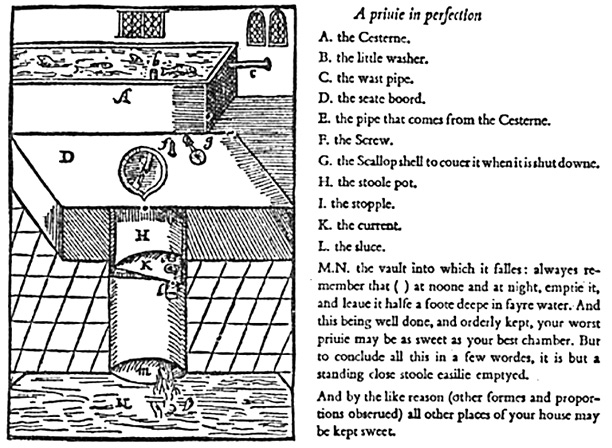
Historical note: Harington was a courtier to Elizabeth I, and one of his claims to fame is that he designed Britain’s first flushable toilet, which he installed in his manor house in Somerset. He included an image in a work he wrote on the subject.

Check out our books about the English language

Categories
English English language Etymology Grammar Linguistics Usage Word origin

Invasion of the brainworms

Q: During the college football bowls, an advertiser proclaimed that “by the end of this game, you or your company can have its own [x].” That sentence is now a worm in my brain. Should “its” have been “your”? Help!

A: When a compound subject is joined by “or” or “nor,” the verb agrees with the part that’s closer (“Cookies or cake is fine” … “Cake or cookies are fine”).

The same is true of any accompanying possessive pronoun (“Cookies or cake has its uses” … “Cake or cookies have their uses”). Take your cue from the part of the subject that’s nearer the verb.

But correct or not, this rule of subject-verb agreement can lead to extremely awkward sentences.

If the problem is that one part of the subject is singular and the other plural (as in the examples above), it often pays to put the plural part last: “Cake or cookies have their uses.”

This solution won’t give anybody a brainworm, because despite the “or” there’s a notion of plurality in that kind of sentence.

To use another example, it may be correct to write, “Neither they nor she has paid her tab.” But it sounds better to turn the subject around: “Neither she nor they have paid their tab.”

The problem isn’t as easy to fix when a compound consists of a “you” and an “it.” Technically, that advertiser was correct: “By the end of this game, you or your company can have its own [x].” But ouch!

And turning the subject around doesn’t help: “your company or you can have your own [x].” Ouch again!

Any sentence that leaves a worm in your brain should be recast, even if it’s written by the rules. There’s always a better way.

For example, the advertiser could have said, “ By the end of this game, you or your company can have an all new, one-of-a kind [x].”

Speaking of brainworms, you don’t hear the usage much nowadays, except in zoology, where the term “brainworm” refers to a parasitic roundworm that infects the brains of deer, moose, and other large hoofed animals.

However, the term has been used figuratively since the early 1600s to describe an imaginative worm infecting the brain, according to citations in the Oxford English Dictionary.

Here’s an example from Antiquity Revived, a 1693 religious tract: “Which undutiful and turbulent Allegation has not seldom created such a restless Brain-worm in the noddles of the multitude.”

The latest OED citation for the figurative use is from Musicophilia: Tales of Music and the Brain, a 2007 book in which Oliver Sacks discusses the earworms set off by movie, TV, and advertising music:

“This is not coincidental, for such music is designed, in the terms of the music industry, to ‘hook’ the listener, to be ‘catchy’ or ‘sticky,’ to bore its way, like an earwig, into the ear or mind; hence the term ‘earworms’—though one might be inclined to call them ‘brainworms’ instead.”

We hope this helps you get rid of that brainworm of yours.

Check out our books about the English language

Categories
English English language Etymology Grammar Linguistics Spelling Usage Word origin

Why “won’t” isn’t “willn’t”

Q: I was having a conversation with one of my co-workers about “won’t” and grabbed my office copy of Woe Is I to resolve the issue, only to find (or fail to find) that the use of this word is not explained in the book. Can you render an opinion as to its acceptability?

A: “Won’t” is a perfectly acceptable contraction of “will” and “not.” However, it’s an odd bird that’s been condemned at times for not looking quite like other contractions.

Merriam-Webster’s Dictionary of English Usage describes it as “one of the most irregular looking of the negative contractions that came into popular use during the 17th century.” Others include “don’t,” “han’t,” “shan’t,” and “an’t” (an early form of “ain’t”).

Why, you may ask, do we contract “will” and “not” as “won’t” instead of “willn’t”? Here’s Merriam-Webster’s explanation:

Won’t was shortened from early wonnot, which in turn was formed from woll (or wol), a variant form of will, and not.”

The M-W editors give early examples of “won’t” from several Restoration comedies, beginning with Thomas Shadwell’s The Sullen Lovers (1668): “No, no, that won’t do.” 

By the way, the verb “will” has been spelled all sorts of ways since first showing up as wyllan around 1,000 in Aelfric’s Grammar, an Old English introduction to Latin grammar.

The Oxford English Dictionary has many Middle English examples of the wole or wol spelling dating back to the 1200s.

So etymologically, there’s a case to be made for contracting “will” and “not” as “won’t.” Nevertheless, some language commentators have grumbled about the usage.

Joseph Addison, for example, complained in a 1711 issue of the Spectator that “won’t” and other contractions had “untuned our language, and clogged it with consonants.”

“Won’t,” in particular, “seems to have been under something of a cloud, as far as the right-thinkers were concerned, for more than a century afterward,” Merriam-Webster’s says.

“This did not, of course, interfere with its employment,” the usage guide adds.

It was popular enough, M-W says, “to enjoy the distinction of being damned in the same breadth as ain’t in an address delivered before Newburyport (Mass.) Female High School in December 1846.”

Both “won’t” and “ain’t” were condemned by the Newburyport speaker as “absolutely vulgar.”

“How won’t eventually escaped the odium that still clings to ain’t is a mystery,” M-W Usage says, “but today it is entirely acceptable.”

Of course a few sticklers still feel that all contractions aren’t quite quite. Well, we beg to differ. As we’ve written on the blog, contractions are impeccably good English.

Check out our books about the English language

Categories
English English language Etymology Expression Linguistics Phrase origin Usage Word origin

Zero-sum games

Q: I see references to both “zero-sum games” and “zero-sum gains” on the Internet. Which is correct?

A: The term “zero sum” is widely misunderstood as meaning that nobody wins—or perhaps that nobody loses. In fact it means quite the opposite.

In any competitive situation, one side can’t win unless the other loses. “Zero-sum” means that when the losses are subtracted from the gains, the sum is zero.

The adjective “zero-sum” originated in the field of game theory in the mid-1940s, and it’s still commonly used to modify the word “game.” But “zero-sum” is also used to modify all kinds of nouns and to describe a wide variety of situations.

It would be inappropriate, however, to use it in the phrase “zero-sum gain.” That’s because “zero-sum” implies an equal balance between gain and loss.

We suspect that people are simply misunderstanding the phrase and hearing “gain” instead of “game.”

You’re right, though, that there’s a lot of zero-sum gaining on the Web. We got nearly 200,000 hits when we googled “zero-sum gain.” But we had nearly ten times as many hits for “zero-sum game.”

In game theory, as the Oxford English Dictionary explains, the adjective “zero-sum” is “applied to a game in which the sum of the winnings of all the players is always zero.”

In other words, the losses offset the gains, and the sum of losses and gains is zero.

But “zero-sum” is also used, the OED explains, to denote “any situation in which advantage to one participant necessarily leads to disadvantage to one or more of the others.”

So, for example, in “zero-sum diplomacy,” both sides can’t be winners.

The adjective was first used, according to OED citations, in John Von Neumann and Oskar Morgenstern’s book Theory of Games and Economic Behavior (1944):

“An important viewpoint in classifying games is this: Is the sum of all payments received by all players (at the end of the game) always zero; or is this not the case? … We shall call games of the first mentioned type zero-sum games.”

Here are a few more of the quotations cited in the OED:

“Perhaps the contestants in most important games nowadays (from labour disputes … to international diplomacy) too readily regard their games as zero-sum.” (From Stafford Beer’s book Decision and Control, 1966.)

“Everybody can win. Manufacturing is not a zero-sum game.” (A quote by L. B. Archer, from Gordon Wills and Ronald Yearsley’s Handbook of Management Technology, 1967.)

“C. Wright Mills … used a zero-sum conception of power (i.e., the more one person had the less was available to others).” (From the Times Literary Supplement, 1971.)

“We live in a zero-sum world.” (From the former BBC magazine The Listener, 1983.)

Check out our books about the English language

Categories
English English language Etymology Linguistics Usage Word origin

A noun for being upside down

Q: Why is there no word that describes the state of being upside down?

A: There’s a hyphenated word that may be what you’re looking for. It’s a noun, “upside-downism” (what else?), and the Oxford English Dictionary has exactly one citation for its use.

The word appeared in a book called The Oxonian in Iceland (1861), a travel book by Frederick Metcalfe about a trip taken in the summer of 1860.

We’ll expand the OED citation to provide some context. Here’s Metcalfe, describing a horseback ride through a volcanic region known as a “hraun” (Icelandic for “lava”):

“It was a ruin indeed, the abomination of desolation; as if the elements of some earlier world had melted with fervent heat; and as they cooled had burst asunder and been hurled by the Demons of Misrule and Upside-downism into a disjointed maze of confusion worse confounded.”

(Makes the eruption sound like a moral failing on the part of the volcano, doesn’t it?)

The OED doesn’t define “upside-downism,” but it describes it as a derivative of “upside down,” which has had an appropriately topsy-turvy history since it entered English in the 1300s.

For many centuries, “upside down” was exclusively an adverb (as in “turned upside down”). The adjective, usually hyphenated (as in “upside-down cake”), came along in the
mid-19th century.

When originally recorded, the Middle English adverb was up so doun (or up swa doun in northern dialects), and it apparently meant something like “up as if down.”

It first appeared in writing around 1340 in a Northumbrian religious poem, The Pricke of Conscience, which the OED attributes to the Oxford-educated mystic and hermit Richard Rolle:

“Tharfor it es ryght and resoune, / That they be turned up-swa-doune.” (We’ve converted the letter thorn to “th” throughout.)

The term appeared in another 14th-century poem, a verse rendition of The Seven Sages of Rome, an ancient Eastern collection of tales found in many languages and probably about 2,500 years old.

Here’s the couplet: “The cradel and the child thai found / Up so doun upon the ground.”

As the OED says, “The use of so is peculiar, the only appropriate sense being that of ‘as if.’ ”

At any rate, the “so” eventually disappeared. The OED explains that the compound was “frequently reduced to upsa-, upse-, and subsequently altered to upset and upside down, in the endeavour to make the phrase more intelligible.”

During the 15th and 16th centuries there were many versions of the term, including “opsadoun,” “upsedoun,” “up set doune,” “upset downe,” “upsydowne,” “vpsyde downe,” and others.

By the early 17th century, the modern spelling “upside down” had become established.

You didn’t ask, but the playful interjection “upsy-daisy,” which we’ve written about on our blog, is no relation—apart from the presence of “up.”

Check out our books about the English language

Categories
English English language Etymology Grammar Linguistics Usage Word origin

“Like” minded

Q: During the apocalyptic talk about the Mayan calendar, I wrote, “Planet Earth will not blow up like Krypton or be smashed by Planet X.” Is “like” OK here? (Krypton, the home planet of Superman, blew up just after little Kal-el left.)

A: The passage you wrote is fine as it is. In the sentence “Planet Earth will not blow up like Krypton or be smashed by Planet X,” the words “like” and “by” are prepositions. The underlined parts, “like Krypton” and “by Planet X,” are prepositional phrases.

This represents the traditionally correct use of “like”—as a preposition. The problem you’re thinking of is the use of “like” as a conjunction, a usage many sticklers frown on.

“Like” is used as a conjunction when it introduces a clause, as in “like Krypton did.” (A clause, you probably know, contains a verb and its subject.) A stickler would insist on “as” instead: “as Krypton did” (or “as did Krypton”).

However, the English in your original example is impeccable, even if you regard the verb “did” as implied but not expressed.

But what if you had included the verb (“like Krypton did”)? Here we part company with the sticklers, because even then we’d give you a passing grade.

You’re not writing elevated, formal prose. And as we’ve said before on our blog, the use of “like” as a conjunction is no crime in less than formal writing.

In fact, it represents a return to the past, before the 19th-century prohibition against the conjunctive “like” came along. And you don’t have to take our word for it.

Here’s what Merriam-Webster’s Collegiate Dictionary (11th ed.) has to say in a usage note:

“Like has been used as a conjunction since the 14th century. In the 14th, 15th, and 16th centuries it was used in serious literature, but not often; in the 17th and 18th centuries it grew more frequent but less literary. It became markedly more frequent in literary use again in the 19th century.”

It wasn’t until the mid-19th century, according to Merriam-Webster’s, that the usage came under fire. The dictionary’s conclusion:

“There is no doubt that, after 600 years of use, conjunctive like is firmly established. It has been used by many prestigious literary figures of the past, though perhaps not in their most elevated works; in modern use it may be found in literature, journalism, and scholarly writing. While the present objection to it is perhaps more heated than rational, someone writing in a formal prose style may well prefer to use as, as if, such as, or an entirely different construction instead.”

By the way, you might like to see a posting of ours about the use of “like” for “such as.” (Yes, it’s OK.)

And if you’re still “like”-minded, you might look at an article that Pat wrote for the New York Times Magazine about the use of “like” to quote or paraphrase people, as in “She’s like, what unusual taste you have.”

Check out our books about the English language

Categories
English English language Punctuation Usage

Elliptical reasoning

Q: I’m a court reporter working in Baton Rouge. When someone ends a sentence with “so,” we have differing thoughts here amongst the 20 plus of us. Example: “Question, Why did you buy the drugs? Answer, I had the money, so.” Some here end the answer with “money … so.” What are your thoughts.

A: In the sense you’re talking about, “so” is a conjunction meaning “therefore” or “consequently” or “with the result that.”

A sentence ending with this kind of “so” is incomplete. The speaker is indicating that a fuller reply is possible but isn’t being offered. So the sentence is deliberately incomplete—that is, the speaker wasn’t cut off mid-sentence.

Such a deliberate omission, according to the ordinary rules of English punctuation, should be indicated with ellipsis points at the end.

The Chicago Manual of Style (16th ed.), under section 13.53 (Deliberately incomplete sentence), says, “Three dots are used at the end of a quoted sentence that is deliberately left grammatically incomplete.”

So your sentence would be transcribed this way: “I had the money, so …” Note the space between “so” and the first ellipsis point. No period follows (three dots, not four).

You definitely should not use ellipsis points BEFORE the “so.” If any are used at all, they should FOLLOW the “so.”

But if ellipsis points would lead to any ambiguity, don’t use them.

We wouldn’t use them, for example, if there’s any chance that they could be interpreted as meaning that something unintelligible followed or that the speaker was interrupted.

We weren’t familiar with the punctuation conventions of court reporting, but we took a crash course by visiting the website of Margie Wakeman Wells, author of Court Reporting: Bad Grammar/Good Punctuation.

Wells says the use of ellipses to mark a trailing off has been gaining favor among court reporters. She says the use of a dash should be avoided, even with a space before the dash and a period after it.

A dash would be misleading, in our opinion: “I had the money, so—” It would indicate that the speaker was cut off.

If any misinterpretation is possible, we’d throw the rules to the wind and use a simple period: “I had the money, so.”

Your principal aim is not to follow the conventions of ordinary English punctuation, but to accurately convey the sense of what a witness said. And a simple period would do that.

In short, ellipsis points would be our choice—but ONLY if you’re sure that ellipses couldn’t be interpreted as signaling that the speaker was cut off or unintelligible.

Check out our books about the English language

Categories
English English language Etymology Grammar Phrase origin Usage

“Each other” vs. “one another”

Q: Some good writers use “each other” and “one another” interchangeably, while others use them in distinctly different ways. What are your thoughts?

A: These terms are interchangeable, despite a common belief that “each other” is properly used in reference to two people or things, and “one another” for more than two. In fact, we’re revising our own thinking on this one.

In a 2006 posting, we said it was OK to use “one another” in either case. But we didn’t go far enough. We said most usage experts would object to using “each other” for three or more, though we acknowledged that the distinction was being relaxed,

Seven years later, our opinion has changed. The old distinction isn’t worth preserving—even for “each other”—and it wasn’t valid in the first place.

Merriam-Webster’s Dictionary of Modern English Usage explains that “the prescriptive rule that each other is to be restricted to two and one another to more than two” can be traced to a 1785 grammar book written by George N. Ussher. But it notes that there’s no foundation for such a rule.

Evidence in the Oxford English Dictionary shows “that the restriction has never existed in practice,” the M-W editors write, adding:

“The interchangeability of each other and one another had been established centuries before Ussher or somebody even earlier thought up the rule.”

The usage guide concludes that the restriction is a mere invention (or, as M-W puts it, “was cut out of the whole cloth”) and “there is no sin in its violation.”

The OED’s entries for the expressions confirm this. The dictionary says “each other” means the same thing as “one another.” And it defines “one another” as a “compound reciprocal pronoun” referring to “two or more.”

R. W. Burchfield, the author of Fowler’s Modern English Usage (rev. 3rd ed.), agrees that the traditional restriction isn’t valid:

“The belief is untenable,” Burchfield writes. He goes on to quote many respected writers who use “one another” for two and “each other” for three or more.

Standard dictionaries also recognize the terms as interchangeable.

The American Heritage Dictionary of the English Language (5th ed.) says the distinction between the two “is often ignored without causing confusion and should be regarded more as a stylistic preference than a norm of Standard English.”

Webster’s Third New International Dictionary, Unabridged, says “each other” means “each of two or more in reciprocal action or relation.” And “one another,” the dictionary says, means “each other.”

In short, this is an issue of style rather than correctness. There’s no harm in following that “traditional” rule if you like, but there’s no harm in ignoring it either.

Check out our books about the English language

Categories
English English language Etymology Linguistics Usage Word origin

Lex appeal: Does size matter?

Q: How many words do most native English speakers know? Do Brits know more than Americans? How many do language mavens know? How about Shakespeare, Samuel Johnson, etc.? And what about age or educational level?

A: We’re afraid this will disappoint you. Many of your questions are impossible to answer. And even if we could contrive numbers for you, they wouldn’t be very meaningful.

We had a post on our blog a few years ago about the difficulty of counting words and comparing the lexicons of different languages.

The linguists Robert P. Stockwell and Donka Minkova, who discuss this in their book English Words: History and Structure (2001), write:

“A question which everyone wonders about, and often asks of instructors, is ‘How many words does English have?’ And even more commonly, ‘How many words does the typical educated person know, approximately?’ There are no verifiable answers to these questions.”

They do say that Shakespeare is known to have used about 30,000 different words in his plays, and that “a really well-educated adult” may have a vocabulary of up to 100,000 words—“but this is a wildly unverifiable estimate.”

As for the size of the lexicon, they conclude: “Nobody knows how many words English has.”

The linguist David Crystal said more or less the same thing in a 1987 article in the journal English Today:

 “How many words are there in English? And how many of these words does a native speaker know? These apparently simple little questions turn out to be surprisingly complicated. In answer to the first, estimates have been given ranging from half a million to over 2 million. In answer to the second, the estimates have been as low as 10,000 and over ten times that number.”

We can tell you that the biggest English dictionaries have about half a million words, but that’s no help because dictionaries are selective.

The editors at Oxford Dictionaries Online and Merriam-Webster’s Online discuss the difficulties of counting the number of words in English.

The principal problem in coming up with a number is which words to count. Are “do” and “does” two separate words? How about “doing,” “doer,” “don’t,” and “undo”? What about “cat” and “cats,” not to mention “catlike,” “catty,” and “anti-cat”?

That 30,000-word estimate for Shakespeare, as Stockwell and Minkova say, would drop to “about 21,000 if you count play, plays, playing, played as a single word,” and do the same in similar cases.

Do features like prefixes (“anti-,” “re-,” “un-,” etc.) and suffixes (“-ly,” “-er,” “-ing”) swell the number of possible words we count? Is a word with two meanings (say, “cleave”) counted as one word or two? Should we count symbols, acronyms, initialisms, spelled-out numbers? The questions go on and on.

We’ve also found varying statements about the number of words the average person knows or uses.

In their book Theory of Language (1999), the linguists Steven Weisler and Slavoljub P. Milekic estimate that “an average-educated English-speaking adult knows more than 50,000 words.”

But they say a person’s “lexical capacity” is larger. As current events and new technology create the need for new language, the authors write, “English-speakers are free to make up new words and to create new uses of existing words at the spur of the moment.”

You ask about age and educational level and how they affect vocabulary. Here’s what the British language writer Michael Quinion says on his website World Wide Words:

“It’s common to see figures for vocabulary quoted such as 10,000-12,000 words for a 16-year-old, and 20,000-25,000 for a college graduate. These seem not to have much research to back them up.”

So much for vocabulary size. But how many of those tens of thousands of words do we actually use? According to the Collins Corpus, an analytical database of English, “around 90% of English speech and writing is made up of approximately 3,500 words.”

That doesn’t sound like a lot, but let’s call it a day. We’ve run out of our daily quota of words.

Check out our books about the English language

Categories
English English language Etymology Politics Usage Word origin

Gramm-ology: “Sequester”

Q: My friend and I are having difficulty figuring out how the government selected the word “sequester” for the current fiscal crisis. Any ideas on this?

A: Let’s begin with a little history.

When the verb “sequester” showed up in English in the late 14th century, it meant to set aside or separate, and it still has that meaning.

The word, which first appeared in the Wycliffe Bible, was adapted from the Late Latin term sequestrare (to place in safekeeping), according to the Chambers Dictionary of Etymology.

The noun “sequester” also showed up in the late 14th century and the noun “sequestration” followed in the mid-15th century.

Over the years, the verb (as well as the nouns) has taken on many different senses related to setting aside or separating: to excommunicate or isolate someone, to confiscate something, to seize the possessions of a debtor, to set apart property in dispute, to isolate a jury, and so on.

In the sense you’re asking about, the term refers to budget sequestration, a process for controlling the size of the federal budget by setting spending limits and enforcing them with automatic cuts.

The term “budget sequestration” was first used in the Gramm-Rudman-Hollings Deficit Reduction Act of 1985. Senators Phil Gramm, Warren Rudman, and Ernest Hollings were the main sponsors.

The measure provided for “sequesters” (automatic spending cuts) if the federal deficit exceeded targets.

The term was later used in the Budget Control Act of 2011 and in the Sequestration Transparency Act of 2012.

How, you ask, did the word “sequester” come to be used in this sense?

Tracey Samuelson, a reporter on public radio, quotes former Senator Gramm, one of the sponsors of the 1985 legislation, as saying, “To me, sequester conjured up taking something off the table, withholding something.”

Gramm, a Texas Republican, said Congress had also considered the word “impoundment” before settling on “sequester,” according to Samuelson’s American Public Media report.

“It’s always helpful if when you invent a term, if it already conjures up what you’re trying to say,” he said, adding, “If a sequester is what you got to do to get people’s attention, I would do it.”

So, did Gramm coin the usage? Not exactly, according to Samuelson’s report. Gramm said the former House majority leader Jim Wright, a Texas Democrat, had suggested this use of the term “sequester” to him.  

Check out our books about the English language

Categories
English English language Etymology Expression Phrase origin Usage Word origin

An arm and a leg

Q: I just caught up with your Thanksgiving post on the names for turkey parts. How about something on the names for people parts? I was recently surprised to learn that the meanings of “arm” and “leg” in anatomy differ from common usage.

A: This was news to us too, but then we skipped anatomy class. You’re right, though. “Arm” and “leg” have special meanings in medicine.

In standard anatomical terminology, the word “arm” means what most of us think of as the upper arm—the part between the shoulder and the elbow.

And the word “leg” in anatomy means what most of us think of as the lower leg—between the knee and the ankle.

The limbs as a whole are called the “upper limb” and the “lower limb.”

We quizzed our own doctor about this as she was giving us our annual physicals the other day. She said physicians call the upper arm the “arm” or the “brachium”; the part below the elbow is the “forearm” or the “antebrachium.”

Why? Because a doctor is generally concerned with one part of a limb, not the limb as a whole. And the parts are distinct—different bones, different muscles, and so on.

Hence, different terminology. The words “arm” and “leg” as used in the general sense would be too broad for medical purposes.

Kenneth Saladin’s book Human Anatomy (2007) has this explanation:

“The upper limb is divided into brachium (arm proper), antebrachium (forearm), carpus (wrist), manus (hand), and digits (fingers); the lower limb is divided into thigh, crus (leg proper), tarsus (ankle), pes (foot), and digits (toes).”

Elsewhere, Saladin explains that the term “arm proper” means the upper arm, which “extends from shoulder to elbow,” while the “leg proper” is “below the knee.”

Another medical textbook, Grant’s Dissector (2012), by Patrick W. Tank, says, “The upper limb is divided into four regions: shoulder, arm (brachium), forearm (antebrachium), and hand (manus).”

Earlier, Tank writes: “The lower limb is divided into four parts: hip, thigh, leg, and foot. It is worth noting that the term leg refers only to the portion of the lower limb between the knee and the ankle, not to the entire lower limb.”

Tank is right—this IS worth noting, since in ordinary language the words “arm” and “leg” are interpreted less narrowly.

The Oxford English Dictionary defines “arm” (the body part, that is) only in the usual sense: “The upper limb of the human body, from the shoulder to the hand.”

There’s no mention in the OED of a medical definition of “arm” that would differ from that one.

Oxford adds that “the part from the elbow to the hand” is known as “the fore-arm.” Elsewhere, it defines the “forearm” as “the part of the arm between the elbow and the wrist; sometimes the whole arm below the elbow.”

On the other hand (if that’s the appropriate expression), the OED’s definition of a person’s “leg” includes the ordinary sense of the word as well as a more restrictive sense.

Here’s the definition: “one of the two lower limbs of the human body; in narrower sense, the part of the limb between the knee and foot.”

It’s interesting to note that while people have “forearms,” they don’t have “forelegs,” a term used only of animals. The OED says a “foreleg” is “one of the front legs of a quadruped.”

We can’t end this without mentioning “an arm and a leg,” which Oxford describes as a colloquial expression meaning “an enormous amount of money, an exorbitant price; freq. in to cost an arm and a leg.”

The OED’s first citation is from Lady Sings the Blues, the 1956 autobiography of one of our favorite singers, Billie Holliday, written with William Dufty: “Finally she found someone who sold her some stuff for an arm and a leg.”

Check out our books about the English language

Categories
English English language Etymology Grammar Linguistics Usage

“By” lines

Q: The Hunter College Reading/Writing Center has this example of a preposition used to show manner: By doing it yourself, you save time. I’m confused. Can you explain what “by doing it yourself” is doing there?

A: “By” and other prepositions are often used with “-ing” words to form phrases that are in effect adverbial—they tell how or in what manner.

In the sentence “He supports himself by teaching,” for example, the phrase “by teaching” tells how or in what manner he supports himself.

And in the sentence “By frowning, he showed his impatience,” the phrase “by frowning” tells how or in what manner he showed his impatience.

Your sentence—“By doing it yourself, you save time”—is a similar example. How do you save time? By doing it yourself.

Those prepositional phrases (“by teaching,” “by frowning,” “by doing it yourself”) are all adverbial because they serve to modify verbs (“supports,” “showed,” “save”).

The Oxford English Dictionary says this use of “by” is especially common in the phrases “begin by” and “end by,” followed by a gerund. (A gerund is a verb form that ends in “-ing” and acts as a noun, so it’s frequently the object of a preposition.)

We found a good illustration in Dorothy Dymond’s An Introduction to Medieval History (1929):

“The barbarians began by imitating the Roman Empire, and they ended by making a group of nations. They began by accepting Christianity, and they ended by making the medieval papacy.”

When a gerund is the object of a preposition (“by teaching,” “upon waking,” “after going,” “in creating,” “without looking,” and so on), the resulting prepositional phrase has an adverbial function because it tells how or in what manner.

This might be a good place to mention that not all verb forms ending in “-ing” are gerunds. Some are participles.

The traditional wisdom is that a gerund acts like a noun. So it can be the subject or object of a verb (“fishing is his passion” … “he loves fishing”), or the object of a preposition (“after fishing he cleans his catch”).

And traditionally, an “-ing” participle is used in a progressive tense (“he is fishing”), as an adjective (“he’s a fishing fool”), after conjunctions (“while fishing, he whistles”), and in some subordinate phrases (“fishing in the lake, he caught cold”).

But today many grammarians don’t make those distinctions in terminology with “-ing” words.

As we’ve written before on our blog, Geoffrey Pullum and Rodney Huddleston, authors of The Cambridge Grammar of the English Language, prefer the term “gerund-participle.”

Check out our books about the English language

Categories
English English language Etymology Grammar Linguistics Usage Word origin

Is “to” part of the infinitive?

Q: In your recent article for Smithsonian magazine, you defend the split infinitive by saying “to” isn’t actually part of the infinitive. Huh? Says who? Not any standard – or even nonstandard – grammar book or authority I’ve ever seen, heard of, or read. Here’s the standard definition of an infinitive, from Warriner’s English Grammar and Composition: “An infinitive is a verbal consisting of to followed by the verb.”

A: Sorry, but you’ve been misled, and the late John Warriner, a teacher and textbook author, was misinformed, as we’ll explain. His is absolutely NOT the “standard” definition of an infinitive.

The infinitive is the uninflected or basic form of a verb, and “to” is not part of it. When “to” appears with an infinitive, it is generally referred to as an “infinitive marker” or “infinitive particle”; it is not part of the verb and is not always used.

“To” is not there, for example, when the infinitive is used with modal verbs (sometimes called modal auxiliaries or secondary auxiliaries). The modal verbs are “can,” “could,” “may,” “might,” “shall,” “should,” “will,” “would,” and “must.”

Examples, “I must go,” “he should read,” “they can eat,” and so on. In modal constructions, infinitives (”go,” “read,” and “eat” in the examples) do not require “to.”

You don’t have to take our word for this. We can cite a great many authorities. Here are only a few.

(1) Fowler’s Modern English Usage (rev. 3rd ed.), edited by the language scholar and lexicographer R. W. Burchfield, likewise describes two uses of the infinitive: (a) “the to-infinitive,” in which “to” is described as a “particle,” and (b) “the bare or simple or plain infinitive.”

The bare infinitive, Fowler’s says, “is often optionally used after the verbs dare, help, and need.” (Examples of infinitives used this way would be, “Does he dare go?” “We helped them move,” “You need not come.” Here, “go,” “move,” and “come” are infinitives.)

Fowler’s adds: “But its use after modal verbs (can, may, must, shall, etc.) and after comparatives and superlatives (better, had better, best, had best, rather than, etc.) is much more significant.” (For example, in constructions like “we had better eat,” and “rather than eat later,” the verb “eat” is an infinitive.)

Fowler’s also mentions these other common uses of the bare infinitive:

(a) At the head of a clause, as in “Try as I might, I couldn’t … etc.” Here, “try” is an infinitive.

(b) After “let” plus its object, as in “Let him enjoy his ignorance.” Here, “enjoy” is an infinitive.

(c) After “is” and “was,” as in “All they want to do is hide in the kitchen.” Here, “hide” is an infinitive.

(d) After “why” and “why not,” as in “Why not ask Robert?” Here, “ask” is an infinitive.

Some other sources:

(2) The Cambridge Grammar of the English Language says the infinitive (as well as the imperative and the subjunctive) “consists simply of the lexical base, the plain base without any suffix or other modification.” (Examples of imperative and subjunctive forms of “run,” respectively would be: “Run as fast as you can!” and “I suggest you run.”)

The Cambridge Grammar, written by the linguists Geoffrey Pullum and Rodney Huddleston, goes on to explain that the marker “to” is “not part of the verb.”

 “The traditional practice for citation of verbs is to cite them with the infinitival marker to, as in ‘to be,’ ‘to take,’ and so on,” Cambridge continues. “That is an unsatisfactory convention, because the to is not part of the verb itself.”

The word “to” here “is not a (morphological) prefix but a quite separate (syntactic) word,” Pullum and Huddleston say, adding:

“This is evident from the fact that it can stand alone in elliptical constructions (as in I haven’t read it yet, but I hope to shortly), need not be repeated in coordination (as seen in I want to go out and get some exercise), and can be separated from the verb by an adverb, as seen in the so-called ‘split infinitive construction,’ I’m trying to gradually improve my game.”

(3) The Oxford English Grammar, written by the linguist Sidney Greenbaum, says the infinitive “has two major uses: (a) bare infinitive (without to) follows a modal auxiliary, [as in] ‘I must write that message’; (b) to-infinitive is the main verb in infinitive clauses [as in] ‘I’d like to write something on process theology.’ ”

Even dictionaries don’t use Warriner’s definition. Witness:

(4) The American Heritage Dictionary of the English Language (5th ed.), definition of “infinitive”: “A verb form that functions as a substantive while retaining certain verbal characteristics, such as modification by adverbs, and that in English may be preceded by to, as in To go willingly is to show strength or We want him to work harder, or may also occur without to, as in She had them read the letter or We may finish today.

(5) Merriam-Webster’s International, Unabridged Third Edition, definition of “infinitive”: “an infinite verb form normally identical in English with the first person singular that performs certain functions of a noun and at the same time displays certain characteristics (as association with objects and adverbial modifiers) of a verb and is used with to (as in ‘to err is human’; ‘I asked him to go’) except with auxiliary and certain other verbs (as in ‘he can see’; ‘let me go’; ‘no one saw him leave’).

(6 ) The Oxford English Dictionary has an extensive discussion of the historical development of “to” with the infinitive in Old and Middle English. Later it has this: “The simple infinitive, without to, remains: 1. after the auxiliaries of tense, mood, periphrasis, shall, will; may, can; do; and the quasi-auxiliaries, must, (and sometimes) need, dare: 2. after some vbs. of causing, etc.; make, bid, let, have, in sense B. 15a; 3. after some vbs. of perception, see, hear, feel, and some tenses of know, observe, notice, perceive, etc., in sense B. 15b; 4. after had liefer, rather, better, sooner, as lief, as soon, as good, as well, etc.: see have v. 21, rather adv. 8d, and the other words.

“The infinitive with to may be dependent on an adj., a n., or a vb., or it may stand independently. To an adj. it stands in adverbial relation: ready to fight = ready for fighting; to a n. it stands in adjectival or sometimes adverbial relation: a day to remember = a memorable day; to a vb. it may stand in an adverbial or substantival relation: to proceed to work = to proceed to working; to like to work = to like working.”

When this preposition was first used in English as an infinitive marker ( in Old English), it did have a prepositional flavor. “I prepared to eat” sounded to the medieval ear something like “I prepared for eating”; “he fails to think” sounded something like “he fails in thinking”; “we strive to please” sounded something like “we strive toward pleasing.” As the OED says, “it expressed motion, direction, inclination, purpose, etc., toward the act or condition expressed by the infinitive; as in ‘he came to help (i.e. to the help of) his friends,’ … ‘he prepared to depart (i.e. for departure).’ ”

There once was a sense of motion, of moving toward accomplishing something (represented by the infinitive), if that makes any sense.

But as the OED says: “in process of time this obvious sense of the prep. became weakened and generalized, so that became at last the ordinary link expressing any prepositional relation in which an infinitive stands to a preceding verb, adjective, or substantive.” [Here the italicized represents the Old English word.]

As we’ve written on our blog, a great many people misunderstand infinitives because they aren’t familiar with their many uses.

In that post, we cite the clause “I saw her fall,” with the verb “fall” in the infinitive. In English, this is a very common pattern: one verb followed by a second in the infinitive. It’s often the case when the first verb is one involving sensory perception (“see,” “feel,” “hear”).

Here are a few examples of the kinds of verbs that are often paired with infinitives (the infinitives are underlined):

“I helped her walk” … “They saw us go” … “We felt it move” … “He heard her cry” … “You need not worry” … “Dare we ask?” … “I would rather die” … “We will let it rest” … “Let there be light.”

In addition, the auxiliary “do” is often used with an infinitive to form a question: “Do you smoke?” … “Did they drive?”

And as we’ve said, the modal auxiliary verbs (“can,” “may,” “must,” etc.) take infinitives as their complements: “She may smoke” [or “May she smoke?”] … “We must leave” [or “Must we leave?”].

In all of these cases, the second verb is in the infinitive. But many people don’t recognize these verb forms as infinitives because they expect infinitives to be preceded by “to.” As you can see, that’s often not the case.

Help support the Grammarphobia Blog with your donation. And check out our books about the English language and more.

Subscribe to the blog by email

Enter your email address to subscribe to the blog by email. If you’re a subscriber and not getting posts, please subscribe again.

Categories
English English language Etymology Linguistics Usage Word origin

Meteoric language

Q: I’m putting together a planetarium exhibition on meteorites. My background documents often say pieces of a meteorite were “recovered” after falling to earth. Can we “recover” something we never had? I’d appreciate your help.

A: We checked all the many meanings of “recover” in the Oxford English Dictionary, and when used in reference to physical objects, it generally means to regain or reacquire something lost.

An old meaning of the verb “cover,” now obsolete, was to get or acquire. And the original, 14th-century meaning of “recover” (literally, “cover again”) was to win back ground lost in battle.

But etymology aside, astronomers and geologists use the word in a different sense. They quite routinely use “recover,” “recovered,” and “recovery” in writing about meteorite fragments found on earth, even though nobody had physical possession of them beforehand.

Though this use of “recover” might seem questionable, at least in the strictly literal sense of the word, we think it’s perfectly reasonable in a scientific context, like an exhibition at a planetarium.

As it happens, the OED does recognize “recover” as a technical term in astronomy. But it has a more celestial meaning than the earthbound one we’re talking about. It refers only to the observation of objects in space.

The OED defines this “recover” as meaning “to observe (an astronomical object, esp. a periodic comet) following an extended period during which it has not been visible or observed.”

The OED’s first citation for this sense of the word is from a 1901 issue of a scientific journal, Monthly Notices of the Royal Astronomical Society: “Professor Howe … recovered the comet on May 27, after its perihelion passage.”

This more recent citation is from a 2006 issue of the Guardian: “The dim comet was lost again until … it was recovered tracing a 5.4 year orbit about the Sun.”

But we think you’re safe using “recover” in reference to meteorites that have fallen to earth. Though the OED hasn’t yet recorded this sense of the word, scientists routinely use it that way, which is a pretty good argument in its favor.

For example, we found this example in a 1977 issue of the British magazine New Scientist:

“Analysis of the photographs suggested the fall of several kilogrammes of meteorites at a point some 150 km east of Edmonton. … A 2.1-kg freshly fallen meteorite was recovered only 500 metres from the predicted impact point.”

Scientists use “recover” even when the meteorites weren’t seen falling beforehand. That’s the case in this passage from Paul W. Hodge’s book Meteorite Craters and Impact Structures of the Earth (1994):

“The Haviland crater itself was not discovered until about 1925, when H. H. Nininger visited the Kimberley farm to recover the meteorites.”

Finally, Robert T. Dodd’s book Meteorites: A Petrologic-chemical Synthesis (1981) has this note about the naming of meteorites:

“A newly fallen or newly discovered meteorite is named for a locality or permanent geographic feature that is near its point of recovery. … The many meteorites recovered from Antarctica raise a serious problem of terminology.”

Check out our books about the English language

Categories
English English language Etymology Expression Grammar Phrase origin Usage

The singularity of “as follows”

Q: I’ve been having a debate with my wife about the phrase “as follows.” I think the verb should be singular (follows) or plural (follow), depending on the context. My wife thinks it’s always singular. Can you please provide some insight?

A: Your wife is right. The construction is always singular: “My position is as follows” … “The three points are as follows” …  “Her favorite books were as follows,” and so on.

The Oxford English Dictionary describes the phrase “as follows” as “a prefatory formula used to introduce a statement, enumeration, or the like.”

In this formula, the OED says, the verb is impersonal and should always be used in the singular—“follows.” Use of the plural verb “follow,” Oxford adds, is “incorrect.”

Merriam-Webster’s Dictionary of English Usage concurs, saying “All experts agree” that “as follows regularly has the singular form of the verb—follows—even if preceded by a plural.”

The OED’s earliest examples of the phrase in writing are in the singular: “als her fast folowys” (as here directly follows), from 1426, and “He openly sayde as foloweth” (He openly said as follows), from 1548.

A more telling example, from George Campbell’s The Philosophy of Rhetoric (1776), discusses the correct use of the phrase:

“Analogy as well as usage favour this mode of expression. ‘The conditions of the agreement were as follows’; and not as follow. A few late writers have inconsiderately adopted this last form through a mistake of the construction.”

An inquiring mind might well ask why this is true. Here’s an answer from Fowler’s Modern English Usage (rev. 3rd ed.), edited by R. W. Burchfield:

“The phrase as follows is naturally always used cataphorically, i.e. with forward reference, and is not replaced by as follow even when the subject of the sentence is plural: His preferences are as follows … ; his view is as follows.”

“The reason for its fixed form,” the usage guide adds, “is that it was originally an impersonal construction = ‘as it follows.’ ”

In case you’re still not convinced, Garner’s Modern American Usage (3rd ed.) has this to say:

As follows is always the correct form, even for an enumeration of many things. The expression is elliptical for as it follows—not as they follow.”

Check out our books about the English language

Categories
English English language Etymology Usage Word origin

Closeted language

Q: I was speaking to my grandmother about getting less-than-desirable presents for Christmas and she said, “We used to put them in the chifen robe.” When I asked about the term, she said it referred to a closet where her mother stored unwanted gifts to be regifted. I’m not sure of the spelling, but I’d appreciate any information you can provide.

A: The term your grandmother used is usually spelled “chifforobe.” It combines two different terms—“chiffonier” and “wardrobe.”

Words like this are sometimes called portmanteau words, which we’ve written about before on our blog. They get their name from their resemblance to a portmanteau, a case that has two hinged compartments.

The Oxford English Dictionary says “chifforobe” originated in the US and means “a piece of furniture incorporating a wardrobe and a chest of drawers.”

It was first recorded, according to OED citations, in a 1908 Sears, Roebuck & Company catalog that carried this entry: “The chifforobes as illustrated on this page are a modern invention, having been in use only a short time.”

The word is sometimes rendered as “chiffing robe,” and your grandma’s version, “chifen robe,” isn’t unusual either.

The OED cites this example from Carson McCullers’s novella The Ballad of the Sad Café (1953): “The room was furnished with a large ‘chiffen robe.’ ”

Like chifforobes, both chiffoniers and wardrobes are free-standings cupboards devoted to storage, much like large dressers but with extras.

Now that homes have built-in closets, we see less of words like “chiffonier” and “wardrobe,” which were once common household terms.

The OED defines a “chiffonier” as “a piece of furniture, consisting of a small cupboard with the top made so as to form a sideboard.”

The word comes from French, in which chiffonnier or chiffonnière originally meant a “rag-gatherer,” the OED says. (In French, chiffon means rag.)

By transference, chiffonnier was later used in French to mean “a piece of furniture with drawers in which women put away their needlework, cuttings of cloth, etc.,” says the OED, quoting the French lexicographer Émile Littré.

The use of “chiffonier” in English, the OED says, was first recorded in 1806 in reference to the furniture.

In the 1850s, in conscious imitation of the French, it was also used in English to mean a rag-picker.

The word was sometimes spelled “sheffonier,” which the OED says “represents the common pronunciation.”

The other half of your grandmother’s word—“wardrobe’’—is much older than “chiffonier” and may date from the 1300s.

It comes from the Old French word warderobe, a variant of garderobe, a locked room for safeguarding clothing, armor, and other valuables.

When “wardrobe” came into our language during the Middle English period, it originally meant a separate room for storing clothing and armor—similar to a dressing room.

As far as we can tell, the word didn’t mean a movable cupboard until the late 1700s.

The term “wardrobe” is used this way twice on the title page of The Cabinet-Maker and Upholsterers Guide (1788), a book of furniture designs by George Hepplewhite. The term is also used this way in four of the engravings, printed in 1787.

(The book was written by Hepplewhite’s widow, Alice, who ran the enterprise as A. Hepplewhite & Company after his death in 1786.)

Each wardrobe in the engravings is described as about four feet wide and seven feet tall, shaped more or less like a refrigerator.

Each has tall doors on top and three to four drawers on the bottom. Behind the doors are five slide-out shelves for folded clothes.

Finally, in case you’re interested, we once wrote a posting on the blog about the verbs “gift” and “regift”:

Check out our books about the English language

Categories
English English language Etymology Usage Word origin

Indian territory

Q: I came across a website that says the use of the word “Indian” for a Native American is derived from the Spanish phrase Gente de Dios. Whaddya think?

A: Didn’t your mother tell you not to believe everything you see on the Web?

The website of La Prensa, a weekly newspaper for Latinos in the Midwest, does indeed say the term “Indian” is derived from that Spanish phrase for People of God.

A “Latino History” page on the site says Gente de Dios was later shorted to en Dios, then endios, and finally “Indian.”

“Yes, ‘Indian’—they were called Indians,” La Prensa adds, “not because they were thought to live in India but because they were children of God.”

As you suspect, that etymology is nonsenseor as one would say in Spanish, una tontería.

The truth, as you were undoubtedly taught in school, is that Christopher Columbus did indeed think he’d reached India when he landed in the Americas and that he referred to the natives as “Indians” in Spanish.

In the diary of his first voyage to the Americas, which Columbus wrote in 15th-century Spanish, he repeatedly referred to the indigenous population as indios and yndios.

Here’s a modern Spanish version of the diary in which he describes the islands he visited in the region as estas islas de India (these islands of India).

As the Oxford English Dictionary explains, the use of the term “Indian” for the indigenous people of the Americas is the result of “Columbus’s assumption that, on reaching America, he had reached the east coast of India.”

The word “Indian” in this sense first showed up in English, according to OED citations, in the mid-16th century.

The earliest reference in the OED is from A Treatyse of the Newe India With Other New Founde Landes and Islandes (1553).

Here’s the citation from Richard Eden’s translation of a work by the German cartographer Sebastian Münster: “They saw certayn Indians gatheringe shel fyshes by the sea bankes.”

Not surprisingly, the adjective “Indian” in reference to the people of India entered English a lot earlier—in the late 1300s, and the noun “Indian” in that sense first showed up around 1400, according to OED citations.

Although English adapted the adjective and noun “Indian” from the Anglo-Norman and Middle French indien, the dictionary notes, the geographic name “India” is a direct borrowing from Latin and showed up centuries earlier.

The OED has two Early Old English citations from History Against the Pagans, a work by Paulus Orosius, a church historian who lived in the late 4th and early 5th centuries.

We won’t go through La Prensa’s “Latin History” page point by point, but we should note one other questionable statement: “Christopher Columbus, by the way, was not his real name—it was Cristóbal Colón.”

Columbus, who made four voyages to the New World under the auspices of the Spanish Crown, was born Cristoforo Colombo on Oct. 31, 1451, in the Republic of Genoa, now part of modern Italy.

“Christopher Columbus” is an Anglicized version of his name in Latin, Christophorus Columbus. Cristóbal Colón is the Spanish version of his name and Cristóvão Colombo is the Portuguese version.

Columbus was a man of the world who spoke all those languages. We imagine that he referred to himself by the name used in whichever language he was speaking.

In his diary, for example, Columbus writes his name in the Spanish of his time: almirante don x’val Colón (almirante is Spanish for “admiral” and “x” is short for Cristo, or “Christ”).

Columbus, by the way, didn’t invent the use of “x” as an abbreviation for “Christ.” This convention is more than a thousand years old, as we’ve written on our blog.

In a posting six years ago, we noted that the practice grew out of Greek, in which “Christ” begins with the letter “chi,” or “X.” In Greek letters it’s spelled ΧΡΙΣΤΟΣ.

Check out our books about the English language

Categories
English English language Etymology Usage Word origin

Our how many-eth beer?

Q: How come we don’t say “many-eth” in English? Example: “This is the how many-eth beer we’ve had?”

A: That’s the kind of question we ask ourselves after having a few too many Becks. And if we don’t know how many we’ve had, we’ve probably had too many.

In sober—that is, standard—English, we’d say something like “How much beer have we had” or “How many beers have we had?” Yet for some reason we don’t use “many-eth” to ask questions like this.

The “-th” suffix is used in its numerical sense with ordinal numbers, like “fifth,” “eleventh,” and “thirty-fourth,” as well as looser ordinals like “nth,” “zillionth,” “umpteenth,” and so on.

When an ordinal number is derived from a cardinal number ending in “y,” the “y” becomes “i” and the “-th” ending becomes “-eth.” For example, “twenty” becomes “twentieth,” and “fifty” becomes “fiftieth.”

The Oxford English Dictionary says the “-th” ending has been used this way since Anglo-Saxon days. The “th” sound was represented then by the Old English letters thorn or eth.

The OED says the “-th” suffix is ultimately derived from –tos, an ancient Indo-European superlative ending.

The “-th” ending is also used to form nouns from verbs (“growth,” “stealth,” and so on) and from adjectives (“health,” “truth,” etc.).

In addition, the “-eth” ending was used to form many third person singular verbs that are now considered archaic: “goeth,” “sendeth,” and so on. But as the Chambers Dictionary of Etymology notes, this ending is still used as a literary device: The Iceman Cometh.

Like “umpteen,” the adjective “many” refers to a large but indefinite number.  We say “umpteenth,” so why then don’t we say “many-eth”? Well, for whatever reason, it’s not considered idiomatic English.

Despite that, we’ve found lots of examples of the usage on the Web, including many from writers whose English is otherwise beyond reproach.

Here’s an example from a review of a concert in which Joshua Bell is the soloist in a performance of the Mendelssohn Violin Concerto: “Here he was, playing it for the … how many-eth time?”

Does “many-eth” have a future? Who knows? If enough people use it for enough time, “many-eth” may become standard English some day. Not yet, though.

Check out our books about the English language

Categories
English English language Etymology Usage Word origin

The full story

Q: Your piece on the use of “full” in reference to eating mentioned in passing the use of “full” to describe, among other things, a sail filled with wind. This got me thinking about the link between “full” and “fill.” Would you comment on it?

A: The words “full” and “fill” have an ancestral connection that not only predates English but is older than written language.

Far back in prehistory, according to the Oxford English Dictionary, the ancestor of “fill” was derived from the ancestor of “full.” So etymologically, to “fill” is to “make full.”

As John Ayto’s Dictionary of Word Origins explains, a prehistoric Germanic adjective that linguists have reconstructed as fullaz (full) was the source of a corresponding verb, fulljan (fill).

These words eventually developed into the English “full” and “fill” along with their equivalents in German, Dutch, Swedish, Danish, Icelandic, and Norwegian.

But the story goes back even beyond the early Germanic languages, which are only one branch of the Indo-European family tree.

The ultimate source, as Ayto notes, is an Indo-European root reconstructed as ple-.

This root, according to The American Heritage Dictionary of Indo-European Roots, by Calvert Watkins, has given us “derivatives referring to abundance and multitude.”

The ple- root has descendants not only in the Germanic languages—in which the “p” sound became “f”—but also in Latin and Greek.

English inherited words having to do with abundance and multitude from both directions.

From the Germanic direction, in addition to “full” and “fill,” English has the word “folk” (people), from the prehistoric Germanic word folkam.

On the classical side, the ple- root is the source of the Latin words plenus (full), plere (to fill) and plus (more), as well as the Greek polus (many), pleres (full), plethein (to be full), and pleon (more).

And from this direction, according to Watkins, English acquired “plenary,” “plenitude,” “plenty,” “replenish,” “plural,” “plus,” “nonplus,” “pluperfect,” “surplus,” “hoi polloi,” “plebian,” “plethora,” “accomplish,” “complement,” “complete,” “compliment,” “comply, “deplete,” “expletive,” “implement,” “replete,” “supply,” and the prefix “poly-,” among others.

In case you’re curious about “fulfill,” etymologically it means to “fill full” though that sense of the word is now defunct.

The OED says that when “fulfill” entered Old English as fullfyllan more than a thousand years ago, it meant “to fill to the full, fill up, make full.”

In case you haven’t had your fill yet, we had a brief post back in 2007 about whether to use the word element “full” or “ful” as a prefix or a suffix.

Check out our books about the English language

Categories
English English language Etymology Grammar Linguistics Usage Word origin

“Want” adds

Q: Why do we say or write things like “I want to thank you for your wonderful lecture the other night” or “I wanted to let you know that the blouse you like is in stock again”? I find myself doing it when I’m in a business situation. What’s with this “want” business?

A: In our opinion, starting a statement like that with “I want to …” (or the even more deferential “I just want to …”) is an example of tentativeness or excessive politeness.

We’ve written on our blog about a similar mannerism, the use of “I would like …” (or “I’d like …”) instead of “I want ….”

As we said in that May 18, 2009, post, people tell a waiter “I would like the braised sirloin tips with artichoke hearts” because it sounds more indirect, hence more polite and less demanding, than “I want the braised sirloin tips with artichoke hearts.”

Some grammarians use the term “tentative volition” to describe this less demanding way of demanding something.

The Cambridge Grammar of the English Language discusses the use of “would” in a sentence like “I would like to see him tomorrow” (vs. “I want to see him tomorrow”).

The authors, Rodney Huddleston and Geoffrey K. Pullum, say that “would” often “introduces a rather vague element of tentativeness, diffidence, extra politeness, or the like.”

Huddleston and Pullum go on to describe “would like” as “more or less a fixed phrase, contrasting as a whole with want.”

We think people insert things like “I wanted to …” and “I’d like to …” in sentences when they’re nervous, overly deferential, addressing someone of importance (such as a valued customer), or unsure of their own authority.

There’s nothing grammatically wrong in all this. It’s more of a psycholinguistic issue.

Etymologically, to “want” something is to lack it, the meaning of the word when it entered English in the early 1200s, according to the Oxford English Dictionary.

The sense of desiring something “is a secondary extension” of the original meaning, according to John Ayto’s Dictionary of Word Origins.

English adapted “want” from the Old Norse vanta (to be lacking), but Ayto says the ultimate source is the prehistoric Germanic root wan- (lacking), which is also the source of the English word “wane.”

The adjective “wanton” is another relative. As Ayto explains: “Someone who is wanton is etymologically ‘lacking in proper upbringing or discipline.’ ”

Check out our books about the English language

Categories
English English language Etymology Expression Phrase origin Usage

Still sleeping with the fishes

Q: After reading your entry on “sleeping with the fishes,” I ran across the usage in Moby-Dick. The passage is late in the book—so few readers get that far, it’s no wonder the reference isn’t cited on the Internet.

A: By Jove, you have it! And so do we now. It’s not the oldest written example of the usage, but we’re happy to have another 19th-century citation.

The reference, from Herman Melville’s Moby-Dick (1851), comes as Stubb, the second mate, recognizes the signs of the zodiac on the gold doubloon that’s nailed to the mast of the Pequod.

In this passage from Chapter 99, “The Doubloon,” Stubb reads the signs with the help of his almanac and interprets them as a birth-to-death calendar of human life. (For blog readers in a hurry, the usage is in the last sentence.)

“By Jove, I have it! Look you, Doubloon, your zodiac here is the life of man in one round chapter; and now I’ll read it off, straight out of the book. Come, Almanack! To begin: there’s Aries, or the Ram—lecherous dog, he begets us; then, Taurus, or the Bull—he bumps us the first thing; then Gemini, or the Twins—that is, Virtue and Vice; we try to reach Virtue, when lo! comes Cancer the Crab, and drags us back; and here, going from Virtue, Leo, a roaring Lion, lies in the path—he gives a few fierce bites and surly dabs with his paw; we escape, and hail Virgo, the Virgin! that’s our first love; we marry and think to be happy for aye, when pop comes Libra, or the Scales—happiness weighed and found wanting; and while we are very sad about that, Lord! how we suddenly jump, as Scorpio, or the Scorpion, stings us in the rear; we are curing the wound, when whang come the arrows all round; Sagittarius, or the Archer, is amusing himself. As we pluck out the shafts, stand aside! here’s the battering-ram, Capricornus, or the Goat; full tilt, he comes rushing, and headlong we are tossed; when Aquarius, or the Water-bearer, pours out his whole deluge and drowns us; and to wind up with Pisces, or the Fishes, we sleep.”

Today the phrase “sleeping with the fishes” is associated with mob rubouts. But as we wrote in our earlier post, death has been likened to sleeping with the fishes since at least as far back as the 1830s, according to searches of digitized books.

In Sketches of Germany and the Germans (1836), Edmund Spencer describes a trip by a British angler to an area occupied by superstitious villagers who considered fly fishing a form of black magic:

“This terrible apprehension was soon circulated from village to village: the deluded peasants broke in pieces the pretty painted magic wand, and forcibly put to flight the magician himself, vowing, with imprecations, if he repeated his visit, they would send him to sleep with the fishes.”

Thanks for rounding out the picture, and all the best,

Check out our books about the English language

Categories
English English language Etymology Expression Grammar Linguistics Phrase origin Usage Word origin

Where is “put” in “stay put”?

Q: My daughter was in the Northeast during the recent snowstorm and I asked her if she was planning to stay put. That got me to thinking: where is put?

A: The Oxford English Dictionary describes “stay put” as a colloquialism that originated in the US in the mid-19th century.

The OED defines the verbal phrase as meaning “to remain where or as placed; to remain fixed or steady; also fig. (of persons, etc.).”

The earliest published reference in the dictionary is from the Sept. 23, 1843, issue of the New Mirror, a weekly journal in New York: “And now we have put her in black and white, where she will ‘stay put.’ ”

The usage apparently raised eyebrows in its early days. John Russell Bartlett, in his Dictionary of Americanisms (1848), describes it as a “vulgar expression”—that is, a common one.

In Haunted Hearts, an 1864 novel by Maria Susanna Cummins, the expression refers to a thing: “This curl sticks right out straight; couldn’t you put this pin in for me, so that it would stay put?”

James Russell Lowell, uses it to refer to a person in his 1871 essay collection My Study Windows: “He has a prodigious talent, to use our Yankee phrase, of staying put.”

Where, you ask, is put?

The OED doesn’t explain the origin of the usage, and we couldn’t find an explanation in any of our usual language references.

But there may be a clue in Oxford’s definition of the phrase: “to remain where or as placed.”

If we had to guess, we’d say the verbal phrase originally meant something like “to stay where someone or something is put,” or “to stay where one puts oneself.”

However, an idiomatic expression like “stay put” doesn’t necessarily have to make sense, as we’ve mentioned several times on the blog, including in a posting a couple of years ago. In other words, there may be no “where” there.

The word “put,” by the way, is one of the commonest English verbs, but its source is uncertain, according to John Ayto’s Dictionary of Word Origins.

Ayto says it goes back to an Old English word, putian, “never actually recorded but inferred from the verbal noun putung ‘instigation,’ but where that comes from is not known.”

He speculates that putung “was presumably related to Old English potian ‘push, thrust,’ whose Middle English descendant pote formed the basis of Modern English potter.” (Think of that, next time you find yourself pottering in the garden.)

In case you’re curious, the golfing term “putt” as well as the track-and-field term “shot put” are descended from that same uncertain source.

Check out our books about the English language

Categories
English English language Etymology Expression Phrase origin Religion Usage

Rhetorical deviltry

Q: Do you know who said this: “God gave us the word and the Devil gave us religion”?

A: This fill-in-the-blank formula—“God gave us X and the Devil gave us Y”—dates back in one form or another at least as far as the 16th century.

The old saying “God sends meat and the Devil sends cooks” has appeared, with slight variations, since about 1542, according to Robert William Dent, a scholar of colloquial and proverbial language in literature.

And it’s been much quoted ever since, especially in the 17th, 18th, and 19th centuries. Sometimes the verb is “give” instead of “send,” and the object is “food” instead of “meat.”

(Dent, a UCLA English professor who died in 2005, dated the expression in a footnote to Colloquial Language in Ulysses: A Reference Tool, a 1994 study of James Joyce’s Ulysses.)

Over the years, the expression has proved highly adaptable, inspiring other proverbs like “God sent the wheat and the Devil sent the bakers,” and “God sends corn and the Devil mars the sack.”

We found this passage, for example, in A Cordial for Low Spirits (1763), a collection of tracts by Thomas Gordon:

“It is a common saying, that God sends meat, but the Devil sends cooks; so I think one may say of the Dean that God gave him an understanding, but the Devil gave him a will.”

In 1796, an English pastor, the Rev. William Huntington, wrote this in a letter to his brother: “As soon as God sent me ten pounds, the devil sent one or other to rob me of twenty.”

The formula is a handy rhetorical device for any writer wishing to contrast something good with something not so good.

For instance, here’s a passage from the April 1869 issue of The Methodist Quarterly Review, published in New York:

“Mr. Froude tells us that God gave us the Gospel, but that the devil gave us theology.” (The italics are the author’s.)

The formula survived intact into the 20th century and beyond.

A classmate of Samuel Beckett’s wrote that the headmaster at their Dublin school used to say, “God sends me the boys but the Devil sends me their parents.”

And you can find dozens of variations on the Internet with “religion” in the final position:

“God gave us truth [the universe … spirituality … reason … the world … love] and the devil gave us religion.”

It’s sometimes embellished a bit: “God gave us truth; the devil organized it and called it religion.”

Deepak Chopra is often quoted at second hand as saying something similar. For a direct quote, here’s an excerpt from an interview with him published April 18, 1998, in the St. Petersburg Times:

 “I like to think of myself as seeking spirituality, which is the basis of religion. God gave humans the truth, and the devil came and he said, ‘Let’s give it a name and call it religion. ’ ”

The original was a highly flexible old proverb and we haven’t seen the last of it.

Check out our books about the English language

Categories
English English language Grammar Punctuation Usage

Quote école

Q: I just discovered your blog and enjoyed reading several entries, although I noticed a small error in the recent post about British and American punctuation. The closing quotation mark in the British example should be inside the period, or rather the full stop, as the British say.

A: We’re glad to hear that you’re enjoying the blog. But our Oct. 29 post is punctuated correctly.

As you note, and as we’ve written before on our blog, British style often calls for placing periods outside closing quotation marks.

Often, but not always. The example we used in our blog post is an exception.

Here’s what The Chicago Manual of Style (16th ed.) has to say in a paragraph devoted to the British style for punctuating quotations:

“Single quotation marks are used, and only those punctuation points that appeared in the original material should be included within the quotation marks; all others follow the closing quotation marks. (Exceptions to the rule are widespread: periods, for example are routinely placed inside any quotation that begins with a capital letter and forms a grammatically complete sentence.) Double quotation marks are reserved for quotations within quotations.”

The sentence we used as an illustration is a typical example of this exception: As Professor Witherspoon told us, ‘The word “fructify” means to bear fruit.’

The quotation begins with a capital letter and is a grammatically complete sentence, so the period is placed BEFORE the closing quotation mark.

Keep reading. And keep reading so closely. We like our readers to keep us on our toes.

Check out our books about the English language

Categories
English English language Etymology Grammar Linguistics Usage Word origin

Look, readers!

Q: I’ve noticed a lot of television commentators starting their comments with the word “look.” Is this something new? What’s the grammatical term to describe this?

A: What you’re describing is an idiomatic use of “look” that’s intended to get someone’s attention. And it’s nothing new. The Oxford English Dictionary says “look” has been “used to bespeak attention” for more than a thousand years.

The verb “look” is used here in the imperative—that is, as a command. But it isn’t meant literally (to direct one’s sight). Here it’s used figuratively in the same way English speakers have also used “see,” “behold,” and “lo.”

According to Oxford, the word often appears as part of a phrase, “look you,” meaning “mind this,” which “in representations of vulgar speech” is written as “look’ee.”

Another such phrase, “look here,” is described as “a brusque mode of address prefacing an order, expostulation, reprimand, etc.” This phrase is often written as “look-a-here” or, in regional American usage, “looky.”

The OED has many examples of all of these attention-getting usages. The earliest is from the Benedictine monk and scholar Ælfric of Eynsham, who used loca nu (Old English for “look now” or “behold”) around the year 1000.

And the usage has been common ever since. Many of the OED’s citations are from written speech in plays, stories, or novels.

In the early 1600s, Shakespeare used “looke you” and “looke thee heere” in two of his plays. Later in the century, the Duke of Buckingham, George Villiers, used “look you now” and “look you, Sir” several times in his play The Rehearsal (1672).

In the early 18th century, Richard Steele used similar constructions in his writings in the Tatler: “Look ye, said I, I must not rashly give my Judgment” (1709), and “Look’ee, Jack, I have heard thee sometimes talk like an Oracle” (1710).

Charles Dickens used such phrases in at least two of his novels: “Now, look here my man … I’ll have no feelings here” (Great Expectations, 1861); and “Now, lookee here, my dear” (Our Mutual Friend, 1865).

American examples are plentiful too. This OED citation is from Mark Twain’s The Adventures of Tom Sawyer (1876): “look-a-here—maybe that whack done for him!”

The use of “look” by itself is more familiar to us today, as in these 20th-century examples:

“Look, my Bill doesn’t include any blanket condemnation of unofficial strikes” (from the former BBC journal The Listener, 1949).

“Look, we don’t have to sit here. We could go down to the beach” (from George Sims’s novel Hunters Point, 1973).

So the commentators you mention are merely continuing a long tradition. People who constantly begin sentences with “Look” can get on one’s nerves. But an occasional example here or there isn’t out of line.

Note: We had a posting on the blog a couple of years ago about the use of “look” as a quasi-transitive verb in an expression like “Never look a gift horse in the mouth.” 

Check out our books about the English language

Categories
English English language Etymology Usage Word origin

Should we dis “disassociate”?

Q: “Dissociate” or “disassociate”? The New Yorker used the latter, and I think it stinks. But what do I know?

A: A search of the New Yorker’s archive finds that writers for the magazine have used each word, with a slight preference for the shorter version.

Is one correct? Well, these verbs mean the same thing and are considered variants of one another, but some usage guides say “dissociate” is better.

For example, Fowler’s Modern English Usage (rev. 3rd ed.) says “disassociate” is “a common but now widely condemned variant (first recorded in 1603), of dissociate.”

Another guide, Garners Modern American Usage (3rd ed.), calls “dissociate” the “preferred term” and labels “disassociate” a “needless variant.”

Though Merriam-Webster’s Collegiate Dictionary (11th ed.) doesn’t condemn “disassociate,” the dictionary defines it in terms of the other verb: “to detach from association” or “dissociate.”

And “dissociate,” M-W says, means “to separate from association or union with another,” as in “attempts to dissociate herself from her past.”

As mentioned above, “disassociate” was first recorded in writing in 1603. The now favored variant, “dissociate,” followed soon afterward.

The Oxford English Dictionary says the verb “dissociate” appeared in 1623 in a dictionary that defined it as meaning “to separate.” So it must have been in use for some time before that.

An adjectival form (“dissociate”) was recorded in 1548; another adjective (“dissociated”) and a noun (“dissociation”) were both recorded in 1611.

Regardless of the chronology, the two verbs are defined similarly in the OED.

“Dissociate,” Oxford says, means “to cut off from association or society; to sever, disunite, sunder.” And “disassociate” means “to free or detach from association; to dissociate, sever.”

Ultimately, the Latin root of both is sociare (to join together or associate), and both have the negative Latin prefix dis-.

As the OED says, “dissociate” is from the Latin dissociare (to separate from fellowship). “Disassociate” was modeled after the 16th-century French verb désassocier.

Since both verbs have been in use for some 500 years, we can’t see why one is preferred over the other. But perhaps people feel shorter is better, and we often feel that way ourselves. “Dissociate” does save a syllable.

Merriam-Webster’s Dictionary of English Usage has an opinion here, as it does on most things:

Dissociate and disassociate share the sense ‘to separate from association or union with another,’ and either word may be used in that sense. Dissociate is recommended by a number of commentators on the ground that it is shorter, which it is by a grand total of two letters—not the firmest ground for decision.”

M-W’s conclusion: “Both words are in current good use, but dissociate is used more often. That may be grounds for your decision.”

PS: In case you’re wondering about the verb “dis” in the title of this post, we had an item on the blog some time ago about the usage.

Check out our books about the English language

Categories
English English language Etymology Expression Phrase origin Usage

Blood and treasure

Q: I’m curious about the origin of the expression “blood and treasure,” as in “Was Vietnam worth the price in blood and treasure?”

A: We’ve seen the phrase “blood and treasure” a lot lately, but it’s an age-old poetic expression meaning “lives and money.” It’s generally been used in reference to the high price of war or conquest.

The expression seems to have been fairly common in the late 17th and early 18th centuries. The earliest references we’ve been able to find appeared in the 1640s.

Passages from the proceedings of the House of Lords include “the Blood and Treasure that hath been spent” (1646) and, reversing the formula, “with great Expence both of their Treasure and Blood” (1643).

We found a petition to the British Parliament on behalf of the counties of Norfolk and Suffolk, dated 1647, that refers to “those our Native Liberties, which have now cost the Kingdom such vast Expence of Blood and Treasure.”

Sir Henry Vane used the expression in attacking Richard Cromwell in a speech before Parliament in 1659:

 “We have driven away the hereditary tyranny of the house of Stuart, at the expense of much blood and treasure, in hopes of enjoying hereditary liberty, after having shaken off the yoke of kingship.” (Vane was executed for treason the following year.)

The phrase crops up a lot in early 18th-century political pamphlets and essays, such as Robert Crosfeild’s The Government Unhing’d, a political treatise written in 1702 and published in 1703:

“In vain has the Nation spent so much Blood and Treasure, to preserve its Liberty, if Men have not the Freedom of Speech without Doors, as well as within.”

Daniel Defoe frequently used the expression. So did Jonathan Swift, who was so fond of it that he used it twice in a single sentence in this passage from his pamphlet The Publick Spirit of the Whigs, written in 1712:

“I cannot sufficiently commend our Ancestors for transmitting to us the Blessing of Liberty; yet having laid out their Blood and Treasure upon the Purchase, I do not see how they acted parsimoniously; because I can conceive nothing more generous than that of employing our Blood and Treasure for the Service of Others.”

In Swift’s other political writings, we find passages like these: “the Disposal of their Blood and Treasure” … “without whose blood and treasure” … “obtained by the Blood and Treasure of others”… “sacrificing so much Blood and Treasure” … “the blood and treasure of his fellow-subjects” … “prodigal of our Blood and Treasure” … “conquered … with so much Blood and Treasure” … “the loss of infinite blood and treasure,” “our best Blood and Treasure,” and others.

Possibly because of Swift’s influence, countless examples of the phrase appeared in books, newspapers, pamphlets, and journals of the 1720s, ’30s and ’40s.

In 1742, a speaker in the House of Commons referred to “Spain, which hath cost us much Blood and Treasure, and is like to cost us much more.”

And the 1778 issue of The Annual Register, a summary of the year’s events in Britain, referred to the Revolutionary War as “So great an exhausture of blood and treasure.”

Byron used the phrase in his poem The Age of Bronze (1823): “Blood and treasure boundlessly were spilt.”

At least two American presidents have used the expression at times of great political turmoil.

John Adams wrote on July 3, 1776: “I am well aware of the Toil and Blood and Treasure, that it will cost Us to maintain this Declaration, and support and defend these States.”

And Abraham Lincoln said on Dec. 1, 1862, that the country’s essential nationhood “demands union and abhors separation. In fact, it would ere long force reunion, however much of blood and treasure the separation might have cost.”

In our own time, we’ve seen the phrase used in reference to the war in Afghanistan.

In a Pentagon press conference on Jan. 10, 2013, Defense Secretary Leon Panetta used the phrase in response to a similar usage by a journalist.

The journalist asked Panetta: “How do you go to the American people and ask for yet another year, 18 months, or more of blood and treasure to pour into this war that kind of seems endless?”

Panetta’s reply: “Look, we have poured a lot of blood and treasure in this war over the last 10 years. But the fact is that we have also made a lot of progress as a result of the sacrifices that have been made.”

Check out our books about the English language

Categories
English English language Etymology Usage Word origin

Homophobia, past and present

Q: Whenever there’s an insensitive, insulting, inhumane, or vulgar comment about homosexuals, the press describes it as homophobia. However, “homophobia” would seem to be the irrational fear of homosexuals, not the hatred of them.

A: It’s true that the noun “phobia” principally means an exaggerated or irrational fear. But when “-phobia” is a word element that’s part of another noun, it can also mean hatred of something, not just fear of it.

The Oxford English Dictionary defines “homophobia” in its usual contemporary sense as “fear or hatred of homosexuals and homosexuality.”

The adjective “homophobic” is defined by the OED as “pertaining to, characterized by, or exhibiting homophobia; hostile towards homosexuals.” And “homophobe” is “a homophobic person”—that is, someone hostile toward gay men or lesbians.

All three terms are relatively new in the sense you’re talking about, judging from the OED’s citations for their first appearances in print: “homophobia” in 1969; “homophobic” and “homophobe” in 1971.

However, the word “homophobia” is much older in another sense: fear of men. The first Oxford citation for this sense is from the June 5,1920, issue of Chambers’s Journal:

“Her salient characteristic was a contempt for the male sex as represented in the human biped …. The seeds of homophobia had been sown early.”

In a search of Google Books, we found a 1908 article in The Alienist and Neurologist, a quarterly medical journal, with what appears to be an even earlier citation for “homophobia” in this sense (juxtaposed with “gynephobia”).

In  an article entitled “La Phobie du Regard” (the fear of being looked at), C. H. Hughes describes a medical case and then adds, “In Beards’ neurasthenia or cerebrasthenia this phobie du regard would appear as homophobia and gynephobia.”

(Hughes is apparently referring to George Miller Beard, a 19th-century American neurologist who popularized the term “neurasthenia.”)

We also found an interesting later example of “homophobia” used to mean hatred of men. It comes  from The New Adventures of Ellery Queen, a 1940 story collection by Frederic Dannay and Manfred Bennington Lee (a k a Ellery Queen):

“Mr. Ellery Queen paled, and choking, set down his weapons. When he had first encountered the lovely Miss Paris, Hollywood’s reigning goddess of gossip, Miss Paris had been suffering from homophobia, or morbid fear of men.”

Now let’s return to your question about the modern use of the word “homophobia” to mean hatred or fear of homosexuals or homosexuality.

A precursor was “’homoerotophobia,” a term used by Wainwright Churchill in Homosexual Behavior Among Males (1967). Churchill, a clinical psychologist, described it as a cultural fear of same-sex sexuality.

Another clinical psychologist, George Weinberg, has said he coined the use of the term “homophobia” in its contemporary sense in the mid-1960s.

In an interview with Gay Today, Weinberg says he used the term in a speech in 1965. However, he didn’t use it in print until 1971, when his book Society and the Healthy Homosexual appeared.

In a prologue to the interview, Gay Today claims inaccurately that the OED credits Weinberg with coining the use of the term “homophobia” in this sense.

In fact, the OED’s first written citation for the term used in its newer sense is from the Oct. 31, 1969, issue of Time magazine:

“Such homophobia is based on understandable instincts among straight people, but it also involves innumerable misconceptions and oversimplifications.”

The noun “phobia” in English—as in “I have a phobia of spiders”—is defined this way in the OED: “a fear, horror, strong dislike, or aversion; esp. an extreme or irrational fear or dread aroused by a particular object or circumstance.”

The noun came into English in the 1780s and was adapted from Latin and Greek compounds that had –phobia as an element, according to the Chambers Dictionary of Etymology.

As Chambers explains, the Romans borrowed the word element –phobia from the Greeks. In Greek, the noun phobos means fear and the verb phobein means frighten or put to flight. A related Greek verb, phebesthai, means to flee in terror.

The first such classical compound to come into English, according to the OED, was “hydrophobia,” which was borrowed from Latin in the 16th century. (Chambers says an early erroneous spelling, “ydroforbia,” appeared in 1392.)

“Hydrophobia” literally means a fear or a morbid dread of water, but since its earliest appearance it has also meant rabies. As the OED explains, this is because “an aversion to water or other liquids, and difficulty in swallowing them,” are symptoms of the disease when transmitted to humans.

“Hydrophobia,” the OED says, “is probably the model for subsequent English formations” ending in “-phobia.” Such words became “very abundant” in the 19th century, Oxford says.

Here are some examples, and the dates when they were first recorded in OED citations:

“Anglophobia” (coined by Thomas Jefferson, 1793), “pyrophobia” (fear of fire, 1858), “agoraphobia” (fear of crowds or of leaving home, 1871), “claustrophobia” (1879), and “gynophobia” (fear of woman, sometimes spelled “gynephobia,” 1886).

Also, “acrophobia” (fear of heights, 1888), “xenophobia” (aversion to foreigners, 1909), “triskaidekaphobia” (fear of the number thirteen, 1911), and “arachnophobia” (fear of spiders, 1925).

Check out our books about the English language

Categories
English English language Etymology Grammar Linguistics Usage

The grayness of they-ness

[Note: An updated post on this subject was published on May 22, 2017.]

Q: I insist that my college students refer to a singular noun (e.g., “student”) with a singular pronoun (e.g., “he” or “she”). They may use “they,” “their,” and “them” only with plural nouns, such as “students.” However, the professor in charge of our Writing Center disagrees. Please help me be sure I am giving my students the correct advice.

A: You’re technically right. But as far as common usage goes, there’s some room for dispute. What’s acceptable may depend on the kind of writing the students are doing and the audience they’re writing for.

What’s indisputably true is that anyone who uses “they,” “them,” or “their” to refer to an indefinite someone is using English that’s considered informal, at least as of today. (Stay tuned for further developments.)

In formal English, these are third-person plural pronouns. And students in any writing program should be aware of that.

We’ve written about this subject in a column in the New York Times Magazine. We’ve also discussed it many times on our blog, including postings in May and August of 2011.

Historically, there’s a case to be made for using “they” and company as indefinite singulars. People used them that way centuries ago without getting their knuckles rapped. But for the past 200 years or so, they’ve generally been considered plural.

This is a usage that’s in transition. In the meantime, anyone who wants to be grammatically as well as politically correct without resorting to “he/she” or some variant can always recast the sentence and make the antecedent plural.

Instead of “Every parent loves his or her (or their) child,” make it “All parents love their children.”

The American Heritage Dictionary of the English Language (5th ed.) labels “they” as a “usage problem” when “used to refer to the one previously mentioned or implied, especially as a substitute for generic he.

The dictionary gives this sentence as an example: “Every person has rights under the law, but they don’t always know them.”

American Heritage explains further in an extensive usage note, which we’ll break up into paragraphs to make it easier to read:

“The use of an ostensibly plural pronoun such as they, them, themselves, or their with a singular antecedent dates back at least to 1300, and over the years such constructions have been used by many admired writers, including William Makepeace Thackeray (‘A person can’t help their birth’), George Bernard Shaw (‘To do a person in means to kill them’), and Anne Morrow Lindbergh (‘When you love someone you do not love them all the time’).

“The practice is so widespread both in print and in speech that it generally passes unnoticed. Forms of they are useful as gender-neutral substitutes for generic he and for coordinate forms like his/her or his or her (which can sound clumsy, especially when repeated frequently).

“Nevertheless, many people avoid using forms of they with a singular antecedent out of respect for traditional pronoun agreement. Most of the Usage Panel still upholds the practice of traditional pronoun agreement, but in decreasing numbers.

“In our 1996 survey, 80 percent rejected the use of they in the sentence A person at that level should not have to keep track of the hours they put in. In 2008, however, only 62 percent of the Panel still held this view, and by 2011, just 55 percent disapproved of the sentence Each student must have their pencil sharpened.

“Moreover, in 2008, a majority of the Panel accepted the use of they with antecedents such as anyone and everyone, pronouns that are grammatically singular but carry a plural meaning. Some 56 percent accepted the sentence If anyone calls, tell them I can’t come to the phone, and 59 percent accepted Everyone returned to their seats.

“The trend, then, is clear. Writers who choose to use they with a singular antecedent should rest assured that they are in good company—even if a fair number of traditionalists still wince at the usage.

“For those who wish to adhere to the traditional rule, one good solution is to recast the sentence in the plural: People at that level should not have to keep track of the hours they put in.

Check out our books about the English language

Categories
English English language Etymology Phrase origin Slang Usage Word origin

Are you bored to flinders?

Q: Any idea of the origins of the phrase “bored to flinders”? I looked up the word “flinders,” but can’t reason out a connection with boredom!

A: Someone who’s “bored to flinders” is bored to pieces. The word “flinders” is defined in the Oxford English Dictionary as meaning “fragments, pieces, splinters.”

So in the phrase “bored to flinders,” the word is used in a figurative way.

The word was first recorded in English, according to the OED, in Golagros and Gawane, a Scottish poem published in a pamphlet in 1508:

“Thair speris in the feild in flendris gart ga.” (“Their spears went to flinders in the field.”)

This seems to echo a line from the 12th-century French epic poem La Chanson de Roland, usually translated as “Right to the hilt, his spear in flinders flew.”

The word “flinders” may be Scandinavian in origin, since according to the OED, it’s similar to the modern Norwegian word flindra, meaning a thin chip or splinter.

But it’s often used figuratively, as in this line from Harriet Beecher Stowe’s novel Poganuc People (1878): “Parson Cushing could knock that air all to flinders.”

(When the speaker here says “that air,” he’s referring to a sermon by another minister, one who “don’t weigh much ’longside o’ Parson Cushing.”)

Though it’s not cited in the OED, there’s another reference to “flinders” in Stowe’s novel. In the chapter “Election Day in Poganuc,” a character says, “Well, Doctor, we’re smashed. Democrats beat us all to flinders.”

It’s a colorful word, and it’s still sometimes used to good effect. The OED has some modern citations, including this one from the novel Speed (1970), by William S. Burroughs Jr.:

“About noon, the transmission went all to flinders and the car would only run in first.” (We’ve expanded the OED citation a bit.)

Green’s Dictionary of Slang records another form of the word, “flindereens,” apparently a slang variant that combines “flinders” and “smithereens.”

We found an example in Dorothy Canfield Fisher’s novel Seasoned Timber (1939), which is set in Vermont: “Ezry, d’y remember the time they busted the Ashley town snowplow t’flindereens?”

The specific phrase “bored to flinders” doesn’t appear in the OED. But we’ve read it in many books, including David Mamet in Conversation (2001), an anthology edited by Leslie Kane.

In an interview conducted in 1994, the critic John Lahr asked Mamet whether he was a bad student in school. The playwright replied: “I was a nonstudent. No interest, just bored to flinders.”

As we all know, there are many others ways of expressing ennui: “bored to pieces,” “bored to death,” “bored to tears,” “bored to distraction,” “bored stiff,” “bored rigid,” “bored silly,” and so on.

If you’re not bored yet, you might be interested in a recent post of ours that discusses whether the word “bore” that refers to tedium is related to the much older word “bore” that refers to making a hole.

Check out our books about the English language

Categories
English English language Etymology Pronunciation Usage Word origin

We’re on safari

Q: I have a memory of my mother pronouncing “safari” as suh-FAIR-ee instead of suh-FAR-ee. Is this a correct pronunciation? Where does it come from?

A: Either pronunciation of “safari” is correct. Merriam-Webster’s Collegiate Dictionary (11th ed.) gives both as standard.

Merriam-Webster’s says the second vowel can be pronounced like the vowel in “mop” or in “ash.” So you can be justified in using either.

The American Heritage Dictionary of the English Language (5th ed.), on the other hand, gives only one pronunciation, with the second vowel pronounced like the broad “a” in “father.”

English borrowed the word “safari” in the 19th century from Swahili, in which it means journey or expedition, the Oxford English Dictionary says.

The Swahili word, Oxford adds, ultimately comes from Arabic, where the noun safar means a journey or tour and the verb safara means to travel, depart, or go on a journey.

In English, “safari” originally meant “a party or caravan undertaking an extensive cross-country expedition on foot for hunting or scientific research, typically in an African country (originally in East Africa),” the OED explains.

Later, the word came to mean other kinds of forays, including “a party travelling, usually in vehicles, into unspoiled or wild areas for tourism or game viewing.” And many extended meanings of the term developed later.

The word was first recorded in English by the explorer Sir Richard F. Burton in the Journal of the Royal Geographical Society of London in 1859:

“These Safari are neither starved like the trading parties of Wanyamwezi nor pampered like those directed by the Arabs.”

This later example is from an 1871 journal entry by the explorer and missionary David Livingstone: “A safari, under Hassani and Ebed, arrived with news of great mortality by cholera … at Zanzibar.”

A historical note: This was the ailing Dr. Livingstone who had lost contact with the rest of the world and was eventually tracked down by the journalist Henry Morton Stanley after a two-year search. Stanley later claimed to have greeted him with the words “Dr. Livingstone, I presume?”

Check out our books about the English language

Categories
English English language Grammar Usage

All or nothing at all

Q: One of my pet peeves is the misuse of “all,” as in this example from a Washington Post column: “All of the Nats’ decisions won’t be correct.” Newspaper headline writers botch the use of this construction on a regular basis. Perhaps you could offer your readers some guidance in this area.

A: A fuller version of that passage from the Aug. 14, 2012, issue of the Washington Post reads: “All of the Nats’ decisions won’t be correct. But every call they make is now based on one standard—what they think is best for the Nats.”

Readers undoubtedly knew what the writer meant, but he committed a common usage mistake: He began a negative statement with “All.” A strictly literal reading of that sentence would leave the impression that none of the Nats’ decisions will be correct.

Negative statements that put “all” ahead of “not” can be ambiguous and even misleading. Pat addresses this problem in her grammar and usage book Woe Is I:

ALL . . . NOT/NOT ALL. Many sentences that are built around all . . . not face backward. Use not all instead: Not all Swedes are blond. To say, All Swedes are not blond, is to say that not a single Swede has golden hair.”

The editors of Merriam-Webster’s Dictionary of English Usage also discuss this problem.

When a sentence in conversation has “all” and “not,” M-W says, the “negative element is often postponed so that it follows the verb, instead of preceding all.”

The usage guide notes that such sentences go back at least as far as Shakespeare: “All that glisters is not gold” (The Merchant of Venice, 1597). The verb “glister” here is an archaic version of “glitter.” 

While these sentences present no problem in speech, says M-W, they can be ambiguous in writing. It cites this example from the Washington Post: “… all seventy-four hospitals did not report every month.”

The ambiguity is obvious. “Did none of the hospitals report?” says M-W. “Or did only some fail to report?”

The conclusion: Writers can avoid the confusion by simply placing the “not” before the “all.”

The M-W editors also note that the same problem crops up in negative sentences that put “every,” “everyone,” and “everything” in front of the negative element. They cite this example: “Everyone in San Francisco is not gay.”

Here, too, “Putting the not first will remove the ambiguity: ‘Not everyone in San Francisco is gay.’ This is a point worth keeping in mind when you write.”

By the way, we recently answered another question concerning “all”—whether it’s singular or plural when part of a noun phrase.

Check out our books about the English language