Categories
English English language Etymology Punctuation Usage Word origin

What’s in a nameplate?

Q: I have often wondered about the period at the end of the Wall Street Journal’s presentation of itself on page one. Is this a pure design choice, by an artist or like person?  Or is there a usage I could learn about?

A: Periods were once common at the end of newspaper names appearing on page one, called “nameplates” or “flags” in American newspaper jargon.

The tradition-minded Wall Street Journal simply kept its period while other newspapers dropped theirs.

The New York Times, no slouch at minding traditions, kept a period at the end of its nameplate until well into the 1960s.

And the Hartford Courant, considered the oldest continuously published paper in the US, revived its old period for a while in the late 20th and early 21st centuries.

We’ll have more to say later about those periods at the Journal, the Times, and the Courant, but first let’s look at the evolution of punctuation in nameplates at American newspapers.

The American colony’s first newspaper, Publick Occurrences, which was shut down by the British after its initial issue on Sept. 25, 1690, didn’t have a period after the nameplate but it had one at the end of the subtitle, “Both Forreign and Domestick.”

A British-subsidized weekly, the Boston News-Letter, the first continuously published newspaper in the colony, had a period at the end of its nameplate when it appeared on April 24, 1704.

The next paper to appear, the Boston Gazette, had a period at the end of the nameplate when it began publishing on Dec. 21, 1719. It later changed the period to a comma and added a subtitle, then alternately used a period, a comma, or nothing after the subtitle.

The fourth paper on the scene, the American Weekly Mercury, had a comma after the nameplate when it began publishing in Philadelphia on Dec. 22, 1719, but a period had replaced the comma by the time it stopped publishing on May 15, 1746.

In one of the odder examples of nameplate punctuation, the Providence Gazette and Country Journal once had a semicolon after “Gazette,” a colon after “Journal,” and a period after its subtitle. But it later had a more typical 18th-century title.

As you can see, the punctuation in nameplates of American newspapers wasn’t all that consistent in the 1700s. Why a comma or a semicolon after the title? Perhaps because some editors considered the date below the title to be part of the nameplate.

But by the 1800s, most US nameplates probably had periods at the end. That’s what we’ve concluded after examining several dozen front pages in America’s Historical Newspapers, a subscription-only database.

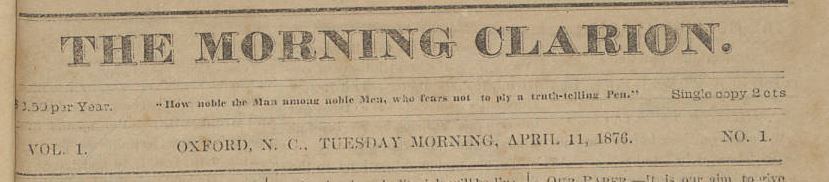
We had similar results in examining a dozen or so front pages in databases available to the general public, including examples from the Richmond Planet, the Washingtonian (Leesburg, VA), the Wabash Express (Terre Haute, IN), and the Morning Clarion (Oxford, NC).

Our searches indicated that newspaper nameplates gradually lost the periods during the 1900s, though some periods lasted until well into the 20th century.

The Cincinnati Post’s period was gone at the time of the San Francisco earthquake in 1906, but the Duluth News Tribune still had a period when the Titanic sank six years later.

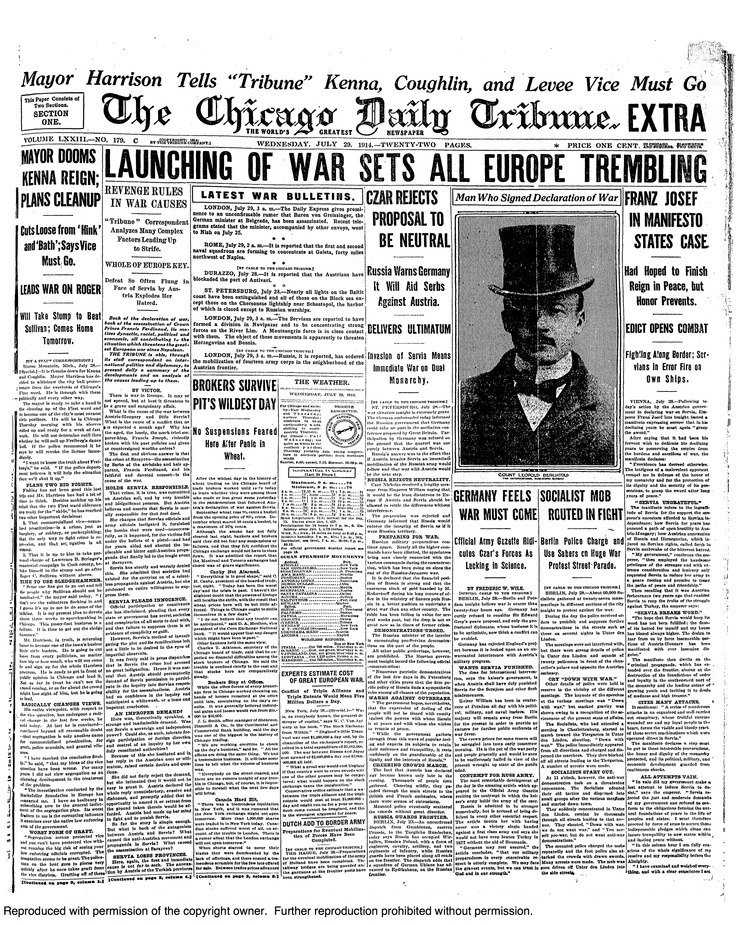
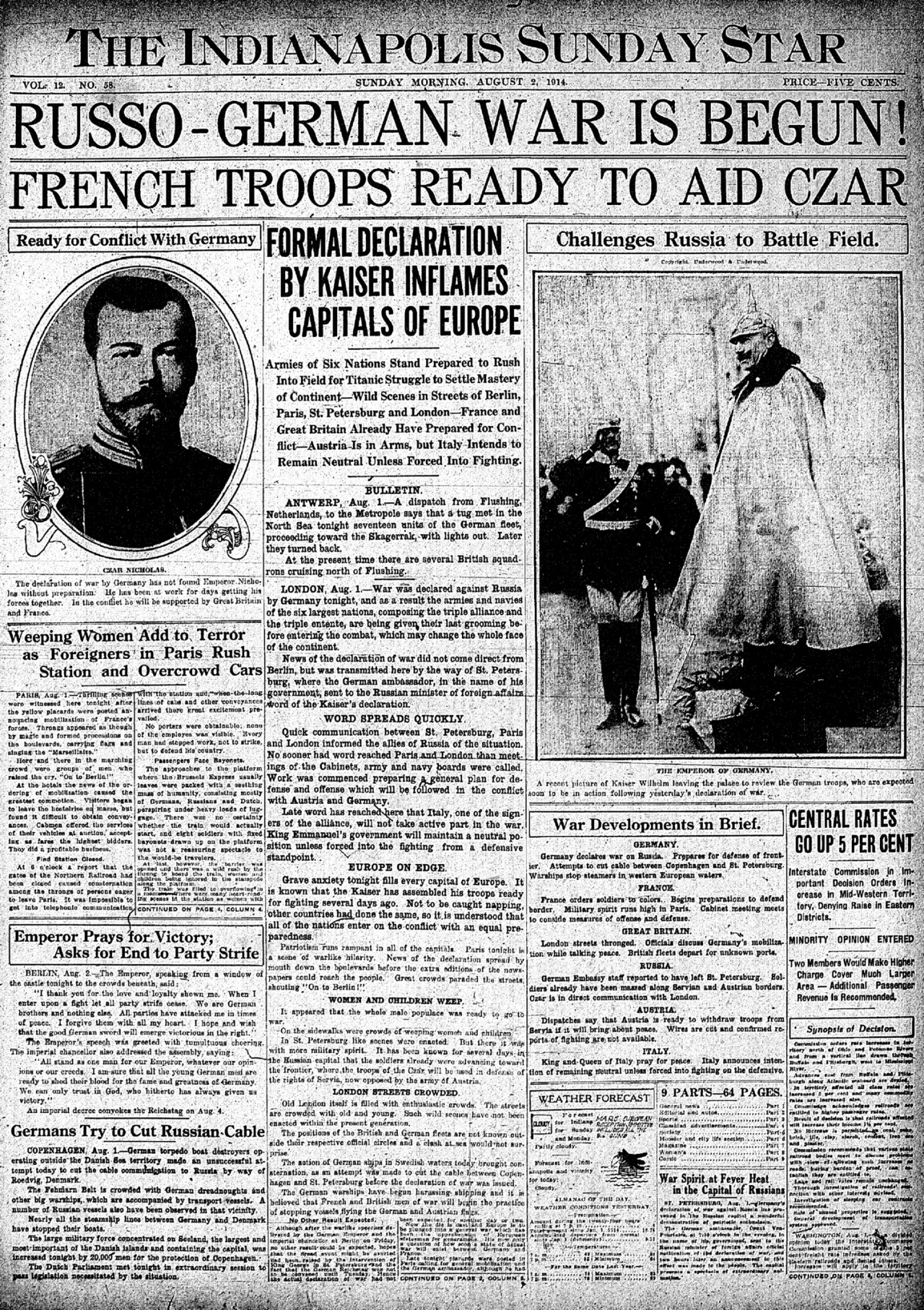
The Chicago Daily Tribune still had its period at the start of World War I, but the Indianapolis Star had dropped its period.

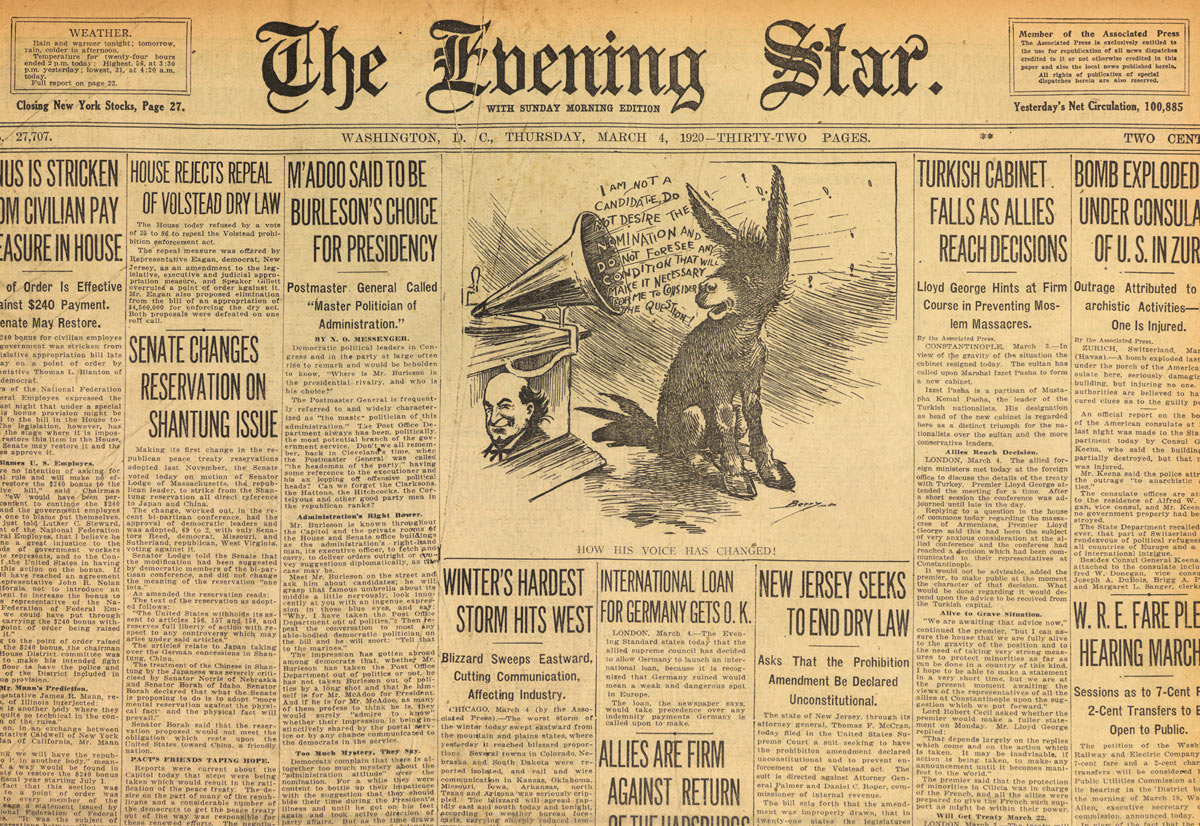
The Evening Star in Washington, DC, still had a period in 1920, while the Daily News in New York didn’t in 1921.

The New York Times had a period from its founding on Sept. 18, 1851, until it dropped the punctuation mark on Feb. 21, 1967, to the consternation of some tradition-minded readers.

Although dropping the period was part of a number of design changes intended to give the newspaper a more modern look, the Times let it be known that the move saved the paper $41.28 a year in ink.

A Times history published in 2001 noted one reader’s reaction to the changes. “What has God re-wrought?” said the letter to the editor. “No period in the New York Times masthead? The weather unboxed? ‘All the News’ restyled?”

The Hartford Courant, which began publishing as the weekly Connecticut Courant on Oct. 29, 1764, brought back the period in its nameplate in 1997, and then turned it into the dot of “.com” as part of a short-lived design change in 2008.

In a Sep. 28, 2008, interview with Poynter.org, Melanie Shaffer, the design director at the Courant, discussed the decision to make the nameplate vertical and incorporate the period in “.com”:

“We already had this period sitting at the end of the Hartford Courant nameplate. Yes. It was there on the original nameplate—200 years ago. It sort of disappeared for a while, then we brought it back with the ’97 redesign. We wanted to figure out how to incorporate the dot-com. When you turn the masthead sideways and the dot-com sort of rounds the corner, it made good sense.”

As it turned out, the upside-down vertical headline, with a perpendicular “.com” at the top of the page, made sense to designers but not to readers of the Courant.

The Courant responded to the grumbling by asking its readers in June 2009 to choose from among three different nameplates. The winner was a black-and-white horizontal design with the period gone.

As you can see from the changes at the Times and the Courant, the use of a punctuation mark at the end of a newspaper’s nameplate is a style or design issue, not a matter of grammar or usage.

As for the Wall Street Journal, which began publishing on July 8, 1889, we asked Ashley Huston, the chief communications officer at Dow Jones, why the paper still had its period.

“The period is a holdover from the 1800s when other papers also had a traditional period,” she emailed us. “We have kept it while others gradually dropped it.”

She noted that the subject had come up in a 2012 article in the Journal about the period at the end of “Forward.”—an Obama campaign slogan.

In the article, she said no one at the paper knew why the Journal had kept the period in its nameplate when other papers gradually dropped theirs.

We should mention here that many newspaper headlines, as well as nameplates, used to end with periods, but the practice died out in the 20th century. If you’d like to read more, we wrote a blog post on the subject in 2013.

And we ran a post in 2014 about the origins of the word “masthead,” both nautical and journalistic. The one on a ship apparently gave us the one in a newspaper.

You didn’t ask, but some British papers, including the Times (London) once had periods at the end of their nameplates, but the practice wasn’t as common in the UK as in the US.

In the UK, a “nameplate” is referred to as a “masthead,” a term that in the US is generally used for the interior box that lists the publisher, senior editors, and address. This box is known as an “imprint” in the UK.

Help support the Grammarphobia Blog with your donation.
And check out
our books about the English language.

Categories
English English language Etymology Expression Grammar Phrase origin Punctuation Usage Word origin

New Year’s daze

(We’re repeating this post for New Year’s Day. It originally ran on Nov. 21, 2013.)

Q: I have a customer who gives out T-shirts at a New Years party. The back of the shirts has the year. Should the date for the next party be 2013 or 2014? I think it should be 2013 because the party starts on New Years Eve. Is there a grammar rule that would apply here?

A: No, we can’t think of any grammar, usage, or style rule that would apply.

The Chicago Manual of Style (15th ed.) says only that the terms “New Year’s Eve” and “New Year’s Day” should be capitalized (don’t forget the apostrophes).

The Oxford English Dictionary defines “New Year’s Day” as the first day of the year and “New Year’s Eve” as the last day of the year.

Most of the standard dictionaries we’ve checked have similar definitions.

What do we think? Well, we’re sorry to disappoint you, but we think the year on the back of those T-shirts should reflect the new year, not the old one.

From our experience, the main point of a New Year’s party is to celebrate the new year, not the old one, though we imagine that some people would disagree with us.

To the extent that New Year partyers do any serious thinking, it’s to make New Year’s resolutions, which the OED describes as resolutions “to do or to refrain from doing a specified thing from that time onwards, or to attempt to achieve a particular goal, usually during the coming year.”

The earliest written example of “New Year” in the OED is from the Ormulum (circa 1200), a book of biblical commentary that refers to “New Year’s Day” (spelled newyeress dayy in Middle English—we’ve replaced the letter yogh with “y”).

Yes, we know what you’re thinking—where’s the apostrophe?

Although “New Year’s Day” now takes an apostrophe, the use of the punctuation mark here is relatively new.

The earliest OED example of an apostrophe in “New Year’s” is from The New Mirror for Travellers, an 1828 travel guide: “It was new year’s eve, and Douw was invited to see out the old year at Judge Vander Spiegle’s.”

The apostrophe showed up in English in the 1500s, but it was originally used to indicate the omission of a letter or letters in a word (as in a contraction like “can’t”).

John Ayto’s Dictionary of Word Origins says “apostrophe” is ultimately derived from prosoidia apostrophos, the classical Greek term for an omission mark—the Greek phrase literally means “accent of turning away.”

If you’d like to read more, we ran a post a few years ago about how the apostrophe became possessive.

Help support the Grammarphobia Blog with your donation.
And check out
our books about the English language.

Categories
English English language Etymology Expression Grammar Slang Usage Word origin

When “bad” means “good”

Q: I understand the difference between “feel bad” and “feel badly,” but “love so bad”? Wouldn’t that be best stated as “love so badly”? Perhaps I hear the wrong phrase so often that my mind is muddled.

A: In slang usage, the adjective “bad” means “good,” as we mentioned in a post we wrote some time ago about the influence of African-American slang on English.

The surprising thing about this use of “bad”—apart from the reversed meaning—is that it’s not recent. It dates back to the 19th century, as we’ll explain later.

But in an expression like “love so bad,” the word is an adverb, not an adjective. It’s being used as an intensifier—that is, to intensify the verb it modifies—with the result that “so bad” means “so greatly” or “so much.”

We know what you’re thinking—“bad” as an adverb? Is that legal?

Well, here’s another surprise. The adverb “bad” isn’t new either. It’s been around since the 16th century, according to citations in the Oxford English Dictionary.

In the earliest adverbial uses, “bad” wasn’t an intensifier. It was used more literally and meant “badly” or “not well.”

The OED’s earliest example is from George Turberville’s The Booke of Faulconrie or Hauking (1575): “He … frames his moode, according as his hawke doth well or bad.”

But by the latter half of the 1600s, “bad” was being used intensively, to emphasize the preceding verb, in the same way that we use “much.”

This 17th-century example is from Joseph Glanvill’s Saducismus Triumphatus, a book on witches and apparitions that was written sometime before 1680: “Haunted almost as bad as Mr. Mompesson’s house.”

In the 18th century, Joseph Bellamy wrote in True Religion Delineated (1750): “We hate him so bad, that we cannot find it in our Hearts to love him.”

And in the 19th century, John Russell Bartlett included in his Dictionary of Americanisms (1859) the expression “I want to see him bad.”

The OED also includes a citation from a British novel, Under the Chilterns (1895), written under the pen name Rosemary: “Las’ week there was a job doin’ up at the squire’s, an’ I wanted to go bad.”

Today, in the OED’s estimation, this sense of “bad” as an intensifier is colloquial and nonstandard, and it appears “chiefly” in North American usage. American language authorities, however, aren’t as critical.

As we’ve written before on the blog, Merriam-Webster’s Dictionary of English Usage maintains that the adverb “bad” is interchangeable with “badly” after the verbs “want” and “need.”

Similarly, Merriam-Webster’s Collegiate Dictionary (11th ed.) has an entry for the adverb “bad” defined as “badly,” and includes the example “doesn’t want it bad enough.” This dictionary treats the usage as standard English.

The American Heritage Dictionary of the English Language (5th ed.) doesn’t go quite that far. It says the adverbial use of “bad” as in “his tooth ached so bad” is “common in informal speech but is widely regarded as unacceptable in formal writing.”

Although the OED considers it nonstandard to use “bad” as an intensifier meaning “greatly” or “very much,” it accepts without reservation the use of “badly” in this way.

Now, let’s take a closer look at the slang use of the adjective “bad.” As we mentioned above, the use of “bad” to mean “good” dates back to the 19th century.

The Random House Historical Dictionary of American Slang says that, especially in African-American English, “bad” is used to mean “wonderful; deeply satisfying; stunningly attractive or stylish; sexy.”

The dictionary’s earliest reference is from George Ade’s Pink Marsh (1897): “She sutny fix up a pohk chop ’at’s bad to eat.” (The book is a collection of sketches about a fictional black shoe-shine man named William Pinckney Marsh, a k a Pink.)

Random House also cites this line from a 1927 review in Variety: “In Duke Ellington’s dance band Harlem has reclaimed its own. … Ellington’s jazzique is just too bad.”

The OED also includes this usage, which it labels as slang. Here “bad” is used, the dictionary says, “as a general term of approbation” and means “good, excellent, impressive; esp. stylish or attractive.”

Oxford’s citations begin with George Ade in 1897 and continue into the present day.

Among them are this definition of “bad” in Leonard Feather’s The Encyclopedia of Jazz (1955): “Bad, adj. Good. (This reverse adjectival procedure is commonly used to describe a performance.)”

The OED also includes this 1980 example, from an article in Time magazine: “Bad as the best and as cool as they come, Smokey is remarkably low key for a soul master.”

But “bad” was used further back in a slightly different and possibly unrelated slang sense.

Both Oxford and Random House have entries for “bad” meaning “formidable” and hence “formidably skilled,” with examples dating from the 1840s and ’50s.

We find some of these early citations ambiguous; the speaker’s meaning isn’t always clear-cut. As far as we can tell, the first example in which this “badness” is clearly viewed with admiration appeared in the 1870s.

Random House gives an example from The Colored Cadet at West Point (1878), an autobiography by Henry O. Flipper, the first black graduate of the U.S. Military Academy.

In this passage, Flipper quotes from a newspaper article that mocked his post-graduation homecoming in 1877:

“A darkey would approach the young man, cautiously, feel of his buttons and clothes, and enthusiastically remark: ‘Bad man wid de gub-ment strops on!’ ” (The newspaper article included this among “expressions of admiration.”)

American Heritage has an interesting note on the positive uses of “bad,” which the dictionary says “illustrate a favorite creative device of informal and slang language—using a word to mean the opposite of what it ‘really’ means.”

“This is by no means uncommon; people use words sarcastically to mean the opposite of their actual meanings on a daily basis,” the dictionary says.

“What is more unusual is for such a usage to be generally accepted within a larger community,” the note continues. “Perhaps when the concepts are as basic as ‘good’ and ‘bad’ this general acceptance is made easier.”

Help support the Grammarphobia Blog with your donation.
And check out
our books about the English language.

Categories
English English language Etymology Slang Usage Word origin

Is “pussy” a dirty word?

Q: Two Fox contributors were benched this month for using inappropriate language. One of them used the word “pussy,” which refers not to the female genitalia, but to a coward, from the same root as “pusillanimous.” Why can’t we use this word?

A: To recap, on Dec. 7, 2015, Ralph Peters, a Fox Business analyst, called President Obama “a total pussy,” and Stacey Dash, a Fox News cultural commentator, said, “I felt like he could give a shit” about terrorism.

Bill Shine, the executive vice president of programming at Fox, then suspended Peters and Dash for two weeks, saying “the comments were completely inappropriate and unacceptable for our air.”

As to your question, get serious. Unless you’re emailing from Alpha Centauri, you must know that the noun “pussy” can refer to a woman’s genitals as well as a coward or a sissy.

Did Fox overreact about the use of “pussy”? In our opinion, no. Dictionaries generally label the the first of these slang senses as vulgar and the second as offensive.

We’d describe the Fox decision to suspend the two contributors for using “shit” and “pussy” on the air as a matter of prudence rather than etymology.

Etymologically, the noun “pussy” has referred to a woman’s genitals for hundreds of years. And it probably comes from Germanic sources, not from pusillanimis, the Latin source of “pusillanimous.”

The earliest example in the Oxford English Dictionary is a naughty reference in A Choice Collection of New Songs and Ballads (1699), by the English writer Thomas D’Urfey:

As Fleet as my Feet Could convey me I sped; / To Johnny who many Times Pussey had fed.”

The noun “pussy” has also referred to a sweet man, or to an effeminate one, for more than a hundred years. The OED’s first citation is from God’s Good Man, a 1904 novel by the British writer Marie Corelli: “I shall invite Roxmouth and his tame pussy, Mr. Marius Longford.”

And this example is from Sinclair Lewis’s 1925 novel Arrowsmith: “You ought to hear some of the docs that are the sweetest old pussies with their patients—the way they bawl out the nurses.”

In the late 1960s and early ’70s, this sense of “pussy” evolved to mean a coward or a weakling, according to examples in the dictionary.

The earliest citation for the new sense is from Pimp: The Story of My Life, a 1969 memoir by Iceberg Slim, the street name of Robert Beck:

“Look Preston, I got lots of heart. I’m not a pussy. I been to the joint twice. I did tough bits, but I didn’t fall apart.”

And here’s an example from If I Die in a Combat Zone, Box Me Up and Ship Me Home, a 1973 memoir by Tim O’Brien about his experiences in Vietnam: “You afraid to be in the war, a goddamn pussy?”

As “pussy” came to mean a coward, its sexual sense changed. Before then, the word had appeared in family publications and (in the words of the OED) referred to “a man likened to a house-cat; a dependent or ‘domesticated’ man.”

Since around 1970, the lexicographer Jonathan Lighter says in an Aug. 17, 2005, posting on the Linguist List, there’s “little doubt of its misogynistic genital origin.”

That explains why The American Heritage Dictionary of the English Language (5th ed.) labels “pussy” as “informal” if it refers to a cat, “vulgar” if it means the vulva, and “offensive” if it refers to man regarded as weak, timid, or unmanly.

When the noun “pussy” showed up in writing in the 1500s, it referred to “a girl or woman exhibiting characteristics associated with a cat, esp. sweetness or amiability,” according to the Oxford English Dictionary.

The dictionary’s earliest example is from The Anatomie of Abuses (1583), an attack against the customs of the times, by the social reformer Philip Stubbes:

“You shall haue euery sawcy boy of x, xiiij, xvi, or xx yeres of age, to catch vp a woman & marie her … so he haue his pretie pussie to huggle withall, it forceth not, for that is the only thing he desireth.” (We’ve expanded the OED citation to add context.)

The dictionary says “pussy” is derived from a somewhat earlier noun “puss,” which it defines as “a conventional proper or pet name for a cat” that’s often “used as a call to attract its attention.”

The OED’s first citation is from a 1533 comedy by the English playwright John Heywood: “I haue sene the day that pus my cat Hath had in a yere kytlyns eyghtene.”

The feline meaning of “puss” is somewhat of a mystery, according to John Ayto’s Dictionary of Word Origins.

“It appears to have been borrowed from Middle Low German pus, but there the trail goes cold,” Ayto says. “Since it is basically used for calling cats, it may have originated simply in an exclamation (like pss) used for gaining their attention.”

He suggests that “pussy the slang term for ‘cunt’ may be of Low German or Scandinavian origin (Low German had puse ‘vulva’ and Old Norse puss ‘pocket, pouch.’ ”

As for the other unfortunate remark on Fox, we’ve discussed “shit” several times on our blog, including posts in 2009 and 2007. We’ve also written about “cunt” and “twat,” but not about the naughty senses of “pussy.” We did, though, discuss the feline sense of the word in 2009.

Help support the Grammarphobia Blog with your donation.
And check out
our books about the English language.

Categories
English English language Etymology Usage Word origin

Who put the “X” in “Xmas”?

[We’re repeating this post for Christmas Day. It originally ran on Dec. 26, 2006.]

Q: I haven’t seen the word “Xmas” much for the last few years, probably because of all the attacks on it as part of a secularist plot against Christmas. In any case, what is the origin of “Xmas” and how did an “X” come to replace “Christ”?

A: Anybody who thinks “Xmas” is a modern creation that represents the secularization and/or commercialization of Christmas should think again. The term “Xmas” has been around for hundreds of years and “X” or “Xp” stood in for “Christ” for many hundreds of years before that.

But don’t blame secularists. Blame the medieval scribes who used the abbreviations while copying Old and Middle English religious manuscripts.

In the the Oxford English Dictionary‘s first recorded example, “Christmas” is written as Xpes mæsse (Christ’s mass) in an Old English entry for the year 1021 in the Anglo-Saxon Chronicle:

“And se eorl Rodbeard her oð Xpes mæsse forneal mid pam cynge wunode” (“And Earl Robert stayed here [in Westminster] with the king [William II] almost until Christmas”).

The Xp at the beginning of Xpes mæsse comes from the Greek letters Χ (chi) and ρ (rho), the first letters of the word for “Christ” in ancient Greek, ΧΡΙΣΤΟΣ or χριστoς (christos, anointed one).

In a Middle English citation dated around 1380, “X” alone stands for Christ in a homily by the English theologian John Wycliffe: “X betokens Christ.”

So for ten centuries, books and diaries and manuscripts and letters routinely used “X” or “Xp” for “Christ” in words like “christen,” “christened,” “Christian,” “Christianity,” and of course “Christmas.”

The OED’s earliest example for the exact spelling “Xmas,” which we’ve expanded, is from an early 18th-century letter  by an English landowner to a son who was away at school:

“I hope you will eat at Xmas some roast beef out of the old kitchen” (from John Buxton, Norfolk Gentleman and Architect: Letters to his son 1719-1729, edited by Alan Mackley and published by the The Norfolk Record Society in 2005).

One other point. Although the St. Andrew’s Cross is shaped like an “X,” there’s no basis for the belief that the “X” used in place of “Christ” is supposed to represent the cross on Calvary.

[Note: This post was updated on March 9, 2023.]

Help support the Grammarphobia Blog with your donation.
And check out 
our books about the English language.

Categories
English English language Etymology Usage Word origin Writing

One mustache or two?

Q: In John Dos Passos’s U.S.A. trilogy, a colonel appears, “his waxed mustaches bristling with fury.” I often see “mustaches” in old books, but not in newer ones. Was the plural standard at one point? If so, when did the singular come along?

A: When the term showed up in English in the 1500s, both “mustache” and “mustaches” could mean the growth of hair above a man’s upper lip.

English borrowed the term from French, where moustache and moustaches were used in the same way, according to the Oxford English Dictionary.

The French got the word from mustaccio, Naples dialect for the Italian mostaccio, but the evolutionary trail takes us back to mystax, Doric Greek for the upper lip or mustache, and menth-, a reconstructed Indo-European root for “chew.”

We should mention here that the term is usually spelled “mustache” in the US and “moustache” in the UK, though dictionaries on both sides of the Atlantic once preferred “mustache.”

As the OED explains, “earlier British dictionaries (Johnson, Walker, Smart) and most American dictionaries prefer the semi-anglicized form mustache.” (The references are to the lexicographers Samuel Johnson, John Walker, and Benjamin H. Smart.)

We haven’t found any authoritative explanation why a man’s “mustache” is often referred to as his “mustaches” in old books.

We’re only speculating here, but a mustache with long bristles is often brushed from the middle to each side to keep the hair above the mouth and out of the gumbo. That may account for the sense of duality.

The Oxford English Dictionary says the word “moustache” (it uses the British spelling) has two meanings:

(1) “A (cultivated) growth of hair above (and sometimes extending to either side of) a man’s upper lip.”

(2) “Either half of such a growth of hair. Freq. in pl. (esp. in pair of moustaches): = sense 1.” In other words, the plural can mean the same as the singular.

Although the use of “mustaches” for a “mustache” is more common in older writing, it’s not unknown today.

A photo caption in the Dec. 20, 2013, issue of Newsweek, for example, refers to a demonstrator in Kiev with “his mustaches painted in yellow-and-blue Ukrainian national flag colors.”

As for Dos Passos, we’ve found examples in the U.S.A. trilogy, published in the 1930s, for “mustache” and  “moustache,” as well as “mustaches” and “moustaches,” in reference to one man’s facial growth.

This lack of consistency is actually consistent with the way the word has been used since it showed up in English in the 16th century, according to citations in the OED.

The earliest two examples in the dictionary, from Thomas Washington’s 1585 translation of a book by the French geographer Nicolas de Nicolay, use both “mustaches” and “moustaches” in reference to multiple facial growths.

“[They] let their mustaches grow very long.”

“[They] suffered no haire to grow, but only the moustaches betwixt the nose & the mouth.”

The OED’s next citation, from a 1587 grammar book by the Scottish scholar James Carmichael, translates the singular Greek mystax as “moustaches” in English.

An Oxford citation from Honours Conquest, Henry Roberts’s 1598 biography of Edward of Lancaster, uses the singular “mustache”:

“For the Page they ordained Turkish attire, and him furnished very orderly, with a counterfeit mustache.”

And an example from Seeing Is Believing, an 1860 collection of essays by Charles Allston Collins, uses the singular “moustache”: “He was a little, middle-aged gentleman … with … a dyed moustache.”

The use of “mustaches” for “mustache” was common in literary writing well into the 20th century.

Here’s an example from Stamboul Train, a 1932 novel by Graham Greene: “The old fellow with the moustaches—he was ill all the time.”

And here’s one from World Enough and Time, a 1950 novel by Robert Penn Warren: “Crawford stood at the foot of the ladder, more gaunt than ever, his mustaches more frazzled and stained, his respectable black coat more threadbare.”

Although English borrowed “mustache” from French, it got “mustachio” from Italian and Spanish, according to the OED.

Interestingly, “mustachio” showed up in English a few decades earlier than “mustache.” The first citation in the OED is from William Thomas’s 1551 translation of Travels to Tana and Persia, a book by the Venetian explorer Giosafat Barbaro:

“They suffer their mostacchi to growe a quarter of a yarde longer than their beardes.” A margin note adds: “Mostacchi is the berde of the vpper lyppe.”

The first example for the word spelled the usual way is from a 1603 pamphlet written by the Elizabethan dramatist Thomas Dekker: “The Souldier … had brisseld vp the quills of his stiffe Porcupine mustachio.”

The noun “mustachio,” like “mustache,” has often been used in the plural for the hair above one man’s upper lip. When used in the plural today, according to Oxford Dictionaries online, the two words refer to a large or elaborate mustache.

Help support the Grammarphobia Blog with your donation.
And check out
our books about the English language.

Categories
English English language Etymology Expression Grammar Phrase origin Usage Word origin

Is “me neither” legit?

Q: When someone says, “I don’t like beef,” it’s apparently incorrect to respond, “Me neither,” since “me” is an object, not a subject. But I’ve never heard, “I neither,” only “Me neither” or “Neither do I.”

A: “Me neither” is technically incorrect here, but a lot of people use it idiomatically. In fact, English speakers have been using it since the late 19th century.

The Oxford English Dictionary describes the use of “me neither” for “nor I” (and, we’d add, for “neither do I”) as colloquial—more suited to conversation than to formal English.

The OED says the usage originated in the US, but two of its four citations are from British sources.

The earliest example is from the Feb. 6, 1882, issue of the Marion (OH) Daily Star: “  ‘When I get out I’m not going to tamper with any more proverbs,’ remarked No. 2. ‘Me neither,’ responded No. 1.”

And this is an example from You Can’t Win, a 1926 memoir by Jack Black about his itinerant life of crime: “ ‘I wouldn’t plead guilty to anything if I were you,’ I advised him. ‘Me, neither,’ said his partner.”

The OED’s latest citation is from Sharking, a 1999 novel by the British writer Sophie Stewart: “ ‘I don’t know what to do,’ I said finally. … ‘Me neither,’ said Lucinda.”

Getting back to your question, “Me neither” is an elliptical (or incomplete) version of a longer reply.

When someone says “I don’t like beef,” you can respond with a full sentence if you like. You might say, for example, “I don’t like it either,” “Neither do I like it,” or “Nor do I like it.” But the last two sound stilted.

Then there are various elliptical versions of those responses: “I don’t either,” “Neither do I,” “Nor do I,” and the even more clipped “Nor I.” All of these are technically correct, because “I” is proper as the implied object of an elliptical sentence.

In our own usage, we prefer “I don’t either” or “Neither do I” in conversation. We find “Nor do I” and “Nor I” too formal for speech, though we might use them in writing.

As for “Me neither,” we don’t bat an eye when someone uses it in speech or casual writing. (“Me too” is commonly used in response to positive statements, as we’ve written before on the blog.)

But “I neither” is seldom (if ever) heard in response to a negative statement like “I don’t like beef.” It’s simply not idiomatic—that is, not commonly used by native speakers.

Help support the Grammarphobia Blog with your donation.
And check out
our books about the English language.
Categories
English English language Etymology Expression Phrase origin Usage Word origin

When the postman came twice

Q: In editing a book on tramways in Australia, I came across a puzzling phrase in old correspondence: “in response to yours of even date.” I finally worked out that the response was to a letter sent the same day—that is, “of today’s date.” This reminded me of when we used to have two mail deliveries a day.

A: Yes, the phrase “of even date” means “of the same date” or “of today’s date,” according to the Collins English Dictionary.

Here the sense of “even” is equal in magnitude, number, or quantity—not “even” as in divisible by two.

The Oxford English Dictionary describes the phrase as “common in U.S.; in England chiefly in legal language.”

Common in the United States? This is news to us, since we’ve never come across it before. Our guess is that it’s always been confined to legal or business language.

In fact, Garner’s Dictionary of Legal Usage (3rd ed.) would like to see “even date” less common in legal usage too.

Bryan A. Garner, a lexicographer and lawyer, writes that the usage “originated in commercialese but has affected lawyers’ writing as well. The best practice is to name the date a second time or to write the same date.”

Written examples for the usage date back at least as far as the mid-17th century. The earliest we’ve been able to find is from a legal document entitled “The Commission for Discoveries,” written by Oliver Cromwell and published in 1656:

“We have by Our Letters of Privy Seal, bearing even date with these presents, given full Warrant and Authority in that behalf, to the said Commissioners of, and for Our Treasury to allow and pay the same accordingly.”

The use of the phrase “even date” in the sense of “today’s date” or “the same date” was probably common in commercial writing during Cromwell’s time.

It was familiar enough to be included at least seven times in a clerical manual of the same era, The Clerk’s Tutor for Writing (1667), by Edward Cocker.

The manual is a collection of mock legal documents that illustrate the proper forms clerks should follow. Wherever one document refers to another of the same date, the phrase “bearing even date with these presents” is used—a formula that’s still found in legal writing today.

The OED cites only two examples of the expression “even date.” The earliest is from a document dated March 10, 1681: “Reciting an Indenture of even date therewith.”

Oxford also has this 19th-century example: “By deed of even date he covenanted to pay all calls in respect of the shares.” (From the Weekly Notes, London, 1885.)

In closing, we’ll quote a poem that appears, with many flourishes, in the front of that 17th-century clerks’ manual:

Your book, arme, pen, right forward place.
Your breast from board, yo[ur] head vpright.
Your fingers strait, minde every grace.
Move your pen freely, beare it light.
Full, small, height, depth, & distance mark.
These, with proportions, make a Clerk.

Help support the Grammarphobia Blog with your donation.
And check out
our books about the English language.

Categories
English language Etymology Usage Word origin

Are your duds a dud?

Q: How did “duds” become slang for clothes?

A: We wouldn’t describe the use of “duds” for clothing as slang. The five standard dictionaries we’ve checked list it as informal or include it without comment—that is, as standard English.

In fact, the word has referred to clothes for hundreds of years, since the Middle Ages, when a “dudde” was “a cloak or mantle,” according to the Chambers Dictionary of Etymology.

The earliest example we could find is from a 1307 entry in Boldon Buke, a survey ordered by Bishop Hugh Pudsey of church possessions in Durham, England:

“xxvj duddis emptis ad pauperes” (“26 duds bought for the poor”).

And here’s a felonious example from Lanthorne and Candle-Light, a 1609 pamphlet by the Elizabethan dramatist Thomas Dekker:

“We will filch some duddes: we will filch some clothes.”

Chambers says the word is “of uncertain origin.” The English philologist Walter William Skeat has said it’s probably of Scandinavian origin, though preserved only in dúða, an Icelandic word for swaddling clothes.

In the early 1500s, the English plural “duds” also came to mean ragged clothing, according to the dictionary, and in the early 1900s the singular “dud” took on the sense of an inefficient or useless person or thing.

Here’s an example from the Jan. 28, 1908, issue of the Westminster Gazette for the useless sense: “A ‘dud’ car is a worthless contraption.”

In World War I, Chambers says, the word “dud” came to mean “a shell which failed to explode; hence, failure.”

The earliest example for the military sense in the Oxford English Dictionary is from Between the Lines, a 1915 book about the war by Boyd Cable, pen name of Ernest Ewart: “One of these [shells] was a dud an’ didn’t burst.”

The OED’s first example for “dud” used in reference to a human failure is from the Sept. 1, 1920, issue of Punch: “He … has … been irritated by his school-boy son derisively addressing him as an ‘old dud.’ ”

Note: Although standard dictionaries accept “duds” (used to mean clothes) as informal or standard English, the  OED describes it as slang or colloquial. However, the OED notes that its entry hasn’t been fully updated.

Help support the Grammarphobia Blog with your donation.
And check out
our books about the English language.

Categories
English English language Etymology Expression Grammar Linguistics Phrase origin Usage Word origin Writing

As the passive progressed

Q: I’ve recently noticed a construction in Emma that doesn’t occur in modern English. When Frank Churchill and Emma entered Ford’s, “the sleek, well-tied parcels of ‘Men’s Beavers’ and ‘York Tan’ were bringing down and displaying on the counter.” Is this a common usage from Jane Austen’s era?

A: You’ve stumbled across a very interesting old usage, from a time when houses were “building” instead of “being built,” portraits were “painting” instead of “being painted,” and boots were “mending” instead of “being mended.”

People used this now-archaic construction, which grammarians call the passival, because the passive progressive tense—“was being built,” “is being painted,” and so on—hadn’t yet come into English.

Although a few examples of the passive progressive were recorded in Jane Austen’s day, the usage was rare at the time.

Austen  wrote that the gloves “were bringing down and displaying” instead of “were being brought down and displayed” because the latter construction was probably unknown to her.

Emma was published in late 1815, when only one form of the verb “be” was commonly used as an auxiliary in standard English.

It wasn’t until later in the 19th century that people began regularly combining two forms of the verb “be” (as in “is being,” “was being,” “were being”) to form the passive progressive tense.

In searches of literary databases, we’ve found many illustrations of the older construction, which uses the active voice to describe what is passive in meaning.

Austen uses it in this Feb. 8, 1807, letter to her sister Cassandra: “Our garden is putting in order, by a Man who bears a remarkably good Character, has a very fine complexion & asks something less than the first.”

She also uses it in Northanger Abbey, which was written in the late 1700s, revised several times in the early 1800s, and published after Austen’s death in 1817:

“The bustle of going was not pleasant. The clock struck ten while the trunks were carrying down, and the general had fixed to be out of Milsom Street by that hour.”

We’ve found many other examples of the usage. In this one, hymns are “singing” instead of “being sung”:

“He saw the [them] al kneele down, and whilest each Gloria Patri, &c. was singing, they al fell prostrat on their faces.” (From An Admirable Method to Love, Serve, and Honour the B. Virgin Mary, written in Italian by Alexis de Salo and published in English in 1639.)

In this humbler example, a “house of office” (that is, a privy) is “emptying” instead of “being emptied”:

“So from thence home, where my house of office was emptying, and I find they will do it with much more cleanness than I expected.” (From a July 28, 1663, entry in Samuel Pepys’s Diary.)

In this passage, ships are “mending” instead of “being mended”:

“Here we found Ruy Freira with part of his Ships, of which some were mending.” (From The Travels of Sig. Pietro della Valle, a Noble Roman, Into East-India and Arabia Deserta, published in English in 1665.)

And here we find a bridge that’s “finishing” instead of “being finished”:

“For whilst the Bridge was finishing with incredible Expedition, some Soldiers for Spyes swam over to the other side.”  (From The History of the Turks, by Sir Paul Rycaut, 1700.)

In an account of a trial for seditious libel, the sentence is “reading” instead of “being read”:

“Whilst his sentence was reading he appeared sometimes to mutter against it.” (From The History of the Reformation and Other Ecclesiastical Transactions in and About the Low Countries, originally written in Low Dutch in 1703 and published in English in 1722.)

Finally, in a usage found often in 17th- and 18th-century writing, tea is “preparing” instead of “being prepared”:

“Tea was preparing. Sir Charles took his own seat next Lord L. whom he set into talk of Scotland.” (From Samuel Richardson’s novel Sir Charles Grandison, 1753.)

This use of “preparing” survived until well into the 19th century: “They were seated in the coolest seats on the piazza, and melons and other fruit brought while tea was preparing.” (From an unsigned story in the January 1836 issue of a New York monthly, the Ladies Companion.)

Jane Austen was among the last generation of writers to use the old verb form without the passive “being.” Later writers made greater use of “being” as they shifted to the new passive progressive tense (or “aspect,” a term many linguists prefer).

But the transition wasn’t a smooth one. As the OED notes, early 19th-century grammarians condemned the new usage.

Oxford cites criticism from David Booth’s An Analytical Dictionary of the English Language (1830): “For some time past, ‘the bridge is being built,’ ‘the tunnel is being excavated,’ and other expressions of a like kind, have pained the eye and stunned the ear.”

That passage does not appear in the original, 1805 edition of Booth’s book, so the new construction must have come to his attention sometime between then and 1830.

The linguist Mark Liberman, in a Jan. 11, 2013, post on the Language Log, notes that the new usage was still being criticized in the second half of the 19th century.

The literary critic Richard Grant White, for example, wrote in Words and Their Uses (1870) that the construction served “to affront the eye, torment the ear, and assault the common sense of the speaker of plain and idiomatic English.”

But there were good reasons why the passive progressive developed, as we’ll see.

Long before Austen’s time, in fact since the late 1300s, people had been combining the old preposition “a” with gerunds used passively to describe an action in progress.

Here’s an example from the King James Bible (1611): “In the dayes of Noah while the Arke was a preparing.”

Here, “preparing” is a gerund—essentially, a noun—rather than a present participle. The “a” preposition, the OED says, was used with a gerund in “expressing process,” and meant “in process of, in course of,” or “underdoing (some process)” such as making, building, mending, etc.

“On,” and “in” had been used the same way. So a theoretical 16th-century writer might say that court papers were “on preparing” or “in preparing” or “a preparing” and mean the same thing—the papers were in preparation.

By Austen’s time, the prepositions had mostly fallen away. But eventually these “-ing” usages led to ambiguity, since in identical constructions one “-ing” word was a participle and the other a gerund.

Someone might write, for example, that his lawyers “were preparing” papers (participle), but also that the papers themselves “were preparing” (gerund).

For an extreme example of the confusion this might cause, take a look at this OED citation from Henry More’s An Antidote Against Atheisme 1653): The shreeks of men while they are a murdering.”

The writer didn’t mean that the men shrieked as they murdered people. He meant that they shrieked as they were being murdered: “a murdering” here meant undergoing murder. But only the context would tell the reader which meaning was intended.

Obviously, English needed a new tense—one combining a form of “be” + “being” + past participle, as in “were being murdered.”

The OED’s earliest use for the new tense is dated 1772, in a letter written by the Earl of Malmesbury: “I have received the speech and address of the House of Lords; probably, that of the House of Commons was being debated when the post went out.”

Two later examples are cited from the 1790s, also from private letters. But it wasn’t until after Jane Austen’s time that the passive progressive became common.

Remnants of the old usages are still with us today. We still say “time’s a-wasting” for “time is being wasted.”

And we still say “nothing doing,” a leftover from the Middle Ages when people said that things were “doing” instead of “being done.”

As the OED says, the old passive construction “to be doing” meant “to be in the course of being done, to be happening.”

Here’s the old usage in action: “Little thought false Reyner what was doing at Canterbury, whiles hee was trotting to Rome.” (From The History of Great Britaine Under the Conquests of ye Romans, Saxons, Danes and Normans, by John Speed, 1614.)

And here’s one with a very modern sound, quoted in the OED: “He always says there is nothing doing.” (From a letter written by the Earl of Manchester in 1700.)

Eventually, in the 19th century, the phrase became simply “nothing doing.” The OED gives this example:

“A friend of mine hailed an outfitter the other day, ‘How is business?’ ‘Nothing doing.’” (From a Liverpool weekly, the Porcupine, 1870.)

And in the first decade of the 20th century, the meaning changed. “Nothing doing” became “an announcement of refusal of a request or offer, failure in an attempt, etc.,” Oxford says.

The dictionary gives this example from the Dec. 13, 1910, issue of the New York Evening Post: “Spottford offered the porter a dime. The negro waved it aside and said: ‘Nothing doing; my price is a quarter at least.’ ”

Help support the Grammarphobia Blog with your donation.
And check out
our books about the English language.
Categories
English English language Etymology Usage Word origin

Whole lotta trepidatin’ goin’ on

Q: Hey, I’ve just referred to a group of workmates as “trepidated,” and I hereby record for posterity that I came up with it. Or did I?

A: Nope, you’re nearly a century late. “Trepidated” has been used adjectivally since the early 1800s to mean shaken, fearful, agitated, or disturbed.

Furthermore, several related words with a similar meaning—“trepidate,” “trepidating,” and “trepidatious”—have been around for quite some time too, with the oldest dating back to the early 1600s.

However, most of those are relatively rare or obsolete. The only one you’ll find today in standard dictionaries is “trepidatious.”

As we wrote in a 2007 post (later updated), six of the ten standard dictionaries we regularly consult recognize the adjective as standard English—all five of the American dictionaries and one of the five British. (All ten include the noun “trepidation.”)

All these words of agitation are ultimately derived from trepidare, a Latin verb meaning to hurry or bustle, as well as to be agitated or alarmed.

The first of them to appear in writing, according to the Oxford English Dictionary, is an adjective spelled “trepidat” or “trepidate.” The earliest example in the OED is from John Dove’s A Confutation of Atheisme (1605):

“The celestiall spheres in continuall volubilitye … their diurnall or daylye course from the East to the West, their retrograde and vyolent motion from the West to the East, their trepidat motion from the South to the North.”

Not many years later, the verb “trepidate,” meaning to shake or tremble with fear or agitation, showed up in writing.

The first citation in the OED is from a 1623 dictionary of “hard English words” compiled by Henry Cockeram: “Trepidate, to tremble for feare.”

The noun “trepidation,” meaning tremulous agitation or alarm, appeared soon after.

The earliest OED citation is from a 1625  essay by Francis Bacon: “There vseth to be more trepidation in Court, vpon the first Breaking out of Troubles, then were fit.”

The dictionary’s earliest example for the present participle “trepidating” used as an adjective is from The Light of Nature Pursued, a seven-volume philosophical opus by Abraham Tucker that was published 60 years after his death in 1774:

“A calm and steady alertness … never anxious nor trepidating.”

The dictionary doesn’t have an entry for the past participle “trepidated” used as an adjective, but we’ve had no trouble finding examples in digital databases.

The earliest is from “The Fatal Prophecy,” an 1838 story by Edward Stirling in the Monthly Magazine, a British periodical that published some of Charles Dickens’s Boz sketches:

“With a voice trepidated and wavering he called off his fierce tribe, and ’spite of their discontent and mutterings, he led them away from the scene of their guilt and carnage.”

The latecomer, “trepidatious,” meaning apprehensive or nervous, showed up in the early 20th century, according to OED citations.

We’ll end with a romantic use of the verb from The Travels of Antenor in Greece and Asia, an anonymous 1799 English version of a Greek manuscript found at Herculaneum:

“At first she attacked me by ogling me with amorous glances and languishing looks, to which I politely answered by some little strokes of gallantry, till, by insensible degrees, a kind of attachment began to be formed on both sides, and our hearts reciprocally trepidated with love.”

{Note: This post was updated on Feb. 19, 2020, to reflect newer dictionary information. A later post about “trepid,” “trepidant,” and “trepidatious” appeared in 2017.]

Help support the Grammarphobia Blog with your donation.
And check out
our books about the English language.
Categories
English English language Etymology Expression Grammar Linguistics Phrase origin Usage Word origin Writing

We are met on a great battle-field

Q: Watching a recent rebroadcast of “The Civil War” on PBS, I was struck by this sentence in Lincoln’s Gettysburg Address, “We are met on a great battle-field of that war.” Is “we are met” just a poetic usage? Or is something else going on?

A: “We are met” is a present-perfect construction, parallel to “we have met.” The usage dates back to the Middle Ages, but by Lincoln’s time it was considered archaic and poetic.

You can still hear it today, though the usage sounds unusual to modern ears because it combines “met” (the past participle of “meet”) with a form of “be” as the auxiliary verb instead of the usual “have.”

So, for instance, a speaker uses “we are met to honor him” in place of “we have met to honor him”—or, to use the simple present tense, “we meet to honor him.”

The poetic “we are met” gives the message a solemnity and gravity it wouldn’t otherwise convey.

Here “met” is used in the sense of “assembled” or “gathered” or “brought together.” And the auxiliary “be” is possible only when this sense of “met” is used intransitively—that is, without a direct object.

In its entry for “meet,” the Oxford English Dictionary notes that “in intransitive use the perfect tenses were freq. formed with the auxiliary be in Middle English and early modern English; subsequently this became archaic and poetic.”

The OED has citations from the 14th century onward, including this Middle English example from Geoffrey Chaucer’s poem “The Complaint of Mars” (circa 1385): “The grete joye that was betwix hem two, / When they be mette.”

This one is from Thomas Starkey’s A Dialogue Between Pole and Lupset, written sometime before 1538: “Seying that we be now here mete … accordyng to our promys.”

And here’s a poetic 19th-century use from William Makepeace Thackeray’s novel The Virginians (1859): “The two gentlemen, with a few more friends, were met round General Lambert’s supper-table.”

Today, we’re more likely to encounter this usage on solemn occasions, as when people gather for religious worship or funeral eulogies.

Lincoln isn’t the only American politician to use “we are met” in elevated oratory. In 1965, in a speech before Congress in support of equal voting rights, President Lyndon B. Johnson said:

“There is no Negro problem. There is no Southern problem. There is no Northern problem. There is only an American problem. And we are met here tonight as Americans—not as Democrats or Republicans—we are met here as Americans to solve that problem.”

A somewhat similar use of “met” with the “be” auxiliary is also antiquated today. This is the expression “to be well met,” first recorded in the 15th century and meaning to be welcome or well received.

This is the source of the old expression “hail fellow well met,” which evolved in the late 16th century from the slightly earlier phrase “hail, fellow!”

“Hail, fellow!” was a friendly greeting of the 1500s that was also used adjectivally, the OED says, to mean “on such terms, or using such freedom with another, as to accost him with ‘hail, fellow!’ ”

We’ll quote 19th-century examples of the shorter as well as the longer adjectival phrases, courtesy of the OED:

“He crossed the room to her … with something of a hail-fellow bearing.” (From Thomas Hardy’s novel The Mayor of Casterbridge, 1886.)

“He was popular … though not in any hail-fellow-well-met kind of way.” (From H. Rider Haggard’s novel Colonel Quaritch, V.C., 1888.)

We’ll close with a more contemporary example we found in a letter to the editor of the Bergen (N.J.) Record in 2012:

“The most exciting thing about the Republican National Convention was the hurricane. … Where is the enthusiasm, the fire they need to capture the voters? Where is the ‘Hail fellow, well met’? This convention was a snore fest.”

Help support the Grammarphobia Blog with your donation.
And check out
our books about the English language.
Categories
English English language Etymology Usage Word origin

Lexical summitry

Q: A review of the 3-D movie Everest in The New Yorker says climbers on the world’s highest peak have “an indomitable urge to use the word ‘summit’ as an intransitive verb.” When was the noun “summit” first used as a verb? Who gets the credit?

A: Believe it or not, the first person to verb the noun “summit” in writing was apparently Chaucer—back in the 1300s!

At that time, according to citations in the Oxford English Dictionary, the verb meant to submit or subject. This sense ultimately comes from submittere, Latin for (among other things) to lower or diminish.

Here’s one of the dictionary’s two examples of the usage from Chaucer’s Middle English translation (circa 1374) of Boethius’s De Consolatione Philosophiae:

“Þanne summytten ȝe and putten ȝoure self vndir þo fouleste þinges” (“Then to submit and put yourself under those foulest things”).

This sense of the verb is now obsolete (the last OED citation is from the 1400s), and it’s not related to the verbing of the noun “summit” in mountain climbing and diplomacy—two relatively recent usages.

The Oxford English Dictionary doesn’t have an entry for the verb “summit” used in mountaineering, but it has citations dating back to the early 1970s for the verb used in the diplomatic sense.

In our searches of digital databases, the earliest example we’ve found for the verb “summit” used in the climbing sense dates from the late 1970s, but the usage has been relatively rare until the last few years.

Three of the six standard dictionaries we’ve checked have entries for “summit” used as a verb in mountaineering or diplomacy, but only one dictionary (Merriam-Webster’s Collegiate, 11th ed.) includes both senses.

Merriam-Webster’s describes the verb as intransitive in both senses—that is, without an object. Examples: “The foreign ministers will summit tomorrow” … “He summited solo on day 10.”

However, The American Heritage Dictionary of the English Language (5th ed.) and Oxford Dictionaries online say the mountaineering verb can be used transitively (with an object) as well as intransitively.

Oxford Dictionaries gives these examples: “in 2013, 658 climbers summited Everest” … “they started climbing at 3:45 a.m. and summited at 8:45 p.m.”

All this lexical summitry began with summum, Latin for highest, according to John Ayto’s Dictionary of Word Origins.

“When the Romans counted up columns of figures they worked from the bottom upwards, and put the total on top—whence the use of the expression res summa, literally ‘highest thing,’ for ‘total,’ ” Ayto writes.

He adds that the Latin phrase “was eventually shortened to summa, which reached English via Old French summe.”

When the noun “summit” (spelled “somette”) showed up in English in the 1400s, it referred to the top of something, specifically the crown of a head.

The first example in the OED is from Le Morte Darthur (1470-85), Sir Thomas Malory’s version of the Arthurian legend:

“It clefte his hede fro the somette of his hede.” (The citation refers to a bloody battle in which the wounded King Arthur uses his sword Excalibur to slash Emperor Lucius from the top of the head all the way down to the chest.)

At about the same time, according to the dictionary’s citations, the noun “summit” took on the meaning of “the topmost point or ridge of a mountain or hill” as well as “the highest elevation” of a road, a canal, and so on.

The OED’s first example for this sense is from Godeffroy of Boloyne, William Caxton’s 1481 English translation of an Old French version of a Latin work about the Crusades by the 12th-century prelate William of Tyre:

“Syon is toward the weste, on the sommete or toppe theron stondeth the chirche which is named Syon.”

In the 1700s, the noun took on the figurative meaning of the highest degree of something, such as happiness or love or literary achievement.

The first Oxford example is from a letter written sometime before 1717 by Lady Mary Wortley Montagu: “Supposing I was at the very summit of this sort of happiness.”

In the mid-20th century, according to the dictionary’s citations, “summit” took on the specific meaning of the highest level “with reference to politics and international relations.”

The first example is from a comment by Winston Churchill in the Feb. 15, 1950, issue of the Times (London): “It is not easy to see how things could be worsened by a parley at the summit, if such a thing were possible.”

The earliest example for the phrase “summit meeting” is from the May 5, 1955, issue of the New York Times: “I say at this moment I see no reason for that summit meeting.”

And the first example for “summit conference” is from the June 23, 1955, issue of the Times (London): “The senator’s resolution demanding that the United States should refuse to attend the ‘summit’ conference.”

By the 1960s, according to the OED, “summit” was being used elliptically—that is, by itself—to mean a “summit conference” or a “summit meeting.”

Here’s an example from the June 30, 1967, issue of the Spectator: “The most certain result of the Glassboro summit, in fact, is no more than that Mr. Johnson’s standing at home is now rather higher.”

As for the verb “summit,” the dictionary’s first modern example (from the June 5, 1972, issue of Time magazine) uses the verb in its diplomatic sense:

”Prime Minister Indira Gandhi is willing to summit with the chap (probably at the end of the month).”

As we’ve said, the OED doesn’t have an entry for “summit” used as a verb in mountain climbing. The earliest example we’ve found is from a 1978 issue of Antarctic, a publication of the New Zealand Antarctic Society:

“It was then onto Africa to climb Mt Kilimanjero in Tanzania which stands at 5,894 m and which they summited on 17 August, prior to flying to Australia to climb the 2,230 metre high Mt. Kosciusko in New South Wales, on 26 August.”

Help support the Grammarphobia Blog with your donation.
And check out
our books about the English language.

Categories
English English language Etymology Expression Phrase origin Usage Word origin

Holiday dressing

Q: This question is too late for Thanksgiving, but you may find it useful for Christmas or New Year’s: Is the verb “dress” (to gut a dead deer) related to the noun “dressing” (the stuffing in a turkey)?

A: Yes, to “dress” a deer is etymologically related to the “dressing” that’s stuffed in a holiday turkey. And both senses are related to the verb “dress” (to put on clothes) and the noun “dress” (the garment).

All those senses are ultimately derived from directus, Latin for “straight” and the source of the English word “direct,” according to John Ayto’s Dictionary of Word Origins.

So how did a Latin word for straight, you may ask, twist and turn in English to give us terms for stuffing a turkey and gutting a hunted deer in the field?

When Middle English borrowed the verb “dress” from Old French in the 1300s, the Oxford English Dictionary says, it meant to straighten, erect, prepare, or arrange. (In Old French, dresser meant to arrange.)

The “prepare” sense of “dress” in Middle English included “preparing for use as food, by making ready to cook” as well as seasoning, according to written examples in the OED.

This example is from Richard Cœur de Lyon, a Middle English romance written sometime before 1400: “Or ye come the flesch was dressyd” (“Before your coming, the flesh was dressed”).

And here’s a 1430 citation from a Middle English cookbook: “Put yn þe Oystrys þer-to, and dresse it forth” (“Put the oysters in [the pot of broth] and dress it”).

This example is from Nicholas Lichefield’s 1582 translation of a book by the Portuguese historian Fernão Lopes de Castanheda: “To dresse their meate with salt water.”

The food sense of the verb “dress” gave us the noun “dressing,” which the OED defines as “the seasoning substance used in cooking; stuffing; the sauce, etc., used in preparing a dish, a salad, etc.”

The earliest Oxford example is a 1504 entry in the Records of the Borough of Nottingham: “For floure and peper, and dressing.”

The food sense also gave us the adjective “dressed,” which refers to that which “has been prepared for eating; covered or mixed through with a sauce or dressing.”

The earliest OED example is from Pylgrimage of Perfection, a 1526 religious treatise by William Bonde: “Delycates [delicacies] or denty [dainty, or tasty] dressed meates.”

Getting back to “dress,” all of the Oxford examples for the culinary sense of the verb refer to the kind of preparation that one would do in a kitchen, not out in the field.

However, the OED has an entry for “field-dress,” which it describes as a “chiefly N. Amer.” verb meaning “to remove the internal organs from (hunted game) soon after the kill, primarily to aid the cooling of the carcass.”

The dictionary’s earliest citation for the usage is from Game in the Desert, a 1939 book by Jack O’Connor about hunting in the American Southwest and northern Mexico:

“For a hunting knife the sportsman should choose a good substantial pocket knife…. With it he can field-dress his game, bore holes in leather, [etc.].”

The most recent OED example is from the Nov. 6, 2008, issue of the New York Review of Books: Another one of those cool Harvard Law Review cats who can’t field-dress a chicken, much less a moose.”

Although the verbal phrase “field-dress” may be more popular in the US than in the UK, as the OED asserts, we’ve found examples for the verb “dress” itself used in that sense on both sides of the Atlantic since the 1800s.

In Woodstock, an 1826 novel by Sir Walter Scott, for example, poachers “flayed and dressed the deer, and quartered him, and carried him off, and left the hide and horns.”

And in A Snow Storm in Humboldt, a story in the November 1892 issue of the Overland Monthly in San Francisco, a neighbor gives the narrator one of three deer he’s shot.

“He stayed but a few minutes,” the narrator says, “then I washed my dishes, dressed the deer, chopped wood, brought water from the spring, and prepared supper.”

Interestingly, the most common sense now of the verb “dress” (to put on one’s clothes) didn’t show up until the 1600s, according to citations in the OED.

We’ll skip ahead to this example from Henry Fielding’s 1749  novel Tom Jones: “He had barely Time left to dress himself.”

The use of the verb in the sense of dressing someone else, not oneself, showed up earlier. Here’s an example from the York Mystery Plays (circa 1440), a Middle English cycle of religious pageants: “Dresse vs in riche array.”

The noun “dress,” used to mean a one-piece garment worn by women and girls, showed up in the 1600s. The earliest OED citation is from The Fancies, Chast and Noble, a 1638 comedy by John Ford: “Your Dresses blab your vanities.”

Finally, here are some additional meanings for “dress” and “dressing” that evolved from the original senses of the verb in Middle English: to “dress” a wound (1471), to “dress” a garden with manure (1526), to “dress up” (1674), the “dressings” on a wound (1713), to “dress” for dinner (1741), to “dress” a shop window (1843), and to give someone a “dressing down” (1876).

Help support the Grammarphobia Blog with your donation.
And check out
our books about the English language.

Categories
English English language Etymology Expression Phrase origin Usage Word origin

On the Pequod, and under weigh

Q: Regarding your post about “under way,” please note that as the ship Pequod left port it was “getting under weigh.” This was a nautical metaphor that alluded to the process of pulling up anchor to begin a trip.

A: As we wrote in our 2009 post, the original term for a ship moving through the water was “under way,” not “under weigh.” Strictly speaking, a ship “weighs anchor” before getting “under way.”

The Oxford English Dictionary labels “under weigh” a common variant of “under way” that arose “from erroneous association with the phr. ‘to weigh anchor.’ ”

But a term that lexicographers label a “variant” is merely that. It’s not incorrect, just an alternative spelling.

In most dictionaries, the “variant” label means the spelling is acceptable in standard English, unless a more restrictive label, like “dialect” or “slang” or “offensive,” is also appended.

Both of these nautical expressions date from the 18th century. Oxford’s earliest example of “under way” in English writing is from 1743, and the earliest for “under weigh” is from 1777.

The dictionary describes the earlier “under way” as a nautical term from the Dutch onderweg or onderwegan.

In Dutch, a language from which English adapted many nautical terms, onder means “under, in the course of, etc.,” and weg means “way.” The phrase, the OED says, is “often spelt under weigh.”

What do standard American dictionaries say about “under weigh”?

Merriam-Webster’s Collegiate Dictionary (11th ed.) treats “under weigh” as a variant derived “by folk etymology” from “under way.”

The American Heritage Dictionary of the English Language (5th ed.) says that the “weigh” here is a variant of “way” that was “influenced by weigh, as in weigh anchor.”

Webster’s New World College Dictionary (4th ed.) says much the same: in the phrase “under weigh,” the dictionary notes, the use of “weigh” for “way” is a variant spelling “modified by the notion of ‘weighing anchor.’ ”

The online Random House Kernerman Webster’s College Dictionary makes no mention at all of “under weigh.” It has only “under way,” and uses the example “The ship is under way.” Elsewhere, Random House defines “weigh anchor” as “to heave up a ship’s anchor in preparation for getting under way.”

In short, many dictionaries accept “under weigh” as a variant. And in our opinion it’s so firmly established in nautical usage that it’s no longer remarkable, though “under way” is preferable on etymological grounds.

As for your comment about Herman Melville’s use of “under weigh” in Moby-Dick, he wasn’t the only literary figure to choose the variant.

As Michael Quinion notes on his website World Wide Words, the usage “has the ghostly support of generations of writers.”

In addition to Melville, Quinion cites William Makepeace Thackeray, Captain Frederick Marryat, Washington Irving, Thomas Carlyle, Lord Byron, Charles Dickens, and C. S. Forester.

The mistaken spelling was perhaps inevitable. As Quinion says, “Some over-clever individuals connected with the sea almost immediately linked it erroneously with the phrase to weigh anchor.”

Here are the two earliest examples for each term, courtesy of the OED:

1743: “To prevent which, we do agree, that when Under-way they shall not separate.” (From A Voyage to the South-Seas in the Years 1740-1, by the shipmates John Bulkeley and John Cummins.)

1751: “We drew up the two boats, and set all hands at work to put the ship under way.” (From Robert Paltock’s novel The Life and Adventures of Peter Wilkins.)

1777: “I can assure you on the authority of Mr. Sullivan, that he saw him underweigh in the Bessborough and for the East Indies several Weeks ago.” (From a letter written by E. Draper, and later published in the journal Notes and Queries in 1944.)

1785: “This perverse wind has at last … come about to the east, so that we are all in high spirits getting under weigh.” (From a piece by Richard Cumberland, published in the Observer, London.)

As you can see, it didn’t take the variant long to catch on.

Help support the Grammarphobia Blog with your donation.
And check out
our books about the English language.

Categories
English English language Etymology Expression Phrase origin Usage Word origin

Yankees fleeced! Mets licked!

Q: These sentences appeared recently in a news roundup in the NY Times: “Red Sox fleece Yankees” and “Phillies lick Mets.” Are these poorly conceived puns by sportswriters?

A: Both “fleece” and “lick” are commonly used in a figurative way to describe getting the better of somebody. These usages are very common and we can’t blame baseball writers for them, since they’ve been in use for many centuries.

In fact, figurative uses of these two verbs probably preceded the literal ones—at least in written English. Here’s the story, beginning with “fleece.”

The verb was derived from the noun “fleece,” the word for an animal’s wooly pelt, according to the Oxford English Dictionary. The noun descended from old Germanic terms and was first recorded in Old English sometime before the year 1000.

In its literal sense, of course, to “fleece” a sheep is to strip it of its wool, a meaning first found in writing in the 17th century—but even then it was used metaphorically.

In fact, the OED’s earliest use of “fleece” in its sheep-shearing sense uses the word in a metaphor: “A Clergy, that shall more desire to fleece, Then feed the flock” (from George Wither’s long poem Britain’s Remembrancer, 1628).

And almost a century earlier the verb was used figuratively in the sense of “to obtain by unjust or unfair means” or “to take toll of, take pickings from.”

The OED’s earliest citation is from a letter sent by King Henry VIII on Feb. 25, 1537, in which he chews out his Lord Deputy and Council in Ireland:

“Good counsailors shuld, before their oune private gaynes, have respecte to their princes honor, and to the publique weale of the cuntrey whereof they have charge. A greate sorte of you (We must be plain) desire nothing ells, but to reign in estimacion, and to flece, from tyme to time, all that you may catche from Us.” (We’ve expanded the OED citation to add context.)

And in the late 1500s, a figurative construction that’s common today showed up in English writing.

The OED defines this use of “fleece” as “to strip (a person, city, country, etc.) of money, property, etc., as a sheep is stripped of its fleece; to make (any one) pay to the uttermost; to exact money from, or make exacting charges upon; to plunder, rob heartlessly; to victimize.”

So the verb was practically made to order for sportswriters looking for more vivid words than “defeat” or “beat” or “rob of a victory.”

Why do figurative uses of the verb “fleece” predate and outnumber the literal senses of the word?

Our guess is that “shear,” a verb that’s been in English writing since the late 800s, has always been the more common literal term for removing a sheep’s wool.

Similarly, the verb “lick,” another word from old Germanic sources, has had both literal and figurative meanings since its first appearances in 10th-century manuscripts

The principal sense of “lick,” to pass one’s tongue over something, was first recorded in Ælfric’s Lives of the Saints, believed to have been written in the late 990s.

But figurative uses of “lick” are even older.

To “lick the earth (or ground)” was to suffer defeat, a usage first recorded in an illuminated manuscript believed to have been created some time in the early 900s.

Here’s the citation, from the Paris Psalter: “His feondas foldan liccigeað.” (“His enemies licked the ground”).

The usage (similar to “bite the dust,” 1749) also shows up in John Wycliffe’s translations of the Psalms and Micah in the 1380s: “His enemys the erthe shul licken,” and “Thei shuln lick dust as the serpent.”

In other usages, to “lick one’s knife” (circa 1400) was to be parsimonious. To “lick one’s lips (or fingers)” (c 1500) was to display “keen relish or delighted anticipation of some dainty morsel,” the OED says.

And to “lick into shape,” meaning “to mould” or make presentable, alludes “to the alleged practice of bears with their young,” Oxford notes.

This expression could be as old as 1413, but the earliest definitive citation is from George Chapman’s comedy The Widdowes Teares (1612): “He has not lickt his Whelpe into full shape yet.”

Finally, the figurative usage we see in sports headlines, in which “lick” means to beat or punish, appeared in writing in the late 16th century.

The OED’s earliest example for this sense of the word comes from A Caueat for Commen Cursetors (1587), Thomas Harman’s pamphlet about tramps and vagabonds.

In the booklet, Harman defines the word “lycke” as meaning “to beate.”

So “lick,” like “fleece,” was a natural for sportswriters!

Help support the Grammarphobia Blog with your donation.
And check out
our books about the English language.

Categories
English English language Etymology Usage Word origin

Oust, ouster, oustered?

Q: I’ve read and heard the word “oustered,” but I can’t find it in dictionaries. Is this really a word? Enquiring minds want to know! (Ten bonus points if you know the reference off the top of your head.)

A: The word “oustered” isn’t in the six standard dictionaries we usually check. Nor is it in the Oxford English Dictionary.

All seven reference books have entries for the verb “oust” (whose past tense and past participle is  “ousted”) and for the noun “ouster.” But nowhere did we find an entry  for a verb “ouster,” let alone a past tense and past participle “oustered.”

Nevertheless, we’ve found examples for “ouster” used as a verb since the late 1960s and “oustered” used since the early 1970s.

A 1968 report by New York State investigators refers to getting councilmen “to ouster” an official in Troy, NY.

And a 1972 article in the journal Intellect says a university chairman “is elected, appointed, or roundly oustered, largely at the behest of his colleagues.”

Although the verbing of the noun “ouster” has increased somewhat in recent years (a Google search for “oustered” gets about 1,700 hits), the usage is still rare, which explains why you can’t find it in dictionaries.

Is “oustered” really a word? Well, it’s a word—a unit of written or spoken language—for the people who use it. But lexicographers don’t think it’s word-y enough to include in their dictionaries.

As for the etymology here, the verb “oust,” the oldest of these words, showed up in the early 1400s as a legal term meaning to eject or dispossess.

English borrowed the word from Anglo-Norman, but it’s ultimately derived from obstare, Latin for to stand in the way of.

The earliest example in the OED is a 1420 entry from the records of the Court of Chancery, an equity court in England and Wales:

“We wol and charge you that … ye see and ordeyne that oure saide tenant … be not wrongfully ousted by maintenance of lordship ner other wyse.”

In the late 1700s, the verb took on its usual contemporary sense of “to expel or drive out from a place or position,” according to OED citations.

The first example in the dictionary for this sense is from an Oct. 8, 1787, letter from Thomas Jefferson to John Jay: “”An intrigue is already begun for ousting him from his place.”

When the noun “ouster” showed up in the early 1500s, according to the OED, it referred to “ejection from a freehold or other possession; deprivation of an inheritance.” (A freehold is a lifetime possession of an estate.)

The dictionary’s earliest example is from a 1531 book by Christopher St. Germain, featuring a dialogue between a clergyman and a barrister about conscience and common law: “To saue them selfe fro confessynge of an oustre.”

In the late 1700s, according to Oxford citations, the noun came to mean “dismissal or expulsion from a position.”

The first citation given is from The Biographical History of Sir William Blackstone (1782), compiled by “a gentleman of Lincoln’s-Inn,” a k a “D. Douglas”:

“Whenever the Lord Keeper of the Great Seal is removed from his high office, be the same by resignation or ouster; that he should be immediately … created a peer of the realm.”

Now, according to Oxford, the noun is chiefly used to mean removal from a place or situation.

Here’s an example of this extended use from the Dec. 20, 1973, issue of the Listener, a defunct BBC magazine:

It is the hope … that enough damning evidence would be found to force the ouster of the President overnight—to make him resign.”

As for your pop quiz, hand over those 10 bonus points. We’re well aware that “Enquiring minds want to know” was a catchphrase used by the National Enquirer in TV ads in the 1980s.

The expression itself, as we found after making a few digital inquiries, is a lot older, and uses the more common spelling of the first word.

The earliest example we’ve found in online searches is from an Aug. 16, 1856, letter by Frances Baroness Bunsen:

“I rejoice in the accounts of your meeting people, and being stimulated the more to write what inquiring minds want to know.”

Note: Although “enquiring” shows up more in the UK than the US, three of the four British dictionaries we’ve checked list “inquiring” as the primary spelling for UK English.

Help support the Grammarphobia Blog with your donation.
And check out
our books about the English language.

Categories
English English language Etymology Expression Phrase origin Slang Usage Word origin

Turkey Day

(Note: This post originally appeared on the Grammarphobia Blog on Thanksgiving Day in 2009.)

Q: I love turkey, especially drumsticks, so here’s my question for Turkey Day: Why is a loser called a turkey?

A: Let’s begin with the bird. It’s called a turkey because the American species was confused with the guinea fowl, which was thought to have been imported from Turkish territory.

A 1655 book about food and diet, cited in the Oxford English Dictionary, says guinea fowl “were first brought from Numidia into Turky, and thence to Europe, whereupon they were called Turkies.” (Numidia was an ancient Berber kingdom in North Africa.)

In the 19th century, the term “turkey” was often used figuratively in colloquial expressions that were generally positive.

To “talk turkey,” for instance, initially meant to speak agreeably or use high-flown language. Now, of course, it means to speak frankly or get down to business. And to “walk turkey” meant to strut or swagger.

In the early 20th century, the expression “cold turkey” came to mean plain truth as well as a method of treating drug addicts by sudden withdrawal.

And let’s not forget “Turkey Day,” which showed up in 1870 in the Hartford Courant: “To-morrow is turkey day, gobbler’s day, or the day when the gobbler is gobbled.”

So when did the word “turkey” get its bad rep?

In the 1920s, “turkey” came to be used as slang for an inferior theatrical or movie production. In other words, a flop.

The first published reference in the OED for this usage is from a 1927 issue of Vanity Fair: “ ‘A turkey’ is a third rate production.”

Here’s a citation from a 1939 letter written by Groucho Marx: “The boys at the studio have lined up another turkey for us…. I saw the present one the other day and didn’t care much for it.”

In the mid-20th century, the word came to mean an inept or worthless person. The earliest OED citation for this usage is from 1951:

“So, if you got a collector [of internal revenue] through the civil service system who was a real turkey, you’d be stuck with that turkey practically until he died.”

As for your question, why a turkey? We don’t know for sure, but here’s one theory.

As any hunter can tell you, the wild turkey is one of the wiliest creatures around, so wily that it’s unlikely to end up at your neighborhood grocery store.

During the 20th century, however, more and more of the turkeys that reached Thanksgiving tables were of the farmed variety – fat, klutzy, and flightless – not those lean, mean, cunning birds of the wild.

Help support the Grammarphobia Blog with your donation.
And check out
our books about the English language.

Categories
English English language Etymology Expression Usage Word origin

On tilling and tills

Q: Your post about “no money in the till” made me wonder whether “till,” the cash box, is related to “tilling” the fields to make money. Or perhaps not make money if the till is empty. 

A: No, the verb “till” (to cultivate land) and the noun “till” (a money box) aren’t related, though they both have ancient Germanic roots.

When the verb showed up in Old English (spelled “tilian”) in the late ninth century, it referred to “striving to obtain a goal,” according to John Ayto’s Dictionary of Word Origins.

Ayto explains that the Old English word is ultimately derived from a prehistoric Germanic term, reconstructed as tilam, meaning “aim, purpose.”

The earliest example in the Oxford English Dictionary is from Pastoral Care (circa 897), King Ælfred’s Old English translation of a sixth-century Latin treatise by Pope Gregory I: “He sceal tilian ðæt he licige” (“He shall strive that he please”).

This sense of striving or exerting oneself toward a goal evolved over the next few centuries to mean to cultivate the land, according to citations in the OED.

By the 12th century, the citations show, the verb “till” was being used in the agricultural sense of “to bestow labour and attention, such as ploughing, harrowing, manuring, etc., upon (land) so as to fit it for raising crops.”

The OED’s first example for this sense is from Layamon’s Brut, a Middle English poem written sometime before 1200: “Þat lond heo lette tilien” (“That land he delayed tilling”).

By the late 14th century, it was also being used specifically in reference to plowing the land. The first Oxford example is from William Langland’s allegorical poem Piers Plowman (1377):

“My plowman Piers … for to tulye treuthe a teme shal he haue” (“My plowman Piers … shall have a team [of oxen] to plow true”).

Now for the cash box. The Chambers Dictionary of Etymology says the noun “till” is derived from tylle, Anglo-French for a compartment, and tille, Old French for a compartment as well as a shelter on a ship.

In Old Icelandic, the dictionary notes, thilja meant a plank or floorboard, a usage that can be traced back to theljon, a reconstructed proto-Germanic term for a flat surface.

When the noun “till” showed up in English writing in the 15th century, it referred to a closed compartment located within a chest or cabinet and used for keeping all sorts of valuables, not just money.

The OED’s first citation is from Munimenta Academica (1452), a collection of documents relating to the University of Oxford that were compiled by the Rev. Henry Anstey. This example is primarily in Latin, with the Middle English “le tylle” showing its French origins:

“Prout patet in scriptis indenturis positis in ‘le tylle’ in studio meo Oxoniæ” (“Insofar as it can be seen in the written indentures placed in ‘the tylle’ in my Oxford study”).

In the late 17th century, the noun “till” took on its usual modern sense, which the OED defines as “a drawer, money-box, or similar receptacle under and behind the counter of a shop or bank, in which cash for daily transactions is temporarily kept.”

The first example of this usage in the dictionary is from a 1698 entry in the London Gazette: “Lost out of Mr. Wray’s Shop in Little-Britain, a Til.”

Getting back to your question, are the verb “till” and the noun “till” related?

No. While they both have prehistoric Germanic roots, the verb ultimately comes from a term for an aim or a purpose, while the noun comes from a word for a flat surface.

If you haven’t had your fill of “till,” you might be interested in a post we wrote in 2006 on “’til,” “till,” and “until.”

Help support the Grammarphobia Blog with your donation.
And check out
our books about the English language.

Categories
English English language Etymology Expression Usage Word origin Writing

Enniched, inurned, and entombed

Q: I beg to disagree with you about the use “inter” for ashes placed in a columbarium. Actually, the proper verb is “enniche” because “cremains” are placed in a niche. Just sayin’.

A: Our “Burial Ground” post was about whether the verb “inter” could be used for remains placed in a niche in a columbarium.

We also mentioned the verb “inurn,” a term favored by many in the funeral or cemetery business. Perhaps we should have mentioned “enniche,” another example of morticianese, and “entomb,” a more established term.

The four standard dictionaries we’ve checked agree that to “inter” means to place in the earth or a tomb (most add “or the sea”).

All four also have entries for “inurn” in the sense of to place cremated ashes in an urn. However, none of them have entries for “enniche,” and the verb barely exists in literary, news, and more general databases.

One of the few examples we’ve found is on a Toledo, Ohio, cemetery website that offers “The Right Place for the Right Price,” as well as this piece of advice:

“A common misconception that people often have when they purchase the right of internment [sic] in a cemetery is that they have purchased the land itself, when in fact what they have really purchased is the right to be interred (also referred to as buried, entombed, enniched or placed) on or in that particular piece of property.”

As we noted in our post, a tomb can be either above the ground or entirely or partly below. So there’s no contradiction in using “inter” for placing ashes in a columbarium.

These days, of course, the funeral industry, like so many other enterprises, has fancier terms for its services.

We suspect that “enniche” (to put remains—or “cremains,” as if we needed to be reminded of the method—into a columbarium) is simply trade jargon.

And we doubt that “enniche” will ever become a term in common usage. Two things should be noted about this verb.

(1) People would disagree on the pronunciation and look askance at one another. As we wrote on our blog in 2009 and 2010, the traditional pronunciation of “niche” is NITCH.

The industry, we’ll bet, prefers the newer, Frenchified NEESH. No funeral director wants to sound as though he’s saying “an itch.”

(2) There was once an old verb “enniche,” which the OED says is now obsolete and which was used in a different, semi-humorous way. The meaning of this now defunct verb was “to set up in a niche, as a statue.”

Oxford gives an example of the usage from Laurence Sterne’s novel Tristram Shandy (1761): “He … deserves to be en-nich’d as a prototype for all writers.”

Finally, in case you’re interested, we wrote on the blog a few year ago about why “bury” is pronounced like “berry.” It all began back in Anglo-Saxon times.

Help support the Grammarphobia Blog with your donation.
And check out
our books about the English language.

Categories
English English language Etymology Usage Word origin

On ignorance and stupidity

Q: As I understand it, “ignorance” is a lack of knowledge about something, while “stupidity” is doing something when you know it’s a mistake. I ascribe a sort of willfulness to “stupidity.” Is my view reasonable?  Is there a better word for this concept of stupidity?

A: Although the two words are often used interchangeably, standard dictionaries generally define “ignorance” as a lack of knowledge, and “stupidity” as a lack of intelligence.

Merriam-Webster’s Collegiate Dictionary (11th ed.), for example, defines “ignorance” as “a lack of knowledge, understanding, or education,” and “stupidity” as “the state of being foolish or unintelligent.”

Most of the five dictionaries we checked (including Merriam-Webster’s) add that “stupidity” can refer to a foolish action as well as foolishness, but we could find only one dictionary that defines the two terms somewhat as you do.

Oxford Dictionaries online says “ignorance” is “lack of knowledge or information,” while “stupidity” is “behavior that shows a lack of good sense or judgment” or “the quality of being stupid or unintelligent.”

You could perhaps defend your view as reasonable by citing Oxford, but we think it would be more sensible to go with the majority on this. The point of language is communicating. Why choose a usage that may be misunderstood?

Is there a better word, you ask, for the quality that leads to willfully doing something stupid?

Well, words like “imprudence,” “incompetence,” and “ineptitude” come to mind, though none of them clearly indicate willfulness. “Rashness” and “recklessness” suggest willfulness but not necessarily lack of intelligence.

Etymology doesn’t help us here. When “ignorance” and “stupidity” showed up in English, they meant pretty much the same as they do today.

English borrowed the word “ignorance” from the Old French ignorance, according to the Oxford English Dictionary, but the ultimate source is ignorantia, Latin for lack of knowledge.

When the word first showed up in Middle English in the early 13th century, the OED says, it meant “the fact or condition of being ignorant; want of knowledge (general or special).”

The earliest Oxford example is from the Ancrene Riwle (circa 1225), an anonymous guide for monastic women: “Sunne & ignorance. þet [is] vnwisdom & unweotenesse” (“Sin & ignorance. That is, unwisdom and unwitnessing”).

As for “stupidity,” English adapted it in the 16th century from stupiditas, Latin for dullness or senselessness. The ultimate source is the verb stupere (to be stunned or benumbed), which also gave us the word “stupor.”

When “stupidity” first appeared, according to the OED, it meant “dullness or slowness of apprehension; gross want of intelligence.”

The dictionary’s earliest citation is from Robert Copeland’s 1542 translation of a medical treatise by the French surgeon Guy de Chauliac:

“Nowe we must esteme the stupydyte or audacyte of the man. I say the stupidite yf he thynke to say well, and the boldnes yf he fele hym selfe culpable to saye nothynge.”

And here’s a shorter and wittier example from Every Man in his Humor, a 1598 play by Ben Jonson: “I forgiue Mr. Stephen, for he is stupiditie it selfe!”

We’re sorry to disappoint you, but none of the senses for “stupidity” in the OED suggest willfulness.

However, an obsolete sense that’s not applicable got our attention: numbness, as in “stupidity of the teeth,” an English version of a late Latin expression, stupor dentium.

Help support the Grammarphobia Blog with your donation.
And check out
our books about the English language.

Categories
English English language Etymology Expression Phrase origin Slang Usage Word origin Writing

Brighton Rock slang

Q: In Brighton Rock, Graham Greene’s characters use “polony” and “buer” for a woman of loose morals, but I can’t find the terms in dictionaries. I know that if I use them in Scrabble I will get challenged!

A: You can find both words in the Oxford English Dictionary, which defines “buer” as a woman, especially “one of loose character,” and “polony” (a variant spelling of “palone”) as “a young woman” or “an effeminate man.”

The OED has a citation from Brighton Rock (1938) that includes both of the words: “ ‘What about that polony he was with?’ ‘She doesn’t matter,’ the Boy said. ‘She’s just a buer.’ ”

The earliest Oxford example for “palone” (also spelled “paloni,” “pollone,” and “polone”) is from Cheapjack, a 1934 memoir by Philip Allingham, the brother of the mystery writer Margery Allingham:

“I’d rather ’andle a man any day than a lot of these silly palones.”

The dictionary describes “palone” as “slang (derogatory),” and most of the citations use the the term along the lines of such slang words as “broad,” “chick,” “doll,” and “dame.”

The OED says “palone” is of uncertain origin, but may be a variant of “blowen,” slang for a wench.

Jonathon Green, in Green’s Dictionary of Slang, cites theories that the term may have come from Italian words for a chick or a straw mattress.

As for “buer,” the OED describes the term (also spelled “bure,” “buor,” and “bewer”) as “north. dial. and Tramps’ slang” of unknown origin.

Green’s Dictionary suggests that “buer” might have originated as a word for “tramp” in Shelta, a language spoken by Irish Travellers (itinerants in Ireland, the UK, and elsewhere).

The OED’s first citation for “buer” is from an 1807 poem by John Stagg: “A bure her neame was Meg, / A winsome weel far’ word body.”

We should mention here that “polony” has another meaning. In the UK, it may refer to a “Bologna sausage,” which Americans usually call “bologna” or “baloney.”

Oxford says “polony” in the sausage sense is “probably an alteration of Bologna.” John Camden Hotten, in The Slang Dictionary (1913), explains that it’s a Cockney version of “Bologna.”

The earliest citation in the OED for “polony” used in this sense is from a 1654 issue of a smutty journal, Mercurius Fumigosus:

“A Lady of Pleasure voiding a Worm in the Coach-box, bigger then a Polony Sassage.” (The term “Worm” here refers to a dildo.)

In researching your question, we came across a Brighton Rock glossary on the collaborative website Book Drum. However, the definitions for “buer” and “polony” differ somewhat from ours, and we can’t vouch for the rest of the entries.

Help support the Grammarphobia Blog with your donation.
And check out
our books about the English language.

Categories
English English language Etymology Usage Word origin

Is the “s” in “pants” out of style?

Q: I’ve been waging a losing battle over the creeping use of  “pant” vs. “pants.” As far as I’m concerned, “pant” is what a dog does on a hot day, not something I’d wear. If you feel I’m a cranky, persnickety nitpicker and should just start wearing skirts, I’ll abide by your ruling.

A: Keep your pants on. We’ve also noticed this use of “pant,” especially—perhaps exclusively—among people in the fashion world.

Anybody who shops, whether in stores or through catalogs or websites, will know what we mean. Apparently, plurals regularly drop when we shop. It’s enough to get one’s knicker in a twist.

And it’s not just a “pant” thing. Fashionistas are singularly using “jean” and “trouser” as well, along with “pajama,” “short,” “legging,” “brief,” “tight,” and “panty.”

Yes, “panty”! We’re reminded that we once answered a reader who asked why his wife put on a “pair of panties” but not a “pair of bras.”

Getting back to your complaint, this “s”-dropping tendency goes against the grain.

As we wrote on the blog in 2012, words for leggy items of clothing are generally plural—“pants,” “jeans,” “shorts,” “trousers,” “breeches,” “overalls,” “long johns,” “drawers,” “briefs,” “panties,” “jodhpurs,” etc.

The same goes for footwear, which more obviously comes in twos: “shoes,” “boots,” “slippers,” “espadrilles,” “sneakers,” “socks,” “moccasins,” and so on. All of these wearable plurals are accompanied by plural verbs.

So what’s up with the shift to the singular in reference to a pair?

It would appear that this is the fashion industry’s notion of creative marketing. An unusual word—like “pant” where the customer expects “pants”—is supposed to make us think the item so named is more stylish (or “on trend”).

In Fabulously Fashionable (2012), her novel spoofing the British fashion world, Holly McQueen comments on this linguistic tendency.

“These people do not speak about clothes the way ordinary people do,” she writes. A word like “pants” is, “more often, a pant. Similarly, shoes are always a shoe; jeans are usually a jean.”

And in 2013, Rachel Braier wrote about this singular trend in the Guardian. The letter “s,” Braier writes, “appears to have become redundant in the lexicon of fashion and style. It’s as if an edict has been issued from Vogue HQ banning its use.”

Does this usage have a future? Braier has this to say: “Well, you may think, what’s the problem? The world of fashion is all about novelty and affectation—this won’t filter down into everyday parlance.” But, she warns, “Don’t be so sure.”

As she explains, “The whole raison d’être of fashion is to influence—it’s why we no longer wear a boot-cut jean or a square-toed shoe (see how naturally I’m doing it). If fashion dictates that we no longer need plurals, ‘s’ will be condemned to the linguistic discount bin quicker than you can say ‘boho-inspired shrug.’ ”

In fact, the usage is beginning to influence some lexicographers.

Of the standard dictionaries we’ve checked, three include entries for the singular noun “pant” for clothing, but they note that it’s “usually” or “often” used in the plural.

One of the three, The American Heritage Dictionary of the English Language (5th ed.), adds this: “The use of the singular pant is largely confined to the fields of design, textiles, and fashion.”

The dictionary gives this example: “The stylist recommended that the model wear a pant with a checkered print.”

The Oxford English Dictionary agrees that the singular “pant” is largely confined to the rag trade. Its description says the singular is “in current sense chiefly used in the retail clothing industry.”

But, as OED citations show, this retail use of “pant” isn’t new. Apart from a lone sighting in 1832, the OED‘s examples begin with uses in the garment industry in the early 1890s.

Here’s a citation from Some Peculiarities of Speech in Mississippi, an 1893 book by Hubert Anthony Shands:

“Pant … an abbreviation of pantaloons, used by clerks in dry-goods stores. They say: ‘I have a pant that I can sell you,’ etc. Of course, pants is a well-known abbreviation, but I think pant is rather a new word.”

From the late 19th century onward, the singular usage appeared steadily in retailing, as in this line from a 1962 L. L. Bean catalog: “A practical and well made pant for general sportswear.”

So in the case of “pant,” the use of the singular isn’t new to the clothing business—just perhaps more widespread lately.

And, as we’ve written before on the blog, the singular is commonly used in an adjectival way, as in “pantleg” and “pantsuit.”

As for the etymology, we can thank San Pantaleone, the patron saint of Venice, for the word  “pants,” according to the OED.

He was so identified with the city that Venetians came to be known as pantaloni and a stock character in commedia dell’arte was a rich miser known as Pantalone.

This character typically wore “spectacles, slippers, and tight trousers that were a combination of breeches and stockings,” says the Chambers Dictionary of Etymology.

In the 17th century, etymologists say, French linked the character with a style of trousers that came to be known as pantaloons in English.

The word “pantaloons” was eventually shorted to “pants” in the US. The earliest Oxford example for the new usage is from an 1835 issue of the The Southern Literary Messenger:

“In walked my friend—pumps and tight pants on—white gloves and perfumed handkerchief.”

Well, it’s time for us to walk our dogs, Pat in her flats and Stewart in his baggy pants.

Help support the Grammarphobia Blog with your donation.
And check out
our books about the English language. 

Categories
English English language Etymology Expression News Phrase origin Poetry Usage Word origin Writing

Plantation mentality

Q: After reading your post about the “master” controversy at Yale, I was shocked to be driving by an Ivy League campus in upstate NY and seeing a sign that pointed the way to “Cornell Plantations.”

A: It’s interesting that you should write to us about this, since Cornell University is even now reconsidering the name “Cornell Plantations” and may end up changing it.

More about that later, and about how Cornell’s arboretum and gardens got that name 70 years ago. But first let’s examine the word “plantation.”

To many Americans, this is a loaded word. In a country that still bears the scars of slavery, “plantation” evokes images of the antebellum South, whose economic system depended upon slave labor.

But even before its use in America, the word had meanings connected with colonialism and the domination of defeated countries. This is because from its earliest appearance in English, “plantation” has had dual meanings.

The ultimate source of “plantation” is the classical Latin plantātiōnem, propagation from cuttings, which was derived from plantāre, to propagate by cuttings.

In medieval Latin, according to the Oxford English Dictionary, plantātiōnem came to mean “something that has been planted,” as in a plant, a foundation, an institution, a nursery, or a colony.

Meanwhile, plantāre gave early Old English the verb “plant,” which had two sets of  meanings: (a) to set a seed or plant into the ground; and (b) to found something like a colony or church, or to instill an idea, emotion, belief, etc.

These dual senses of the verb “plant” were first recorded at the same time, in King Ælfred’s 9th-century translation of Boethius’s Consolation of Philosophy.

When “plantation” appeared in English in the early 1400s, the OED says, it was a product of both the medieval Latin plantātiōnem  and the Old English verb “plant.” Consequently it had two broad meanings—the establishment of an institution or a colony, or the placing of a seed or shoot in the soil.

The sense of “plantation” that was recorded first, according to OED citations, was “something that has been founded, established, or implanted, as an institution, a religion, a belief, etc.”

This sense of the word first appeared in the Foundation Book of St. Bartholomew’s Church, Hospital and Priory in London, which the OED dates at around 1425. The manuscript refers to St. Bartholomew’s as “this new plantacioun.”

(Sir Norman Moore, who published a history of the 12th-century hospital in 1918, places the date of the manuscript at “about the year 1400.”)

The next recorded meaning of “plantation” is defined by the OED as “the action of planting seeds or plants in the ground.”

This sense first appeared around 1429 in an anonymous book, Mirour of Mans Saluacioune: “Aarons ȝerde [rod] fructified without plantacioune.” (In the biblical Book of Numbers, Aaron’s rod sprouted buds and produced almonds.)

Both of those early senses of “plantation” are now obsolete, the OED says, but they evolved into these later meanings in the 16th and 17th centuries:

(1) “A cultivated bed or cluster of growing plants of any kind,” or “an area planted with trees, esp. for commercial purposes.”

(2) ”A settlement in a conquered or dominated country; a colony.” This usage, the OED says, is found “chiefly with reference to the colonies founded in North America and on the forfeited lands in Ireland in the 16th-17th centuries; also with reference to the ancient colonies of Greece, etc.”

(3) “An estate or large farm, esp. in a former British colony, on which crops such as cotton, sugar, and tobacco are grown (formerly with the aid of slave labour).”

An extended use of that last meaning, the OED says, developed in the 1950s: “any institution regarded as exploitative or paternalistic, esp. in fostering an environment of inequality and servitude reminiscent of slavery.”

Oxford says this sense appears “chiefly in African-American usage,” and all of its citations are from African Americans. Among them is this one from Miles Davis’s Autobiography (1989):

“All the record companies were interested in at the time was making a lot of money and keeping their so-called black stars on the music plantation so that their white stars could just rip us off.”

This OED example appeared a decade later in the New York Times: “Civil rights groups advocated a boycott of Twins games and the future Hall of Famer Rod Carew said he did not want to keep playing for Griffith’s ‘plantation.’ ”

However, we’ve found many examples of “plantation” used pejoratively by whites as well as blacks, especially in politics.

In September 2014, a Republican Congressman, Bill Cassidy of Louisiana, said that Democratic Senator Harry Reid “runs the Senate like a plantation.” Cassidy added, “It is his personal, sort of, ‘It goes if I say it does, if not it stops.’ ”

Cassidy was then running for a Louisiana Senate seat, and his rival, Rep. Rob Mannes, the Tea Party candidate, jumped all over him for using the word:

“Congressman Cassidy may not realize this,” Mannes said, “but the language he used included a term that is incredibly offensive to many Americans and he should immediately apologize.”

As many journalists noticed, the controversy was reminiscent of a similar remark by Hillary Clinton in 2006, when she was a senator. She accused Republicans of running the House “like a plantation … in a way so that nobody with a contrary view has had a chance to present legislation, to make an argument, to be heard.”

But she wasn’t the first. In 1994 Newt Gingrich, then Speaker of the House, said the Democrats “think it’s their job to run the plantation” and “it shocks them that I’m actually willing to lead the slave rebellion.”

Black public figures have even used the term against one another. In 2013, the scholar Cornel West called the Rev. Al Sharpton “the bonafide house negro of the Barack Obama plantation.”

Similarly, the phrase “plantation politics” has been used since the early 1960s to describe the control that a small, select few can exercise over a much larger group.

The term was apparently coined by the sociologist and historian Timuel Black, who used it to describe how Chicago’s mayor used black ward bosses to control the black vote.

When Black ran for the Chicago City Council in 1963, he “took on the political machine of Mayor Richard J. Daley, accusing him of ‘plantation politics’—a phrase that garnered national attention,” according to a page honoring him on the University of Chicago’s website.

While the OED has no entry for the phrase “plantation politics,” it does have one for “plantation mentality.”

Oxford describes this as a “derogatory” term for “an attitude likened to that which was prevalent on plantations operating with slave labour, esp. in accepting or condoning racial inequality or paternalism.” We’ll quote a couple of the citations, beginning with the earliest:

“The plantation mentality still prevails and policy tends too strongly toward rehabilitation of the bankrupt planter.” (From the Journal of the Royal African Society, 1936.)

“The continuation of the plantation mentality in both blacks and whites, the white student activists told us, has got to stop.” (From Black Power and Student Rebellion, 1969, by James J. McEvoy and Abraham H. Miller.)

The six standard dictionaries we’ve checked don’t mention slavery in their entries for the noun “plantation.” They use terms like “resident labor” or “resident workers” to describe the people cultivating crops on a large estate or farm.

Considering all the evidence, though, we believe that more Americans associate the word “plantation” with its slave past than with its purely horticultural meaning.

This brings us back to Cornell University, which named its vast complex of arboretum, gardens, and nature preserves “Cornell Plantations” in 1944. Why that name?

This use of “plantations,” according to university websites, was an attempt to cleanse the term and re-establish its purely horticultural sense.

Don Rakow, a former director of the Cornell Plantations, said the name “Cornell Plantations” was coined by the botanist and horticulturist Liberty Hyde Bailey, the first dean of the Cornell College of Agriculture.

“We believe that Bailey purposely chose to dismiss older associations of the word ‘plantations’ with slavery in favor of its proper meaning: ‘areas under cultivation or newly established settlements,’ ” Rakow said in a 2011 interview with the Ithaca Times.

Bailey (along with his father) was named “Liberty” because his grandfather was “an ardent abolitionist, one of the earliest in Vermont,” according to a 2011 article in Verdant Views, the Cornell Plantations magazine.

“When it came time in 1944 for Bailey to name Cornell’s newly established botanical garden and arboretum,” the magazine says, “it was perhaps this history and his own passion for democracy and education that led him to choose Cornell Plantations. He purposely chose to dismiss old associations with slavery in favor of the proper meaning of the word.”

Apparently this linguistic rehabilitation never came to pass, at least not in the view of A. T. Miller, Cornell’s associate vice provost for academic diversity.

“There have been rather steady expressions of surprise and objections to the name by individuals since 1944 itself, when there were clearly misgivings,” Dr. Miller told us in an email.

We heard much the same thing from Prof. Edward E. Baptist.  “I have also noted the weirdness of this name in my own lectures,” said Dr. Baptist, who specializes in 19th-century American history, particularly the history of slavery in the South.

But as we mentioned above, change may be in the air.

Christopher P. Dunn, current director of the Cornell Plantations, said in an email that the institution has begun a process that “will determine if our current name does or does not support our brand, vision, mission, and values.”

He announced this “rebranding” in a column he wrote for the Cornell Daily Sun on Oct. 8, 2015:

“There is one key element that all botanic gardens have in common: celebrating, displaying and studying the rich diversity of the world’s plants,” he wrote. “Yet to be truly effective, this celebration of natural diversity must also embrace human diversity.”

Help support the Grammarphobia Blog with your donation.
And check out
our books about the English language.

Categories
English English language Etymology Expression Phrase origin Usage Word origin

The thing about thing

Q: I’m accustomed to the use of “thing” with a modifier to mean a fad (“X is the next big thing” or “I’m sick of this X thing”), but now I’m seeing it used by itself in that sense (“X is now a thing”). Your thoughts?

A: We discussed the history of the word “thing” in a post a few years ago, but we didn’t mention the usage you’re asking about.

As far as we can tell, the use of “thing” by itself to mean a fad or trend cropped up in print in the mid-1980s. But before getting into all the trendy senses of “thing,” let’s look at the origins of this very adaptable word.

The noun “thing,” as we said in our earlier post, has roots that go back into pre-history, before written language, when a Germanic root reconstructed as thingam is believed to have referred to time.

In the Germanic languages, according to John Ayto’s Dictionary of Word Origins, this ancient  term came to mean “appointed time” and then evolved into a “judicial or legislative assembly.”

That was the meaning of the word when it showed up in Old English, a sense that’s still seen in other Germanic languages. The Icelandic parliament, Ayto notes, “is known as the Althing (literally ‘general assembly’).”

“In English, however, it moved on through ‘subject for discussion at such an assembly’ to ‘subject in general, affair, matter’ and finally ‘entity, object,’ ” Ayto says.

All those senses—and many more—developed back in Anglo-Saxon times, according to citations in the Oxford English Dictionary.

The OED has Old English examples for “thing” as subject, business, concern, matter, affair, deed, circumstance, fact, event, experience, incident, statement, idea, object, and so on.

In short, “thing” can mean almost anything. And some of its trendy contemporary meanings sound similar to senses that were around in the days of Ælfred the Great, the scholar-king who used the word quite a few times himself.

We don’t have the time or the stamina to discuss all the meanings of “thing” (it takes us more than 60 screenfuls to scroll through the OED’s online entry).

So let’s begin with the first usage you mentioned, “the next big thing,” which the OED defines as “the latest popular sensation; the newest trend in a particular field.”

The earliest Oxford example for the expression used this way is from a July 9, 1977, issue of Sounds weekly: “Chelsea mainman Gene October sez that the next big thing will be up and coming band New Hearts.”

However, we’ve found examples for “the next big thing” dating back to the late 1800s, when it originally referred to an important theatrical production.

The earliest example in our searches of online databases is from the June 2, 1883, issue of Punch: “I promised to put him into my next big thing.”

The modern sense of “the next big thing” as a fad or trend first showed up, we’ve found, in an 1894 article in the Journal of the American Medical Association:

“The next ‘big thing’ to which I call attention, is the nostrum vendor. This dare-devil worries me; every mail brings some of his diabolical literature or some of his infernal stuff, ‘all free gratis and for nothing.’ ”

A 1912 article in the International Socialist Review, entitled “The Next Big Thing,” uses it to mean “big and important” campaigns that “chase each other off the stage of life” with “the speed of a quick change artist.”

And an April 24, 1922, article in the American Dyestuff Reporter describes radiotelephony as “beyond a doubt, ‘the next big thing.’ ”

In this phrase, the meaning of “thing” clearly has a lot in common with those Old English examples in the OED that we mentioned above.

And it brings to mind a sense of the word that appeared in the early 1700s—the use of the phrase “the thing” to mean “the embodiment or epitome of stylishness.”

The OED’s first citation for “the thing” is from a 1734 essay by Alexander Pope, but we prefer this example from Distress Upon Distress, a 1752 play by George Alexander Stevens:

“Cæsar had certainly something smart about him: Mark Anthony was a very jemmy Fellow, and Cleopatra quite the Thing to be sure.”

The OED also has citations dating back to the early 1900s for the colloquial use of “thing” after a noun, noun phrase, or adjective to mean “the matter or business which pertains to or is associated with the specified place, phenomenon, etc.”

The dictionary’s earliest example is from Skidoo! (1906), a collection of comic sketches by Hugh McHugh, the pen name of George V. Hobart, a director, producer, and writer on Broadway:

When it comes to that poetry thing he thinks he can make Hank Longfellow beat it up a tree.”

The OED’s most recent citation is from the March 2003 issue of the gadget magazine T3: “There’s an FM/MW tuner inside to pick up any slowcoaches who haven’t cottoned on to the digital thing yet.”

Contributors to the Language Log website pointed out in 2011 that “thing” here is sometimes used to dismiss the subject as unimportant. One example cited is a quote, attributed to former President George H. W. Bush: “Oh, the vision thing.”

However, this OED citation, from a May 18, 1955, letter by Flannery O’Connor, is a more clear-cut example of the term used dismissively: “I will be real glad when this television thing is over with.”

Finally we come to the use of “thing” by itself to mean a fad or a trend. The earliest example we’ve found is from an article in the November 1984 issue of Musician magazine.

In the article, Garry Tallent, the bassist for the E Street Band, comments on a People magazine piece that compared the “clean-living” band to the Hardy Boys.

“It’s true,” Tallent is quoted as saying, “but, especially since People magazine, it’s become a thing.”

Tallent was ahead of the curve, since most of the examples we’ve found for the usage are from the last few years, as in this May 5, 2015, headline from the Huffington Post: “If ‘Dadbod’ Is a Thing, What About Mombod?”

What, you ask, are our thoughts about all this thinginess?

Well, the word “thing” has been doing its own thing since Anglo-Saxon days. And the thing about “thing” is that the newest incarnations often aren’t all that new.

In fact, the modern-sounding expression “do your thing” (or “do your own thing”) first showed up in an 1841 essay by Ralph Waldo Emerson:

“But do your thing and I shall know you. Do your work, and you shall reinforce yourself.”

Emerson knew a thing or two.

Help support the Grammarphobia Blog with your donation.
And check out
our books about the English language.

Categories
English English language Etymology Expression Phrase origin Usage Word origin

Can you listen askance?

Q: What’s the deal with “askance”? It’s invariably used with “look” (or “watch”), as in “They looked askance at her unorthodox proposal.” Would it be correct to say someone “listened askance”?

A: It’s possible to read too much into a word, as you’ve done here. In the case of “askance,” you’re taking a figurative usage a bit too far.

The adverb “askance” literally means sideways or obliquely or askew. So on a strictly literal level, to “look askance” means to look out of the corner of one’s eye.

Of course, we all know that a sidelong glance can express skepticism or mistrust. That’s why for nearly 500 years the expression “to look askance” has had the figurative meaning “to be skeptical or mistrustful.”

Because this figurative usage is so well established, dictionaries (though not the Oxford English Dictionary) now define “askance” as meaning with skepticism, suspicion, or disapproval.

What some standard dictionaries fail to say is that in modern English, “askance” is rarely used except with verbs of seeing—as in “look askance,” “view askance,” or “eye askance.”

Only about half the dictionaries we’ve checked say specifically that “askance” is used in describing a look or a glance.

However, all of them, both British and American, use verbs of seeing to illustrate the use of the word: “tourists are looking askance” … “they eyed the stranger askance” … “the company may view askance your plan for early retirement,” and so on.

So the answer to your question is no—“askance” is not normally used with a verb like “listen.”

Figurative usages generally retain some element of reality, and people generally don’t listen sideways. Modifying such verbs with “askance” would stretch the figurative usage all out of shape.

“Askance” is interesting to etymologists because nobody knows for sure where it came from. Most sources, including the OED, date “askance” from the early 16th century and say its etymology is unknown.

However it developed, etymologists agree that the adverb meant sideways or askew when it first showed up.

The OED’s earliest example (written as “a scanche”) appeared in a French-English dictionary published in 1530. The English “a scanche” was defined in French as “de travers, en lorgnant” (askew, eying).

Another early literal usage cited by Oxford is this one from a poem by Sir Thomas Wyatt, written sometime before his death in 1542: “For as she loked ascaunce, vnder a stole she spied two stemyng Ise [glowing eyes] In a rownde hed.”

While the adverb has been used throughout its history with verbs related to looking or viewing, it has occasionally been used with others, mostly in poetry. The OED has these examples, both from long poems:

“He bid his Angels turne ascanse / The Poles of Earth” (from John Milton’s Paradise Lost, 1667).

“They meet, they dart away, they wheel askance” (from James Beattie’s The Minstrel, 1771).

And the OED has a lone example of the adverb used with “speak” to mean “with a side or indirect meaning.” It comes from Algernon Charles Swinburne’s Erechtheus, 1876):  “Journeying to the bright God’s shrine / Who speaks askance and darkling.”

But these days, “askance” is used almost exclusively in figurative expressions that include verbs related to sight. This is how the OED explains the usage:

“In the fig. phrases to look, eye, view askance the idea expressed has varied considerably, different writers using them to indicate disdain, envy, jealousy, and suspicion. The last of these is now the prevalent idea, and to look at, eye, view askance = to look at with mistrust.”

The earliest example for the figurative use of “askance” is from Edmund Spenser’s poem The Shepheardes Calender (1579): “That scornefully lookes askaunce.”

And Ben Jonson used the expression in his comic play Every Man Out of His Humor (1600): “Nay boy, neuer looke askaunce at me for the matter.”

Not all of the figurative examples in Oxford come from literature, though. In his book The Life and Growth of Language (1875), William Dwight Whitney wrote about “words … which come to be looked askance at and avoided.”

We mentioned above that the origin of “askance” has never been pinned down with any certainty.

The OED mentions some suggestions by philologists over the years: that it comes from the Italian a schiancio (“bias, slanting, sloping or slopingly, aslope, across”); or the Old Norse á ská (“askew”); or the Jutlandish ad-skands or West Frisian skân, schean, which could have a connection with the Dutch schuin (“sidewise, oblique”).

As Oxford explains in a note, “there is a whole group of words of more or less obscure origin” beginning with “ask-,” including “askance,” “askant,” “askew” and others that are now long dead: “askie,” “askile,” “askoye,” and “askoyne.”

These “ask-” words are “more or less closely connected in sense,” they appeared “mostly in the 16th or end of the 15th” century, and they “seem to have influenced one another in form,” the OED says.

But none of them can be “certainly” traced back to Old English, Oxford says. And “though they can nearly all be paralleled by words in various languages, evidence is wanting as to their actual origin and their relations to one another.”

A dissenting view comes from the Chambers Dictionary of Etymology, which suggests that “askance” has a longer history.

Chambers maintains that the adverb developed from a late 14th-century conjunction found in Chaucer’s Canterbury Tales—“ascaunce,” meaning “as if, pretending that.”

This word, Chambers says, “appears to be an alteration of earlier ase quances meaning ‘in such a way that, even as.’ ”

And Chambers traces “ase quances,” which appeared in the early 1300s, through Old French quances (as though) back to the Latin quasi (as if, as it were, almost).

While acknowledging that this explanation is “contrary to most sources,” Chambers says it “follows the semantic and structural evidence of the Middle English Dictionary.”

So “askance” may have originated as a 14th-century Latinate conjunction or it may have appeared as a 16th-century adverb traveling incognito. We’ll say only that etymologists disagree, and leave it at that.

Help support the Grammarphobia Blog with your donation.
And check out
our books about the English language.

Categories
English English language Etymology Expression Phrase origin Usage Word origin

When a waiter waits

Q: Have you ever addressed the issue of “wait tables” rather than “wait on tables”? The dropping of the preposition gives me indigestion.

A: There’s no reason to get heartburn over this. The two versions showed up around the same time in the 19th century. And the one you prefer is itself a clipped version of a longer expression that appeared in the 1500s. Here’s the story

When the usage first showed up in English, it was “wait at the table” or “wait on the table,” according to written examples in the Oxford English Dictionary.

The OED’s earliest example (with the preposition “at”) is from The Arbor of Amitie (1568), a collection of Thomas Howell’s poetry: “Yee and ich can, if neede be than, waight at the table well.”

The first “on” example is from Glasse of Governement, a 1575 play by George Gascoigne about the Prodigal Son: “Wee should haue beene fayne to wayte on the table, and to bee contented with their leauings after supper.”

By the early 1800s, the shortened version “wait at table” was being used. The first example in the OED is from Jane Austen’s novel Pride and Prejudice (1813): “She had not prudence enough to hold her tongue before the servants, while they waited at table.”

An even shorter, preposition-less version, “wait table,” appeared later in the 1800s. The earliest Oxford example is from St. Ives, a novel that Robert Louis Stevenson left unfinished when he died in 1894:

We had a good many pleasant passages as she waited table or warmed my bed for me.”

However, we’ve found several earlier examples of “wait table,” including this caption on an engraving in The Eccentric Traveler, an anonymous 1826 novel published in London: “James waiting Table at Don Gallina’s.”

Here’s another example, from The Laird of Fife, an 1828 novel by an anonymous author: “By the bye, didn’t you wait table there last Tuesday?”

And this one is from The Adventures of Barney Mahoney (1832), a novel written by Marianne Nicholson Croker and published under her husband’s name, Thomas Crofton Croker:

“Two maids an’ a man it is she keeps, an’ you’re to be the man, Barney,—that’s if yees gets it; an’ to clane plate, an’ knives, an’ shoes, an’ windy’s, an’ run errants, an’ wait table, an’ go out wid de carriage, an’ —”

All the examples we’ve seen so far—the longer as well as the shorter—use the singular “table,” probably because the expression had been used up until this time in reference to a domestic servant waiting at a single table in a home.

The two plural expressions you’ve asked about, “wait on tables” and “wait tables,” didn’t appear until well into the 1800s.

The earliest example we’ve found for “wait on tables” is in the transcript of an 1837 debate in Cincinnati between Alexander Campbell and the Rev. John B. Purcell about the Roman Catholic religion:

“The apostles exercised various functions—I admit it. But they substituted the deacons to wait on tables, and distribute the alms, so do their successors; Christ gave them powers adequate to every emergency.”

And here’s a more worldly example from an 1884 issue of New Peterson magazine, an American periodical intended for women: “How was I to know that gentlemen in white gloves ever wait on tables?”

Finally, this is from an 1894 issue of the Methodist Magazine: “Since you like so well to wait on tables, I’ll set you at that, though I doubt you are swift-footed enough for a waiter.”

The earliest example we’ve seen for the “on”-less “wait tables” is from Memoir of Jane Martin and Her Little Brother (1843), a novel written anonymously by “A Lady”:

“She made no reply, but in answer to my asking what attendance I could have, she said that her daughter had been accustomed to attend her lodgers, and added in an under tone, ‘but perhaps she was too godly now to wait tables or tidy rooms.’ ”

This example comes from a July 3, 1879, advertisement in the New York Herald: “Smart boy—wait tables—make himself useful [in] restaurants, and old man to carry signs.”

And this one appeared in a help-wanted ad from the Feb. 7, 1895, issue of the Omaha World Herald: “Wanted—boys to wait tables for their board. Webster hotel, 16th and Howard.”

Nowadays, when waiters do their table-waiting in restaurants, the plural “tables” is more common.

Here are the results of a few Google searches: “wait tables,” 225,000 hits; “wait at table,” 77,900; “wait on tables,” 72,300; “wait table,” 28,900, and “wait at tables,” 23,100.

We’ve found examples for all these usages cited without reservation in the “wait” entries of standard dictionaries, though none of the dictionaries include all of them.

In Divided by a Common Language: A Guide to British and American English (2005), Christopher Davies describes “wait on tables” as American English and “wait at tables” as British. That’s generally true, but not always, especially in the UK.

This is from a Dec. 13, 2003, column in the Telegraph (London): “Ben hasn’t had to babysit for slave wages. Or wait on tables for even less.”

And this is from a June 27, 2014, article in the Times (London): “Waiting on tables may be a more lucrative career for the better looking, with 40 per cent of British diners admitting to tipping attractive waiting staff double what they normally would.”

As for the etymology here, the verb “wait” ultimately comes from old Germanic words meaning to watch or guard. When it first appeared in English writing around 1200 in Vices and Virtues, a Middle English religious treatise, it meant to spy upon or lie in wait for.

It took nearly two centuries for “wait” to take on the usual contemporary sense of to remain in place or delay doing something.

The earliest known example is from “The Knight’s Tale” in Chaucer’s Canterbury Tales (circa 1390): Now certes lord, to abiden your persence / Heere in this temple of the goddesse clemence / We haue been waytynge al this fourtenyght.”

And as we’ve noted above it took almost two centuries more for the verb “wait” to mean, in the words of the OED, “To serve as an attendant at table; to hand food and drink to persons at a meal.”

The noun “waiter,” which has had a similar evolution, meant one who watches when it showed up in the Wycliffe Bible around 1382.

It wasn’t until the mid-1600s that it took on the sense of “a man employed, at inns, hotels, eating-houses, or similar places, to wait upon the guests (esp. during meals),” according to the OED.

We’ll end with this modern-sounding example from The Parson’s Wedding, a 1664 comedy by the English dramatist Thomas Killigrew: “The sum is six pounds, and be pleased to remember the Waiters.”

Help support the Grammarphobia Blog with your donation.
And check out
our books about the English language.

Categories
English English language Etymology Expression Phrase origin Usage Word origin

Between two stools

Q: I’ve often wondered if there’s a connection between the “stool” one sits on and the “stool” one evacuates. So I’m asking.

A: The noun “stool” has referred to a toilet seat for hundreds of years. Hence, the use of “stool” for the fecal matter discharged while sitting on the toilet. Here’s the story.

When the word “stool” showed up in Old English in the late 800s, it could refer to “any kind of seat for one person,” according to the Oxford English Dictionary.

The OED’s earliest example is from Pastoral Care (circa 897), King Ælfred’s translation of a treatise by Pope Gregory I. The king uses “stole” (the objective form of the Old English “stool”) in translating cathedra, Latin for “chair.”

In case you’re curious, the English word “cathedral” is a shortening of “cathedral church,” which refers to the church housing a bishop’s throne, according to John Ayto’s Dictionary of Word Origins.

The OED notes that “stool” was often used for “a chair of authority, state, or office; esp. a royal or episcopal throne,” though this sense is now obsolete.

However, a similar term, the noun “see” (from sedes, Latin for “seat”), is now used in reference to the Papacy. In church Latin, the Holy See is Sancta Sedes.

Getting back to that other throne, in the early 1400s, according to Oxford, the term “stool” took on the sense of “a seat enclosing a chamber utensil; a commode; more explicitly stool of ease”—in other words, a potty chair.

The dictionary cites James E. Thorold Rogers’s A History of Agriculture and Prices in England from 1259 to 1793, which includes two 1410 examples that refer to commodes as “close stoles.”

Although you don’t hear “stool” used much now for a commode, many standard dictionaries still include the usage.

The American Heritage Dictionary of the English Language (5th ed.), for example, says it can mean “a toilet seat” or “a commode.”

The OED notes that the “groom of the stole” originally oversaw “the room containing the king’s close-stool.” And the dictionary’s citations indicate that the position  was often referred to as the “groom of the stool.”

Oxford has examples for this royal usage going back to the mid-1400s, but we’ll skip ahead to this 1526 citation from a collection of royal household ordinances and regulations:

“It is the King’s pleasure, that Mr. Norres shall be in the roome of Sir William Compton, not onely giveing his attendance as groome of the King’s stoole, but also in his bed-chamber.”

And here’s a more interesting citation, from John Harington’s A New Discovrse of a Stale Svbiect, Called the Metamorphosis of Aiax (1596):

“A seuenth (whome I woulde guesse by his writing to be groome of the stoole to some Prince of the bloud in France) writes a beastly treatise, only to examin what is the fittest thing to wipe withall, alledging that white paper is too smooth.”

Over the years, the position of “groom of the stole” evolved to become what the OED describes as “a high officer of the king’s household … ranking next below the vice-chamberlain of the household.”

Although the word “stole” here is sometimes said to be a reference to the royal robe or a stole-like ornament, the dictionary pooh-poohs this “unauthenticated sense” and says “there seems to be little doubt” that “the word is properly a variant of stool n.”

Not surprisingly, the use of “stool” in the potty-chair sense led to the “stool” that means “a discharge of fæcal matter” or “the matter discharged,” as the OED puts it.

Oxford’s earliest citation is from a 1598 translation of Jacques Guillemeau’s Frenche Chirurgie [Surgery]: “His vrine bloodye; his stoels like matter.”

Finally, if you’re wondering, the expression “to fall (or sit) between two stools” showed up in the late 1300s, meaning “to incur failure through vacillation between two different courses of action.”

We’ll end with this OED citation about the quandary facing Lily Dale in The Last Chronicle of Barset (1867), the final book in Anthony Trollope’s six Barsetshire novels:

“She was like to fall to the ground between two stools—having two lovers, neither of whom could serve her turn.”

Help support the Grammarphobia Blog with your donation.
And check out
our books about the English language.

Categories
English English language Etymology Expression Phrase origin Pronunciation Usage Word origin

Hallowe’en be thy name

(Note: This post originally appeared on the blog on Halloween a year ago.)

Q: My husband grew up in New York and says “HOLLOW-een.” I grew up in Chicago and pronounce it “HALLOW-een.” Which is right?

A: We answered a similar question five years ago, but this is a good day to revisit it!

As we wrote in 2009, dictionaries accept both pronunciations, but your preference (“HALLOW-een”) is more historically accurate. We’ll expand on our earlier post to explain why.

Back in the seventh century, the early Christians had more saints than they had days in the year. To commemorate the leftover saints who didn’t have a day all to themselves, the church set aside a day devoted to all of them, and in the next century the date was standardized as Nov. 1.

The Christian holiday became known as the Day of All Saints, or All Hallows Day. “Hallow,” an old word for a holy person or a saint, evolved from the Old English word halig, meaning “holy.”

Meanwhile, the pagan Celts of northwestern Europe and the British Isles were already celebrating Oct. 31, the final day of the year in the Celtic calendar. It was both a celebration of the harvest and a Day of the Dead, a holiday on which the Celtic people believed it was possible to communicate with the dead.

As Christianity spread, these celebrations neatly dovetailed. The pagan Day of the Dead was transformed by Christianity into the Eve of All Saints, or All Hallows Eve. This later became All Hallow Even, then was shortened to Hallowe’en and finally Halloween.

Pat spoke about this recently on Iowa Public Radio, and mentioned some of the whimsical names for the night before Halloween. Like the pronunciation of “Halloween,” these regional names vary across the country: Devil’s Night … Cabbage Night … Goosey Night … Clothesline Night … Mischief Night … Hell Night, and so on. (Sometimes, these occasions are excuses for vandalism and general bad behavior.)

Several Iowa listeners called and tweeted to say that in the small rural towns where they grew up, kids went “corning” on the night before Halloween, throwing handfuls of corn at neighbors’ windows and doors. Well, perhaps that’s better than throwing eggs or strewing trees with toilet paper!

Pat also discussed the etymologies of some of the more familiar Halloween words:

● “Ghost” came from the Old English gast (spirit, soul). It has roots in ancient Germanic words, and you can hear it today in the modern German geist (mind, spirit, ghost). The word “poltergeist” is from German, in which poltern means to rumble or make noise.

People didn’t begin to spell “ghost” with an “h” until the 1400s, probably influenced by the Dutch word, which began with “gh-.”

● “Ghastly,” from the old verb gast (frighten), didn’t always have an “h” either. It was written as “gastliche” or “gastly” in the 1300s. The “gh-” spelling 200 years later was influenced by “ghost,” but otherwise they’re unrelated.

● “Haunt” is derived from an Old French verb meaning “to frequent,” and in the English of the 1200s it meant to do something habitually or frequently. Later, in the 1500s, a figurative use emerged in reference to supernatural beings who would “haunt” (that is, frequently visit) those of us on earth.

● “Goblin” has a spooky history dating back to the fourth or fifth century in France. Legend has it that an extremely ugly and very nasty demon was driven out of the town of Évreux by an early Christian bishop. When the story was recorded later in a medieval Latin manuscript, the demon was called Gobelinus. Thus the word gobelin passed into Old French to mean an evil demon, and in the early 1300s “goblin” came into English.

● “Ghoul,” a relative latecomer, came into English in the late 18th century from Arabic, in which ghul means an evil spirit that robs graves and feeds on corpses. The Arabic word comes from a verb that means to seize.

● “Mummy” also has an Arabic ancestry. It can be traced to the Arabic mumiya (embalmed body), derived from mum, a Persian word for wax. The word passed into Egyptian and other languages, then into 14th-century English, where “mummy” first meant a medicinal ointment prepared from mummified flesh. By the 17th century, it had come to mean a body embalmed according to Egyptian practices.

● “Witch” has its roots in an Old English verb, wiccian, meaning to practice sorcery. There were both masculine and feminine nouns for the sorcerers themselves: a man was a wicca and a woman was a wicce. The “cc” in these words was pronounced like “ch,” so they sounded like witchen, witcha, and witchee. (Wicca, the pagan religion of witchcraft that appeared in the 20th century, is spelled like the Old English masculine wicca though its followers pronounce it as wikka.)

Eventually the nouns for male and female sorcerers (wicca and wicce) merged, the endings fell away, and the word became the unisex “witch” in the 13th century. Later in its history, “witch” came to be more associated with women, which explains a change in this next word.

● “Wizard” literally meant “wise man” when it entered English in the 1400s. But in the following century it took on a new job. It became the male counterpart of “witch” and meant a man who practices magic or sorcery.

● “Vampire” may have its roots in ubyr, a word for “witch” in the Kazan Tatar language spoken in an area of what is now Russia, according to John Ayto’s Dictionary of Word Origins. The OED suggests an origin in Magyar (vampir), the language of modern Hungary. However it originated, the word is now very widely spread and has similar-sounding counterparts in Russian, Polish, Czech, Serbian, Bulgarian, Ruthenian, German, Danish, Swedish, Dutch, Italian, Spanish, Portuguese, and even modern Latin (vampyrus). When it came into English from French in the 1740s, it was spelled “vampyre,” which for some reason looks scarier in writing (perhaps it seems more gothic).

● “Werewolf” has come down from Old English more or less intact as a word for someone who can change (or is changed) from a man into a wolf. It was first recorded as werewulf around the year 1000. In those days, wer or were was a word for “man,” so “werewolf” literally means “wolf man.”

● “Zombie” has its roots in West Africa and is similar to words in the Kongo language, nzambi (god) and zumbi (fetish), as the OED notes. Transferred to the Caribbean and the American South in the 19th century, “zombie” was part of the language of the voodoo cult. It first meant a snake god, and later a soulless corpse reanimated by witchcraft.

● “Hocus-pocus” can be traced to the 1600s, when it meant a juggler, trickster, or conjuror. It may even have been the name of a particular entertainer who performed during the reign of King James I (1601-1625), according to a citation in the OED.

This man, the citation says, called himself Hocus Pocus because “at the playing of every Trick, he used to say, Hocus pocus, tontus talontus, vade celeriter jubeo, a dark composure of words, to blinde the eyes of the beholders, to make his Trick pass the more currantly without discovery.” (From A Candle in the Dark, a 1655 religious and political tract by Thomas Ady.)

It has also been suggested that “hocus-pocus” was a spoof on the Latin words used in the Eucharist, hoc est corpus meum (“this is my body”), but there’s no evidence for that. At any rate, the phrase “hocus-pocus” eventually became a famous incantation. “Hocus” by itself also became a verb and a noun for this kind of hoodwinking, and the word “hoax” may be a contracted form of “hocus.”

● “Weird” once had a very different meaning. In Old English, the noun wyrd meant fate or destiny, and from around 1400 the term “weird sister” referred to a woman with supernatural powers who could control someone’s destiny. This is how Shakespeare meant “weird” when he called the three witches in Macbeth “the weyard sisters.” It wasn’t until the 19th century that “weird” was used to mean strange or uncanny or even eerie.

● “Eerie,” another much-changed word, is one we owe to the Scots. When it was recorded in writing in the early 1300s, “eerie” meant fearful or timid. Not until the late 18th century did “eerie” come to mean inspiring fear—as in spooky.

● “Jack-o’-lantern,” a phrase first recorded in the 17th century, originally meant “man with a lantern” or “night watchman.” It became associated with Halloween and carved pumpkins in the 19th century. And incidentally, the British originally hollowed out large turnips, carving scary eyes and mouths and putting candles inside. Americans made their jack-o’-lanterns out of pumpkins.

Help support the Grammarphobia Blog with your donation.
And check out
our books about the English language.

Categories
English English language Etymology Usage Word origin

Words with a checkered past

Q: What is the difference between “plaid” and “tartan”? I’ve found many answers online, but they’re not consistent. Can you help?

A: We can see why you’re confused. The terms “plaid” and “tartan” are often used interchangeably, and the definitions in standard dictionaries differ in one way or another.

To confuse things more, the same design or fabric may be “plaid” in one place and “tartan” in another. The popular checked design called Buffalo plaid in the US, for instance, is Rob Roy tartan in Scotland.

Despite their differences, dictionaries in both the US and the UK generally describe “plaid” as a pattern or fabric with a crisscross motif that includes “tartan” designs associated with Scotland.

Oxford Dictionaries online, for example, broadly defines “plaid” (the fabric) as “Chequered or tartan twilled cloth, typically made of wool.”

Oxford defines “tartan” more precisely as “a woollen cloth woven in one of several patterns of coloured checks and intersecting lines, especially of a design associated with a particular Scottish clan.”

Merriam-Webster’s Collegiate Dictionary (11th ed.) defines “plaid” broadly as “a pattern on cloth of stripes with different widths that cross each other to form squares.”

But Merriam-Webster’s defines “tartan” more narrowly as “a traditional Scottish cloth pattern of stripes in different colors and widths that cross each other to form squares.”

The two of us use “plaid” as a general term for a design or cloth with a criss-cross pattern of stripes of various widths. But we use “tartan” for a design or fabric in a Highland clan pattern or one that’s similar.

Interestingly, the “traditional” association of tartan patterns with specific Scottish clans isn’t all that traditional. We’ll have more to say about this later, but first let’s talk about what makes a “plaid” design “tartan.”

On House Beautiful magazine’s website, the designer Scot Meacham Wood provides an explanation for why “All tartans are plaid, but not all plaids are tartan.”

“All plaids and tartans are comprised of stripes (in varying sizes and colors) that meet at a 90-degree angle,” he says. “We start heading into ‘tartan’ territory by looking at the geometry on the pattern.”

With nearly every tartan, he writes, “the pattern on the stripes running vertically is exactly duplicated on the horizontal axis too. Basically, this matching pattern in both directions will create a grid.”

“When looking at a simple plaid,” he adds, “you’ll notice that the stripes—either in color, size, or pattern—are not the same in both directions.”

Although the “tartan” pattern is now associated with Scotland, cloth has been woven with similar designs for thousands of years, according to the textile archeologist Elizabeth Wayland Barber.

In The Mummies of Ürümchi (1999), she discusses similarities between the tartan-like leggings on a 3,000-year-old mummy found in China and the plaid textiles produced in Central Europe some 2,500 years ago.

As for the etymology, “plaid” and “tartan” had overlapping meanings when they showed up in Scottish English in the early 1500s, much as the two terms do today, according to the Oxford English Dictionary.

The OED says the origins of the words are uncertain, but “plaid” may perhaps be related to the verb “ply” (to bend or fold cloth or other material) and “tartan” to tiretaine, an Old French term for a cloth made of wool mixed with linen or cotton.

When “plaid” first appeared, the OED says, it referred to “a twilled woollen cloth, usually with a chequered or tartan pattern.” Later, the term could also mean “any fabric having a tartan pattern.”

The dictionary’s earliest example, from a 1510 entry in the accounts of the diocese of Dunkeld in central Scotland, refers to an expense of two shillings for dying four ells of “plaidis.” (In Scotland, an ell was a length of 37.2 inches.)

About the same time, Oxford says, a “plaid” could also mean a length of such material “worn in the north of England and all parts of Scotland, later mainly in the Scottish Highlands, and now chiefly as part of the ceremonial dress of the pipe bands of Scottish regiments.”

The dictionary adds that outside the Highlands the material was “worn as a shawl by women, and as a cloak or mantle by men, but in the Highlands also as the principal article of dress.”

The OED’s earliest example for this usage is from a 1512 entry in the accounts of the Lord High Treasurer of Scotland:

“Item, the vj day of Maij, in Air, for ane plaid to be the King ane coit” (“Item, the sixth day of May, in Ayr, for one plaid to be the King’s own coat”).

As for “tartan,” the OED defines it as a woolen cloth, associated with the Scottish Highlands, that is “woven in stripes of various colours crossing at right angles so as to form a regular pattern” or “the pattern or design of such cloth.”

Oxford has one questionable citation dating from sometime before 1500, but the first definite example is from a 1533 item in the accounts of the Lord High Treasurer of Scotland: “For fresing of ane tartane galcot” (“For shearing of one tartan jacket”).

The dictionary notes that each Scottish Highland clan generally has a distinctive “tartan” pattern, “often preceded by a clan-name, etc. denoting a particular traditional or authorized design.”

However, the earliest example in the OED for a tartan pattern linked to a specific clan dates back only to the 19th century. Here’s the citation from David Stewart’s Sketches of the Character, Manners and Present State of the Highlanders of Scotland (1822):

“The pipers wore a red tartan of very bright colours, (of the pattern known by the name of the Stewart tartan).”

The earliest known tartan in Scotland can be dated to the third or fourth century AD, according to the Scottish Tartans Museum.

“Originally, tartan designs had no names, and no symbolic meaning,” the museum says on its website.  “All tartan cloth was hand woven, and usually supplied locally.”

Although “certain colors or pattern motifs were more common in some areas than others, no regulated or defined ‘clan tartan’ system ever existed,” according to the museum.

“Tartan, in general, however came to be extremely popular in Scottish Highland culture,” the museum adds. “So much so that by the seventeenth and eighteenth centuries, tartan clothing is seen to be characteristic of Highland dress.”

In fact, Britain briefly prohibited the wearing of tartan (except in British military uniforms) after defeating the Jacobite forces, primarily Scottish Highlanders, at the Battle of Culloden in 1746.

It wasn’t until the early 1800s that specific tartan designs began to be associated with the various Highlands clans, thanks to the commercial production of tartan and the interest of expatriate Scots in preserving what they mistakenly thought of as an old tradition.

“In 1815 the Highland Society of London wrote to the clan chiefs asking them to submit samples of their clan tartans,” the museum says. “Many chiefs had no idea what ‘their clan tartan’ was supposed to be.”

So the clan chiefs “either wrote to tartan suppliers” for a design “or asked the older men of their clan if they recalled any particular tartan being worn.”

Help support the Grammarphobia Blog with your donation.
And check out
our books about the English language.

Categories
English English language Etymology Expression Phrase origin Usage Word origin

When “for sale” isn’t “on sale”

Q: I am wondering why everything being sold is “for sale,” but only promoted items with special pricing are “on sale.” Can you help?

A: We’ve often wondered about this ourselves. As all shoppers know, everything that’s “on sale” is “for sale.” But the reverse isn’t necessarily true. How did this come about?

The explanation requires a detour into etymological history.

The noun “sale” first appeared in late Old English writing around 1050, according to the Oxford English Dictionary. It has ancient Germanic roots, and probably came into English by way of Old Norse.

It’s always meant more or less the same thing—the disposal of a commodity for a price. Here’s the OED definition:

“The action or an act of selling or making over to another for a price; the exchange of a commodity for money or other valuable consideration.”

Oxford’s citations include this one from a will written in 1411: “Þ’ forseyd sale of my londes and tenementes.” (“Th’ foresaid sale of my lands and holdings.”)

The phrase “for sale,” which dates back to Elizabethan times, has always meant “intended to be sold” or “with a view to selling,” according to citations in the OED.

The earliest example given in Oxford is from Shakespeare’s Cymbeline (circa 1611): “The other is not a thing for sale.”

This later example is from Nathaniel Hawthorne’s Our Old Home: A Series of English Sketches (1863): “We went into a bookseller’s shop to inquire if he had any description of Boston for sale.”

Another phrase that’s just as old, “on (or upon) sale,” has meant the same thing as “for sale.” We’ll quote a pair of the OED’s modern English examples:

“A book which has been upon sale ever since it was published, twelve years ago” (from Robert Southey’s The Life and Works of William Cowper, 1835).

“The Times is on Sale for 3d. per Copy at all railway bookstalls in England and Wales” (from a 1901 issue of the Times, London).

So far so good. For hundreds of years, the noun “sale” and the phrases “on sale” and “for sale” were pretty straightforward.

But in the hubbub of the mid-19th century marketplace, as department stores began to flourish, “sale” took on another meaning—the selling of something at a discount.

Here’s the OED definition: “A special disposal of shop goods at rates lower than those usually charged in order to get rid of them rapidly, e.g. at the end of a ‘season.’ ”

The dictionary’s earliest example is from an advertisement that ran in an 1866 issue of Chambers’s Journal:

“Enormous and incredible sale … for ten days only!!!” (As you can see, hyperbole and multiple exclamation marks are nothing new in advertising.)

Lady Laura Troubridge used “sale” this way in an 1875 entry in her journal, published in Life Amongst the Troubridges (1966):

“We … found a vague little shop where a sale was going on and everything was too ridiculously cheap. We bought some little silk scarves for a penny three farthings each.”

Standard dictionaries, as well as the OED, recognize that in modern English, a “sale” is a two-edged proposition. It means a disposal of goods, either at or below the usual price.

So things were becoming confused even before the phrase “on sale” took on a new sense: available for purchase at a discount.

The OED has no entries for this newer meaning of “on sale,” but standard dictionaries have taken notice of it.

Both Merriam-Webster’s Collegiate Dictionary (11th ed.) and The American Heritage Dictionary of the English Language (5th ed.) say “for sale” has only one meaning (available for purchase), but “on sale” has two (available for purchase or available at a discount).

Shoppers, of course, are good at translating the language of ads, so they’re aware of the difference. And as we all know, even a discounted “sale price” isn’t always a bargain.

(“Bargain,” by the way, has been around since Middle English and can be traced to the Old French verb bargaignier, “to haggle.”)

We can’t sign off without mentioning that the original meaning of “sell” was to give—a meaning that, needless to say, is now defunct! It was recorded that way in Beowulf, which probably dates to the mid-700s.

In the late 10th century, “sell” acquired another meaning—to give up or hand over someone to an enemy. This usage is still with us, generally in the verb phrase “sell out,” which developed in the 19th century.

The most common meaning of “sell,” to hand over something for a price, was first recorded around the year 1000.

Help support the Grammarphobia Blog with your donation.
And check out
our books about the English language.

Categories
English English language Etymology Expression Phrase origin Usage Word origin

At the instance of a reader

Q: My boss and I have a disagreement about the phrase “at my instance,” which I think should be “at my insistence.” The first time he wrote “at my instance,” I thought it was an auto-corrected version of “at my insistence,” but he insists it’s a common phrase.  I’ve never heard it before, and to me, it grates. Who’s right?

A: Your boss is using “instance” correctly, though it’s not an everyday usage in American or British English.

The phrase “at the instance of” means something like “at the urging of,” “at the suggestion of,” or as you propose, “at the insistence of.”

Today, this sense of “instance” is found chiefly in legal documents, legislative transcripts, and formal business correspondence.

Oxford Dictionaries online includes this example: “In criminal causes, an appeal lies to the House of Lords at the instance of the defendant or prosecutor.”

Although four of the five standard dictionaries we’ve checked include “at the instance of,” the expression is no longer common in ordinary usage in the US or the UK. It still turns up, however, in everyday African and Indian English.

This meaning of “instance” has been in use since the 14th century. Here are a few representative examples of the exact phrase you asked about (“at my instance”) that we found in online searches:

1742: “It was at my instance that he was first made a page, then a querry [equerry], and afterwards groom of the bed-chamber to the Prince” (from a memoir by Sarah Churchill, Duchess of Marlborough).

1852: “At my instance he called on me several times, and entered at length into the discussion of subjects on which he proposed to employ his pen” (from a Baltimore editor’s reminiscence of Edgar Allan Poe).

1886: “In 1878, at my instance and largely through my efforts, the present Trades Assembly of Chicago and vicinity was organized” (from Autobiography of Albert R. Parsons).

2006: “At my instance we did a reorganisation that improved matters but unfortunately did not eliminate delays completely” (from The Story of My Life, by the Nigerian novelist T. M. Aluko).

2013: “His vision had become impaired and only the day before, at my instance, he had got his eyes examined by Dr. B. S. Rathke” (from an interview in an Indian daily newspaper, The Hindu.)

So how did an “instance” come to mean an urging or an entreaty? The story begins with the Latin verb instare, which means to be present—literally to stand (stare) upon (in-).

By extension, the notion of being present, at hand, or on the spot came to imply urgency, as John Ayto notes in his Dictionary of Word Origins.

Latin derivatives of instare reflect this complexity—like instantia (presence, urgency, a judicial pleading, an objection) and instantem (present, pressing, urgent).

In medieval times, Old French borrowings from the Latin included instancier (to plead), instant (imminent), and instance (eagerness, anxiety, solicitation, objection).

It was the Old French noun instance, according to the Oxford English Dictionary, that gave us the English “instance,” meaning an entreaty or an “urgency in speech or action.”

This sense of the word is now archaic, the OED says, except in the phrase “at the instance of (a person),” which means “at the solicitation, suit, instigation, or suggestion of.”

The OED’s earliest written example is from Prose Treatise (circa 1340), by the Yorkshire hermit and mystic Richard Rolle of Hampole: “At þe prayere and instaunce of oþer.”

And here’s a 19th-century citation: “The Emperor, at the Pope’s instance summoned Flavianus to Rome” (from Robert Hussey’s The Rise of Papal Power, 1851).

As we said, the noun “instance” has died away except in such phrases. In fact, most senses of the noun are now obsolete.

A notable exception is the use of “instance” to mean an example or illustration, a sense that came into English writing in the late 16th century.

The earliest such usage in the OED is from Angell Day’s The English Secretorie (1592), a letter-writing manual: “I will but giue you an instance of the same.”

This is the noun we use in the phrase “for instance,” which dates from the mid-17th century.

(We wrote a post in 2012 about “for instance” versus “for example,” and a post in 2011 about “instance,” “incident,” “incidence.”)

Oxford’s first written example of “for instance” is from Richard Ligon’s A True & Exact History of the Island of Barbados (1657): “The proof of this I found, by looking on the Stars. … For instance; There is a little Star, called Auriga [etc.].”

As a verb, too, “instance” is all but dead. One sense of the verb, to urge or entreat, has died out; another, to cite as an example, is still with us though seldom used today.

Here’s a 19th-century illustration of the latter usage, cited in Oxford: “I may instance olive oil, which is mischievous to all plants” (from Benjamin Jowett’s 1871 translation of Plato’s Dialogues).

Finally, since your boss uses “at my instance” in his official correspondence, you may be interested in a related business usage that has a venerable history, but isn’t seen much these days.

Since the mid-16th century, the word “instant”—in this case meaning “present”—has been used by letter writers to mean “of the current month.” So, as the OED explains, “the 10th instant” means “the tenth day of the current month.”

When the usage is seen, it’s generally abbreviated (“I received your invoice of the 15th inst.”). Similarly, “ult.” (for “ultimo”) means “of last month” and “prox.” (for “proximo”) means “of next month.”

When we see these terms now, they evoke images of ink-stained clerks copying letters by lamp light.

Help support the Grammarphobia Blog with your donation.
And check out
our books about the English language.

Categories
English English language Etymology Expression Phrase origin Usage Word origin Writing

Spinning a yarn

Q: I assume the “yarn” one tells is somehow related to the “yarn” one knits with, but how are they related?

A: Terms from sewing, knitting, weaving, and other textile crafts have long been used in a literary sense, though the relationship between the “yarn” one tells and the “yarn” one knits with is somewhat murky. Here’s the story.

When the word “yarn” showed up in writing around the year 1000 (spelled “gearn”), it referred to spun fiber, as from cotton, silk, wool, or flax. (In Old English, “g,” before “e” “i,” or a diphthong, sounded like “y.”)

The Chambers Dictionary of Etymology notes that the Old English word and similar ones in other Germanic languages were ultimately derived form ghorna, a reconstructed Indo-European term for gut.

John Ayto’s Dictionary of Word Origins adds that a sailors’ expression, “spin a yarn” (tell a story), “led in the 19th century to the use of yarn for ‘story, tale.’ ”

As the Oxford English Dictionary explains, “Hence yarn = a (long) story or tale: sometimes implying one of a marvellous or incredible kind; also, a mere tale.”

The earliest OED example for the expression is from a list of criminal slang in the Memoirs of James Hardy Vaux (1819): “Yarning or spinning a yarn, signifying to relate their various adventures, exploits, and escapes to each other.”

OK, “spin a yarn” gave us the noun “yarn” used in the story sense, but how did the nautical expression come to mean “tell a tale”?

The OED, Chambers, and Ayto don’t offer an explanation, but one theory is that the expression evolved from storytelling by sailors while spinning yarn—for example, in rope-making.

As Eric Partridge writes in Origins, an etymological dictionary, the usage arose “from the sailors’ and deep-sea fishers’ practice of reminiscing and story-telling while they are sedentarily engaged, e.g. in yarn-twisting.”

That’s possible, though we haven’t seen any evidence to support it. It makes sense, however, since many textile terms have long been used figuratively in reference to writing.

In fact, the words “text” and “textile” come from the same Latin source, texere (to weave). In classical Latin, textus (literally that which is woven) could refer to the style or  texture of a literary work.

The verb “weave” has been used since the 1300s “in metaphorical expressions relating to the contriving of plots or deception,” according to the OED. And “a richly woven tapestry” is now considered a cliché of book reviewing.

Since the 1600s, the noun “thread” has referred to a narrative train of thought, according to OED citations. Here’s an example from James Howell’s Instructions for Forreine Travell (1642):

“If one read skippingly and by snatches, and not take the threed of the story along, it must needs puzzle and distract the memory.”

Indeed, the OED has an example for the expression “spin a thread” used as far back as the 1300s in the sense of “tell a tale.”

This citation is from Kyng Alisaunder, a medieval romance written sometime before 1400: “He hath y-sponne a threde, / That is y-come of eovel rede.”

Interestingly, the literary use of “thread” has adapted itself to the information age, where the term is now used for a linked series of posts or messages relating to the same subject.

As we wrote last year, the OED’s earliest citation for the usage is from a May 30, 1984, comment on a newsgroup for beta testers: “When following subject threads, the next article with the same subject is located while the last page of the previous article is being read.”

And let’s not forget knitting! We’ve found examples of the terms “well knit” or “tightly knit” used since the early 20th century to describe literary works. Here’s an example from a 1910 article in The Bookman, an American literary journal:

“The conception of a well-knit plot without irrelevant characters and episodes and with the interest strongly focussed upon some one main issue is distinctly modern.”

(The author, Winston Churchill, was an American novelist, not the British statesman.)

Well, it’s time to wrap things up. Pardon us if we’ve left any loose ends.

Help support the Grammarphobia Blog with your donation.
And check out
our books about the English language.

Categories
English English language Etymology Expression Phrase origin Usage Word origin

Laudy, Laudy!

Q: Which is correct: “lord it over” or “laud it over”?

A: The verb here is “lord” (to act in a lordly manner), not “laud” (to praise).

Interestingly, the two usages first appeared in writing in the same work, Piers Plowman (1377), a Middle English allegorical poem by William Langland, according to citations in the Oxford English Dictionary.

Here’s the earliest OED example for the verb “lord” used to mean play the lord or act lordly: “Þe more he … lordeth in londes þe lasse good he deleth.” (“The more he lords in land the less he shares in good.”)

And this is the first OED citation for “laud” used in the sense of singing or speaking praise: “Neyther for loue laude it nouȝt ne lakke it for enuye.” (“Neither laud love naught, nor be troubled by its defects.”)

An early version of “lord it over” (minus the “over”) showed up in The Shepheardes Calender, a 1579 poem by Edmund Spenser: “They reigne and rulen ouer all, and lord it, as they list.”

And here’s an example from Shakespeare’s Henry VI, Part 2 (believed written in the early 1590s): “I see them Lording it in London streets.”

The earliest example in the OED for the full expression is from a Nov. 13, 1775, entry in the journal of the novelist Fanny Burney: “He disdains submitting to the Great, or Lording it over the little.”

And here’s a scenic American example from The Sketch Book of Geoffrey Crayon, an 1819 collection of essays and short stories by Washington Irving:

“The Kaatskill mountains … are seen … swelling up to a noble height, and lording it over the surrounding country.”

As for the etymology, the verb “lord” is derived from the noun, which was spelled hláford when it showed up in Old English in the ninth century.

The Old English noun was a combination of hlaf (loaf or bread) and weard (keeper). Keeper of the loaf? Here’s how the OED explains the usage:

“In its primary sense the word (which is absent from the other Germanic languages) denotes the head of a household in his relation to the servants and dependents who ‘eat his bread.’ ”

The Old English word for “lady,” in case you’re wondering, was hlæfdige, literally “kneader of the loaf.” And not surprisingly, the Old English word for a servant was hlaf-æta, literally “bread eater.”

As for the title of this post, the interjection “Lordy” (used to  express surprise, dismay, annoyance, and so on) showed up in the US in the mid-19th century, according to the Dictionary of American Regional English.

The earliest example in DARE is from an 1853 issue of the Southern Literary Messenger: “On the sofa … you sank down and bounded up and said Lordy!”

The dictionary’s earliest citation for “Lordy, Lordy” is from Ida Cox’s Lawdy, Lawdy Blues (1923), but we’ve used an Ida Cox recording of the song for this example:

Lord, Lord! Lordy, Lordy, Lord!
You know the man I love treats me like a dog.

Help support the Grammarphobia Blog with your donation.
And check out
our books about the English language.