Categories
English English language Etymology Expression Grammar Linguistics Phrase origin Usage Word origin

Have you got rhythm?

Q: Near the bottom of your home page, you ask, “Have you GOT rhythm?”  No, Simple Simon Babblers, I AIN’T GOT NO rhythm. I’m sick of YOU GOT. What ever happened to YOU HAVE? Correct English would be “Have you rhythm?”

A: Calm down.

The title “Have you got rhythm?” on our home page uses “got” quite correctly. “Have you got” here is the present-perfect form of the verb “get,” used in the second person.

The present-perfect of “get” has been used to denote mere possession (that is, to mean “have”) since the 16th century, according to Merriam-Webster’s Dictionary of English Usage.

The earliest example of the usage in the Oxford English Dictionary is from Shakespeare’s Merchant of Venice, written in the late 1590s:

“What a beard hast thou got; thou hast got more haire on thy chinne, then Dobbin my philhorse hase on his taile.”

Merriam-Webster’s also cites examples from Jane Austen, Charles Lamb, Lord Byron, Lewis Carroll, Emily Dickinson, and others.

In the late 19th and early 20th centuries, some language commentators objected to the usage, complaining that “got” was superfluous. However, contemporary usage guides accept “have got,” though some consider it informal.

There are two theories about why English speakers began using “have got” to mean “have.”

One is that the verb “have” began losing its sense of possession because of its increasing use as an auxiliary.

The other theory is that “got” was originally inserted because of the tendency to use contracted forms of the verb “have.” So a clunky sentence like “I’ve a cat” became “I’ve got a cat.”

Philip Boswood Ballard, writing in Teaching the Mother Tongue (1921), argues that the “have got” version “implies a stronger sense of possession”  than a simple “have.” We tend to agree.

In case you didn’t know, the headline on our home page was a play on words, a reference to the song “I Got Rhythm,” by George and Ira Gershwin.

Granted, the song title used “got” in a deliberately slangy, nonstandard way. The technically correct version would have been “I’ve Got Rhythm,” though as we’ve said before, song lyricists are allowed poetic license.

The title we wrote, however, is correct. In Teaching the Mother Tongue, Ballard dismisses the objection to “have got” as “a counterfeit invented by schoolmasters.”

Sir Ernest Gowers, writing in the second edition of Fowler’s Modern English Usage (1965), cites Ballard’s comment and adds, “Acceptance of this verdict is here recommended.”

Nobody objects, of course, to the use of “have got” to mean “have acquired,” though Americans generally use “have gotten” in this sense. The British once used “have gotten” too, as we pointed out back in 2006.

Keep in mind that “get” is an entirely separate verb from “have,” though some of its tenses use the auxiliary “have,” as we wrote on our blog in 2008 and 2010:

We’ve also examined the modern colloquial usage “I got this” (meaning something akin to “This one is mine” or “I’ll take care of this”).

And you may be interested in a comparison of two “have got” usages in The Cambridge Grammar of the English Language: “She has got a swimming pool” and “She has got to swim each day.”

In examples like the first, the Cambridge Grammar notes, “have got” appears “with an NP [noun phrase] object … expressing possession and similar relations.”

In examples like the second, according to Cambridge, it’s “a catenative verb with a to-infinitival complement  … where the meaning is of obligation or necessity, much like must.”

A catenative verb is one linked to another verb form—in this case, “has got” and “to swim” are linked in meaning “must swim.”

We’ll end with an example of the “have got” usage you asked about, from Alice’s Adventures in Wonderland (1865), by Lewis Carroll:

“Oh dear! I’d nearly forgotten that I’ve got to grow up again! Let me see—how is it to be managed?”

Help support the Grammarphobia Blog with your donation.
And check out
our books about the English language.

­

Categories
English English language Etymology Expression Phrase origin Usage Word origin

Why shavers are little

Q: In respect to your article about “little shaver,” the phrase actually comes from bitti chavo (“little boy”) in Romanichal, the Romany language spoken in England. It’s ultimately derived from chavo, Romany for “youth.”

A: Yes, the English word “shaver” resembles the Romany (and Romanichal) word chavo, but resemblance alone is not sufficient evidence to prove that the two terms are related.

In serious etymology, one has to do more than show that words in one language sound or look like those in another.

We haven’t found any authoritative reference that accepts chavo as the source of “shaver,” though one questionable 19th-century book does suggest as much.

Charles G. Leland, writing in The English Gypsies and Their Language (1874), says the use of “shaver” for a child “is possibly inexplicable, unless we resort to Gipsy, where we find it used as directly as possible.”

However, the Oxford English Dictionary, the most authoritative guide to English etymology, says “shaver” is simply derived from the verb “shave” and the suffix “-er.”

When the verb “shave” first showed up around 725 in a glossary of Latin and Old English terms, it meant to scrape or pare away the surface of something by removing thin layers.

If you think of those layers, or shavings, as little pieces of the original, the figurative use of “shaver” to mean a boy makes perfect sense, much like the 17th-century expression “chip off the old block.”

The word “shaver” referred literally to someone who shaves when it showed up around 1425, according to the OED.

In the late 1500s, the term came to mean a fellow or chap or joker, but that sense is now dialectal. Today, according to Oxford, this usage generally refers to “a youth, with the epithet young, little.”

The OED’s first citation for “shaver” to mean a fellow or joker is from a conversation between Barabas and a slave in The Jew of Malta, a 1592 play by Christopher Marlowe:

Slave: “I can cut and shaue.”
Barabas: “Let me see, sirra, are you not an old shauer?”
Slave: “Alas, Sir, I am a very youth.”

The dictionary’s earliest citation for the phrase “young shaver” is from Love and a Bottle, a 1699 comedy by the Irish dramatist George Farquhar: “Who wou’d imagin now that this young shaver cou’d dream of a Woman so soon?”

And the OED’s first example of “little shaver” is from The World Went Very Well Then, an 1887 novel by Walter Besant: “Forty-five years ago I was just such a little shaver as this.”

We’re sorry if this answer disappoints you, but we try to be as exacting as we can about language.

For example, a reader of the blog once wrote to suggest that hundreds of American slang words come from Irish. This isn’t so, as we wrote in a post last year.

While a phonetic similarity might provide a starting point, it shouldn’t be the conclusion.

Help support the Grammarphobia Blog with your donation.
And check out
our books about the English language.

­

Categories
English English language Etymology Usage Word origin

How educated is your English?

Q: On this morning’s news show, someone said people should “educate” themselves on the dearth of women in computer science. To my mind, people should “inform,” not “educate,” themselves on issues. Am I wrong?

A: In modern English, the verb “educate” can mean either to teach or to inform, so one can be educated in the field of computer science as well as on the issue of women in computer science.

Merriam-Webster’s Collegiate Dictionary (11th ed.) gives these two definitions: (1) “to teach (someone) especially in a school, college, or university,” and (2) “to give (someone) information about something.”

However, “educate” didn’t mean either to teach or to inform when the verb first showed up in English in the 1400s.

It originally meant to bring up a child “so as to form his or her manners, behaviour, social and moral practices, etc.,” according to the Oxford English Dictionary.

English adopted the usage from educare, Latin for to rear children or young animals.

The OED’s earliest example is from a 1445 translation in Middle English of a Late Latin elegy, Claudian’s De Consulatu Stilichonis: As grete cure also thou haddist his brothir to mayntene / To educate and to brynge forthe.

In the early 1500s, the verb took on its modern sense of to teach someone at a school, college, or university.

The first Oxford citation is from a 1536 act by King Henry VIII: “Where yowth and good wyttes be educate and norysshed.”

In the late 1700s, the verb “educate” took on its sense of to inform.

The earliest OED example is from The Quartern Loaf for Eight-Pence (1795), a pamphlet by the pseudonymous Jack Cade: “This must spur you on to the most daring exploits to educate the public mind.”

(Bread was commonly sold in the 18th and 19th centuries as a quartern loaf, which was made from 3.5 pounds of wheat flour. The author of the pamphlet apparently took his pen name from the leader of the Jack Cade Rebellion in 15th-century England.)

Help support the Grammarphobia Blog with your donation.
And check out our books about the English language.

­

Categories
English English language Etymology Expression Phrase origin Usage Word origin

How pie became à la mode

Q: We had cherry pie with vanilla ice cream on Thanksgiving, which inspires this question: Who is responsible for the use of a French expression at even the most humble American diners to describe such desserts?

A: The use of the expression “à la mode” to mean “served with ice cream” first showed up in the late 19th century, but it’s uncertain who coined the usage.

Despite the uncertainty, you’ll find lots of claims online that one person or another or still another was the first to use “à la mode” in this sense.

The three alleged contenders (none of whom we accept) are John Gieriet, who briefly owned the Hotel La Perl in Duluth, MN; Charles Watson Townsend, a diner at the now-defunct Cambridge Hotel in Cambridge, NY, and Mrs. Berry Hall, another Cambridge Hotel diner.

Gieriet supposedly used the phrase “à la mode” in the 1880s to describe a dessert of blueberry pie and ice cream. Townsend reputedly used it in either the 1880s or ’90s (depending on the story) after ordering a slice of apple pie with ice cream. And Mrs. Hall is said to have suggested the phrase to Townsend.

However, the only evidence that exists for these events is a handful of poorly sourced accounts written dozens of years after the events supposedly took place.

There’s no report in writing from the 19th century showing that Gieriet actually served pie and ice cream together, or that Townsend ordered them as a dessert.

More to the point (since this is a language blog), there’s no account in print from the 19th century that either man (or Mrs. Hall) used the phrase “à la mode” in the 1880s or ’90s to mean “served with ice cream.”

Etymologists trying to track down the source of a word or phrase look for the earliest written example of the usage, not comments about the usage made years after the fact.

We’ll return later to the sources of these suspect etymologies, but let’s first look at a few facts about “à la mode.”

The expression was borrowed from French, where it means “in the fashion.” It’s been used in English since the mid-1600s as an adjective to mean fashionable and as an adverb to mean fashionably, according to the Oxford English Dictionary.

It’s also been used adjectivally since the 17th century in the name of “beef à la mode,” a dish consisting of beef braised with vegetables and wine, then served in a rich sauce.

The earliest written example that we could find for the phrase “à la mode” linked to a dessert  is from an article in the April 26, 1893, issue of the St. Paul Daily News about the price of food at the upcoming Chicago World’s Fair, which opened on May 1.

The article, headlined “Chicagoans Indignant at Probable High Prices for World’s Fair Pie,” reports that the city’s residents “are inclined to kick at the impending raise in life’s necessities.”

Among the “necessities” listed, “apple pie, a la mode, was raised 20 cents—10 cents for apple pie and ten cents for a la mode.”

However, the article is unclear about what “à la mode” actually meant at the World’s Fair (officially the World’s Columbian Exposition). Did it really mean “served with ice cream” at that time? Not necessarily.

An article in the April 6, 1896, issue of the Duluth (MN) News Tribune, for example, has a recipe for “Apple pie a la mode” that’s actually an apple meringue pie, served with a dollop of whipped cream, not ice cream.

The recipe calls for stewed apples, strained through a sieve, then poured into a pie pan and baked. Here’s the rest of the recipe, picking up after the initial baking:

“Spread over the apple a thick meringue made of the whites of the eggs and tablespoonfuls of pulverized sugar beaten stiffly and not flavored. Brown slightly in the oven and serve with a large spoonful of whipped cream stirred with candied cherries and flavored with almond.”

The earliest example we could find for “à la mode” clearly used to mean “served with ice cream” is from an article in the Aug. 4, 1895, issue of the Chicago Daily Tribune that describes a diner chowing down at a Windy City restaurant:

“He’s got a glass of beer and a great big piece of pie with a chunk of ice cream on top of it. Pie a la mode, I believe they call it.”

Now let’s examine those questionable etymologies about “pie à la mode.”

As we’ve said, there’s no written evidence from the 1880s or ’90s that John Gieriet, Charles Townsend, or Mrs. Berry Hall had any role in inventing or naming pie à la mode.

The belief that Townsend concocted the dessert at the Cambridge Hotel and that Mrs. Hall named it was primarily inspired by newspaper and magazine articles published in the 1930s and 1950s—many years after the alleged events.

The earliest written source of the Townsend story is an Associated Press obituary for him that appeared  in various newspapers, including the May 20, 1936, issues of the Schenectady (NY) Gazette and the Emporia (KS) Gazette as well as the May 21, 1936, issue of the New York Times.

The AP obituary in the Times, incorrectly datelined Cambridge, Mass. (it should have been Cambridge, NY), says Townsend “inadvertently originated pie a la mode here 52 years ago.”

The obituary states that Townsend “amazed waiters at a local hotel by asking for ice cream on his pie,” and that the Cambridge Hotel “here specializes in the dish and points at the table at which Townsend was dining when he created it.”

The AP article doesn’t cite any evidence beyond the hotel’s questionable claim to be the birthplace of pie à la mode.

Well, Townsend may have ordered the dish “52 years” before he died (that is, in 1884), but not at the Cambridge Hotel, which was built in 1885 and closed in 2012.

However, another account says the “blessed business” of the pie occurred in the mid-1890s.

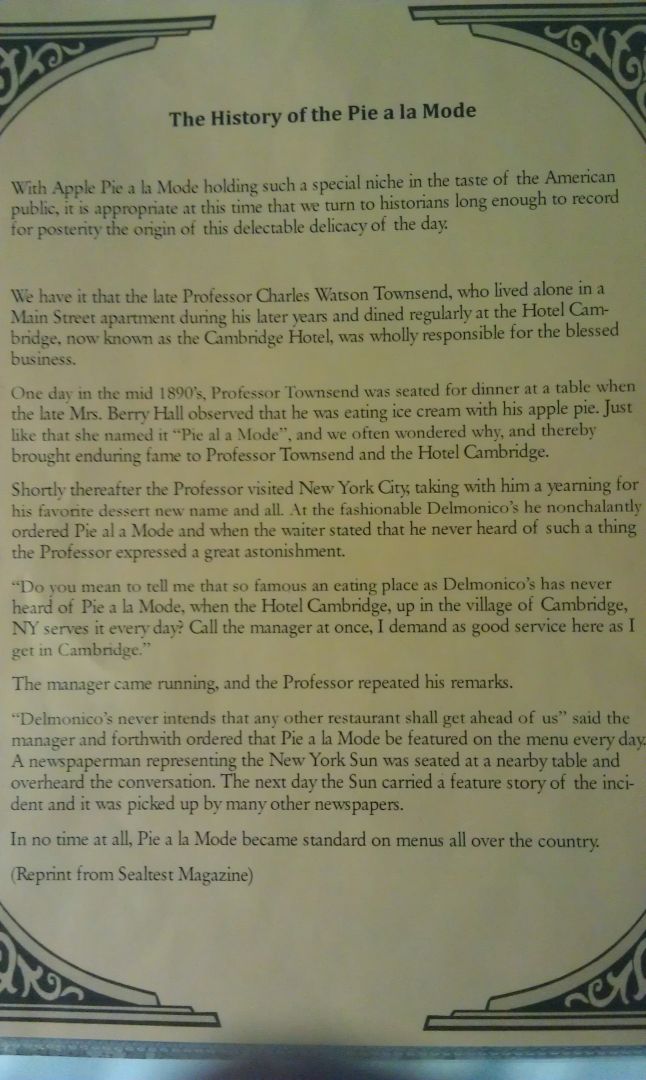
Before it closed, the hotel used to provide each guest room with a folder of information that included a page entitled “The History of the Pie a la Mode.”

A patron who stayed at the hotel shortly before it closed posted a photo online of this dubious history. Here’s how it begins:

“With Apple Pie a la Mode holding such a special niche in the taste of the American public, it is appropriate at this time that we turn to historians long enough to record for posterity the origin of this delectable delicacy of the day.

“We have it that the late Professor Charles Watson Townsend, who lived alone in a Main Street apartment during his later years and dined regularly at the Hotel Cambridge, now known as the Cambridge Hotel, was wholly responsible for the blessed business.

“One day in the mid 1890’s, Professor Townsend was seated for dinner at a table when the late Mrs. Berry Hall observed that he was eating ice cream with his apple pie. Just like that she named it ‘Pie al a Mode’ [sic], and we often wondered why, and thereby brought enduring fame to Professor Townsend and the Hotel Cambridge.”

The “history” goes on for four more paragraphs, but does not provide any evidence to support its claims that in the 19th century Townsend ordered apple pie and ice cream, or that Mrs. Hall suggested the name “pie à la mode.”

The hotel characterized this account as a “Reprint from Sealtest Magazine.” No date was given, but the Sealtest Dairy didn’t exist until dozens of years after the events described. Sealtest began life in 1935 as a research division of National Dairy Products, which was founded in 1923.

The hotel also passed along the story to the Ice Cream Review magazine in 1951, and it was later picked up by newspapers, websites, and other news media.

In our own searches of newspaper and literary databases, we could find no written evidence from the 19th century to support the claims that Townsend ordered pie à la mode in the 1880s or ’90s, or that Mrs. Hall suggested the name “pie à la mode” at that time.

The primary source for the story that Gieriet created pie à la mode in Duluth is a local historian, Mike Flaherty, who wrote a March 1, 2012, report that’s on file with the Duluth Public Library.

Flaherty’s report was cited on Wikipedia’s “Pie a la mode” page on March 27, 2013, and the so-called inventor of the dessert was changed on the page from Townsend to Gieriet on April 2, 2013.

In his unpublished report, which the Duluth library copied for us, Flaherty says pie à la mode is believed to have been invented on March 26, 1885, at the grand opening of the Hotel La Perl on West Superior Street in Duluth.

Flaherty discussed this in a May 21, 2013, interview with the Fox News TV station in the Twin Ports area of Duluth, Minn., and Superior, Wis.

He based his claims primarily on a May 23, 1936, article in the St. Paul Pioneer Press and an advertisement in the March 26, 1885, issue of the Duluth Daily Tribune. But neither item said John Gieriet invented or named pie à la mode.

The Pioneer Press article, headlined “An Invention in Doubt,” makes note of the AP report crediting Townsend “with having been the originator of this method of glorifying apple pie some 50 years ago.”

“However, there is some doubt as to where the distinction for this discovery really belongs, for Minnesota has a candidate,” the article says.

In the 1880s, it goes on, “the owner of a Superior Street café in Duluth introduced a delicacy which made an instant hit under a name which, in common parlance, was pronounced ‘pylie mode.’ ”

The article doesn’t identify the Duluthian, but notes that “he used blueberry pie precisely warmed to an exact degree of heat” as a “foundation for the ice cream,” as opposed to the apple pie favored by “the Townsend school.”

Like the AP article, however, the one in the Pioneer Press doesn’t offer any evidence to support the claim that  pie à la mode originated in Duluth in the 1880s or that it was pronounced “pylie mode” at the time.

And it doesn’t mention John Gieriet, who supposedly invented and named pie à la mode.

The March 26, 1885, advertisement in the Duluth Daily Tribune does mention Gieriet (it refers to him as “J. Gieriet”), but says nothing about pie à la mode. Here’s how it begins:

Hotel La Perl

The Hotel La Perl, formerly the Commercial, will be ready to receive guests Thursday, March 26th. The opening will be celebrated with a palatable dinner, from 12 o’clock till 2:30. A hearty welcome is tendered to the people of Duluth by the proprietor.

J. Gieriet, Proprietor.

The ad continues with a “Bill of Fare” that includes sections entitled “Pastry” and “Dessert.” The Pastry section includes blueberry pie and the Dessert section includes vanilla ice cream. But there’s no indication that two would be served together, and there’s no mention of “pie à la mode” or “à la mode.”

Gieriet sold the hotel a year later when his wife became ill, according to an article in the Aug. 13, 1886, issue of the Duluth Weekly Tribune.

If the date 1886 rings a bell, it’s because (as we mentioned earlier) the term “à la mode” was used in Duluth that year to refer to a meringue pie topped with whipped cream, not ice cream.

Help support the Grammarphobia Blog with your donation.
And check out
our books about the English language.

Categories
English English language Etymology Usage Word origin

How wonderful is wonderment?

Q: Which is more wonderful: “wonder” or “wonderment”? I wonder.

A: Standard dictionaries generally define the nouns “wonder” and “wonderment” much the same way: astonishment, awe, puzzlement, or something that arouses such emotions.

Is there a difference between the two words, aside from the extra syllable? Well, the Oxford English Dictionary describes the longer noun as “chiefly literary.”

Internet searches indicate that “wonder” is overwhelmingly more popular than “wonderment.” And many examples of the longer noun may seem stilted or affected to readers.

Of the two nouns, “wonder” is by far the oldest, dating back to Old English, Old Frisian, Old Saxon, Old Norse, and other early Germanic languages.

When the word “wonder” (wundor or uundra in Old English) first showed up, it meant “something that causes astonishment,” according to the OED.

The dictionary’s earliest citation is a reference to uundra gihuaes  (“wonder’s things”) from a hymn written around 700 by the Northumberland poet Cædmon.

And in the epic poem Beowulf, which is believed to date from the early 700s, many nobles travel great distances to “gaze upon the wonder” (wundor sceawian) of the monster Grendel’s tracks.

When the noun “wonderment” first appeared in the 1500s, it meant a wonder or the state of wonder.

The OED’s first citation is from a 1535 letter by William Barlow, prior of Haverfordwest Priory, to Thomas Cromwell, chief secretary of King Henry VIII.

In the letter, Barlow complains about the “most shamefull rumors raysed uppe to theyre dyffamacion, with slaunderouse wonderment of the towne.”

Help support the Grammarphobia Blog with your donation.
And check out
our books about the English language.

­

Categories
English English language Etymology Expression Phrase origin Usage Word origin

Getting along famously

Q: Any idea where the “get along famously” phrase originated? I like to use it as much as I can, but sadly I have the feeling that most people don’t know what I mean when I say it these days.

A: When the adverb “famously” showed up in English in the 16th century, it meant in a famous (that is, a widely known) manner, a sense that fell out of favor in the 19th century but had a revival in the 20th century.

The earliest example in the Oxford English Dictionary is from a 1579 religious tract by the Puritan theologian William Fulke: “Rome doeth set foorth the merites of Peter and Paule the more famously and solemnly.”

And here’s a more famous example from Shakespeare’s historical play Richard III (1597): “This land was famously enricht / With pollitike graue counsell.”

The OED doesn’t have any 20th-century examples of this sense, but here’s one from the Nov. 23, 2014, issue of the New York Times: “New Yorkers, both in lore and reality, can be hard to please, and famously outspoken about their grievances.”

The first Oxford citation for “famously” used in your sense of the word—to mean excellently or splendidly—is almost as old as the original meaning.

It comes from Coriolanus, a tragedy that Shakespeare wrote in the early 1600s: “I say vnto you what he hath done Famouslie, he did it to that end.”

The only Oxford example of “famously” used in a phrase similar to the one you’re asking about (“get along famously”) is from Edward Bannerman Ramsay’s Reminiscences of Scottish Life & Character (1858): “We get on famously.”

However, we’ve found a couple of earlier examples in Google Books, including this one from Strathern, an 1844 novel by Marguerite Blessington (the Countess of Blessington):

“The postboys get along famously. I had no notion that these cursed Italians, or their horses either, could go at such a pace.”

And, finally, here’s an example from The Watchman, an 1855 novel by James A. Maitland:

“George Hartley is getting along famously at Messrs. Wilson and Co.’s, and for two years past has been the managing clerk of the concern, with a salary of two thousand five hundred dollars a-year.”

Help support the Grammarphobia Blog with your donation.
And check out
our books about the English language.

­

Categories
English English language Etymology Usage Word origin

Craven images

Q: Standard dictionaries define “craven” as cowardly, but I can’t recall hearing or reading it used that way in the last 10 years. It’s usually used to mean brazen or shameless. Are the dictionaries just not keeping up on this one?

A: We’ve checked eight standard dictionaries and all of them define the adjective “craven” as meaning cowardly, though a couple include secondary senses. Collins lists mean-spirited and Random House lists dastardly.

You’re right that many people now use “craven” to mean brazen or shameless, but many others still use it in the traditional sense of cowardly.

For example, a recent column in the Portland Mercury, an alternative weekly in Oregon, uses the brazen or shameless sense when it refers to “a craven attempt” by industrialists to take over the city’s utility bureaus.

But a Nov. 10, 2013, article in the Atlantic uses the traditional meaning in commenting on the “craven decision” of Bloomberg News to curb critical stories from China to avoid angering the Chinese government.

We assume that lexicographers have the new sense on their radar. And if enough people use “craven” brazenly or shamelessly, we’ll be seeing the usage in dictionaries one of these days.

When the adjective “craven” first showed up in the 1200s (spelled crauant in early Middle English), it meant vanquished or defeated, but the Oxford English Dictionary says that sense is now obsolete.

John Ayto’s Dictionary of Word Origins says “craven” probably comes from cravente, Old French for defeated, but the OED is doubtful and describes the etymology of the term as “obscure.”

The earliest Oxford citation for “craven” is from a West Midland manuscript, dated sometime before 1225, about the perhaps apocryphal life of St. Margaret the Maiden and Martyr:

Ich am kempe ant he is crauant þet me wende to ouercumen (“I am a warrior, and he that expected to overcome me is craven”).

The cowardly sense of “craven” apparently showed up sometime before 1400 in the Alliterative Morte Arthure, an anonymous Middle English poem about King Arthur: Haa! crauaunde knyghte! a cowarde þe semez! (“Ha, craven knight! A coward you seem!”)

The OED has a question mark in front of the citation above, apparently unsure whether “craven” here is being used in the sense of defeated or cowardly. We lean toward the cowardly sense, since earlier in the poem the “craven knight” is described as one of a group of Romans who “cowered like puppies before the King’s person.”

We’ll end with a few lines from “The Ballad of High Noon” (perhaps better known as “Do Not Forsake Me, O My Darlin’ ”), as performed by Tex Ritter in the movie. It won the Oscar for best original song in 1952:

The noonday train will bring Frank Miller.
If I’m a man I must be brave.
And I must face that deadly killer
Or lie a coward, a craven coward,
Or lie a coward in my grave.

Help support the Grammarphobia Blog with your donation.
And check out
our books about the English language.

­

Categories
English English language Etymology Usage Word origin

One never knows, do one?

Q: Why do people use “one” instead of “I” or “me”? I would love to know the history of this one.

A: As you might guess, “one” is among the earliest words in recorded English.

In early Old English, it could be a noun or an adjective (expressing the simple numeral) as well as an indefinite article (an early version of “a” or “an”).

In later Old English, “one” took on various pronoun senses in which it could stand for a single person or thing.

But the usage you’re asking about represents a function of “one” that goes beyond any of these senses. In this usage, “one” is a third-person substitute for a first-person pronoun—that is, “one” stands in for the speaker.

At first, this “one” had a very broad sense and could mean anybody. Here’s how the Oxford English Dictionary defines this use of the pronoun:

“Any person of undefined identity, esp. one considered as representative of people in general; any person at all, including (esp. in later use) the speaker himself or herself; ‘you, or I, or anyone’; a person in general.”

People have been using “one” as a generic pronoun in writing since the early 1300s, according to OED citations. But this later example, from Shakespeare’s Romeo and Juliet (1597), will be more familiar: “Why Romeo may one aske?”

And here’s a 20th-century example from a favorite author of ours, Nancy Mitford: “One is not exactly encouraged to use one’s brain over here, you know.” (From her 1931 novel Highland Fling.)

The use of “one” to mean oneself exclusively—that is, the speaker instead of just anyone—is a further refinement of the pronoun. And we use “refinement” deliberately, since the use of “one” to mean “I” or “me” strikes many people as over-refined.

This narrower use dates from the 18th century and, according to the OED, is “associated esp. with British upper-class speech, and now freq. regarded as affected.”

The earliest example cited in Oxford is a line spoken by an affected young lady in The Provok’d Husband (1728), a play by Colley Cibber and John Vanbrugh:

One has really been stufft up in a Coach so long, that—Pray Madam—could not I get a little Powder for my Hair?”

This more recent citation is from Frank Johnson’s Out of Order (1982), a collection of political sketches: “How to persuade the Telegraph that … one was a man of immense culture? (Saying ‘one’ when you mean ‘I’ would do for a start, I decided.)”

But whether you use “one” to mean “I/me” or an indefinite someone, it’s a third-person singular pronoun. So grammatically it’s treated like “he/him” or “she/her,” even when it implies “I/me.”

The possessive form of the pronoun is “one’s,” and the reflexive is “oneself.” Those forms, however, as well as “one” used as an object rather than a subject, are more characteristic of British than American speech.

As the OED explains, the forms “his, him, himself … are still usual in the U.S.; thus, ‘If one showed oneself (himself) to one’s (his) townsmen, they would know one (him).’ ”

Incidentally, we once heard from a reader who was bugged by the use of “you” as an indefinite pronoun in place of “one”, as in “You meet all kinds” instead of “One meets all kinds.” As we replied in a post, this use of “you” is standard English.

Finally, we’d like to expand on our comment at the beginning that “one” was an early version of “a” or “an.”

In addition to its numerical sense, the Old English word for “one” (written an, aan, ane, etc.) had a sense that was indistinguishable from the indefinite article (“a” or “an”) in modern English.

For example, an fugel meant both “a fowl” and “one fowl”; ane burh meant both “a fortress” and “one fortress.” The words for the indefinite article and the adjective weren’t differentiated until the Middle English period.

In fact, as we’ve written on our blog, “one” still serves as an indefinite article in some varieties of English, mainly in India, the Caribbean, Hawaii, and parts of the US South.

Oxford gives several examples, including this one from the Indian English Supplement to the Advanced Learner’s Dictionary of Current English (5th ed., 1996): “I met one lady the other day.”

In the immortal words of Fats Waller, “One never knows, do one?”

[Note, Dec. 28, 2014. A reader writes: “I always thought the use of ‘one’ as a pronoun had to be related to the French pronoun on, which means essentially the same thing.  Is this etymologically significant?” Our reply: The evolution of “one” as an indefinite generic pronoun developed in late Middle English, and some have suggested that it may have been influenced by Anglo-Norman (hom, on, un), or by Old or Middle French. But as the Oxford English Dictionary says, “this is not regarded as a necessary influence by some scholars.” In other words, the developments could have been parallel.]

Help support the Grammarphobia Blog with your donation.
And check out
our books about the English language.

­

Categories
English English language Etymology Expression Phrase origin Usage Word origin

Let’s talk turkey

Q: How did our native Thanksgiving bird get named for a country at the crossroads of Europe and Asia?

A: Yes, turkey, the main event at Thanksgiving dinners in the US, is native to the Americas.

The big bird came to the attention of Europeans in 1518 when the Spanish conquistador Juan de Grijalva encountered it in Mexico. The following year, Hernán Cortés found turkeys being domesticated by the Aztecs.

Knowing a good thing when they saw it, the Spanish soon transplanted the turkey (Meleagris gallopavo) to Europe.

(Columbus may have come across the bird in Honduras in 1502 on his fourth voyage, but it’s unclear whether the fowl that he referred to as gallina de la tierra, or land hen, was actually a turkey.)

But why, you ask, is the bird called a “turkey”? The reason is that Europeans confused it with the  guinea fowl, an African species that was very briefly referred to as a “turkey” because it was thought to have been imported into Europe by way of Turkey.

The word “turkey” first began showing up in English as the name of the bird in the mid-16th century, according to the Oxford English Dictionary.

For example, Thomas Tusser’s book Fiue Hundreth Points of Good Husbandry Vnited to as Many of Good Huswiferie (1573) suggested that the Christmas table should include “shred pies of the best … & Turkey wel drest.”

The turkey is a noble bird, and in 19th-century North America the term “turkey” was often used figuratively in colloquial expressions that were generally positive.

For instance, to “talk turkey,” an expression first recorded in 1824, means to speak openly or frankly.

But pejorative uses of “turkey” eventually crept in.

In the 1920s, “turkey” came to be used as slang for an inferior theatrical or movie production. In other words, a flop.

The OED’s first example is from the American magazine Vanity Fair in 1927: “ ‘A turkey’ is a third rate production.”

The slang expression was soon extended to other kinds of failures and disappointments.

This example comes from James M. Cain’s novel Mildred Pierce (1943): “The beach … was studded with rocks and was therefore unsuitable to swimming. For all ordinary purposes it was simply a turkey.”

Later, in the early 1950s, “turkey” became a slang word for a stupid or inept person.

Incidentally, in case you’re wondering why the leg of a turkey or chicken is called the “drumstick,” check out a blog post we wrote in 2012.

No matter which part of the turkey you prefer, we hope that you and all our other readers will enjoy Thanksgiving dinner with your families tomorrow, a holiday that’s often referred to as “Turkey Day.”

The expression was first recorded, the OED says, in the Nov. 23, 1870, issue of the Hartford Courant: “To-morrow is turkey day, gobbler’s day, or the day when the gobbler is gobbled.”

Help support the Grammarphobia Blog with your donation.
And check out
our books about the English language.

Categories
English English language Etymology Expression Phrase origin Usage Word origin

Queues and lines

Q: I am given to understand that what is referred to as a “line” of people in the US is called a “queue” in the UK, though both Americans and British use “queue” the same way in its computer sense. How did all this come about?

A: Broadly speaking, you’re right—people ranked in an orderly sequence and waiting for something will be called a “line” in the US and a “queue” in the UK.

In Britain, violators who don’t take their turn are “jumping (or barging) the queue.” In North America, those who cheat are “cutting in line.”

However, the division between “line” and “queue” isn’t as clear as all that. The British used “line” for “queue” in the distant past, and some Americans have begun to use “queue,” probably influenced by British usage rather than by computer terminology.

But how did that broad general rule come to pass? Here’s the story.

“Line” is an extremely old word, dating back as far as the 600s in Old English. This word, like the equally ancient “linen,” has its source in the Latin linum (flax), and the earliest sense of “line” was flax—either spun into thread or woven into cloth.

So etymologically, a “line” is a linen thread. Even in Latin, the word linea (line), a derivative of linum, originally meant a linen thread, according to the Oxford English Dictionary.

Later senses of the word in English preserved this notion of a “line” as something stringlike—a narrow mark resembling a long string; a row of letters set into type; a string of objects or people, and so on.

The written use of “line” to mean a row of people dates to the late 16th century, the OED notes.

Shakespeare used “line” this way in Macbeth (circa 1606) in reference to a procession of ghostly kings: “What will the Line stretch out to’ th’ cracke of Doome?”

This sense of the word persists in American English, but the British replaced it in the 19th century with “queue,” a French word that originally meant “tail” and has roots in the Latin cauda (tail).

In English, “queue” didn’t originally mean a line of people. It was used in the 1400s to mean a band of parchment or vellum attached to a letter, according to the Chambers Dictionary of Etymology.

And in the 1500s, as John Ayto writes in his Dictionary of Word Origins, “queue” appeared in descriptions of heraldic shields and meant the tail of a beast.

Imaginative metaphorical uses appeared in the 1700s, etymologists say, when the word came to mean a braid (or “pigtail”), and a billiard stick (spelled “cue”).

Meanwhile, the French too were using their word queue in imaginative ways. In the 1790s, the OED says, French speakers began using queue to mean a “line or sequence of people waiting their turn to proceed or to be attended to.”

This usage leaped across the Channel in the following century. The OED’s earliest written example in English is from Thomas Carlyle’s The French Revolution (1837):

“That talent … of spontaneously standing in queue, distinguishes … the French People.”

Oxford says this use of “queue” is “chiefly British,” and the Dictionary of Word Origins says it “has never caught on in American English.” That explains why Chicagoans stand in a “line” while Liverpudlians form a “queue.”

The Americans, of course, are “lining” up. But how is the British participle spelled? Both “queuing” and “queueing” are correct, according to Fowler’s Modern English Usage (rev. 3rd ed.).

[Update, Dec. 16, 2014. A reader from New Zealand writes to comment: “Here in NZ, and I suspect the UK, we use both ‘queue’ and ‘line (up).’ While obviously related, there is a distinct difference between the two. We ‘queue’ as a way for many people to wait to receive service in an orderly fashion, while we ‘line up’ in order to proceed as a structured group. So we ‘queue’ to make a deposit at a bank, but we ‘line up’ to enter a classroom or to begin a parade. ‘Queue’ implies waiting your turn, while ‘line up’ implies organising prior to moving as a unit.”]

As for the computer sense of “queue,” the OED defines it as “a list of data items, commands, etc. stored so as to be retrievable in a definite order, usually the order of insertion.”

However, the earliest citation in the dictionary (from Automatic Data Processing, a 1963 book by F. P. Brooks and K. E. Iverson) refers to a queue in which the items are retrievable in the reverse order of insertion:

“The queue of components in the pool therefore obeys a so-called last-in-first-out, or LIFO discipline.”

[Update, Jan. 12, 2015. A reader notes that the Brooks and Iverson citation “was written in 1963 when dinosaurs roamed the earth and the terminology was still in a state of flux. What they describe as a ‘queue’ is what we would call a ‘stack’ in today’s jargon.”]

Help support the Grammarphobia Blog with your donation.
And check out
our books about the English language.

­

Categories
English English language Etymology Expression Phrase origin Usage Word origin

How healthy is “healthcare”?

Q: Here’s a headline from an editorial in the journal Health Care Management Review: “It’s health care, not healthcare.” What are your thoughts?

A: With Ebola still in the news, we’re seeing a lot of this term, and it’s written every which way—sometimes one word and sometimes two, sometimes with a hyphen and sometimes without.

Standard dictionaries are all over the place, but in our opinion the term is well on its way to being accepted by lexicographers as a solid word.

It’s not there yet, though, so our advice is to go with whichever dictionary or style manual you usually follow.

The style guides of the New York Times and the Associated Press, for example, recommend separating “health care.” The Times adds that the phrase shouldn’t be hyphenated when used adjectivally.

However, the one-word version is the only one listed in the online Oxford Dictionaries and the Cambridge Dictionaries Online.

“Healthcare” is also the more common version given in Webster’s New World College Dictionary (4th ed.), with the two-worder listed as an acceptable variant.

On the other hand, The American Heritage Dictionary of the English Language (5th ed.) gives “health care” as the more common form, with “healthcare” as a variant. When the term is used adjectivally, a third variant, “health-care,” is added.

Merriam-Webster’s Collegiate Dictionary (11th ed.) sticks with “health care” as the noun. It adds, though, that the term is “usually hyphenated” as an attributive adjective (as in “health-care standards”).

And here’s an oddity. The online Macmillan Dictionary, in its British and its American editions, lists “health care” as the noun and “healthcare” (no hyphen) as the adjective derived from it.

The Oxford English Dictionary gives the noun usage as “health care,” but the dictionary notes that its overall “health” entry “has not yet been fully updated.”

The OED says the compound noun, which it defines as “care for the general health of a person, community, etc., esp. that provided by an organized health service,” originated in the US.

The earliest Oxford  citation is from a pamphlet, Health Care for Children, published by the United States Government in 1940: “State and local agencies will need to make available to the staff information in regard to the facilities for health care.”

The attributive adjective is hyphenated in the OED examples: “health-care systems” (1973) and “health-care workers” (1985).

However, we’ve found much earlier examples of “health care” and “health-care.”

An 1883 issue of Popular Science Monthly referred to a paper entitled “The Health Care of Households, with Especial Reference to House Drainage,” presented at a conference the previous year by Dr. Ezra M. Hunt.

And in the early 20th century, the hyphenated term appeared in the titles of two books by Dr. Louis Fischer, The Health-Care of the Baby (1906) and The Health-Care of the Growing Child (1915).

The single word version, “healthcare,” seems to be a relatively new phenomenon. The earliest examples we could find in a search of Google Books date from the mid-1990s.

In Legal and Healthcare Ethics for the Elderly, a 1996 book by George Patrick Smith, for example, the author proposes a “new healthcare delivery ethic for the elderly.”

As we’ve said, our guess is that “healthcare” will one day be more widely accepted. Why? Because familiar nouns that are compounds tend to become joined over time, as with “daycare,” “childcare,” and “eldercare.”

In fact, our Google searches suggest that “healthcare” is already somewhat more popular than “health care.”

Help support the Grammarphobia Blog with your donation.
And check out
our books about the English language.

­

Categories
English English language Etymology Grammar Linguistics Usage Word origin

Hear Pat live today on WNYC

She’ll be on the Leonard Lopate Show around 1:20 PM Eastern time to discuss the English language and take questions from callers. Today’s topic: On Thanksgiving tables, New World foods with Old World names. If you miss the program, you can listen to the show  on Pat’s WNYC page.
Categories
English English language Etymology Expression Phrase origin Usage Word origin

A little black dress

Q: What is the origin of the phrase “little black number,” synonymous with Coco Chanel’s “little black dress”? Why is it called a “number”?

A: The word “number” is often used in ways that have nothing to do with arithmetic, and this is one of them. Since the late 19th century, according to the Oxford English Dictionary, “number” has been used to mean “an article of clothing.”

The OED’s earliest citation comes from The Real Charlotte (1894), a novel by Edith Somerville and Martin Ross. It has a passage describing shop windows that “had progressed … to straw hats, tennis shoes, and coloured Summer Numbers.”

The OED’s next two examples appear to use “number” to mean, more specifically, a dress:

“Deedee had swathed herself in an afternoon number” (from the Ladies’ Home Journal, 1935), and “an exquisite but throat-high ‘little number’ redeemed by lumps of jade” (from Marguerite Steen’s novel Anna Fitzalan, 1953).

So “little black number” is another way of saying “little black dress,” a phrase from the 19th century that’s almost a cliché in the fashion world today.

Here are just a few of the many references to a “little black dress” that we’ve found in Google searches:

“Then her aunt went to a wardrobe which stood at one end of the room, and brought out a parcel, which she opened, and inside Rosalie saw a beautiful little black dress very neatly and prettily made.” (From A Peep Behind the Scenes, an 1877 novel by Mrs. O. F. Walton.)

“All the time she was braiding my hair, and fastening my little black dress, I was growing sick with dread.” (From “Ma’amselle Fèlice,” a short story by Julia Schayer, published in January 1884 in Swinton’s Story-Teller, a New York literary magazine.)

“Look at her little black dress—rather good, but not so good as it ought to be.” (From Henry James’s novel The Awkward Age, 1899.)

“She wore a simple little black dress that had cost her thirty guineas, and was quite right. She had not been in the Hall ten minutes before bright-eyed Anna Kays had made some very useful mental notes of the simple little black dress.” (From Lindley Kays, a 1904 novel by the British humorist Barry Pain.)

But “little black dress” wasn’t an only child—it had a sister with the same meaning, the “little black frock.” The OED dates “little black frock” back to 1898, when it appeared in an issue of the Manchester Times:

“If I lived in such a place as Northtowers for a continuance, I would buy a little black frock, and when that was worn out I would buy another little black frock, and when that was done with I would build another on the same pattern.”

And, as the OED notes, this clever garment also made an appearance in Henry James’s novel The Wings of the Dove (1902): “She might fairly have been dressed tonight in the little black frock … that Milly had laid aside.”

Until the end of World War I, all such references (whether to a dress or a frock) simply meant a dress noted for being little—the implication is unfussy—and black. But the fashion industry of the 1920s changed all that.

In the world of designer fashion, “little black dress” came to have a more specific meaning, one identified with the fashion houses of Edward Molyneux and Coco Chanel.

Here’s the OED’s definition of this chic fashion classic: “a simple black one-piece garment regarded as an important item of a woman’s wardrobe, suitable for wearing at most kinds of relatively formal social engagement.”

The OED’s earliest citation is from a 1928 issue of the Times (London): “For the afternoon there are simple little black dresses with frilled and draped skirts.”

And here’s the word from Woman & Beauty magazine in 1951: “Invest your all in one good little black dress.”

The phrase became so much a part of the apparel world that it earned a definition in Janey Ironside’s book A Fashion Alphabet (1968):

Little black dress. This highly useful garment was at first almost the trademark of the British designer, Molyneux, who perfected it as an ‘after 6’ look in the cocktail party era between 1920 and 1939. The ultimate in sophistication then, it is still much in demand.”

When Vogue ran a feature on Chanel’s little black dress in 1926, the magazine referred to the LBD as “Chanel’s Ford,” a reference to the popular Model T car, according to The Little Black Dress, a 1998 book by Amy Holman Edelman.

Interestingly, a Newsweek review of Coco, a 1969 Broadway musical, uses both “dress” and “number” in describing a musical routine that featured one of Cecil Beaton’s costumes as “the ‘little black dress’ number.”

In case you’re wondering why the adjectives in “little black dress” appear in that order (not “black little dress”), we once wrote a post on the subject.

But before leaving your original question, about “little black number,” we should point out that we owe “number” to the classical Latin word numerus (sum, total, numeral, number). It has been part of English since around 1300.

And as we noted above, “number” has had many nonmathematical meanings. Here are some of them, along with the dates they were first recorded in the OED:

A single issue of a publication (1728); a person’s fate or doom, as in “his number is up” (1804); a character assessment, as in “to get someone’s number” (1853);  an item in a musical program (1865); a theatrical routine (1908); any person or thing referred to colloquially, as in “that corkscrew is a nice little number” (1903); a reefer or other quantity of marijuana (1963); and an adverse effect, as in “to do a number” on someone (1968).

Help support the Grammarphobia Blog with your donation.
And check out
our books about the English language.

­

Categories
English English language Etymology Usage Word origin

A doozy of an etymology

Q: Do you have any information on the word “ripstaver”?

A: A “ripstaver” is an impressive person or thing—a beaut, a corker, a crackerjack, a doozy, a humdinger, a knockout, a lollapalooza, a jim-dandy, or a ripsnorter.

The Oxford English Dictionary describes the word as a colloquialism that originated in the US in the early 19th century and is now archaic.

The earliest example of the usage in the OED is from an 1828 issue of the Bower of Taste, a short-lived magazine in Boston: “She beheld him striding down the street, lustily exclaiming to himself, ‘She’s a ripstaver, so help me Davy Rachel!’ ”

The dictionary’s next citation is from the anonymously published Sketches and Eccentricities of Col. David Crockett of West Tennessee (1833): “In ten minutes he yelled enough, and swore I was a ripstavur.”

Although the OED describes the usage as archaic, it has three 20th-century citations, including this one from Maggie: A Love Story, a 1993 memoir by the author John B. Sanford about his marriage to the screenwriter Maggie Roberts:

“That was one ring-tailed roarer he singled out, and no mistake, a regular rip-staver, a pure jim-dandy.”

The dictionary says the noun “ripstaver” is derived from two verbs: “rip” (to tear in a forceful way) and “stave” (to break up a cask into staves). The later noun “staver” (1860) refers to an energetic person—that is, one who is continually staving about.

The phrasal verb “stave off” now means to hold off or repel. The American Heritage Dictionary of the English Language (5th ed.) gives this example from the New York Times:

“For 12 years, we’ve sought to stave off this ultimate threat of disaster.”

Help support the Grammarphobia Blog with your donation.
And check out
our books about the English language.

­

Categories
English English language Etymology Phrase origin Usage Word origin

How to capitalize food names

Q: I’m never sure about how food names are capitalized. Is it “Waldorf salad” or “waldorf salad”? “Swiss cheese” or “swiss cheese”? “French fries” or “french fries”? And so on.

A: The one thing we can tell you for sure is that the generic noun in these dishes—the “salad,” the “fries,” and so on—is lowercased.

But should the other part of the name be capitalized if it’s derived from a proper name, like “Waldorf” or “French” or “Caesar”? On that point, dictionaries and usage guides disagree. In some cases, their policies have more holes than swiss cheese.

We’ll start with the argument against capitals, which can be found in The Chicago Manual of Style (16th ed.):

“Personal, national, or geographical names, and words derived from such names, are often lowercased when used with a nonliteral meaning.” Note that the manual emphasizes the word “nonliteral.”

For example, the editors write, “the cheese known as ‘gruyère’ takes its name from a district in Switzerland but is not necessarily from there; ‘swiss cheese’ (lowercase s) is a cheese that resembles Swiss emmentaler” but doesn’t come from Switzerland.

Thus the manual’s list of terms derived from proper names includes these lowercase examples: “brie,” “brussels sprouts,” “cheddar,” “dutch oven,” “frankfurter,” “french dressing,” “french fries,” “scotch whisky,” “stilton,” and “swiss cheese” (not made in Switzerland).

The Chicago Manual doesn’t specifically mention the salads named for the Waldorf-Astoria Hotel and the chef Caesar Cardini. We assume from its guidelines that Chicago would recommend “waldorf salad” and “caesar salad.”

The style guide acknowledges that while it prefers to lowercase proper names “in their nonliteral use,” some such names “are capitalized in Webster’s.”

Sure enough, Merriam-Webster’s Collegiate Dictionary (11th ed.), like the online Merriam-Webster Unabridged, has entries for both “Waldorf salad” and “Caesar salad.”

M-W Collegiate doesn’t seem as consistent here as the Chicago Manual. For example, the dictionary lowercases “napoleon” (the pastry gets its name from Naples, not from the emperor).

It also lowercases “crêpes suzette” (named after a real Suzette), as well as “brussels sprouts” and “french fries,” but notes that in these cases the parts derived from proper names are “often cap.”

And in one rather baffling entry, the M-W Unabridged has “Baked Alaska,” with “baked Alaska” given as a lesser alternative. (Why the folks at M-W would prefer to capitalize “baked” is beyond us.)

The American Heritage Dictionary of the English Language (5th ed.) leaves us scratching our heads, too. It capitalizes the first term in “Brussels sprouts” and “French toast,” but lowercases “french fries” and “caesar salad.”

Our former employer, the New York Times, recommends in its style guide that “crêpes suzette,” “napoleon” (the pastry), “brussels sprouts,” and “baked alaska” be lowercased. But it capitalizes the first word in “Bavarian cream” and always capitalizes “French” in food names (“French fries,” “French dressing,” “French toast,” etc.).

The conclusion? If you want to be consistent, pick one route or the other: (1) Always capitalize food terms derived from proper names, or (2) lowercase them when there’s no longer a literal connection.

In the end, there’s no right or wrong here. This is a stylistic issue, and if lexicographers can’t agree, the rest of us shouldn’t lose sleep over it. Bon appétit!

Help support the Grammarphobia Blog with your donation.
And check out our books about the English language.

­

Categories
English English language Etymology Usage Word origin

The “c” word in fact and fiction

Q: In Colleen McCullough’s historical novel Fortune’s Favorites, one of the characters mentions the Latin term cunnus, which I found means vagina. So Latin is apparently the source of the dirtiest word in the English language, right?

A: No, the word “cunt” is not derived from Latin—it came into English from ancient Germanic sources.

It’s possible that the Latin and Germanic words came from the same Indo-European root, but the Oxford English Dictionary is doubtful because of the presence of the letter “t” in the Germanic words, but not in Latin.

The OED says the “t” in Old Frisian kunte, Old Icelandic kunta, Middle Low German kunte, and other Germanic sources “would not be easy to explain.”

On the Internet, you’ll find lots of nonsense about the origins of “cunt,” including suggestions that it’s an ancient word for “goddess.”

We discussed “cunt” in Origins of the Specious, our book about language myths and misconceptions. Here’s what we had to say:

“The usual story, which is quoted from one end of the blogosphere to the other, goes something like this: ‘cunt’ is a sacred ancient word derived from the terms cunti or kunda, titles of the Hindu goddess Kali.

“The truth is more down-to-earth. There’s no evidence that ‘cunt’ comes from the title of a goddess, Hindu or otherwise. It’s a very old English word going back to the Middle Ages, when it meant, as it does today, ‘the female external genital organs,’ according to the OED. The earliest surviving reference (spelled ‘cunte’) appeared around 1325 in the Proverbs of Hendyng, a collection of religious and moral advice from the 1200s and perhaps earlier. In one of the precepts (I’m roughly translating the Middle English), women are advised to ‘Give thy cunte wisely and ask for marriage.’

“Language researchers have discovered even older references within English surnames and street names. The last name Sitbithecunte (sounds like a spoof, doesn’t it?) appeared in 1156 in the Norfolk public records. And Gropecuntelane was a red-light district in London around 1230. It was later called Grub Street (Samuel Johnson lived there), then Milton Street, near what is now the Barbican Centre for performing arts.

[A March 2014 update in the third edition of the OED has even earlier sightings of the use of “cunt” in personal names and place names. The earliest (cuntan heale) is in a land charter recorded in 960.]

“The source of all these words, according to the OED, is believed to be a prehistoric Germanic root that linguists have reconstructed as kunton. That’s about all we can say for sure about the origin of ‘cunt.’ Everything else is speculation, some of it more plausible than the rest. The most unlikely theory is that ‘cunt’ comes from a similar-sounding word like cunti or kunda in Sanskrit, the language of the Hindu holy books.”

We go on to say in Origins of the Specious that English has borrowed lots of words from the languages of India (including “candy,” “guru,” “mantra,” “nirvana,” “yoga,” “bandanna,” “cot,” “dungaree,” “juggernaut,” “jungle,” “loot,” “pundit,” and thug”). But no reputable linguist or etymologist has ever suggested that “cunt” is one of them. Here’s why:

“Most of the words that we’ve adopted from India entered the language during the English colonization of the subcontinent, from the early 1600s until the mid-1900s, well after ‘cunt’ was established in England. And the majority of the Indian words either didn’t have English equivalents or were trendy alternatives. It’s unlikely that we would have adopted an Indian word for such a basic body part.

“Granted, cunti and kunda sound like ‘cunt.’ But could a sound-alike in Sanskrit have given birth to that ancient Germanic root kunton, which presumably gave us the c-word? No way, according to linguists who have studied the ancient languages of Europe and Asia.”

As we say in the book, things here get a bit complicated. Read on:

“Way back when, both Sanskrit and ancient Germanic evolved from Indo-European, a prehistoric language that developed in different ways in different parts of the world. An Indo-European word something like peter, for instance, evolved into pitar in Sanskrit and fadar in ancient Germanic, giving us the modern words vater in German and ‘father’ in English. In ancient times, a ‘k’ sound in a Sanskrit word (like kunda) would have been an ‘h’ sound in Germanic. And a ‘k’ sound in an ancient Germanic root (like kunton) would have been a ‘g’ sound in Sanskrit. Linguists call this sound shift Grimm’s Law. In plain English, we couldn’t have gotten ‘cunt’ from cunti or kunda or any Hindu holy word starting with a ‘k’ sound.”

We go on to say that while the root of “cunt” isn’t divine, it’s not smutty either.

“The ‘cu’ sound in Old English (spelled cwe), like the ‘gu’ sound in ancient Sanskrit, stood for the essence of femininity. The Old English cwithe (‘womb’) was certainly nothing to be ashamed of, and neither was cwene (‘queen’). Sharing this ancestry is our ‘cow’ and the sacred go (pronounced ‘gow’) in Sanskrit.”

[Note, June 8, 2023: In Old English, the word gecyndlim or cyndlim (from cynd, nature or kind, and lim, limb) referred to either male or female reproductive organs.

Here’s an example from Luke 2:22 in The Bath Old English Gospels, written in the West Saxon dialect at Bath Abbey in the 11th century (Luke 2:22-23 in modern translations):

“& æfter þam þe hyre clænsunge dagas gefyllede wæron æfter Moyses æ, hi læddon hyne on Hierusalem þæt hi hine gode gesettun swa swa on drihtnes æ awriten is, þæt ælc wæpned gecyndlim ontynende byð Drihtne halig genemned.”

“And after the days of her purification were fulfilled according to the Law of Moses, they brought him to Jerusalem to present him to God, as it is written in the Lord’s law, ‘Every male that opens the womb shall be called holy to the Lord.’ ”

Help support the Grammarphobia Blog with your donation.
And check out
our books about the English language.

­

Categories
English English language Etymology Grammar Usage Word origin

Is it “shined” or “shone”?

Q: I use “shined” with an object and “shone” without one. But lately I’ve read a lot of books whose authors use “shined” in all contexts. Have you ever written on the difference between those two words?

A: No, we haven’t written about the the verb “shine,” but thanks for giving us the opportunity.

Standard dictionaries generally accept either “shone” or “shined” as the past tense and past participle of “shine.”

However, the dictionaries often note that the past tense and past participle are usually “shone” when the verb is intransitive and “shined” when it’s transitive.

A verb is transitive when it needs an object to make sense (“He shined his shoes”) and intransitive when it makes sense without one (“The sun shone”).

The American Heritage Dictionary of the English Language (5th ed.), one of seven standard dictionaries we checked, has a good explanation of all this.

“By tradition,” American Heritage says in a usage note, “the past tense and past participle shone is used when the verb is intransitive and means ‘to emit light, be luminous’: The full moon shone over the field.

On the other hand, the usage note continues, “shined” is the form “normally used when the verb is transitive and means ‘to direct (a beam of light)’ or ‘to polish,’ as in He shined his flashlight down the dark staircase or The butler shined the silver.

American Heritage says its usage panel, in a 2008 survey, “found both forms acceptable in transitive literal use (shone/shined the light) and in figurative intransitive use (Carolyn always shined/shone at ribbon-cutting ceremonies).”

However, the usage note says “a larger majority preferred the traditional usages (shined the light; shone at ceremonies) over the nontraditional ones, so maintaining the traditional distinction remains a sensible practice.”

As for the etymology, the verb “shine” is a Germanic word that first appeared in Old English in the early eighth century, spelled scynan, scine, scaan, and so on.

The earliest citation in the Oxford English Dictionary is from a glossary of Latin and Old English, dating to around 725: Ardebat, scaan. (In Latin, ardebat means burns, glows, or sparkles.)

The spelling of the past tense roughly evolved from scan and scean in Old English to scean, schon, shoon, etc., in Middle English, and finally to shone and shined in the 1500s, during the early Modern English period.

In Shakespeare’s A Midsummer Night’s Dream (written in the 1590s), for example, Hippolyta says: “Well shone, Moon. Truly, the moon shines with a good grace.”

As for the past participle, the OED says early versions of “shined” were popular in Middle English, while “shone” was rarely seen until the second half of the 16th century.

We’ll end with an example of the past participle from Miss Dividends, an 1892 novel by Archibald Clavering Gunter: “His large boots have been very brightly shined by the boot-black on the corner opposite.”

Help support the Grammarphobia Blog with your donation.
And check out
our books about the English language.

­

Categories
English English language Etymology Usage Word origin

Overwhelm, underwhelm, whelm

Q: I’ve heard the verb “overwhelm” all my life. In recent years, I’ve been hearing “underwhelm” used in a sarcastic tone. Was “whelm” ever a verb?

A: Yes, “whelm” was—and still is—a verb. Though it’s not overwhelmingly popular today, “whelm” is a fine old word with roots that may go back to Anglo-Saxon times.

When the word “whelm” showed up sometime around 1300 (spelled quelm or welme in Middle English), it meant to overturn or capsize, but that sense is now obsolete, according to the Oxford English Dictionary.

The OED’s earliest citation is from the Northumbrian poem Cursor Mundi: Quen þe scip suld quelm and drunken (“When the ship should overturn and sink”).

The OED notes that an older verb, “whelve,” dating from around 1200, meant to turn upside down or roll over, but it’s now obsolete except in dialectal use.

Oxford raises the possibility that the original source of “whelm” may have been the Old English word hwelman, or perhaps hwelfan, the Old English source of “whelve.”

In contemporary English, according to The American Heritage Dictionary of the English Language (5th ed.), the word “whelm” means to submerge or overwhelm.

Oxford Dictionaries online offers this example of “whelm” used in the sense of submerge: “a swimmer whelmed in a raging storm.”

And Merriam-Webster’s Collegiate Dictionary (11th ed.) has this example of the word used in the sense of overwhelm: “whelmed with a rush of joy.”

As for the verb “overwhelm,” it meant “to overturn, overthrow, upset; to turn upside down” when it showed up in the 1300s, but the OED describes that sense as obsolete.

The modern sense of “to bring to sudden ruin or destruction; to engulf; to crush; to defeat utterly or conclusively” appeared in the early 1400s.

The dictionary’s earliest citation is from Troyyes Book, John Lydgate’s 1425 Middle English poem about the rise and fall of Troy: O ydel fame, blowe up to þe skye, Ouer-whelmyd with twyncling of an eye!

The sense of to overcome or overpower someone with emotion showed up in the early 1500s. The OED’s first citation is from the Coverdale Bible, a 1535 translation of the Bible in modern English: “An horrible drede hath ouerwhelmed me.”

The newcomer here, as you point out, is “underwhelm,” which showed up in the mid-20th century, according to citations in the dictionary.

The OED defines the verb as “to leave unimpressed, to arouse little or no interest in.” However, the dictionary says the word is chiefly seen in its adjectival forms “underwhelmed” and “underwhelming.”

The dictionary’s earliest example of the usage is from Giant Corporations (1956), by T. K. Quinn. The author, commenting on a price reduction at a time of rising prices, says, “I was underwhelmed, and investigated.”

We’ll end with a dramatic example of “whelm” from Milton’s Paradise Lost (1667), where Abdiel warns Satan that God “with solitary hand / Reaching beyond all limit, at one blow, / Unaided, could have finished thee, and whelmed / Thy legions under darkness.”

Help support the Grammarphobia Blog with your donation.
And check out
our books about the English language.

­

Categories
English English language Etymology Usage Word origin

Fulsome and then some

Q: At a news conference the other day, the Pentagon press secretary, Rear Adm. John Kirby, referred to having “a more fulsome discussion” of Iraq/Syria strategy. Hmmm. Is Admiral Kirby right to use the word this way? I, the traditionalist, think “fulsome” means excessive, not abundant.

A: We discussed “fulsome” on the blog in 2007, but it’s probably time to take another look at this troublesome adjective.

To begin at the beginning, the word “fulsome” meant simply “abundant” when it first appeared in writing back in 1250, according to the Oxford English Dictionary.

Over the centuries, it came to mean overdone, cloying, gross, nauseating, disgusting, loathsome, foul, and so on. In the 18th century, in fact, it was sometimes spelled “foulsome.”

Nearly all of those negative senses, the OED says, are now considered obsolete. The dictionary says the adjective “fulsome” is “now chiefly used in reference to gross or excessive flattery, over-demonstrative affection, or the like.”

However, the dictionary acknowledges that its “fulsome” entry, which was originally published in 1898, “has not yet been fully updated.”

Today, some standard dictionaries include “abundant” as either a standard or an informal meaning of “fulsome.”

The up-to-date Oxford Dictionaries online, for example, defines “fulsome” as either “complimentary or flattering to an excessive degree,” or “of large size or quantity; generous or abundant.” Both senses are treated as standard English.

The Oxford Dictionaries website site gives this example of the first sense: “the press are embarrassingly fulsome in their appreciation.” And it gives this example of the second: “the fulsome details of the later legend.”

Merriam-Webster’s Collegiate Dictionary (11th ed.) also lists the “abundant” sense of “fulsome” as standard while the Collins English Dictionary describes it as informal.

Merriam-Webster’s says in a usage note that the original “abundant” sense of the word “has not only been revived but has spread in its application and continues to do so.”

But M-W cautions that the “chief danger for the user of fulsome is ambiguity,” and unless “the context is made very clear, the reader or hearer cannot be sure whether such an expression as ‘fulsome praise’ is meant” in the sense of “abundant” or “excessive.”

The American Heritage Dictionary of the English Language (5th ed.) is even more troubled by the “abundant” sense. The dictionary describes it as a “usage problem,” and says a large majority of its usage panel objects to it.

We think the chance of being misunderstood is so great that it’s probably best to give “fulsome” an extended sabbatical.

Help support the Grammarphobia Blog with your donation.
And check out
our books about the English language.

­

Categories
English English language Etymology Religion Usage Word origin

Hallowe’en be thy name

Q: My husband grew up in New York and says “HOLLOW-een.” I grew up in Chicago and pronounce it “HALLOW-een.” Which is right?

A: We answered a similar question five years ago, but this is a good day to revisit it!

As we wrote in 2009, dictionaries accept both pronunciations, but your preference (“HALLOW-een”) is more historically accurate. We’ll expand on our earlier post to explain why.

Back in the seventh century, the early Christians had more saints than they had days in the year. To commemorate the leftover saints who didn’t have a day all to themselves, the church set aside a day devoted to all of them, and in the next century the date was standardized as Nov. 1.

The Christian holiday became known as the Day of All Saints, or All Hallows Day. “Hallow,” an old word for a holy person or a saint, evolved from the Old English word halig, meaning “holy.”

Meanwhile, the pagan Celts of northwestern Europe and the British Isles were already celebrating Oct. 31, the final day of the year in the Celtic calendar. It was both a celebration of the harvest and a Day of the Dead, a holiday on which the Celtic people believed it was possible to communicate with the dead.

As Christianity spread, these celebrations neatly dovetailed. The pagan Day of the Dead was transformed by Christianity into the Eve of All Saints, or All Hallows Eve. This later became All Hallow Even, then was shortened to Hallowe’en and finally Halloween.

Pat spoke about this recently on Iowa Public Radio, and mentioned some of the whimsical names for the night before Halloween. Like the pronunciation of “Halloween,” these regional names vary across the country: Devil’s Night … Cabbage Night … Goosey Night … Clothesline Night … Mischief Night … Hell Night, and so on. (Mostly, these occasions are excuses for vandalism and general bad behavior.)

Several Iowa listeners called and tweeted to say that in the small rural towns where they grew up, kids went “corning” on the night before Halloween, throwing handfuls of corn at neighbors’ windows and doors. Well, perhaps that’s better than throwing eggs or strewing trees with toilet paper!

Pat also discussed the etymologies of some of the more familiar Halloween words:

● “Ghost” came from the Old English gast (spirit, soul). It has roots in ancient Germanic words, and you can hear it today in the modern German geist (mind, spirit, ghost). The word “poltergeist” is from German, in which poltern means to rumble or make noise.

People didn’t begin to spell “ghost” with an “h” until the 1400s, probably influenced by the Dutch word, which began with “gh-.”

● “Ghastly,” from the old verb gast (frighten), didn’t always have an “h” either. It was written as “gastliche” or “gastly” in the 1300s. The “gh-” spelling 200 years later was influenced by “ghost,” but otherwise they’re unrelated.

● “Haunt” is derived from an Old French verb meaning “to frequent,” and in the English of the 1200s it meant to do something habitually or frequently. Later, in the 1500s, a figurative use emerged in reference to supernatural beings who would “haunt” (that is, frequently visit) those of us on earth.

● “Goblin” has a spooky history dating back to the fourth or fifth century in France. Legend has it that an extremely ugly and very nasty demon was driven out of the town of Évreux by an early Christian bishop. When the story was recorded later in a medieval Latin manuscript, the demon was called Gobelinus. Thus the word gobelin passed into Old French to mean an evil demon, and in the early 1300s “goblin” came into English.

● “Ghoul,” a relative latecomer, came into English in the late 18th century from Arabic, in which ghul means an evil spirit that robs graves and feeds on corpses. The Arabic word comes from a verb that means to seize.

● “Mummy” also has an Arabic ancestry. It can be traced to the Arabic mumiya (embalmed body), derived from mum, a Persian word for wax. The word passed into Egyptian and other languages, then into 14th-century English, where “mummy” first meant a medicinal ointment prepared from mummified flesh. By the 17th century, it had come to mean a body embalmed according to Egyptian practices.

● “Witch” has its roots in an Old English verb, wiccian, meaning to practice sorcery. There were both masculine and feminine nouns for the sorcerers themselves: a man was a wicca and a woman was a wicce. The “cc” in these words was pronounced like “ch,” so they sounded like witchen, witcha, and witchee. (Wicca, the pagan religion of witchcraft that appeared in the 20th century, is spelled like the Old English masculine wicca though its followers pronounce it as wikka.)

Eventually the nouns for male and female sorcerers (wicca and wicce) merged, the endings fell away, and the word became the unisex “witch” in the 13th century. Later in its history, “witch” came to be more associated with women, which explains a change in this next word.

● “Wizard” literally meant “wise man” when it entered English in the 1400s. But in the following century it took on a new job. It became the male counterpart of “witch” and meant a man who practices magic or sorcery.

● “Vampire” may have its roots in ubyr, a word for “witch” in the Kazan Tatar language spoken in an area of what is now Russia, according to John Ayto’s Dictionary of Word Origins. The OED suggests an origin in Magyar (vampir), the language of modern Hungary. However it originated, the word is now very widely spread and has similar-sounding counterparts in Russian, Polish, Czech, Serbian, Bulgarian, Ruthenian, German, Danish, Swedish, Dutch, Italian, Spanish, Portuguese, and even modern Latin (vampyrus). When it came into English from French in the 1740s, it was spelled “vampyre,” which for some reason looks scarier in writing (perhaps it seems more gothic).

● “Werewolf” has come down from Old English more or less intact as a word for someone who can change (or is changed) from a man into a wolf. It was first recorded as werewulf around the year 1000. In those days, wer or were was a word for “man,” so “werewolf” literally means “wolf man.”

● “Zombie” has its roots in West Africa and is similar to words in the Kongo language, nzambi (god) and zumbi (fetish), as the OED notes. Transferred to the Caribbean and the American South in the 19th century, “zombie” was part of the language of the voodoo cult. It first meant a snake god, and later a soulless corpse reanimated by witchcraft.

● “Hocus-pocus” can be traced to the 1600s, when it meant a juggler, trickster, or conjuror. It may even have been the name of a particular entertainer who performed during the reign of King James I (1601-1625), according to a citation in the OED.

This man, the citation says, called himself Hocus Pocus because “at the playing of every Trick, he used to say, Hocus pocus, tontus talontus, vade celeriter jubeo, a dark composure of words, to blinde the eyes of the beholders, to make his Trick pass the more currantly without discovery.” (From A Candle in the Dark, a 1655 religious and political tract by Thomas Ady.)

It has also been suggested that “hocus-pocus” was a spoof on the Latin words used in the Eucharist, hoc est corpus meum (“this is my body”), but there’s no evidence for that. At any rate, the phrase “hocus-pocus” eventually became a famous incantation. “Hocus” by itself also became a verb and a noun for this kind of hoodwinking, and the word “hoax” may be a contracted form of “hocus.”

● “Weird” once had a very different meaning. In Old English, the noun wyrd meant fate or destiny, and from around 1400 the term “weird sister” referred to a woman with supernatural powers who could control someone’s destiny. This is how Shakespeare meant “weird” when he called the three witches in Macbeth “the weyard sisters.” It wasn’t until the 19th century that “weird” was used to mean strange or uncanny or even eerie.

● “Eerie,” another much-changed word, is one we owe to the Scots. When it was recorded in writing in the early 1300s, “eerie” meant fearful or timid. Not until the late 18th century did “eerie” come to mean inspiring fear—as in spooky.

● “Jack-o’-lantern,” a phrase first recorded in the 17th century, originally meant “man with a lantern” or “night watchman.” It became associated with Halloween and carved pumpkins in the 19th century. And incidentally, the British originally hollowed out large turnips, carving scary eyes and mouths and putting candles inside. Americans made their jack-o’-lanterns out of pumpkins.

Help support the Grammarphobia Blog with your donation.
And check out
our books about the English language.

­

Categories
English English language Etymology Expression Phrase origin Usage Word origin

“Body” or “bodily” fluids?

Q: With all the attention on Ebola, there is increased use of the term “bodily fluids.” I keep muttering at the TV screen whenever I hear this pretentious phrase. My gut says it should be “body fluids.” What is your opinion?

A: Both phrases are OK, so use whichever one sounds best to your ear—or to your gut.

The word “bodily” has been used as an adjective since the 1200s, and the noun “body” has been used adjectivally nearly as long.

The earliest citation in the Oxford English Dictionary for “bodily” used as an adjective is from Cursor Mundi, a Middle English poem written sometime before 1300.

We’ll skip the OED citation, since most of our readers will probably find this different example from the same poem somewhat easier to read: Of bodili substance if þu wil witt, Manis saule þat es it. (The letter thorn, þ, here was pronounced like “th.”)

The earliest Oxford example of “body” used adjectivally is from King Horn, a Middle English poem written around 1225: Þu art kniȝt … of grete strengþe & fair o bodie lengþe. (The letter yogh, ȝ, was pronounced like a “y.”)

Standard dictionaries now list “bodily” as either an adjective or an adverb.

The adverb, which dates from the 14th century, has to do with the body as a physical entity, and is seen in phrases like “they were bodily present” and “thrown bodily from the room.”

As an adjective, however, “bodily” usually concerns the inner workings of the body.

Oxford Dictionaries online gives this example of “bodily” used as an adjective: “children learn to control their bodily functions.”

As for the phrases “bodily fluids” and “body fluids,” the “bodily” version appears to be older, with examples in Google Books dating from the 1700s.

Here’s an example of “bodily fluids” from Mammuth, or Human Nature Displayed on a Grand Scale, a 1789 travel book by the Scottish writer William Thomson:

“A revulsion in the bodily fluids, occasioned by sea sickness, or some other cause, often effects the most surprising bodily cures.”

And here’s an example of “body fluids” from an 1891 issue of the Journal of the Royal Microscopical Society: “The germicidal action of human blood and other body-fluids was effectually removed by heating it for half an hour up to 60 degrees.”

As for the word “body,” it’s something of an etymological mystery, according to John Ayto’s Dictionary of Word Origins.

“For a word so central to people’s perception of themselves,” Ayto writes, “body is remarkably isolated linguistically.”

The noun, spelled bodæi in early Old English, has a cousin in Old High German (botah, potah, etc.), “but otherwise it is without known relatives in any other Indo-European language,” Ayto says.

Finally, you may wonder why “Ebola” is always capitalized. The virus is named after the Ebola River in the Democratic Republic of the Congo, where an outbreak occurred in 1976.

Help support the Grammarphobia Blog with your donation.
And check out our books about the English language.

­

Categories
English English language Etymology Grammar Usage Word origin

The “worse” case

Q: I’m puzzled by the grammar of this sentence: “Worse, the huge sums spent on subsidizing kerosene make a mockery of government health spending.” What part of speech is the word “worse” here?

A: “Worse” has many functions in English—it can be an adverb, an adjective, or a noun. When it introduces a sentence or a clause, it’s an adverb.

In such a construction, according to the Oxford English Dictionary, the adverb introduces “an additional clause or sentence containing a further and stronger instance of action which incurs reprobation.”

In other words, when the adverb introduces a sentence or clause, it presents something regarded as worse than what was mentioned before.

The OED’s examples of this usage date back to the 18th century, but we’ll cite a couple of the more recent ones for purposes of illustration:

“He had denied the gods; worse, he had denounced the doings of the gods as evil” (from Gilbert Murray’s Euripides and His Age, 1913). Here, “worse” introduces a clause—a group of words containing a verb and its subject.

“Worse still, he has omitted one leaf” (from Hyder E. Rollins’s anthology of Tudor poems, A Gorgeous Gallery of Gallant Inventions, 1926). Here, “worse” introduces a sentence.

When the adverb “worse” isn’t making introductions, it modifies a single verb or adjective, as in “You could do worse” … “Don’t think worse [or ‘the worse’] of him” … “He writes worse than I” … “Back then, girls were worse educated” … “She is worse off.”

As we said, “worse” is also a noun, as in these examples: “for better or worse” … “from bad to worse” … “there was worse to come” … “a change for the worse.”

And it’s an adjective, as in these: “he is bad but she is worse” … “a worse situation” … “there are worse things.” (As an adjective, “worse” is the comparative form of “bad,” and the opposite of “better.”)

There’s even a verb form, “worsen,” meaning to make worse or become worse (that is, deteriorate). It’s been part of English since around 1200 and comes from an earlier, now defunct verb, “worse.”

All four words—the adverb, the noun, the adjective, and the old verb “worse”—were recorded in writing in the 800s, according to OED citations.

All of the forms have ancient roots. Etymologists have traced them to a prehistoric Germanic root reconstructed as werz- or wers-, meaning to entangle, confuse, or bring into discord.

John Ayto’s Dictionary of Word Origins notes that this root is the ancestor not only of “worse” and the superlative form “worst,” but also of the English noun “war” and the German verb wirren (confuse).

If you’d like to read more, we had a post in 2008 about “worse” versus “worst,” as well as the various versions of the expression “if worse comes to worse.”

Help support the Grammarphobia Blog with your donation.
And check out
our books about the English language.­

Categories
English English language Etymology Usage Word origin

Ongoing concerns

Q: I may be wrong, but I am irked by people saying “the investigation is ongoing.” I would say “there is an ongoing investigation” or “the investigation is going on,” but not “the investigation is ongoing.” Am I just plain wrong?

A: “Ongoing” is a legitimate adjective, and typically adjectives can be used either before or after the nouns they modify.

When “ongoing” precedes the noun (as in “an ongoing investigation”) it’s used as an attributive adjective. When it follows the noun (“the investigation is ongoing”), it’s a predicate adjective.

The second usage sounds like bureaucratese to us, and “continuing” or “in progress” would sound less stuffy than “ongoing.” But we can’t find any legitimate argument against this usage.

The adjective “ongoing” has this definition in the Oxford English Dictionary: “that goes on or is going on; continuing, continuous; that is in progress; current; proceeding, developing.”

The OED’s earliest written example is from an 1841 issue of the Dublin University Magazine: “Nothing better for the ongoing expenses of an establishment, than an attorney’s bills of cost.”

In Oxford’s entry for “ongoing,” all the citations are attributive uses: “this ongoing age” (1851), “a steady on-going thing” (1877), “his on-going cases” (1960), “prior or ongoing … infection” (1984), and others.

But elsewhere in the OED, in unrelated entries, we found examples of “was ongoing” (1991) and “is ongoing” (2003). In fact, “ongoing” is quite often used as a predicate adjective, appearing directly after a linking verb (like “be” or “seem”).

The vast majority of adjectives can be used either way—before a noun (as in “a surprising/unfortunate/historic verdict”) or after (“the verdict was surprising/unfortunate/historic” … “a verdict surprising/unfortunate/historic in its implications”).

There are exceptions, of course. Some adjectives always precede the nouns they modify (like “mere,” “utter,” “former,” “principal”). And a handful of adjectives invariably follow nouns, either directly or with a linking verb in between (like “asleep,” “galore,” “afraid,” “aware”).

But we see no good reason why “ongoing” can’t be used either way. Some similarly constructed adjectives (“forthcoming,” “outstanding,” “outgoing”) can be used either before or after a noun. We can say “She was an outgoing child” or “As a child, she was outgoing.”

The only complaint we can come up with against “ongoing” as a predicate adjective is that it’s not very elegant in our opinion.

Since you’re irked by this usage, you’ll probably be even more irked by two words derived from “ongoing.”

The OED has citations for the use of an adverb, “ongoingly,” and a noun, “ongoingness,” both recorded in the mid-20th century and mercifully uncommon. Here are the OED’s most recent citations for each of them:

Adverb: “I wonder what it must be like to be part of something ongoingly huge like a number-one sitcom” (from Nicholson Baker’s novel The Anthologist, 2009).

Noun: “Hopper’s paintings are not vacancies in a rich ongoingness” (from an essay by the poet Mark Strand in the New York Review of Books, 1995).

If you’re being semi-humorous, like Nicholson Baker, or writing art criticism, as Mark Strand was doing, you can get away with “ongoingly” and “ongoingness.” Otherwise, we don’t recommend them.

But to be fair, “ongoing” was a noun before it was anything else. The word was first recorded as a noun in the 1630s, according to the OED, when it meant “the action of proceeding, developing or happening,” or a “continuing or continuous movement or action.”

Oxford’s earliest recorded usage is from a letter written by the Scottish clergyman Samuel Rutherford in 1637: “The Lord, who hath … stopped the on-going of that lawless process.”

There’s a plural form too. “Ongoings” is defined in the OED as meaning the same thing as “goings-on”—that is, “noteworthy actions, proceedings, or doings.”

The earliest use, as far as we know, is from 1673, when local records show that members of a school council in Paisley, Scotland, passed an ordinance because they were “moved by certain ongoings in their midst.” (The “ongoings” involved the sale of alcohol to students.)

This usage is still occasionally found; the OED has a 1999 reference to “ongoings at the eye clinic.”

But we’re partial to “goings-on,” which dates from the late 18th century. As Oxford notes, it “usually” implies censure of some kind. It can mean “questionable proceedings, extravagances, frolics.” We think that’s what the Paisley school council had in mind.

Help support the Grammarphobia Blog with your donation.
And check out
our books about the English language.

­

Categories
English English language Etymology Grammar Linguistics Spelling Style Usage Word origin

The rise and fall of capital letters

Q: In rereading Emily Dickinson’s poems, I’m impressed by her use of midline capitals. Can you shed some light on the capitalization of common nouns in 19th-century America? Is it intended for emphasis?

A: When William Caxton introduced printing to England in the 15th century, “great uncertainty” surrounded the use of capital letters, according to the linguist David Crystal.

In The Stories of English (2004), Crystal writes that capital letters were “first used for proper names as well as for sentence and verse-line openings.”

Later, he says, capitals “were extended to any words thought to be important (such as titles, terms of address, and personification) as well as to words receiving special emphasis.”

“During the seventeenth century, virtually any word might be capitalized, if it were felt to be significant, and compositors—to be on the safe side—tended to over-capitalize,” he writes.

In the 19th century, he adds, “a reaction set in against excessive capitalization … and we find the present-day system emerging.”

“Then as now there were heavy and light capitalizers, as well as heavy and light punctuators,” Crystal says. “Indeed, this is one of the areas where standard English is still most unstable, as a glance at the ‘sometimes capitalized’ note in modern dictionaries suggests.”

In The Cambridge Encyclopedia of the English Language, Crystal expands on some of these points, noting efforts by John Hart, a 16th-century grammarian and spelling reformer, to bring some order to the language.

“Hart recommended his readers to use a capital letter at the beginning of every sentence, proper name, and important common noun,” he writes. “By the 17th century, the practice had extended to titles (Sir, Lady), forms of address (Father, Mistris), and personified nouns (Nature).  Emphasized words and phrases would also attract a capital.”

By the beginning of the 18th century, Crystal writes, “the influence of Continental books had caused this practice to be extended still further (e.g. to the names of the branches of knowledge), and it was not long before some writers began using a capital for any noun that they felt to be important.”

“Books appeared in which all or most nouns were given an initial capital (as is done systematically in modern German)— perhaps for aesthetic reasons, or perhaps because printers were uncertain about which nouns to capitalize, and so capitalized them all,” he writes.

Crystal says the use of capitals “was at its height in the later 17th century, and continued into the 18th. The manuscripts of Butler, Traherne, Swift, and Pope are full of initial capitals.”

“However, the later 18th-century grammarians were not amused by this apparent lack of discipline in the written language,” he says. “In their view, the proliferation of capitals was unnecessary, and causing the loss of a useful potential distinction. Their rules brought a dramatic reduction in the types of noun permitted to take a capital letter.”

We’ll end with “This Is My Letter to the World,” a poem in which Emily Dickinson uses capital letters liberally:

This is my letter to the World
That never wrote to Me—
The simple News that Nature told—
With tender Majesty
Her Message is committed
To Hands I cannot see—
For love of Her—Sweet—countrymen—
Judge tenderly—of Me

Help support the Grammarphobia Blog with your donation.
And check out
our books about the English language.

­

Categories
English English language Etymology Usage Word origin

The product in your hair

Q: I had my hair cut the other day and as usual the stylist asked me whether I wanted her to use any product. When did “product” enter our vocabulary as something you buy at a salon?

A: The noun “product,” which first showed up in English in the 15th century as a mathematical term, has taken on many other meanings since then.

The sense you’re asking about (“any commercial preparation used to style the hair”) appeared in the late 20th century, according to citations in the Oxford English Dictionary.

The earliest example in the OED is from the April 27, 1989, issue of the St. Louis Post-Dispatch: “The key to making mascara work is ‘to make sure that there is not too much product on it.’ ”

The dictionary notes that the term “product” is occasionally used to mean a cosmetic, which may be how it’s being used in that first example.

Here’s a clearly hairy example from the June 25, 2001, issue of New York Magazine: “I don’t wash my hair or even rinse it after the beach—I just put a lot of product in to make it shiny.”

When the noun “product” first showed up in English, according to the OED, it was far removed from the hair salon. It referred to “the quantity obtained by multiplying two or more quantities together.”

The dictionary’s first citation, written around 1450, is from the Art of Nombryng, a translation of De Arte Numerandi, a 13th-century treatise sometimes attributed to the monk Johannes de Sacrobosco.

The anonymous Middle English translator of the Latin treatise refers to the “product or provenient, of takyng out of one fro another, as twyes 5 is 10.”

Over the years, the OED notes, this sense of “product” has been widely used to mean “any of various other entities (as matrices, permutations, sets, tensors, vectors, etc.) obtained by certain defined processes of combination of two or more entities.”

Other senses of “product” include someone or something produced by a natural process (1600), the value of goods produced (1793), something produced for sale (1825), creative work considered marketable (1974), and illicit drugs (1983).

In other words, “product” has had a very productive life.

Help support the Grammarphobia Blog with your donation.
And check out
our books about the English language.

­

Categories
English English language Etymology Expression Phrase origin Usage Word origin

A hydra-headed question

Q: Why do so many people say “I can’t get my head around” a problem? I always thought the expression was “I can’t get my arms around” it. You’d have to be a Hydra to get your head around a problem.

A: For dozens of years, people have been trying to get or wrap their heads, minds, brains, or arms around problems (often unsuccessfully, as in the example you mention).

The older of these expressions appears to be to “get one’s head around” something, a usage that the Oxford English Dictionary has been tracking since the 1920s.

The OED defines the expression and its variants as “to master or fully comprehend (a subject or fact), esp. despite initial difficulty or reluctance” or “to come to terms with (a situation).”

The dictionary’s earliest example of the usage is from the July 15, 1922, issue of Gem: “Wait a minute, my boy. Let me get my head round it.”

The most recent citation is from a July 26, 2010, post on the Spitalfields Life blog: “So many have pegged out. I can’t get my head round it. I suppose I’m next for the chop.”

The Cambridge Idioms Dictionary (2d ed.) describes the “get your head” version of the expression as informal and defines it as “to be able to understand something (usually negative).”

Cambridge gives this example of the usage: “He’s tried to explain the rules of the game dozens of times but I just can’t get my head around them.”

The OED doesn’t have separate entries for the other versions of the expression, but Cambridge defines “get your mind around something” as “to succeed in understanding something difficult or strange (usually negative).”

Here’s the example in Cambridge: “I still can’t get my mind around the strange things she said that night.”

The Cambridge Idioms Dictionary doesn’t have an entry for “get your arms around something,” but the Cambridge Dictionary of American Idioms says it means “to feel confident that you have a good understanding of something that is complicated.”

The dictionary gives this example of what its editors apparently consider an American idiom: “There are so many different aspects of the energy situation that it’s hard to get your arms around it.”

The use of “wrap” instead of “get” in the expression seems to be a relatively recent phenomenon. In a search of Google Books, we found this example in Wild Harvest, a 1987 novel by Eleanor Gustafson: “I can’t wrap my mind around the stuff I should believe.”

As for the hydra-headed business, relax. Idioms don’t have to make literal sense. So don’t worry your head about them.

[Update, Jan. 6, 2015. A reader of the blog sent in this interesting comment: “Given the 1920s early citation of ‘get one’s head around’ something, I’m wondering if it’s a humorous inversion of getting something into one’s head, parallel to P. G. Wodehouse’s frequent use of ‘getting outside’ something (or similar words) to mean consuming food or drink. For instance, ‘The Oldest Member, who had been meditatively putting himself outside a cup of tea and a slice of seed-cake, raised his white eyebrows.’ (From a short story, ‘The Long Hole,’ published in The Strand, August 1921.) And this even earlier example: ‘You were in bed. Remember? You got outside your breakfast, while I sat on the chest of drawers and asked you questions.’ (From ‘How Kid Brady Joined the Press,’ published in Pearsons, May 1906.)”]

Help support the Grammarphobia Blog with your donation.
And check out
our books about the English language.

­

Categories
English English language Etymology Expression Usage Word origin

Getting involved

Q: Which preposition should follow “involve”—“in” or “with”? I must be using the “wrong” preposition in casual conversations, because I seem to use the two interchangeably. Is there an easy rule to follow?

A: We have a hunch that you’re mostly concerned with the use of “involve” in the passive (“to be involved”) or as a participial adjective ( “the suspects involved”).

When you need a preposition here, the choice depends on your meaning, according to the Oxford English Dictionary. This is how the OED illustrates these passive or adjectival uses:

● “To be involved in” means “more generally, to be occupied, engrossed, or embroiled in.”

Oxford has the examples “deeply involved in smuggling” (1843), and “involved in a union dispute” (1940).

● “To be involved with” means “to be concerned or associated with” or “to commit (oneself) emotionally; spec. to have a sexual relationship with.”

Oxford has these examples: “one of those people one liked to know but not really be involved with” (1983), and “He had involved himself with Ellie” (1955).

Otherwise, when “involve” is used in ordinary constructions (not passively or adjectivally), the usual preposition, if one is needed at all, is “in.”

For example, if “involve” means to envelop or entangle in troubles, difficulties, crime, perplexities, or the like, then “in” is used, not “with.”

The OED has these examples: “to involve as many persons as they could in the charge” (1838) … “involved both kings and people in one common ruin” (1847) … “you will involve me in a contradiction” (1871).

As for its history, “involve” first entered written English, as far as we know, in the 1380s.

The OED says it comes from the Latin verb Latin involvere, meaning “to roll into or upon, to wrap up, envelop, surround, entangle, make obscure.” The Latin verb is formed from the prefix in- plus the verb volvere (to roll).

In its earliest English use, “involve” meant “to envelop within the folds of some condition or circumstance; to environ [surround], esp. so as to obscure or embarrass; to beset with difficulty or obscurity,” Oxford says.

OED citations indicate that this sense of “involve” was accompanied at first by “with” as well as “in.” Gradually the “in” uses became dominant.

You can see a progression in these examples from the dictionary: “ [a doctrine] involved with absurdities, and inexplicable contradictions” (1635) … “[a passage] involved in great obscurity” (1790) … “the numerous difficulties in which this question is involved” (1871).

Help support the Grammarphobia Blog with your donation.
And check out
our books about the English language.

­

Categories
English English language Etymology Expression Phrase origin Usage Word origin

Do fish have tongues?

Q: I recently returned from a vacation in Newfoundland, where I enjoyed the regional dish of “cod tongue.” Or should it be “cod’s tongue”? Or maybe “cods’ tongues”? I suspect that “cod” in “cod tongue” is an adjective (telling us what kind of tongue), not a noun (telling us whose tongue).

A: The word “cod” in “cod tongue” is an attributive noun, a noun that acts as an adjective. It’s attributive because the attributes associated with “cod” are applied to “tongue.”

All three of the versions you mention—“cod tongue,” “cod’s tongue,” and “cods’ tongues”—are legitimate, though “cod tongues” appears to be the most common way of referring to the dish, according to online searches.

Your question led us to ask one of our own: Do fish have tongues?

Yes, we’ve learned, most fish do have tongues. The tongue of a fish is formed from a fold in the floor of the mouth, according to an FAQ on the website of the Australian Museum.

However, fish tongues aren’t much like ours. Fish use their tongue muscles to thrust food backward while mammals use the tongue to position food for grinding, according to a study by researchers at Brown University.

We couldn’t find the term “cod tongues” (or its variants) in the Oxford English Dictionary or any of the standard dictionaries we usually check.

A Dictionary of Newfoundland English defines the term as “the tongue or hyoid apparatus of the cod-fish, much prized for its glutinous jelly-like consistency and delicate flavour when lightly fried.” (The hyoid bone anchors the tongue.)

The term “cod tongues” has been around since at least the 18th century. The earliest citation in the Newfoundland dictionary is from a 1771 entry in the journal of George Cartwright, an English trader and explorer in Newfoundland and Labrador:

“In the morning Condon came up and brought some cod tongues and sounds.” (The dictionary defines “sound” as the “’swimming bladder of certain fish.”)

In its entry for “tongue,” the dictionary has several examples of the word used in the sense we’re talking about, including this one from the September 1975 issue of The Rounder, a Newfoundland magazine:

“Best known is the tongue, much prized in certain circles for its jellylike consistency. Young children in many fishing communities make extra pocket money by cutting out the tongues and selling them by the dozen, door to door.”

In case you’re interested, we came across a video on a Norwegian website that shows young fishermen cutting the tongues out of cod.

The noun “cod” first showed up in the 1300s, according to the Oxford English Dictionary, but the origin of the word is uncertain.

Interestingly, it doesn’t appear in any other language and it’s not related to the name for the fish in classical Greek (gados) or zoological Latin (gadus).

The OED says it’s been suggested that the name might come from cod, an Old English term for a pouch, perhaps because of the baglike appearance of the fish. (John Ayto’s Dictionary of Word Origins says this theory is not all that convincing.)

We’ll end with an excerpt from a Nov. 14, 1825, letter that Thomas Jefferson wrote to his granddaughter Ellen Coolidge, who was living in Boston:

“We should be very glad occasionally to get small supplies of the fine dumb cod-fish to be had at Boston, and also of the tongues and sounds of the cod.”

Help support the Grammarphobia Blog with your donation.
And check out
our books about the English language.

­

Categories
English English language Etymology Usage Word origin

A medieval mystery

Q: I’m enjoying Mel Starr’s Hugh de Singleton series of medieval mysteries. I take notes when he mentions unfamiliar dishes and I look up the terms later. I’ve finally come across one I can’t track down. It’s cevy, which seems to be a broth or herb or flavoring for cooking fish or rabbit. Can you help?

A: The term cevy is a variant of cive, a Middle English word for a “spicy sauce containing chives or onions,” according to the Middle English Dictionary (5th ed., 1998), edited by Hans Kurath and Sherman M. Kuhn.

The dictionary says cive (pronounced with a long e) is derived from civé, Old French for “chive” or “onion.”

Other Middle English variants for cive include civey and cyvee. (In Middle English, the “v” sound is often written as u.)

In addition, Kurath and Kuhn note, the term is sometimes misspelled as ciney, cene, sine, and sene.

The dictionary has citations, dating from sometime before 1300 to sometime before 1500, for cive and its variants, including Harys in cyuee, mallard in cyuey, Connyngnes [rabbits] in cyuee, Mawlard in gely or in cyuey, and Oysturs in ceuy.

The Oxford English Dictionary, which spells the word civy or civey, cites a more expansive description of the now-obsolete term from A Dictionarie of the French and English Tongnes (1611), compiled by Randall Cotgrave:

“A broth or sauce made of the entrails of a hog; also broth or sauce for the forepart of a fried hare, made of wine, vinegar, verjuice, herbs, and spices; oyster broth, or broth made of boiled oysters.”

Help support the Grammarphobia Blog with your donation.
And check out
our books about the English language.

­

Categories
English English language Etymology Pronunciation Usage Word origin

How do you say “long-lived”?

Q: Should “long-lived” and “short-lived” be pronounced with a long or a short “i”?  I have always wondered about that and I would appreciate your consideration of this issue.

A: The traditional pronunciation of “-lived” in a compound is with a long “i,” but current dictionaries say the vowel can now be either long (as in the noun “life”) or short (as in the verb “live”).

How did this change come about?  The American Heritage Dictionary of the English Language (5th ed.), which accepts both pronunciations, sheds some light in a Word History note.

“Some uncertainty exists as to the correct pronunciation of long-lived,” the note says. “The answer depends in part on how one looks at the word.”

Historically, according to American Heritage, “the first pronunciation is the more accurate. The word was formed in Middle English times as a compound of long and the noun life, plus the suffix –ed.”

In Middle English, the editors note, “the suffix -ed was always pronounced as a full syllable, so long-lifed (as it was then spelled) had three syllables.”

Later, the dictionary continues, the “f” came to be pronounced as “v,” and “eventually, the spelling became long-lived to reflect the pronunciation.”

But this new spelling, American Heritage says, “introduced an ambiguity; it was no longer clear from the spelling that the word came from the noun life, but rather looked as though it came from the verb live.

Thus the new pronunciation was introduced, and over the years it has come to be accepted as standard English, along with the traditional pronunciation.

Help support the Grammarphobia Blog with your donation.
And check out
our books about the English language.

­

Categories
English English language Etymology Usage Word origin

What’s “flat” about “flatware”?

Q: I was in a restaurant with three golfing buddies when I told the waitress we needed flatware. All three guys hooted, saying I should have said “silverware.” (The utensils were stainless steel. Are plastic knives, forks, and spoons “silverware” too?) Anyway, where does “flatware” come from, especially the “flat” part?

A: Originally, “flatware” meant not cutlery but dishes—that is, “plates, dishes, saucers and the like, collectively,” in the words of the Oxford English Dictionary.

Such things were called “flatware” in the mid-19th century to distinguish them from “holloware” (or “hollow-ware”), a 17th-century term for bowls, cups, pots, pans, and other vessels with some depth to them, mostly made of metal.

The word “flatware” was first recorded, according to the OED, in the official catalogue for the Great Exhibition of 1851, which carried this description:

“Plates, dishes, saucers, &c., termed ‘flat ware,’ are made from moulds which form the inside of the article, the exterior being given by ‘profiles’ of the required outline, made of fired clay, glazed.”

But by the end of the century “flatware” was being used—especially in the US—to mean “domestic cutlery,” the OED says. All four of the dictionary’s citations are American, and show that “flatware” could be made of silver.

Oxford’s earliest example is from an 1895 Montgomery Ward catalogue: “Solid Sterling Flat Ware … Tea Spoons … Dessert Forks … Sugar Shells … Butter Knives.”

A few years later, in 1901, the New York Evening Post carried a reference to “a complete line of Rogers Flatware.”

The American author Gertrude Atherton used the term in her 1914 novel Perch of the Devil: “A magnificent silver service, from many dozens of ‘flat ware,’ to silver platters.”

And Mary McCarthy used it in her 1952 novel The Groves of Academe: “She seemed to fix her eyes on the flatware and napery with the same hypnotized effort that dragged her fork to her lips and back again.” (Earlier, we were told the table had been laid with a lace cloth and “wedding silver.”)

Today, many people use “flatware” to mean any kind of cutlery, and reserve “silverware” (another term coined in the mid-19th century) for tableware made of silver or an alloy of silver.

But this isn’t universally the case. In our experience, people sometimes use “silverware” loosely to mean knives, forks, and spoons in general.

“Tableware,” by the way, is a general term for articles used at the table—“cutlery, crockery, etc.,” as the OED says. It was first recorded in the late 1700s.

“Ware” in all these compounds, Oxford says, is a collective term for “articles of merchandise or manufacture; the things which a merchant, tradesman, or pedlar, has to sell; goods, commodities.”

This Germanic word, first recorded in English around the year 1000, is also used in the plural, as when we speak of a shopkeeper’s “wares.”

But etymologists think it may be older yet in English, and that it could be the same word as a now defunct “ware” from the 800s.

This obsolete word, first recorded in the ninth century, meant “watchful care,” “safekeeping,” and the like, and is the source of “wary,” “beware,” and “aware.”

So the 11th-century version of “ware” meaning goods, the OED suggests, is “used in the concrete sense ‘object of care.’ ”

As for plastic knives, forks, and spoons, we’d call them “plastic knives, forks, and spoons,” but some googling suggests that “plastic cutlery” is the preferred term among the people who make and sell the stuff.

Although the term “cutlery” has traditionally referred to knives, scissors, and other cutting implements since it entered English in the 1400s (via the Old French coutelerie), many standard dictionaries now accept its use for knives, forks, and spoons.

Help support the Grammarphobia Blog with your donation.
And check out
our books about the English language.

­

Categories
English English language Etymology Grammar Linguistics Usage Word origin

Transitive, intransitive, or both?

Q: I’m appalled by the intransitive use of transitive verbs such as “excite,” “engage,” “inform,” and “entertain.” Then there’s the transitive use of intransitive verbs, as in “grow the economy.” I gag on these, almost as much as “between you and I.”

A: In English, the line dividing transitive and intransitive verbs isn’t as distinct as you might think. Most English verbs—including the ones you mention—can be both.

As we’ve written before here, a verb is said to be transitive when it requires a direct object, as in “She raises the shade.” (The verb’s action is transmitted to an object.) And a verb is intransitive when it doesn’t require an object, as in “The shade rises.”

Some verbs are always one or the other—they’re either transitive (like “raise”) or intransitive (like “rise”). But such one-or-the-other verbs are the exceptions.

As Joseph M. Williams writes in Origins of the English Language (1986), “Most verbs in English are neither strictly transitive nor intransitive.”

It’s true that the verbs you mention—“excite,” “engage,” “inform,” “entertain,” and “grow”—are generally used in limited ways (except for “grow,” they’re mostly used with objects).

But none of them are exclusively transitive or intransitive, according to their entries in the Oxford English Dictionary. Here’s a brief summary:

● “Excite,” while usually transitive (used with a direct object, as in “don’t excite the children”), has also been used without one for almost two centuries.

As the OED says, “excite” is used in modern English to mean “to move to strong emotion, stir to passion; to stir up to eager tumultuous feeling, whether pleasurable or painful.” And in this sense it’s sometimes used intransitively.

An early 19th-century example in the OED suggests to us that the intransitive “excite” may have originated as fashionable London slang. Here’s the citation, from a footnote in Pierce Egan’s novel Life in London (1821): “If some of the plates should appear rather warm, the purchasers of ‘Life in London’ may feel assured, that nothing is added to them tending to excite.” (In his novel, Egan italicized slang words.)

The OED also gives this later example of the verb’s intransitive usage: “Last week’s legitimate television drama failed to excite” (from a BBC publication, the Listener, 1968).

● “Engage,” usually transitive, has had intransitive (or “absolute”) uses since the mid-17th century. The OED has a representative example from 1693: “When Beauty ceases to engage” (from a poem by Matthew Prior).

The American Heritage Dictionary of the English Language (5th ed.) says that “engage” used intransitively can also mean, among other things, “to involve oneself” or “participate.”

● “Inform,” originally transitive, began acquiring intransitive uses in the 16th century. The OED’s examples include these: “They held that the Senses inform not alwaies truly” (from the classical scholar Thomas Stanley, 1656) …  “The basis of the patient’s claim is essentially the doctor’s failure to inform of risks” (the Modern Law Review, 1989).

Merriam-Webster’s Collegiate Dictionary (11th ed.) says that “inform” used intransitively means “to impart information or knowledge.”

● “Entertain,” which also started out as a transitive verb, has had intransitive senses since the 19th century. The OED has these early examples: “My favourite occupations … now cease to entertain” (Charles Lamb, 1828), and “We were in such confusion … that we could not entertain” (from Macmillan’s Magazine, 1880).

American Heritage says that when used intransitively, to “entertain” can mean “to provide entertainment.”

● “Grow,” an intransitive verb in Old English (as in “the corn grows”), has been used transitively (“he grows corn”) since the 18th century, according to citations in the OED.

In the transitive sense, to “grow” means to cultivate or cause to grow. Many people object, however, to uses that don’t involve living things (“grow the business” … “grow the economy”).

As we’ve written on our blog, you can feel free to object to this inanimate usage (we don’t particularly like it ourselves), but not on the grounds that “grow” is only intransitive.

Merriam-Webster’s Collegiate Dictionary (11th ed.) accepts without reservation the use of “grow” to mean “promote the development of” and gives as an example “start a business and grow it successfully.” So as far as M-W is concerned, this use of the verb is standard English.

There’s a much broader point to be made here. English verbs are very flexible in how they’re used, with transitive verbs taking on intransitive uses and vice versa. This has happened from the earliest times, and it’s likely to continue.

Origins of the English Language, which was mentioned above, notes that “starve” was originally always intransitive (“He starved”), but it took on a transitive sense in the 16th century (“Someone starved him”).

Williams, the author, argues that a sentence like “Someone starved him” probably sounded ungrammatical once upon a time. But such change is normal and to be expected.

In the end, he writes, the differences between transitive and intransitive senses “may not be in the meaning of the word but in whether the word occurs before an object, before a noun phrase.”

Another grammarian, Josephine Turck Baker, put it this way back in 1907: “The distinction between transitive and intransitive verbs is not an important one, for the reason, that most verbs are capable of either a transitive or an intransitive use.”

And in her book English Mediopassive Constructions (2007), the linguist Marianne Hundt notes that “the flexibility of using verbs both transitively and intransitively goes back to the Old English (OE) period. This tendency seems to have been strengthened through the following centuries.”

We’ve written before about verbs that change their spots, as with the newer uses of “disappear,” “bank,” “progress,” “consent,” “do,” “look,” “present,” and others.

There’s one more issue to consider here. Sometimes a verb’s alteration from transitive to intransitive has to do with its “voice”—that is, whether it’s being used in the active voice, the passive voice, or a “middle” voice (sometimes called the “mediopassive”) that’s somewhere in-between.

The German linguist Ekkehard König, writing in The Germanic Languages (2013), has this to say:

“In the so-called ‘middle’ voice, transitive verbs are constructed like intransitive ones and what is normally selected as object appears in subject position: Shakespeare does not translate, this bed folds up easily, this tent puts up in five minutes, this paint applies evenly.”

People use such constructions every day, in sentences like “My new silk blouse washes beautifully” … “Your house will sell in a week” … “The car drives smoothly.”

Note that the subjects (blouse, house, car) aren’t performing any action; they’re in fact the recipients of the action. Someone offstage presumably does the actual washing, selling, and driving.

In sentences like these, what would normally be the object of the verb disappears and becomes the subject. So the verb, even if it’s normally transitive and takes an object, must change its spots and become intransitive.

In our view, this flexibility between transitive and intransitive is a pretty nifty characteristic of English verbs. Sure, usages will emerge that make you gag. Some make us gag too.

But that’s the price we pay for speaking an exciting, engaging, and growing language.

Help support the Grammarphobia Blog with your donation.
And check out
our books about the English language.

­

Categories
English English language Etymology Usage Word origin

Lobbies where lobbyists lobby

Q: I assume that the verb “lobby,” meaning to try to influence politicians, is related to the noun “lobby,” a room near an entrance. Can you tell us a little about the history of the two words, and how they’re connected?

A: Yes, the noun and the verb “lobby” are related. When the verb showed up in the 1830s, it meant to hang out in the lobby of a legislative building with the aim of influencing the voting.

When “lobby” first appeared in this sense, it was an intransitive verb—that is, it didn’t need an object to make sense. By the mid-1800s, it was being used transitively—that is, with an object.

The earliest example in the Oxford English Dictionary is from the Oct. 6, 1837, issue of the Cleveland (Ohio) Herald:

“Gen. Bronson … spent a considerable portion of the last winter in Columbus, lobbying to procure the establishment of a Bank at Ohio City.”

The OED’s first transitive example is from an 1850 book by Sir Charles Lyell, an English geologist, about his travels in North America:

“A disappointed place-hunter, who had been lobbying the Houses of Legislature in vain for the whole session.”

The use of “lobbying” as a noun (a gerund is a verbal noun) showed up in an entry for the verb “lobby” in an 1855 supplement to The Imperial Dictionary, edited by John Ogilvie.

Here’s a more interesting OED example from the Jan. 6, 1862, issue of the Times (London): “ ‘Lobbying’ as it is termed, is a well known institution at Washington.”

The earliest Oxford citation for the guy doing all that lobbying is from the January 1863  issue of the Cornhill Magazine: “A Representative listening to a lobbyist.”

The latest cite is from Epitaph for a Lobbyist, a 1974 mystery by R. B. Dominic (pen name of Mary Jane Latsis and Martha Henissart, who also wrote as Emma Lathen): “I don’t like high-powered lobbyists and their greasy favors.”

But let’s go back to the place where all this started. When the noun “lobby” appeared in the 1500s, it referred to a covered walk or cloister in a monastery.

The OED’s earliest (and only) example of this sense is from Thomas Becon’s 1553 book, The Relikes of Rome: “Our Recluses neuer come out of their lobbeis, sincke or swimme the people.”

By the late 1500s, the noun was being used to mean a corridor with one or more apartments in a building or a waiting area in a hall or theater.

Polonius uses the word in that sense in Shakespeare’s Hamlet, written around 1600: “You know, sometimes he walkes foure houres together / Heere in the Lobby.

The noun “lobby” took on a political sense in 17th-century England, when it was used to mean the entrance hall in the House of Commons—a place where MPs could speak with members of the public.

Here’s a 1640 example from the Historical Collections, a series of works by the English historian John Rushworth:

“The outward Room of the Commons House, called the Lobby … where the Cryer of the Chancery first made Proclamation in the King’s name.”

In the 1800s, according to the OED, the noun took on another political sense in the US: “the persons who frequent the lobby of the house of legislature for the purpose of influencing its members in their official action.”

The dictionary’s earliest citation for this sense is from a Feb. 2, 1808, debate in Congress: “If we move to Philadelphia we shall have a commanding lobby.”

In the mid-20th century, the OED says, the noun took on yet another political sense: “a business, cause, or principle supported by a group of people; the group of persons supporting such an interest.”

The dictionary’s first example is from the July 26, 1952, issue of the Economist: “American … interests have maintained their effective lobby against the project.” (The reference is to the St. Lawrence Seaway.)

Help support the Grammarphobia Blog with your donation.
And check out
our books about the English language.

­