Categories
English English language Etymology Expression Usage Word origin Writing

An ‘utter’ and an ‘utter’

Q: Is the “utter” that means “absolute” related to the “utter” that means to “make a sound”?

A: Yes. As John Ayto explains in his Dictionary of Word Origins, “English has two distinct words utter, but they come from the same ultimate source—out.”

In Old English, the adjective “utter” (spelled úteraúterra, úttera, etc.) was the comparative form of “out” (spelled út).

So “utter,” Ayto explains, “morphologically is the same word as outer.”

In Anglo-Saxon times, “utter” meant “farther out than another” or “forming the exterior part or outlying portion” of something, according to the Oxford English Dictionary.

The earliest Old English example in the OED is from King Ælfred’s Laws (900): “ðæt uterre ban bið þyrel” (“the utter edge of the hole”).

The word “did not begin to be used as an intensive adjective until the 15th century,” Ayto writes.

The first Oxford example for “utter” used intensively to mean absolute, complete, total, and so on is from Generides, a Middle English verse romance dated around 1430: “This wer to vs … an vttir shame for euermore.”

Meanwhile, the verb “utter” meant to make a sound or to say something, when it showed up in the 1400s. (An early sense, now obsolete, was to offer something for sale.)

The OED says the verb comes partly from út, Old English for “out,” and partly from uteren, Middle Dutch for “to drive out, announce, speak.”

The earliest Oxford example for “utter” in its sound-making sense is from a book, written around 1400, on the founding of St. Bartholomew’s Church in London: “the vtteryng of his voice begane to breke.”

The first OED citation for “utter” in its speaking sense is from Twenty-Six Political and Other Poems (circa 1444), by John Lydgate: “Yiff thow art feerffulle to ottre thy language.”

We’ll end with a recent example of the adjective from an Aug. 28, 2017, headline on the website of the magazine Inc.: “Texas Businesses React to ‘Utter Devastation’ of Hurricane Harvey.”

Help support the Grammarphobia Blog with your donation.
And check out our books about the English language.


Categories
English English language Etymology Expression Phrase origin Usage Word origin Writing

Months of our lives

Q: Why do September, October, November, and December come from Latin numbers, but the rest of the months aren’t numerical?

A: We inherited the names for our months from the Romans, who used numerals for some and other designations for the rest. In fact, the Romans sometimes went back and forth, switching from a number to another term and vice versa.

For example, mēnsis Quintilis (“fifth month”) was renamed mēnsis Iulius (“month of Julius”) for Julius Caesar, while mēnsis Sextilis (“sixth month”) was renamed mēnsis Augustus for Augustus Caesar, as Matthew Bunson notes in the Encyclopedia of the Roman Empire (2002).

Caligula changed mēnsis September to mēnsis Germanicus to honor his father, according to the Roman historian Suetonius, but the month went back to its numerical name after the emperor’s death.

And Nero renamed several months, including mēnsis Neroneus for mēnsis Aprīlis, but again, the new names didn’t stick, Suetonius writes in De Vita Caesarum (“On the Lives of the Caesars”).

You didn’t ask, but some readers are probably wondering why September, October, November, and December are our ninth, tenth, eleventh, and twelfth months, while the words mean seventh, eighth, ninth, and tenth in Latin.

As the Oxford English Dictionary explains, the “ancient Roman calendar (dating from around the mid 8th cent. B.C.) had ten months.”

The original months were Mārtius, Aprīlis, Māius, Iūnius, Quintīlis, Sextīlis, September, Octōber, November, and December.

Around the year 713 BC, according to the OED, Iānuārius and Februārius were added to the end.

But in 153 BC, the dictionary says, “the beginning of the year was moved to 1 January, when the Roman consuls were elected,” throwing the original meanings of the numerical months out of sync with the calendar.

“This new ordering of the months remained when the Julian calendar was introduced in 45 B.C. and in the Gregorian calendar widely used today,” the OED adds.

As for those non-numerical months, Mārtius was named for Mars, the Roman god of war, according to the OEDAprīlis is “of uncertain origin; perhaps [from] Etruscan.” Māius was named for Maia, the ancient Roman goddess of fertility and spring, and Iūnius for Juno, the goddess of marriage.

Of the two later additions, Iānuārius was named for Janus, the god of beginnings, while Februārius comes from februa, Latin for means of purification (the Roman festival of purification was held on the fifteenth day of February).

Help support the Grammarphobia Blog with your donation.
And check out our books about the English language.

Categories
English English language Etymology Expression Usage Word origin Writing

Leery of leers?

Q: I was recently struck by two words that seemed related, but didn’t have an apparent connection in meaning: “leer” and “leery.” I found that interesting. So what’s with these words?

A: As it turns out, “leer” and “leery,” words with negative connotations, began life innocently in Anglo-Saxon times, though their Old English ancestors are now obsolete.

The ultimate source for both is hléor, Old English for the face or countenance of someone, and often used in positive alliterative expressions like “lovely leer,” “lovesome of leer,” or “lily-like leer,” according to the Oxford English Dictionary.

The earliest example in the OED is from a Latin-Old English entry in the Epinal Glossary, believed written in the late 600s: “Frons, hleor.” (Frons is “forehead” or “countenance” in Latin.)

The next Oxford example is from Felix’s Life of Saint Guthlac, an Old English account written for King Ælfwald around 730 to 740 by an East Anglian monk known as Felix:

“he to eorðan on þam anade hleor onhylde” (“he bowed his face to the ground in solitude”).

And here’s a clearly positive Middle English example from the Legend of St. Katherine, written sometime before 1225: “Þi leor is, meiden, lufsum, & ti muð murie” (“Your leer, oh maiden, is lovely, and your mouth pleasant and wise”).

Meanwhile, the noun “leer” took on a new sense in late Old English: the cheek. The earliest example in the OED is from Old English Leechdoms, a collection of Anglo-Saxon medical texts dated around 1000:

“hwylcum weargbræde weaxe on þam nosum oððe on þam hleore” (“boil, warty eruption, wax on nostrils or cheeks”).

The dictionary says the “cheek” sense of the noun “leer” indirectly inspired the verb “leer,” meaning to “look obliquely or askance; to cast side glances. Now only, to look or gaze with a sly, immodest, or malign expression in one’s eye.”

How did the “cheek” sense of the noun lead to the “look askance” sense of the verb? As the OED explains, “the early examples of the verb suit well the explanation ‘to glance over one’s cheek.’ ”

In fact, the earliest Oxford citation for the verb (from John Palsgrave’s Lesclarcissement de la Langue Francoyse, 1530, a French grammar for English speakers) doesn’t have anything to do with glancing sideways over one’s cheek, though it does suggest sneakiness:

“I leare or lere, as a dogge dothe underneth a doore. Je regarde de longue veue.”

But the next example (from William Stevenson’s 1575 comedy, Gammer Gurtons Nedle) does indeed mention a side glance: “By chaunce a syde she leares / And gyb our cat in the milke pan, she spied ouer head and eares.”

The verb “leer,” in turn,” inspired a new sense of the noun “leer” that the OED defines as a “side glance; a look or roll of the eye expressive of slyness, malignity, immodest desire, etc.”

The dictionary’s first citation is from Shakespeare’s The Merry Wives of Windsor, believed written around 1597:

“Shee discourses: shee carues: she giues the leere of inuitation.” (The quote is from the 1623 first folio. The OED notes that the 1602 quarto spells it “lyre.”)

And here’s Milton’s description in Paradise Lost (1667) of the Devil as he looks askance at Adam and Eve in Eden: “Aside the Devil turnd / For envie, yet with jealous leer maligne / Ey’d them askance.”

The adjective “leery” showed up in the 1600s, but the sense you’re asking about (doubtful or suspicious) didn’t appear until the late 1800s, according to OED citations.

The dictionary’s first example is from Artie: A Story of the Streets and Town (1896), a collection of fictional sketches by George Ade: “The old lady’s a little leary of me, but I can win her all right.”

We’ll end with an example from Academic Graffiti (In Memoriam Ogden Nash), a 1971 poem by W. H. Auden.

The Geheimrat in Goethe
Made him all the curter
With Leute who were leery
Of his Colour Theory.

(Geheimrat was Goethe’s title as Privy Councillor; leute means people.)

Help support the Grammarphobia Blog with your donation.
And check out our books about the English language.

Categories
English English language Etymology Expression Usage Word origin Writing

Is flyering the new leafleting?

Q: The other day I read that someone volunteered to help by “flyering,” as in handing out flyers. It’s not in my dictionary. How about yours?

A: It’s not in any of our standard dictionaries either. Nor is it in the Oxford English Dictionary, an etymological dictionary based on historical evidence.

But standard dictionaries do have entries for a similar usage: “leaflet” as a verb meaning to distribute leaflets, with “leafleting” as the present participle. And the OED has an entry for “leafleting” as a noun meaning the distribution of leaflets.

Although “flyering” isn’t recognized by standard dictionaries, the collaborative Wiktionary has entries for the noun “flyering” (the distribution of flyers) as well as the verb “flyer” (to distribute flyers).

And we’ve seen hundreds of American and British examples for “flyering”—in municipal laws restricting the distribution of flyers, appeals for volunteers to hand out flyers, ads for such jobs, university regulations, and so on.

For example, the University of California at Santa Barbara has a formal process to “request flyering in the residence halls.”

And the Cornwall Council in England has an application for the “Distribution of Free Printed Material (Flyering)” in Newquay Town Centre, and offers “a chargeable service to support Flyering applications.”

An archived Reddit page from the Bernie Sanders presidential campaign offers “Tips and Ideas for Flyering” by someone who “just finished my first flyering experience.”

PureGym, a chain of fitness clubs in the UK, has advertised on the employment website Indeed for “Face-to-face promotion and flyering” jobs in Bury, England.

Also, myjobsearch.com has this description of such work: “A flyer distributor hands out flyers to promote events, venues or establishments. The job is referred to as ‘flyering’ in the trade.”

And Denver Door2Door Advertising offers “Neighborhood Flyering Services” as the “affordable alternative to direct mail marketing.”

When the noun “flyer” showed up in English in the 15th century, according to the OED, it referred to a “living thing (e.g. a bird or insect) that propels itself with wings; often preceded by some qualifying adj., as high, etc.”

The earliest Oxford example is from Promptorium Parvulorum, an English-Latin dictionary written around 1440: “Flyare, volator.” (The author is said to be a medieval monk known as Galfredus Grammaticus, or Geoffrey the Grammarian.)

The first citation for the term used to mean an aviator is from the 1934 second edition of Webster’s New International Dictionary of the English Language: “Flier, flyer, an airman.”

The noun meaning a leaflet, spelled “flier” or “flyer” and defined as “a small handbill,” showed up in the late 19th century.

The earliest OED example is from the Dec. 21, 1889, issue of the Literary World, an American weekly magazine: “Inserting gaily-colored advertising fliers in the body of the magazine.”

Two earlier terms, “flying sheet” (1769) and “fly-sheet” (1833), also referred to such handouts. The sense of the adjective “flying” here originally referred to a tale or rumor that flies about, according to Oxford.

The OED defines the handbill sense of “leaflet” as a “single sheet of paper, folded or unfolded, containing printed matter, such as advertising or public or political information, and typically distributed free in public places or door-to-door.”

The dictionary’s earliest example is from the June 4, 1860, issue of the Daily News in London: “Some of the children … had in their possession leaflets with pictures and prayers in the French language upon them.”

The first OED citation for the noun “leafleting” (distributing leaflets) is from The Psychological Warfare Division (1945), an account of the Anglo-American unit’s operations in World War II:

“The one remaining problem was the inaccuracy of the leafleting.”

The verb “leaflet” (to distribute leaflets) showed up in the early 1960s. The first Oxford citation is from the Sept. 6, 1962, issue of the Concord (MA) Enterprise: “Mrs. Boardman has leafleted at the gates of American Optical.”

Is “flyering” the new “leafleting”?

Well, “leafleting” is nearly five times as popular as “flyering” in the News on the Web corpus, a database of billions of words from online newspapers and magazines.

We don’t recall using either term, but we’d go with “leafleting” if the occasion were to arise.

We wonder, though, if “flyering” or “leafleting” will be around much longer, as more and more handouts go digital and become “spamming.”

Speaking of which, when the word “Spam” showed up in the 1930s, it was the “proprietary name of a type of tinned meat consisting chiefly of pork,” according to the OED.

The dictionary’s first citation is from the July 1, 1937, issue of the Squeal, a trade magazine published by Hormel: “In the last month Geo. A. Hormel & Co. … launched the product Spam.”

The journal credited Kenneth Daigneau, a New York actor and brother of a Hormel vice president, with thinking up the name:

“Seems as if he had considered the word a good memorable trade-name for some time, had only waited for a product to attach it to.”

In the early 1990s, the OED says, “spam” became slang for “irrelevant or inappropriate postings to an Internet newsgroup, esp. messages sent to a large number of newsgroups simultaneously, often for advertising purposes.”

The dictionary’s first citation is from the May 30, 1994, issue of Network World: “Internet users suffered another ‘spam attack’ last week, this time from a Florida public-access host user who flooded Usenet conferences with ads for a thigh-reducing cream.”

Now, according to the dictionary, “spam” is chiefly slang for “similar unsolicited electronic mail, esp. when sent to individuals as part of a mass-mailing.”

Here’s an OED email example from the Aug. 7, 2000, issue of the Times (London): “Don’t worry. It sounds like some stupid spam to me.”

Meanwhile, “spam” showed up as a slang verb meaning to “flood (a network, esp. the Internet, a newsgroup, or individuals) with a large number of unsolicited postings, or multiple copies of the same posting.”

The first Oxford example is from the July 25, 1994, issue of Time: “What the Arizona lawyers did that fateful April day was to ‘Spam’ the Net, a colorful bit of Internet jargon meant to evoke the effect of dropping a can of Spam into a fan and filling the surrounding space with meat.”

Finally, the use of the slang noun “spamming” for the “practice of sending irrelevant, inappropriate, or unsolicited postings or e-mails over the Internet, esp. indiscriminately and in very large numbers.”

The dictionary’s earliest citation is from the April 28, 1994, issue of the San Francisco Chronicle:

“People around the world started flooding Canter and Siegel’s mailbox, sending junk faxes to the fax number that was in the ad, and basically doing everything possible to overload them. (This is known as spamming.)”

Help support the Grammarphobia Blog with your donation.
And check out our books about the English language.

Categories
English English language Etymology Expression Usage Word origin Writing

On sloth, human and arboreal

Q: Is the slow-moving sloth that lives in trees the source of our word for laziness? Or vice versa?

A: Vice versa. The noun “sloth” (idleness, indolence, or laziness) is derived from the Old English adjective sláw (slow), according to the Oxford English Dictionary.

The earliest OED example for “sloth” (spelled slauðe in Middle English) is from the Lambeth Homilies (circa 1175): “Þe licome luuað muchele slauðe and muchele etinge” (“The body loves great sloth and great eating”).

The dictionary’s first example for “sloth” used in reference to the “arboreal mammal of a sluggish nature” is from Purchas His Pilgrimage, a 1613 book by the Anglican cleric Samuel Purchas about his travels and observations:

“The Spaniards call it … the light dog. The Portugals Sloth.”

(Purchas is mistaken here. He apparently confused perro, Spanish for “dog,” with perezoso, which means both “lazy” and the arboreal “sloth.” In Portuguese, preguiça means both “laziness” and the “sloth” that lives in trees.)

The OED citation is from a note to an interesting description of the sloth’s habits, in a section of the Purchas book about the wildlife of Brazil:

“There is a deformed beast of such slow pace, that in fifteene dayes it will scarse goe a stones cast. It liueth on the leaues of trees, on which it is two dayes in climing, and as many in descending, neither shouts nor blowes forcing her to amend her pace.”

Getting back to human sloth, writers don’t mention it much these days, though Mike Dover cites “sloth” in his 2016 book, Dante’s Infinite Monkeys, as one of the seven deadly sins of our digital lives:

“The Internet, and technology in general, have provided new ways for wrath, lust, gluttony, sloth, pride, envy and greed to insert themselves into our lives.”

Help support the Grammarphobia Blog with your donation.
And check out our books about the English language.
Categories
English English language Etymology Expression Usage Word origin Writing

Mrs. Elton’s ridicule

Q: Why did Jane Austen call Mrs. Elton’s handbag a “ridicule” instead of a “reticule”? Was it a mistake? Is that why many modern editions of Emma have changed “ridicule” to “reticule”?

A: No, it wasn’t a mistake. Both words referred to a woman’s small handbag when Austen was writing the novel in the Regency England of the early 19th century.

In fact, the use of “ridicule” for a handbag showed up in English two years before the similar use of “reticule,” according to the Oxford English Dictionary.

The OED says both terms apparently came from French, where ridicule was “probably a punning alteration of réticule.”

“The ridicule (or reticule) was introduced in the late 18th and early 19th centuries as an alternative to pockets, which were not suited to the high-waisted Empire-style dresses fashionable at the time,” the OED says.

The ultimate source of “reticule” is rēticulum, classical Latin for a small meshwork bag or a little net, according the dictionary, while “ridicule” ultimately comes from rīdiculum, Latin for a humorous piece or a joke.

The earliest Oxford example of “ridicule” in the handbag sense appears as the caption on a print, dated 1799, in the British Museum’s collection of prints and drawings.

The next citation is from the February 1804 issue of the Lady’s Monthly Museum, an English magazine: “A Kerseymere Spencer of the same Colour, with Tippet. Purple ridicule.”

And here’s one we found in the January 1812 issue of Ackermann’s Repository of Arts, an illustrated British periodical: “Pink embroidered ridicule.”

The earliest OED example of “reticule” used this way is from An Irish Peer on the Continent (1801), by the Irish diarist Catherine Wilmot:

“We have not seen Bonaparte yet, except adorning ‘Reticules’ (which are a species of little Workbag worn by the Ladies, containing snuff-boxes, Billet-doux, Purses, Handkerchiefs, Fans, Prayer-Books, Bon-bons, Visiting tickets, and all the machinery of existence).” We’ve expanded the OED citation.

As for Emma, it was published in three volumes on Dec. 23, 1815 (with 1816 as the date on the title page). The reference to Mrs. Elton’s handbag is on page 296 of the third volume.

You’re right that many modern editions of Emma have changed “ridicule” to “reticule.” Our Oxford Illustrated edition, based on early versions, uses “ridicule,” but our George G. Harrap edition uses “reticule.”

We imagine that editors at publishing houses who changed “reticule” to “ridicule” erroneously believed she had either made a mistake or used an inappropriately slangy term.

For example, Reginald Brimley Johnson, who edited an 1892 collection of Austen novels, left in “ridicule” but added this footnote: “a corruption of ‘reticule’—Johnson’s Dictionary.”

(Samuel Johnson didn’t mention this use of “ridicule” or “reticule” in A Dictionary of the English Language. The usage showed up in writing dozens of years after his dictionary was published in 1755.)

Although the use of “ridicule” for a handbag is now considered obsolete or regional, according to the OED, the dictionary’s citations suggest that the term was standard English when Austen was writing Emma.

We assume that Austen was familiar with both words, but deliberately chose “ridicule,” because of its double meaning, as the better term for describing the gaudy purple and gold handbag carried by the vulgar Mrs. Elton.

Finally, all this talk about “reticule” and “ridicule” reminds us of the polysyllabic definition of “network” in Johnson’s dictionary: “Any thing reticulated or decussated, at equal distances, with interstices between the intersections.”

Help support the Grammarphobia Blog with your donation
And check out our books about the English language.

Categories
English English language Etymology Expression Linguistics Pronunciation Usage Word origin Writing

That’s all, ffoulkes!

Q: Why do some British surnames begin with “ff”? Is this an Anglo-Saxonism? I find “ffoulkes,” “ffarington,” “ffolliott,” and others effing peculiar.

A: No, the use of “ff” at the beginning of surnames didn’t originate in Old English, the Anglo-Saxon language spoken from roughly 450 to 1150.

The earliest examples we’ve found in searches of the British National Archives are in Middle English, spoken from about 1150 to 1500.

For instance, a 1398 petition from Robert de ffaryngton, clerk of chancery, asks King Richard II to grant his brother, Nicholas, exemption from holding any office against his will. The King granted the petition.

The National Archives description of the petition refers to the petitioner as “Robert de Faryngton (Farrington),” but the document itself spells the name “ffaryngton.”

The oldest “ff” surname we’ve seen in the archives is in a writ for release from prison, dated 1275 to 1300.

The appellant is identified by the archives as “Simon Feukz (Folke),” but the name in the writ is written as “ffoukz,” apparently an early spelling of “ffoulkes.”

We haven’t found any recent scholarship on “ff” surnames, but 19th-century paleographers (scholars of ancient handwriting) traced the usage to legal scribes in the Middle Ages.

In “The Capital Letter F In Early Chirography,” a note in the April 1893 issue of the scholarly journal Notes and Queries, Sir Edward Maunde Thompson writes that “legal handwriting of the middle ages has no capital F.”

Thompson, a paleographer as well as the chief librarian and first director of the British Museum, says, “A double f (ff) was used to represent the capital letter.”

A note in the January 1893 issue of Notes and Queries, by the philologist, paleographer, and Anglican canon Isaac Taylor, says the “ff” in Middle English legal writing of the 14th century evolved over two centuries from the Latin capital “F.”

He writes that a vertical tick on the upper horizontal bar of the Latin “F” gradually lengthened in legal writing, making it appear that there was a double “f.”

Taylor, author of The AlphabetAn Account of the Origin and Development of Letters (1883), says, “It is this elongated tick which has been mistaken for a second /f/. People who spell their names with /ff/ are merely using obsolete law hand.”

However, it’s clear to us from a survey of Middle English documents that by the 14th century legal scribes were using two distinct letters “f” joined in a ligature. (The letter “f” was also linked to “i” or “l” in ligatures.)

A contributor to the Sept. 1, 1855, issue of Notes and Queries, identified as “M. D. W.,” says “this custom prevailed amongst engrossing clerks and writers in attorneys’ offices to within the last forty years, and in some instances even later.” (Many contributions to the journal are signed with abbreviations.)

Another contributor to the Sept. 1, 1855, issue, identified as “W.,” suggests that the “ff” usage is “a corrupted form” of the capital “F” in the Old English script introduced in the 12th century.

The “F” in some versions of Old English script, also known as Blackletter, can look somewhat like two letters “F” back to back, sharing the same vertical line. Despite the name, Old English script wasn’t used in Anglo-Saxon times.

We’d add that the practice may also have been influenced by the appearance of the double “f” at the beginning of some common nouns in Middle English.

Here are a few examples from the Oxford English Dictionary and the dates of the earliest citations: “ffrendes” (sometime before 1350), “ffolk” (before 1425), “fflessh” (1400s), “ffe” (fee, 1465), and “ffurst” (1500s).

We’re speculating here, but some Middle English scribes may have used “ff” in common nouns to differentiate between the “f” and “v” pronunciations of the letter “f.”

The letter “f” had only an “f” pronunciation when it was borrowed from Latin in early Old English, but the “v” pronunciation developed around the year 700, the linguist Raimo Anttila writes in Historical and Comparative Linguistics (1989).

The letter “f” sounded like “f” most of the time in Old English, according to the OED, but “f” was pronounced like “v” when it appeared between two vowels.

So the “f” sound of wīf, Old English for a woman or female head of household, changed to a “v” sound in the plural wīfes. Similarly, the “f” sound became “v” when lif (“life”) became lifes, and hlāf (“bread” or “loaf”) became hlāfas.

And in southern England, the initial “f” sounded like “v” in the pronunciation of fæt and fyxen, “vat” and “vixen” in Old English.

In Middle English, scribes gradually began replacing the “v”-sounding letter “f” with a “u” in the middle of words. They used the letter “v” at the beginning of words.

However, “f” was sometimes used for “v” sounds, and vice versa, especially in regional speech, through much of the Middle English period, and persisted into the 16th century, according to the OED.

The dictionary cites this passage in Thomas Langley’s 1546 translation of the works of the Italian scholar Polydore Vergil:

“Euen so oure Englishmen vse to speake in Essexe, for they say fineger for vineger, feale for veale, & contrary wyse a voxe for a foxe, voure for foure, etc.”

(In modern English, the OED notes, “F is always sounded /f/, except in the word of, where it is voiced to /v/ through absence of stress.”)

In all that effing confusion, it’s not surprising that legal scribes began, for whatever reason, to use “ff” in place of capital “F.”

By the way, we’ve seen no evidence of the common belief that the use of “ff” at the beginning of surnames comes from Welsh, where “f” sounds like “v” (carafan = caravan) and “ff” like “f” (ffilm = film).

In the 1965 second edition of Fowler’s Modern English Usage, Sir Ernest Gowers notes that the “ff” in surnames evolved from a scribal symbol to a symbol of distinction.

He cites Cranford, an 1853 novel by Elizabeth Gaskell, in which Mr. ffoulkes is described as someone who “looked down upon capital letters and said they belonged to lately invented families.”

It was feared that he would die a bachelor, Mrs. Gaskell writes, until he met a Mrs. ffaringdon and married her, “and it was all owing to her two little ffs.”

We’ll end with a passage from “A Slice of Life,” a 1926 short story by P. G. Wodehouse:

“Sir Jasper Finch-Farrowmere?” said Wilfred.

“ffinch-ffarrowmere,” corrected the visitor, his sensitive ear detecting the capitals.

[Note, July 25, 2024: A reader of the blog has this comment: “I was disappointed that you closed the post without a reference to Audrey fforbes-Hamilton, the character played by Penelope Keith in the BBC television sitcom To the Manor Born.”]

Help support the Grammarphobia Blog with your donation
And check out our books about the English language.

Categories
English English language Etymology Expression Phrase origin Slang Usage Word origin Writing

Do you give good meeting?

Q: I’ve been hearing people say things like “He gives good meeting” and “Do you give good meeting?” I find it strange that “give” is used here, and even stranger that it’s used without an article. Thanks for any insight.

A: One might conduct, hold, lead, or run a meeting, but it’s not idiomatic to “give a meeting,” let alone to “give good meeting.”

The usage isn’t in standard dictionaries, though we’ve found quite a few examples of “give good meeting” and similar expressions in books, film, and on the web.

The earliest example of “give good meeting” that we’ve found is a comment by a guest at a Hollywood party in Woody Allen’s 1977 film Annie Hall:

“Not only is he a great agent, but he really gives good meeting.”

From the examples we’ve seen, the expression can mean either to be good at running meetings or good at taking part in them. Where does it come from?

In “Language and Sexuality,” an article in Human Sexuality: An Encyclopedia (1994), Martha Cornog suggests that the slang expression “give good head” inspired “give good meeting” as well as “give good telephone”:

“An interesting reversal of euphemism has occurred with the phrase ‘give good head’ (be skilled at oral sex), since the same construction has been generalized to produce such phrases as ‘give good meeting’ and ‘give good telephone.’ ”

The result, she writes, “has been to imbue nonsexual activities with sexual implications as well as to get a laugh for inventive wordplay.”

The Oxford English Dictionary describes “to give head” as a slang usage meaning “to perform fellatio or cunnilingus (on a person). Also with qualifying adjective, as to give good head, etc.”

The dictionary’s first example for the slang usage is from Sideman, a 1956 novel by Osborn Duke: “She’s wild, man! Gives the craziest head!”

The Random House Historical Dictionary of American Slang, edited by J. E. Lighter, has many expressions “reminiscent of (and patterned after) give head.” Here are a few:

“Now look at Tony! He gives good belt!” (From The Dream Girls, a 1972 book by William Murray. An excerpt was published in Cosmopolitan in November 1971.)

“When she finished, the artist said, ‘You give great studio.’ ” (From a 1982 issue of the journal American Speech.)

“Miami does give good sushi.” (From the March 19, 1988, issue of TV Guide.)

“Rush [Limbaugh] gives great spiel.” (From the Sept. 23, 1991, issue of Time.)

Finally, here’s a recent Hollywood example that we found in a Sept. 8, 2016, movie-industry glossary on Vanity Fair’s website:

Good in a Room–Applies mainly to writers; it means you give good meeting. A huge compliment for scribes who tend to live up to the stereotype that they’re anti-social nerds.”

Help support the Grammarphobia Blog with your donation
And check out our books about the English language.

Categories
English English language Etymology Expression Phrase origin Usage Word origin Writing

Supremacist or supremist?

Q: Is it just me, or is the term “supremacist” mispronounced as “supremist” more often than not these days? It’s driving me nuts. I was about to punch a wall, but decided to write you instead.

A: The word “supremacist” has only two standard pronunciations, suh-PREM-a-cist or soo-PREM-a-cist, according to the 10 dictionaries we’ve checked. However, people are indeed using a shorter word, “supremist,” in writing as well as speech.

Although you won’t find “supremist” in standard dictionaries, it’s been used in the same sense as “supremacist” since the late 1800s, according to the Oxford English Dictionary.

(In fact, “supremist” showed up back in the 1600s with a different meaning—someone who assumes supreme authority—but the OED says that sense is now obsolete or rare.)

It turns out that “supremacist” and “supremist” appeared in writing around the same time in phrases that referred to people who believed whites were superior to others.

The earliest Oxford example for “supremacist” is from the April 5, 1896, issue of the Daily Picayune in New Orleans:

“The combine are determined to register the negroes, and the white supremacists are equally determined that they shall not.”

And the dictionary’s earliest racial citation for “supremist” is from the April 6, 1896, issue of the Daily Inter Ocean, a Chicago newspaper:

“The ‘white supremists,’ or regular Democrats, say that the negroes shall not register.”

The racial sense of “supremacist” and “supremist” probably showed up even earlier in speech, but the use of quotation marks around “white supremists” suggests that it may have been less common than “white supremacists.”

The OED explains that “supremist” was formed by adding the suffix “-ist” to the adjective “supreme,” while “supremacist” was the result of adding the suffix to the noun “supremacy.”

Both “supremacist” and “supremist” are ultimately derived from suprēmus, classical Latin for highest in position, topmost, culminating, and so on.

Getting back to your question, “supremacist” is overwhelmingly more popular than “supremist” today, according to searches of the Corpus of Contemporary American English, the British National Corpus, and News on the Web, a huge database of articles from online newspapers and magazines.

So “supremacist” is still supreme, despite your concerns, though people are indeed using “supremist.” Here are a few recent examples:

“White supremist supporter James Alex Fields Jr drove his car through the anti-racist crowd, injuring 19 people and killing Heather Heyer” (from an Aug. 17, 2017, item on the Mac Observer website).

“Antifa and white supremist rallies” (a headline in the Aug. 15, 2017, issue of the Washington Times).

“An avowed white supremist killed six people at a Sikh Temple in 2012” (from the Aug. 3, 2017, issue of the Houston Chronicle).

Is “supremist” legit? Well, it’s as old as “supremacist,” and the OED doesn’t describe it as nonstandard. But we wouldn’t use it. And we wouldn’t describe a word that hasn’t made it into standard dictionaries as standard.

Help support the Grammarphobia Blog with your donation
And check out our books about the English language.

Categories
English English language Etymology Pronunciation Usage Word origin Writing

“Valet”: VA-lay, VA-let, va-LAY?

Q: It’s recently come to my attention that “valet” should rhyme with “mallet.” The problem is, I don’t know anyone who has this pronunciation. So how does one ask for “valet parking” properly without seeming like a contemptible snoot?

A: It’s hard to mispronounce the noun “valet.” We’ve checked ten standard British and American dictionaries and found three acceptable pronunciations: VA-lay, VA-let, and va-LAY. The Oxford English Dictionary, an etymological dictionary based on historical evidence, has similar pronunciations.

Some dictionaries list them in a different order and some include only two, but all three are treated as standard in several dictionaries, including Merriam-Webster’s online and The American Heritage Dictionary of the English Language.

Three of the dictionaries have pronunciations for “valet” used adjectivally in “valet parking.” The online Cambridge and Longman dictionaries pronounce it VA-lay, while the online Macmillan pronounces it VA-let.

If we were speaking about a manservant in an old English novel, we’d use VA-let. But if we were referring to “valet parking” at a restaurant or “valet service” at a hotel, we’d say VA-lay.

English adopted the noun “valet” in the 16th century from French and Old French. However, the ultimate source is the Old Celtic term wasso- (young man, squire), which has given us “vassal” and “varlet,” according to John Ayto’s Dictionary of Word Origins.

In the 1500s and 1600s, the noun was sometimes spelled “vallett” or “valett,” suggesting that the French pronunciation of valet had been Anglicized, with an audible “t” sound at the end.

However, OED citations show that some English speakers began dropping the “t” sound in the 1700s and 1800s, first in Scotland and then in England.

By the mid-1800s, multiple pronunciations were standard, according to Walker’s Pronouncing Dictionary of the English Language.

The 1862 edition of the dictionary, by Francis R. Sowerby, includes these three pronunciations: VAL-et, VAL-lay, and va-LET.

When the noun showed up in English, according to the OED, it meant a “man-servant performing duties chiefly relating to the person of his master; a gentleman’s personal attendant.”

The earliest citation in the dictionary is from Certaine Tragicall Discourses, the English statesman Geoffrey Fenton’s 1567 translation of works by the Italian writer Matteo Bandello: “Not worthy any waye to be valet to the worste of us.”

This 1791 example of a “t”-less pronunciation is from the Scottish poet William Hamilton’s Epistles to his fellow poet Allan Ramsay: “I wad nae care to be thy vallie, / Or thy recorder.”

And here’s an example from Richard Barham’s Ingoldsby Legends (1840) in which “valet” rhymes with “Sally”:

“Thompson, the Valet, / Look’d gravely at Sally.” (Barham, an Anglican cleric, wrote the humorous ghost stories under the pseudonym Thomas Ingoldsby.)

The first OED example for “valet service” is from Some Buried Caesar (1939), a Nero Wolfe detective novel by Rex Stout: “You should have put on some old clothes. The valet service here is terrible.” (The “Caesar” of the title is a champion Guernsey bull, Hickory Caesar Grindon.)

The first Oxford citation for “valet parking” is from the The Britannica Book of the Year (1955): “Valet parking … referred to a system in which an attendant was responsible for parking the car.” The OED describes the usage as North American.

The dictionary also has citations for the verbs “valet” (1840, to wait upon or serve) and “valet-park” (1983).

We’ll end with an example of the verb used in its “manservant” sense: “Fancy me waited upon and valeted by a stout party in black, of quiet, gentlemanly manners” (from Tom Brown at Oxford, an 1861 novel by Thomas Hughes). We’d pronounce the past participle here as VAL-et-ed.

Help support the Grammarphobia Blog with your donation
And check out our books about the English language.

Categories
English English language Etymology Expression Phrase origin Usage Word origin Writing

A last-ditch attempt

Q: Does the expression “last ditch” come from trench warfare during World War I?

A: It does indeed come from the excavated defensive positions used in warfare, but the fighting that inspired the phrase “last ditch” took place hundreds of years before World War I.

The usage can be traced back to William of Orange’s vow to fight to the death in the 17th century rather than see the Dutch Republic conquered by invading French and British forces.

William, the Dutch stadtholder, or steward, was the son of the previous stadtholder and Princess Mary, daughter of King Charles I of Britain. He later became King William III of Britain.

On July 5, 1672, an envoy from Charles II, then the ruling British monarch, met with William in southern Holland and offered to make him sovereign prince of Holland if he surrendered to the British and French.

If he refused, the envoy said, William would witness the death of the Dutch Republic.

The Oxford English Dictionary cites two versions of  William’s reply. The first is in Jure Divino, a 1706 poem by Daniel Defoe, but we prefer this one, written sometime before 1715, from Bishop Burnet’s History of His Own Time:

“There was a sure way never to see it lost, and that was to die in the last ditch.” (Burnet was a philosopher, historian, and Anglican bishop of Salisbury.)

The OED defines the noun phrase “last ditch” as “the innermost or only remaining defensive entrenchment, the last line of defence; often fig. and in figurative contexts.”

The dictionary defines the expression “to die in the last ditch” as “to die still fighting to defend something, to resist to the last.”

When the adjective “last-ditch” showed up in the late 19th century, according to the Oxford, it described “fighting, resistance, or opposition to the very last; maintained to the end.”

The first OED citation for the adjective is from Personal Memoirs of P. H. Sheridan, General, United States Army (1888):

“It was said … the French intended to die to the last man before giving up that city. But this proved all fudge, as is usual with these ‘last ditch’ promises.”

In the 20th century, the adjective came to describe something done “at the last minute in an attempt to avert disaster; resulting from desperation.”

The earliest OED example for this new sense is from Death in the Desert: The Fifty Years’ War for the Great Southwest (1935), by Paul I. Wellman:

“It was a last-ditch law, dictated by the fear which death from the north had engendered in every Mexican heart.”

Help support the Grammarphobia Blog with your donation
And check out our books about the English language.

Categories
English English language Etymology Expression Phrase origin Usage Word origin Writing

Locked and loaded

Q: I’ve been thinking about “locked and loaded” since President Trump used it last week to warn North Korea. Why is it “locked and loaded” when the logic of it is “loaded and locked”? Where did this begin?

A: We think “locked and loaded” makes sense, especially when used literally on the firing range. But like many expressions, it’s strayed quite a bit when used figuratively.

We’ve seen a couple of early examples, one from the late 1700s and the other from the early 1800s, of “locked and loaded” used to describe firearms, but the expression may have been used in different ways.

In the first example, it apparently refers to a flintlock musket, loaded with ball and powder, and with its firing mechanism at half-cock, or locked.

Why was “locked” mentioned before “loaded”? Probably because the cock, or hammer, was locked first to prevent an accidental discharge while the weapon was being loaded from the muzzle, or open end, of the barrel.

To fire a flintlock weapon, the hammer must be at full cock when the trigger is pulled. The cock holds a piece of flint that strikes the steel frizzen, creating a spark that falls into the pan, igniting powder and causing the weapon to fire, as in this illustration.

The earliest written example we’ve seen for “locked and loaded” is from a document in the archives of the New Brunswick Historical Society. It describes a dispute on Aug. 6 and 7, 1793, over the possession of a house and lot in what was then the British colony of Nova Scotia.

When a disputant “brought in two musquets and justice Hubbard asked him if the guns were well locked and loaded,” according to the document, he replied, “One of them is.” We assume “well locked” here meant “safely locked.”

The Wiktionary contributor who tracked down the 1793 example has suggested to us that “locked and loaded” may ultimately come from the language of gun crews on British warships. However, he hasn’t found evidence to support this.

It’s unclear in the second example whether “locked and loaded” is being used for a half-cocked or fully cocked pistol. In Lord Roldan, an 1836 novel by the Scottish writer Allan Cunningham, Davie Gellock, a young man posing as a commissioned officer, is asked to show his commission:

“Davie, snatching a pistol from his pocket, and cocking it at the same moment; ‘There is my commission, steel mounted, inlaid with gold, locked and loaded.’ ”

The next example we’ve seen, from a July 20, 1940, US War Department training manual for the M1 rifle, makes clear that the safety should be set, or locked, before the M1 is loaded.

“The instructor, after announcing the range and the position to be used, commands: 1. With dummy cartridges, lock and load; 2. Ready on the right; 3. Ready on the left; 4. Ready on the firing line; 5. Cease firing; 6. Unload. At the first command the rifles are locked and loaded. At the fourth command the safety on all rifles is set in the forward position. When the target is exposed, pupils take position rapidly and simulate firing 16 rounds, reloading from the belt.” (The M1 safety is off when set in the forward position, and on when pulled back.)

The Oxford English Dictionary defines “to lock and load” as “to prepare a firearm for firing by pulling back and ‘locking’ the bolt and loading the ammunition (frequently in imperative, as an order).”

The dictionary’s earliest example, from the Nov. 19, 1940, issue of the New York Times, uses the expression in the imperative: “Lieut. Col. Joseph T. Hart, range officer, boomed through his microphone, ‘Lock and Load.’ ”

The OED says the expression has also been used figuratively as “to ready oneself for action or confrontation.” The first figurative example is from the September 1990 issue of Snow Boarder: “He was locked and loaded in the starting gate, completely focused and obviously amped for his final run.”

Although “locked and Loaded” is the usual expression now, we’ve also found quite a few older examples for “loaded and locked,” as in this one from a Feb. 18, 1912, article in the Dallas Morning News about a rifle shoot: “Competitor stands at the order of trail, piece loaded and locked.”

And here’s one from the Sept. 15, 1911, article in the Philadelphia Inquirer about a rifle match in Essington, PA: “The men were to take their rifles and carry them at the position of trail arms, loaded and locked.”

But as we said at the beginning, we think the expression “locked and loaded” makes sense, especially on the firing line.

By the way, a linguist would refer to two words paired together in an idiomatic expression (like “locked and loaded,” “fish and chips,” “quick and dirty”) as a binomial pair or an irreversible binomial, as we say in a 2016 post.

Many factors determine the choice of which word comes first in the pair, such as meaning, rhythm, chronology, length, and vowel position.

We think “locked” comes before “loaded” because of chronology or rhythm, but a reader of the blog suggests that it’s because a word pronounced with the tongue in front often comes before one with the tongue in back.

We’ll end with a definition of the term from Soldier Talk, Frank A. Hailey’s 1982 book about military language:

Lock and load. A firing range command for soldiers to place safety levers of weapons in the ‘save’ position and load ammunition. Soldiers frequently used the expression when in a group and a brawl or confrontation was imminent.”

[Note: This post was updated on Aug. 16, 2017.]

Help support the Grammarphobia Blog with your donation
And check out our books about the English language.

Categories
English English language Etymology Expression Grammar Linguistics Usage Word origin Writing

Hear Pat on Iowa Public Radio

She’ll be on Talk of Iowa today from 10 to 11 AM Central time (11 to 12 Eastern) to discuss the English language and take questions from callers.

Help support the Grammarphobia Blog with your donation
And check out our books about the English language.

Categories
English English language Etymology Expression Phrase origin Usage Word origin Writing

An uncommon courtesy

Q: “Courtesy” as a verb? This is from a local Fox News employee in Austin, TX: “We would courtesy you.”

A: It’s not just Fox News in Austin. We’ve found many examples of the identical wording from broadcasters around the country in offering people credit for using their online videos.

Here’s a request by an assignment editor at KTLA News in Los Angeles for consent to use a rock-climbing video on Facebook:

“I am writing to request permission to use your video ‘The Dawn Wall Push Day 08’ in our newscast. we would courtesy you.”

And here’s a request from NY1 News in New York City on a website about Yaks: “We are seeking permission to use this video during a news piece on Yak Meat. We would courtesy you of course.”

This example on Twitter is from a sports producer at a Fox station in Oakland, CA: “Can we use your Mark Davis sound on air and social media. We would courtesy you.”

Finally, the ESPN assignment desk added this comment to a YouTube video of someone doing a backflip over water on a modified snowmobile:

“ESPN would like permission to use this video on our TV and web platforms. We would courtesy you if approved.”

A media executive who reads our blog informs us that “courtesy you” is shorthand in the media business for “provide you with a courtesy credit.” As he explains, a courtesy credit in television “is one that is not contractually mandated, as when material is licensed for a fee (say, from Getty Images).”

“Sometimes a credit will read ‘by courtesy of’ in connection with licensed material for stylistic reasons, as when a producer wants to emphasize that the material was used in a friendly manner,” he says. “But generally, a ‘courtesy credit’ is one which a producer or broadcaster has no obligation to provide.”

In programming covered by one of the guilds, such as the Screen Actors, Directors, or Writers Guilds, there are explicit crediting provisions, he says. But for “non-guild programming (much of ‘non-scripted’ basic cable), credits are more discretionary: there are certain credits established by contract (executive producers, for instance or high-level talent) which must be included on a program, and certain credits established simply by custom (production or network personnel), which are considered expendable.”

“Since non-tabloid news programming frequently has a policy of not paying sources, the courtesy credit is provided in lieu of compensation, as an inducement to provide the material,” he writes.  “Without seeing the actual licenses, this latter arrangement is how I’d interpret all the examples cited in your post. And, since for any contract to be valid, it must contain the phrase ‘for good and valuable consideration, receipt of which is hereby acknowledged,’ the ‘valuable consideration’ offered and received here is publicity. Which, for some people, is priceless.”

The media use of “courtesy” as a verb meaning to provide a courtesy credit hasn’t made its way into the 10 standard dictionaries we regularly consult or the Oxford English Dictionary, an etymological dictionary based on historical evidence.

Interestingly, the word “courtesy” has occasionally been used over the centuries as a verb meaning to bow before a superior. (The word in this sense was later shortened to “curtsy.”)

Here’s an example from The History of Sir Charles Grandison, a 1753 novel by Samuel Richardson: “Beauchamp, in a graceful manner, bowed on her hand: She courtesied to him with an air of dignity and esteem.”

In fact, we’ve found several recent examples, including a reader comment last month on the website of the Sunday Express that criticized Theresa May, the British Prime Minister, for curtsying before Queen Elizabeth II:

May courtesied? Disgraceful. No human is superior to another, certainly not by an accident of birth.”

As it turns out, “courtesy” (and “curtsy”) is related to “courtesan,” “cohort,” and “court,” according to John Ayto’s Dictionary of Word Origins. All are ultimately derived from cohors, classical Latin for an enclosed yard. [Update: we wrote more extensively on the history and the various meanings of “court” in 2020.]

“By extension it came to stand for those assembled in such a yard—a crowd of attendants or company of soldiers; hence the meaning of cohort familiar today,” Ayto writes.

He traces the judicial sense of “court” to “an early association of Old French cort [a judicial tribunal] with Latin curia [a legal tribunal or sovereign’s assembly].”

[Note: This post was updated on Feb. 26, 2020.]

Help support the Grammarphobia Blog with your donation
And check out our books about the English language.

Categories
English English language Etymology Expression Grammar Phrase origin Usage Word origin Writing

Either or neither of three?

Q: I was under the impression that “either”/”neither” constructions are used with only two alternatives. But I often see them with three or more. Am I too restrictive?

A: Yes, you’re too restrictive. “Either” and “neither” usually refer to only two things, but not always.

When “either” showed up in Old English as ǽghwæðer (also contracted as ǽgðer), it meant “each of two.” And when “neither” showed up in Old English as nauðer (næþer in early Middle English), it meant “none of two.”

Yes, there’s clearly an etymological two-ness about the terms. And as we’ve said, that’s the way “either” and “neither” are generally used.

However, writers haven’t been confined by etymology when the terms are used to introduce a series, as in these examples from Shakespeare:

“They say there is divinity in odd numbers, either in nativity, chance, or death” (from The Merry Wives of Windsor, circa 1597).

“You know neither me, yourselves nor any thing” (from Coriolanus, c. 1605-08).

If Shakespeare’s not good enough for you, how about Samuel Johnson? His biographer, James Boswell, quotes the great lexicographer as saying “neither tea, nor coffee, nor lemonade, nor anything whatever.”

The Cambridge Grammar of the English Language notes that the duality of “either” and “neither” is weakened when they’re used as conjunctions to introduce a series.

The authors, Rodney Huddleston and Geoffrey K. Pullum, say the two terms can be used “in multiple as well as the more common binary coordination.”

Huddleston and Pullum give these examples: “either Kim, Pat, or Alex” and “neither kind, handsome, nor rich.”

Standard dictionaries generally accept the use of “either” or “neither” to introduce a series of more than two items.

Merriam-Webster Unabridged, for example, says “either” can be used “before two or more coordinate words, phrases, or clauses joined usually by or.” It defines “neither” as “not one of two or more.”

However, dictionaries say “either” and “neither” refer to only two alternatives when used as an adjective (“I’ll take either flavor, vanilla or chocolate”) or a pronoun (“Neither [of them] for me”).

We gave examples above of Shakespeare’s use of “either” and “neither” with more than two items. We’ll end with an example from Hamlet (c. 1600), in which he overdoes the usage to emphasize the pedantry of Polonius:

“The best actors in the world, either for tragedy, comedy, history, pastoral, pastoral-comical, historical-pastoral, tragical-historical, tragical-comical-historical-pastoral, scene individable, or poem unlimited.”

Help support the Grammarphobia Blog with your donation
And check out our books about the English language.

Categories
English English language Etymology Expression Phrase origin Usage Word origin Writing

She Who Must Be Obeyed

Q: If someone referred to as “She Who Must Be Obeyed” becomes the object of a preposition, should it be “She” or “Her”?

A: We’d treat the noun phrase “She Who Must Be Obeyed” as any other noun. We’d use it as a subject or an object, just as we’d use “Queen Victoria,” “Catherine the Great,” or “Aunt Hilda.”

George Bernard Shaw, for example, uses it as an object in his 1911 play Getting Married. When asked whether he’s staying for breakfast, Hotchkiss replies: “How do I know? Is my destiny any longer in my own hands? Go: ask She Who Must Be Obeyed.”

The Oxford English Dictionary describes “She-Who-Must-Be-Obeyed” (it uses hyphens) as a colloquial, usually mildly depreciative noun for “a strong-willed or domineering woman, esp. a wife or female partner.”

The earliest example in the OED (from H. Rider Haggard’s 1887 novel She) uses the noun phrase as a subject. Here it refers to a powerful queen: “ ‘She-who-must-be-obeyed’ commands thy presence, my Baboon.”

Oxford also cites a TV script by John Mortimer, who uses it as an object in an episode of Rumpole of the Bailey that was aired in 1978, the year the British series had its debut.

In the script, Horace Rumpole says, “Hoping to turn a bob or two which won’t be immediately grabbed by the taxman, or my clerk Henry, or by She Who Must Be Obeyed.”

(Hilda Rumpole, the barrister’s wife, is often referred to as “She Who Must Be Obeyed,” not only throughout Mortimer’s TV scripts, but in the short stories and books that followed.)

The noun phrase is also an object in the most recent OED citation, from the Nov. 18, 2007, issue of the Sunday Mail in Brisbane, Australia:

“The groom [was] wearing his future mother-in-law’s corsage. He had picked up the flowers but didn’t realise the beautiful buttonhole was meant for she-who-must-be-obeyed.” (In British English, a “buttonhole” can be a “boutonnière.”)

Help support the Grammarphobia Blog with your donation
And check out our books about the English language.

Categories
English English language Etymology Expression Phrase origin Sports Usage Word origin Writing

Hit right on the screws

Q: After a fielding play, a baseball announcer recently said the batter “hit it right on the screws, but the first baseman snared it.” This caused me to wonder about targeting phrases like “on the screws,” “on the nose,” and “on the button.” How old are these and how did they develop?

A: “Hit on the screws” or “hit right on the screws” originated as a golfing expression in the mid-20th century, according to our searches of digitized books and newspapers.

The earliest example we’ve seen is from The Driver Book (1963), by Sam Snead: “The clubhead zings through the impact area just a fraction of an inch above the ground and this enables you to hit the ball right on the screws—smack in the center of the clubface—even though half of the ball was resting above the clubface at address.”

Why “on the screws”? The golf-club maker Hireko says on its website that the term originated when woods, the long-distance clubs, were still made from wood.

“To protect the wood against repeated impacts with the ball, wooden woods were equipped with face inserts made from many different materials. To keep the insert in place, some were fastened with ‘screws’ which were located in a small area in the center of the face (as pictured).”

(The heads of woods were generally made of wood until the late 1980s, but most are now made of titanium, steel, or various composites.)

The use of the expression in baseball showed up in the 1970s. The earliest baseball example we’ve found is a comment by Reggie Jackson in the Sept. 15, 1977, issue of the New York Times:

“The night before, I met George Steinbrenner in P. J. Clarke’s and he told me I’d win the next game with a home run. He also picked up my tab, so that’s another 30 dollars in the package. I hit the ball on the screws and I knew it was gone.”

(Jackson met the Yankee owner at the bar on the eve of hitting a 400-foot home run in the ninth inning of what had been a scoreless game with the Boston Red Sox.)

The Dickson Baseball Dictionary (3rd ed.) says “on the screws” describes “a hard-hit ball, esp. one that is batted solidly and squarely.”

We haven’t found the expression in any standard dictionary or in the Oxford English Dictionary, an etymological dictionary based on historical evidence. However, the online collaborative reference Wiktionary has this definition for “hit the ball on the screws”:

“To hit the ball even center with measured force, often resulting in a loud crack of the bat. A slumping batter might be comforted by ‘hitting the ball on the screws’ when not getting a hit. Taken from golf terminology, going back to an era when persimmon woods were used that had a face insert that was affixed by screws.”

As for those other targeting phrases you asked about, “on the nose” and “on the button,” the first one showed up first, according to citations in the OED.

The dictionary defines “on the nose” as meaning “exactly on target; precisely on time; to the point.”

The earliest Oxford citation (from the May 20, 1883, issue of Sporting Life) has a baseball for the target: “He hit the ball fairly on the nose, sending it clear to the right field fence.”

(The OED notes an obsolete 17th-century use of “on the nose” to mean immediately before or on the eve of. It also includes “on the nose” as both an Australian slang term meaning offensive or smelly and a vintner’s term for the aroma of a wine, as in “chocolaty on the nose.”)

As for “on the button,” the dictionary defines it as a colloquial expression meaning “on target, at exactly the right moment; exactly (right), precisely.”

The dictionary’s first example is from The Front Page, a 1928 Broadway comedy by Ben Hecht and Charles MacArthur, set in the Chicago newspaper world.

When Hildy Johnson, star reporter of the Herald Examiner, tosses an empty hip flask out the window of the press room at the Criminal Courts Building, a voice in the yard below yells out and Hildy responds, “On the button!”

The OED also has a 1921 boxing citation for the noun “button” used by itself to mean “point of the chin,” and this punchy 1936 example from P. G. Wodehouse’s 1936 novel Laughing Gas:

“He soaked him on the button, don’t you know.”

[Note: This post was updated on Aug. 6, 2017.]

Help support the Grammarphobia Blog with your donation
And check out our books about the English language.

Categories
English English language Etymology Expression Phrase origin Usage Word origin Writing

Sense and synthesis

Q: I have long used “keyboard grabber” for the person who organizes the creative, smart, or silly ideas generated at a meeting of hand-waving academics or lawyers. But I heard only derision when I used the term recently and had zero hits when I googled it. What term can you recommend for this concept?

A: It’s a good thing you’re looking for an alternative, since “keyboard grabber” brings to mind “keyboard capturing,” which usually refers to the covert recording of computer keystrokes by hackers. The term is also called “keystroke logging” and “keylogging.”

What should one call the person who organizes the clutter of silly, smart, and creative ideas from a meeting of academics or lawyers?

Terms such as “arranger,” “coordinator,” “developer,” “facilitator,” “orchestrator,” and “organizer” would do, but they lack a certain je ne sais quoi, while éminence grise may have too much of it.

Our choice would be “synthesizer,” which can refer to someone who organizes ideas, as well as to the electronic keyboard instrument that combines simple wave forms into complex sounds. Both could be described as “keyboard grabbers,” we suppose.

When the word “synthesizer” showed up in the mid-19th century, it meant someone or something that synthesizes, or combines things into a complex whole.

The earliest example in the Oxford English Dictionary is from the January-April, 1869, issue of the Contemporary Review:

“Then for the next ten, twenty, or more years, the competent synthesizer, designer, prescriber, writer, statesman, theorist, is found.” We’ve expanded the citation.

In the 20th century, the term came to mean “one of various types of instrument for generating and combining signals of different frequencies; esp. a computerized instrument used to create music electronically.”

The first OED example is from the 1909 supplement to The Century Dictionary and Cyclopedia: “Synthesizer, in acoustics, an instrument for the production of complex tones of predetermined composition.”

The term “synthesizer” is derived from the earlier verb “synthesize” (1830) and noun “synthesis” (1611).

All three terms ultimately come from the classical Latin synthesis (a collection, a set of dishes, a medicinal combination, or a suit of clothes), and the Greek sunthesis, a combination or a putting together.

Help support the Grammarphobia Blog with your donation
And check out our books about the English language.

Categories
English English language Etymology Expression Phrase origin Usage Word origin Writing

Henry the Fifth or Henry Five?

Q: I recently saw Kenneth Branagh on the Stephen Colbert show. When Shakespeare’s Henry V came up, Colbert referred to it as “Henry Five,” Branagh as “Henry the Fifth.” Are both correct?

A: The customary way to pronounce Henry V is “Henry the Fifth,” though some people think it’s creative or cute to say “Henry Five,” while others who say it that way may perhaps be unfamiliar with the usual pronunciation.

We suspect that Colbert was being cute. A creative example would be Dancing Henry Five, the title of a mixed-media work in which the choreographer-writer-director David Gordon deconstructed and reconstructed Shakespeare’s play.

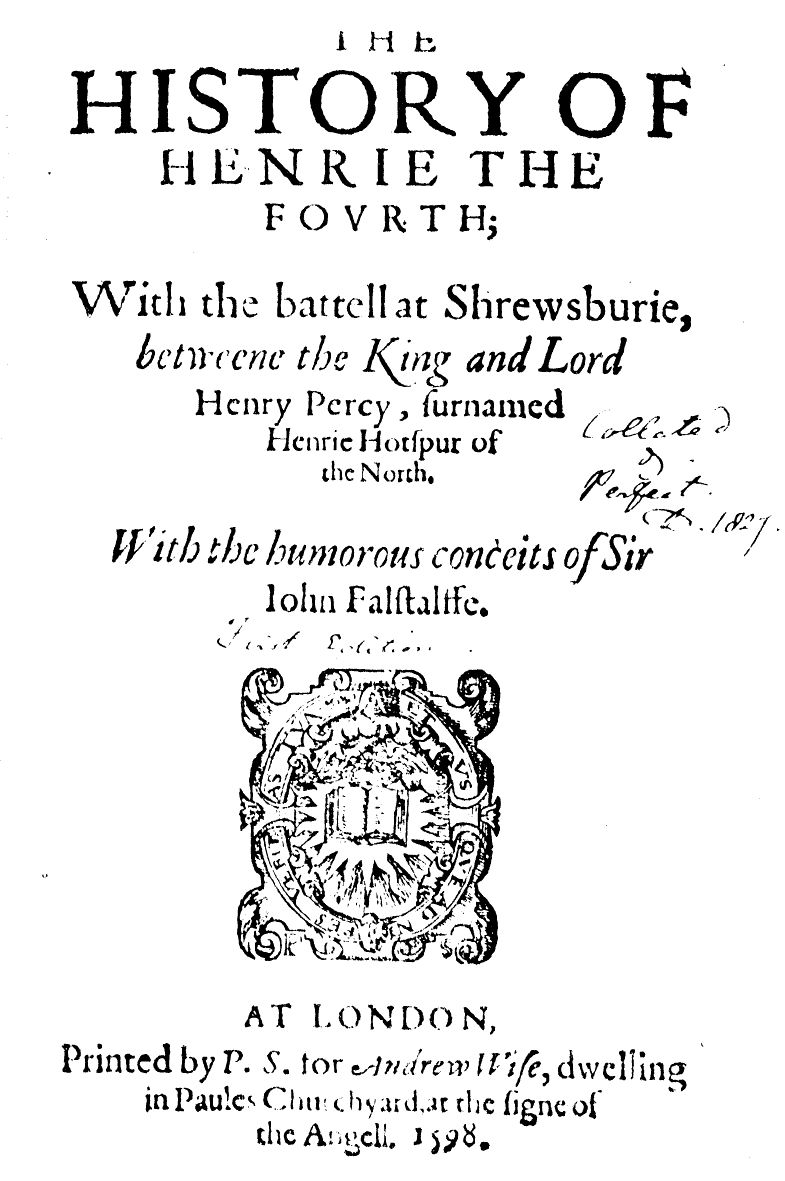
Shakespeare apparently pronounced it “Henry the Fifth” (or, rather, “Henry the Fift,” as the name was written on the title page of the 1600 quarto of the play). The earliest texts of Shakespeare’s plays were printed in quarto format, with each printed sheet folded into four leaves.

The numbers following the names of monarchs in other Shakespeare plays are similarly spelled out on the title pages, as in these examples from the 1596 quarto of Edward III, the 1597 quarto of Richard III, and the 1598 quarto of Henry IV, Part 1.

When Roman numerals are used to differentiate monarchs, popes, and others with the same name and position, the custom is to pronounce them as ordinal numbers. (Ordinal numbers, like “first,” “third,” and “fifth,” indicate place or order in a sequence, while cardinal numbers, like “one,” “three,” and “five,” indicate how many.)

Customarily, Roman numerals are also spoken as ordinals when used to identify family members with the same name (Adlai E. Stevenson III), but spoken as cardinals on clock faces (I, II, III, etc.) and in movie sequels (The Godfather, Part III). Roman numerals can go either way in sports events: Super Bowl XLVI (cardinal, “forty-six”) and  XXIV Olympic Games (ordinal, “twenty-fourth”).

Although the Anglo-Saxons had their own Germanic names for numbers, they used lowercase Roman numerals for the figures. So the Roman numeral v was the figure that represented the Old English word fíf (five) or fífta (fifth). In fact, the two usages were sometimes combined in the same passage.

The entry for the year 900 in The Anglo-Saxon Chronicle, for example, says King Ælfred died “syx nihtum ær ealra haligra mæssan” (“six nights before the All Hallows mass”) after ruling his kingdom “oþrum healfum læs þe .xxx. wintra” (“a year and a half less than thirty winters”).

Roman numerals were generally used for calculations in Old English (roughly 450-1150) and Middle English (1150-1500). Arabic numerals were introduced in Europe during the Middle Ages, but took centuries to replace most uses of Roman numerals in English.

A search of the Early English Books Online database suggests that the use of ordinal numbers to identify English monarchs showed up in the early 1500s, with the numbers sometimes written as Roman numerals and sometimes spelled out.

For example, The Statutes Prohemium Iohannis Rastell, a 1527 compilation of public general acts, by the English writer and printer John Rastell, has numerous references to numbered kings, including “The vi. yere of henry viii” …  “kynge Edwarde the thyrde” … “The .ij. yere of. Richard .ii.” (The letter “j” was sometimes used for the final “i.”)

Help support the Grammarphobia Blog with your donation
And check out our books about the English language.

Categories
English English language Etymology Expression Phrase origin Usage Word origin Writing

A rising sophomore?

Q: When did expressions like “rising sophomore” start? It’s new to me, a great-grandmother who was last in college 20 years ago.

A: It was new to us too, but not to the lexicographers at The American Heritage Dictionary of the English Language (5th ed.).

In addition to defining the adjective “rising” as ascending, developing, and increasing in power, American Heritage includes this sense: “About to begin a certain grade or educational level: rising seniors.”

Several other standard dictionaries describe “rising” as a preposition or an adverb with a similar sense.

Cambridge, for example, defines the preposition as “about to become,” and gives this example: “The school accepts children who are rising five years old.” And Collins defines the adverb as “approaching the age” and gives this example: “he’s rising 40.”

The Oxford English Dictionary, an etymological dictionary based on historical evidence, includes the use of “rising” as an adjective “designating a student about to enter a specified year of high school or college.”

The first OED citation is in the July 1893 issue of the Kappa Alpha Journal: “Mr. Young is a rising Sophomore and was asked to join us the first of the year.”

We’ve found an even earlier example from another fraternity publication, a report on the 51st annual convention of Beta Theta Pi on Aug. 25-30, 1890, at Wooglin-on-Chautauqua, NY:

“ ‘Did you say that the Lakewood girls like to come to the clubhouse?’ asked the undergraduate, who is a rising sophomore.”

The OED defines this sense of “rising” as “U.S. Educ. Designating a student about to enter a specified year of high school or college.”

The dictionary has three other examples—the latest is an April 22, 2001, advertisement in the New York Times Magazine: “Your rising senior or high school graduate can earn two college credits.”

When the word “rising” showed up in the early 1200s, it was a noun meaning “return to life” or “rising from the dead,” according to the OED. When the adjective showed up in the late 1300s, it meant increasing, advancing, or growing.

Both the noun and the adjective are derived from the verb “rise,” which the Anglo-Saxons inherited from Germanic, a prehistoric language reconstructed by linguists.

In Old English, the verb (spelled risan) originally referred to getting up in the morning or rising from the dead.

Getting back to your question, the educational use of “rising” may have evolved from a much earlier sense of the adjective as moving toward a position of higher social status, greater wealth, or increased power.

The earliest Oxford example for this sense is from The Tragidie of Ferrex and Porrex, a 1570 play by the English writers Thomas Norton and Thomas Sackville:

“Who seeth not now how many rising mindes / Do feede their thoughts, with hope to reach a realme?”

The adjective has also been used to describe a horse or person approaching a specified age. The first OED citation is from John Cheny’s 1730 history of horse racing in England and Wales: “All the rising five Years Old, 200 Guineas each, Half forfeit.”

[Note: This post was updated on Aug. 10, 2023.]

Help support the Grammarphobia Blog with your donation
And check out our books about the English language.

Categories
English English language Etymology Expression Usage Word origin Writing

Let’s pick a few nits

Q: I was under the impression “nitpicking” was a seriously racist phrase, originating from when slaves picked cotton.  Am I incorrect about this?

A: “Nitpicking” isn’t racist, and it doesn’t come from picking cotton.

The term originally referred to picking nits, the eggs of lice, from hair, and later to picking out the lice themselves, as in this 19th-century image by the German photographer Giorgio Sommer of a Neapolitan woman and her children.

The word “nit” is very old, with roots in two reconstructed prehistoric languages—ancient Germanic (hnitö) and Indo-European (knid-), according to The American Heritage Dictionary of Indo-European Roots. It was spelled hnitu when it showed up in early Old English.

The earliest example in the Oxford English Dictionary is from a Latin-Old English entry in the the Epinal Glossary, believed written in the late 600s: “Lendina, hnitu.”

And here’s a Middle English example that refers to picking lice and nits from men’s heads:

“She can wel pyke out lyse and netis out of mens heedis” (from The History of Reynard the Fox, William Caxton’s 1481 translation of the Reynard fables from Middle Dutch).

The word “nit” has been used figuratively since Shakespeare’s time to mean “an insignificant, inconsequential, or contemptible person,” according to the OED, and later “a foolish, stupid, or incompetent person.”

In this expanded OED citation, from The Taming of the Shrew, written in the early 1590s, Petruchio berates Kate’s tailor:

“O monstrous arrogance! Thou liest, thou thread, thou thimble, / Thou yard, three-quarters, half-yard, quarter, nail! / Thou flea, thou nit, thou winter cricket thou!”

The figurative terms “nitpick” (to criticize overzealously), “nitpicker” (a pedantic fault finder), and “nitpicking” (petty criticism) showed up in the mid-20th century.

The first OED example for “nitpicker” is from the November 1951 issue of Collier’s: “nit-pickers are those who quarrel with trivialities of expression and meaning.”

The earliest “nitpicking” citation is from the Dec. 21, 1951, issue of the Charleston (WV) Daily Mail: “Sen. Johnson is encouraged to proceed with his nit picking.”

Finally, the dictionary’s first example for the verb “nitpick” is from the 1956 issue of the journal Military Affairs:

“His decisions in the main were so well conceived and executed that it would be quibbling to ‘nit-pick’ those few instances where his judgment was fallible.”

Although these terms were often hyphenated or written as two words in the past, “nitpick,” “nitpicker,” and “nitpicking” are usually single words today.

Help support the Grammarphobia Blog with your donation
And check out our books about the English language.

Categories
English English language Etymology Expression Usage Word origin Writing

Why ‘spay’ her, but ‘neuter’ him?

Q: Why do we “spay” a female cat or dog, but “neuter” a male? Why don’t we have a single, unisex word for the procedure?

A: You’re right that we usually say a female cat or dog is spayed, while a male is neutered.

However, “neuter” (as well as “sterilize” and “desex”) can be used with male or female pets, as can euphemisms like “fix,” “alter,” and “doctor.” (“Neuter” itself is a euphemism for “castrate” when used for males.)

Interestingly there’s no good etymological reason for restricting “spay” to females, except that’s how the term has been used since it showed up in English six centuries ago.

“Spay” is derived from the Anglo-Norman espeier (to cut with a sword), but it ultimately comes from the classical Latin spatha (a broad, flat weapon or tool) and the Greek spathe (a broad blade), according to the Chambers Dictionary of Etymology.

When the verb “spay” arrived in English in the early 15th century, it meant to remove the ovaries and destroy the reproductive power of female animals.

The earliest example in the Oxford English Dictionary is from The Master of Game, a book on hunting written around 1410 by Edward, Duke of York:

“And bycause þei [they] shuld not lese [lose] her tyme, men make hem [them] yspayed, saue þose men will kepe open to bere whelpes.”

A century later, English adopted “castrate” from castrāre, a classical Latin verb meaning to castrate, prune, expurgate, or deprive of vigor.

The first citation in the OED uses the term to mean deprive of vigor: “Ye castrate the desyres of the fleshe” (from Thomas Martin’s Traictise Marriage of Priestes, a 1554 tract challenging the marriage of Anglican priests).

In the early 17th century, “castrate” came to mean emasculate in the literal sense—that is, to remove the testicles of a man or male animal.

The first OED citation for the new sense is from a 1633 religious tract by the Anglican Bishop Thomas Morton: “Origen—having read that scripture, ‘There be some that castrate themselves for the kingdom of God’ … he did castrate himself.”

(The reference is to the passage in Matthew 19:12 about men who “have made themselves eunuchs for the kingdom of heaven’s sake.”)

In the early 20th century, the verb “neuter” showed up, meaning to castrate or spay an animal. It was derived from the adjective “neuter,” originally a grammatical term for words neither masculine nor feminine.

The first example for the verb in the OED is from The Book of the Cat (1903), by Frances Simpson: “A cat should be kept on low, plain diet … before being neutered.”

(In the late 19th century, the adjective “neuter” came to describe a castrated or spayed animal, as in this example from Domestic or Fancy Cats, 1893, by John Jennings: “Among the principal reasons that commend neuter cats as pets, the element of non-production is chiefly important.”)

Finally, here are the other verbs mentioned above and the earliest OED dates for their use in reference to castrating or spaying animals: “alter” (1821), “desex” (1928), “doctor” (1902), “fix” (1930), and “sterilize” (1828, a human citation).

Help support the Grammarphobia Blog with your donation
And check out our books about the English language.

Categories
English English language Etymology Expression Usage Word origin Writing

The convinced and the persuaded

Q: I was taught that “persuade” is used with “to” and “convince” with “of” or “that.” This rule must have changed when I wasn’t looking, since I can’t for the life of me figure out how the two verbs are being used now. Your help would be appreciated.

A: Yes, “convince” and “persuade” once had two different meanings.

The old rule was that you “convince” someone “of” something or “that” something is the case, while you “persuade” someone “to” do something.

In other words, “convince” meant to make someone believe something, while “persuade” meant to make someone believe something and act on that belief.

However, most standard dictionaries have dropped the old distinction. Today both verbs can be used with “to” infinitives, “of” prepositional phrases, and “that” clauses.

The American Heritage Dictionary of the English Language (5th ed.), for example, has almost identical definitions of “convince” and “persuade”:

Convince: “To cause (someone) by the use of argument or evidence to believe something or to take a course of action.”

Persuade: “To cause (someone) to accept a point of view or to undertake a course of action by means of argument, reasoning, or entreaty.”

So now you can say: “The polls convinced [or “persuaded”] the candidate to drop out” … “He was convinced [or “persuaded”] of the need to drop out” … “The polls convinced [or “persuaded”] him that he should drop out.”

In fact, “persuade” has been used in all three ways since it showed up in English in the 15th century, according to the Oxford English Dictionary.

And “convince” has been used similarly since the 17th century, according to our searches of literary databases, though its use with an infinitive wasn’t common until the 20th century.

Merriam-Webster’s Dictionary of English Usage notes that the expansive use of “persuade” is long established, while the similar use of “convince” is now “fully established.”

Merriam-Webster’s adds that language commentators insisted unsuccessfully for a century and a half that “convince” and “persuade” had distinct meanings.

“The earlier usage writers who tried to fence off persuade from convince and the later ones who tried to fence off convince from persuade have failed alike,” the usage guide says.

Even the conservative Garner’s Modern English Usage (4th ed.) acknowledges that the use of “convince as an equivalent of persuade” is “fully accepted” (that is, stage 5 on Garner’s index of language change).

The older of the two verbs, “persuade,” is ultimately derived from persuādēre, classical Latin for to get someone to believe something or do something.

When the verb showed up in English in the mid-15th century, according to the Oxford English Dictionary, it meant to “induce to believe or accept a statement, doctrine, etc.; to convince that or of; to urge successfully to think, believe, etc.”

The earliest OED citation is from an English translation, dated around 1450, of Giovanni Boccaccio’s De Claris Mulieribus (Concerning Famous Women):

“This witty lady togyder didd them call … Persuadynge them …To thynke that they were creatures racionall And vndirstondyng hadd of good and ill.” (The Latin work is a collection of biographies of historical and mythological women.)

The dictionary’s first citation for “persuade” meaning to make someone believe and act on the belief is from a translation, dated around 1487, of Bibliotheca Historica, a 40-book world history written in the first century BC by the Greek scholar Diodorus Siculus:

“They perswade the kyng wilfully to take his deth aftre the accustumable vsaige observed of olde” (originally translated by John Skelton; edited by F. M. Salter and H. L. R. Edwards, 1968-1971).

As mentioned above, we’ve found examples from the 17th century for “convince” meaning to make someone believe something and act on that belief.

Here’s a passage from a statement by Sir Francis Winnington during an Oct. 30, 1680, debate in the House of Commons:

“I conceive, by the proposal of this Question, that the House is fully convinced to proceed to prepare things to bring these persons to Judgment” (from Debates of the House of Commons from 1667 to 1694, published in 1763).

Finally, here’s a 20th-century example from The Powers That Be, a 1979 book by David Halberstam about the American news media: “He worked very hard personally to convince Ike to run.” (The reference is to Henry R. Luce, creator of the Time-Life magazine empire.)

Help support the Grammarphobia Blog with your donation
And check out our books about the English language.

Categories
English English language Etymology Usage Word origin Writing

Nonfiction before ‘nonfiction’

Q: The earliest citation that my OED CD-ROM has for “nonfiction” (it’s hyphenated there) is from 1903. What was it called before then? And why doesn’t “nonfiction” have its own name instead of being defined as not something else?

A: The term “nonfiction” (or “non-fiction”) is older than you think. The online Oxford English Dictionary, which is regularly updated, has an example from the mid-19th century.

As we say in a 2008 post, Oxford cites a passage from the 1867 annual report of the trustees of the Boston Public Library: “This, as we have seen, is above the proportion of our circulation between fiction and non-fiction.”

But how did English speakers refer to factual writing before the term “nonfiction” showed up?

In the past, people used terms for specific types of nonfiction writing: “history” (early Old English), “epistle” (early Old English), “story” (before 1200), “chronicle” (1303), “treatise” (before 1375), “tract” (1432-50), “diary” (1581), “essay” (1597), “journal” (1610), “dissertation” (1651), “memoir” (1659), and others. The dates are for the earliest OED citations of the terms used in their usual literary senses.

We don’t know of a word other than “nonfiction” that encompasses all kinds of writing about facts, real events, and real people, but several of the terms mentioned above, especially “history,” were used broadly in the past, embracing some of the senses of “nonfiction.”

“History,” for example, was used as a factual counterpart to “fiction” in this example from Devereux, an 1829 novel by Edward Bulwer-Lytton:

“ ‘To be sure,’ answered Hamilton, coolly, and patting his snuff-box— ‘to be sure we old people like history better than fiction.’ ” (The comment concerns whether a description of a person is factual or false.)

English adopted the word “history” from the classical Latin historia in Anglo-Saxon times. In Latin, the word had many senses, including an investigation, a description, a narrative, a story, and a written account of past events.

In Old English, the word (usually spelled stær, ster, or steor), referred to a “written narrative constituting a continuous chronological record of important or public events (esp. in a particular place) or of a particular trend, institution, or person’s life,” according to the OED.

An early Old English translation of Bede’s Historia Ecclesiastica, for example, refers to “þæt stær Genesis” (“the history of Genesis”), while the Harley Glossary defines istoria, medieval Latin for historia, as “gewyrd uel stær” (“event or history”) in late Old English.

In Middle English, the stær spelling gave way to the Anglo-Norman and Old French spellings istorie, estoire, and historie.

An Oxford citation from The Boke of Noblesse, an anonymous patriotic work written in the mid-1400s, says England’s right to Normandy is supported “by many credible bookis of olde cronicles and histories.”

“History” has sometimes been used loosely, from Middle to modern English, in the sense of a “narration of incidents, esp. (in later use) professedly true ones; a narrative, a story,” the OED says.

In this Oxford example from a 1632 travel book, the Scottish writer William Lithgow uses “history” in the sense of a true story: “all hold it to bee a Parable, and not a History.”

Why, you ask, “doesn’t nonfiction have its own name instead of being defined as not something else”?

Well, you can blame the Boston library trustees who used “nonfiction” a century and a half ago. Or you can blame the rest of us for not coming up with a positive word since then.

Some writers use the terms “creative nonfiction,” “literary nonfiction,” or “narrative nonfiction” to describe the more literary factual writing. John McPhee’s writing class at Princeton University has been called “Literature of Fact” as well as “Creative Nonfiction.”

However, the poet and essayist Phillip Lopate has described the term “creative nonfiction” as “slightly bogus.”

In a 2008 interview in Poets & Writers magazine, he says, “It’s like patting yourself on the back and saying, ‘My nonfiction is creative.’ Let the reader be the judge of that.”

Lopate prefers “literary nonfiction,” though he acknowledges that there’s “a bit of self-congratulation” in it.

In an article in the summer 2015 issue of Creative Writing magazine, the author and educator Dinty W. Moore describes some of the ways writers of nonfiction refer to their work.

Moore traces the term “creative nonfiction” to a contribution by David Madden in the 1969 Survey of Contemporary Literature.

Madden, a writer and teacher, uses the term in calling for a “redefinition” of “nonfiction” in the wake of books by Truman Capote, Jean Stafford, and Norman Mailer.

He cites Making It, the 1968 memoir by Norman Podhoretz, who says the postwar American books that mattered most to him were “works the trade quaintly called ‘nonfiction,’ as though they had only a negative existence.”

Help support the Grammarphobia Blog with your donation
And check out our books about the English language.

Categories
English English language Etymology Expression Phrase origin Usage Word origin Writing

Digital footprint

Q: Our local public radio station advertises that it broadcasts “digital.” This doesn’t sound right to me. I would say that it broadcasts “digitally.” Am I correct?

A: It doesn’t sound right to us either. A radio station broadcasts “digitally,” not “digital.”

We’ve checked eight standard dictionaries and all of them of say “digital” is solely an adjective and “digitally” is the adverb. The Oxford English Dictionary, an etymological dictionary based on historical evidence, agrees.

And a search of the News on the Web Corpus, a database of billions of words from newspapers and magazines on the internet, shows that contemporary publications use the two terms that way.

As you know, a verb is generally modified by an adverb, not an adjective, which is why a radio station broadcasts “digitally,” not “digital.”

However, adjectives are used with linking verbs (or copulas) like “be,” “become,” “feel,” “look,” and “seem.” Linking verbs convey a state or condition, rather than an activity.

In fact, a good example of this usage is “to go digital” (to become digital, or computerized), as in “The film business has gone digital.” The word “go” in this case is a linking verb because it means “become.” We’ll have more to say about “go digital” later, but let’s look now at some “digital” etymology.

English adopted the word “digital” in the 15th century from digitālis, classical Latin for “measuring a finger’s breadth.” The Latin for “finger” or “finger’s breadth” is digitus.

In English, the word “digital” was originally a noun and an adjective referring to a digit, a whole number less than 10.

The first examples in the Oxford English Dictionary for both the noun and the adjective are from The Art of Nombryng (circa 1450), an anonymous treatise based on a work by the 13th-century French scholar Alexander de Villa Dei.

The noun is now obsolete so we’ll cite only an adjectival example: “Neither of the subtraccioun, tille it come to the first figure vnder the whiche is a digitalle nombre to be founde” (from The Earliest Arithmetics in English, 1922, edited by Robert Steele).

In the mid-17th century, people began using the adjective “digital” in senses “relating to fingers or finger-like structures,” according to the OED. The dictionary’s first example is an entry from Glossographia, a 1656 dictionary by Thomas Blount: “Digital, pertaining to a finger.”

Here’s a modern example of this sense from The Horrors of the Half-Known Life, a book written in 2000 by G. J. Barker-Benfield about the attitudes of men, especially male doctors, toward women in the 19th century:

“He could emulate ‘the finger of God’ by digital examination and repair of reproductive organs.”

The modern technological senses of “digital” began showing up in the 1940s. Here are the most common technical areas where the adjective is used and the earliest Oxford citations:

Signals, information, or data: “In the transmission of direct current digital impulses over a long line the characteristics of the line tend to mutilate the wave shape” (from a 1940 patent for an electrical communications system).

Computers and calculators: “Description of the ENIAC and comments on electronic digital computing machines” (from a 1945 report by the Applied Mathematics Panel, a US agency dealing with mathematical problems during World War II).

Other electronic measurement devices: “Digital voltmeter or potentiometer” (from An Introduction to Electronics, 1964, by Bernard Vincent Rollin).

Audio, video, and other recorded works: “The limb appears in … a few real-time digital A-camera frames” (from the Oct. 3, 1969, issue of Science).

Musical instruments: “A digital electronic organ wherein a digital representation of an organ pipe waveshape is stored in a memory” (from a 1970 patent for a digital electronic organ).

Clocks, watches, and other timepieces: “Digital clock covers a 24-hour period” (from an ad in the Jan. 10, 1958, issue of Science).

Computer culture, on the internet: “The worldwide digital revolution” (from the July 28, 1983, issue of Electronics).

As for “to go digital,” the first example in the OED is from the May 18, 1964, issue of Electronics: “A comparison of factors that influence the decision to go digital or analog.” And if you’d like to read more about linking verbs like “go” here, we discuss them in items #4 and #5 of our Q&A about English.

We’ll end with some other “digital” expressions  and the earliest OED dates: “digital calculator” (1946), “digital TV” (1959), “digital camera” (1961),  “digital audio” (1969), “digital signature” (1976), “digital art” (1978), “digital video disk” (1978),  “digital money” (1984), “digital photo” (1986), “digital rights” (1990), “digital economy” (1994), and “digital footprint” (1995).

Help support the Grammarphobia Blog with your donation
And check out our books about the English language.

Categories
English English language Etymology Expression Phrase origin Usage Word origin Writing

Turning state’s evidence

Q: I have never been able to parse the expression “turn state’s evidence.” Does the witness turn himself into evidence for the state, or turn over evidence to the state?

A: A convicted or accused criminal, as you know, “turns state’s evidence” by testifying in court against former accomplices.

Why “turn” evidence? We don’t know, though we suspect that the usage may have been influenced by both the “turn over” and “turn against” senses of the verb “turn.”

In fact, “turning state’s evidence” indicates both turning against accomplices and turning over evidence.

When the courtroom expression showed up in writing in the early 1700s, it was simply to “turn evidence.”

The earliest example in the Oxford English Dictionary is from Colonel Jack, a 1723 novel by Daniel Defoe: “One of the Gang, who to save his own Life, has turn’d Evidence.”

In modern British usage, the expression now refers to “King’s” or “Queen’s” evidence, as in this citation from The Hillyars and the Burtons, an 1865 novel by Henry Kingsley: “I hate a convict who turns Queen’s evidence.”

Here’s a figurative “King’s” example from the Dec. 25, 1889, issue of the Daily News in London: “The Bishop might have been better employed than in turning King’s evidence against the Sermon on the Mount.”

In the US, such testimony is called “state’s evidence,” as in this OED example from a Dec. 24, 1886, issue of Science: “Mr. Bartlett Channing Paine comes into court, and, as state’s evidence, gives the following testimony.”

Finally, here’s a more recent example for “state’s evidence” from the Oct. 16, 1976, issue of the National Observer: “He fired up his investigators, offered deals to suspects who would turn state’s evidence, and played off the knowledge of one suspect against the other.”

When the verb “turn” showed up in late Old English, it meant to “cause to move round on an axis or about a centre; to cause to rotate or revolve, as a wheel,” according to the OED.

The dictionary’s earliest citation is from Ælfric’s Lives of the Saints, believed to have been written in the late 990s: “Þa tyrndon þa hæðenan hetelice þæt hweowl” (“then the bloodthirsty heathens turned the wheel savagely”).

By the 1300s, people were using the verb in the expressions “turn against” (change from friend to foe) and “turn one’s back” (abandon someone or something).

Here’s an OED example, dated around 1300, from Thomas Wright’s Political Songs of England (1839): “turnden hem aȝeynes with suerd ant with launce” (“turned against them with sword and with lance”).

And here are a couple of later “turn one’s back” examples from Shakespeare:

“The shame Of those that turnd their backes” (from Henry IV, Part 2, 1600) … “To turne thy hated backe Vpon our kingdome” (from King Lear, 1608).

In the 1500s, people began using the expression “turn one’s coat” to mean change one’s principles or party.

The term “turncoat,” which is more common today, showed up soon after. Here’s an example from a 1570 church history by John Fox:

“I will beleue none of you all, for you be turne coates, and chaungelinges, and be wauering minded.”

Around the same time, the expression “turn over” came to mean to transfer or hand over. The first OED example is from Richard Huloet’s 1552 dictionary, Abcedarium Anglo Latinum:  “Turne ouer, transuerto.”

Help support the Grammarphobia Blog with your donation
And check out our books about the English language.

Categories
English English language Etymology Expression Phrase origin Usage Word origin Writing

Good grief!

Q: I saw “good grief” used in a story recently, and first encountered it as a child from Charlie Brown. Is it a euphemism for something else?

A: Yes, “good grief” was originally a mild oath. It’s “a euphemism for ‘good God,’ ” according to The American Heritage Dictionary of Idioms (2d ed.), by Christine Ammer.

Ammer describes it as an “exclamation expressing surprise, alarm, dismay, or some other, usually negative, emotion. For example, Good Grief! You’re not going to start all over again, or Good Grief! He’s dropped the cake.”

Although the noun “grief” is quite old, showing up in the Middle Ages, the exclamation “good grief” is relatively new.

The earliest example in the Oxford English Dictionary is from The English Dialect Dictionary, a six-volume opus by the philologist Joseph Wright, published from 1898 to 1905:

“Good grief, a mild imprecation.” We’ve expanded the Oxford citation to add the definition (from the extensive entry for “good” in the 1900 second volume of the dialect dictionary, covering D to G).

The OED notes in an entry for “good” that it’s used “with another word euphemistically substituted” for “God” in such expressions as “good golly,” “good gravy,” “good land,” “good me,” “good gracious,” and “good grief.”

The oldest of these “good” euphemisms in the dictionary, the obsolete exclamation “good lack,” showed up in the early 1600s. (The word “lack” here comes from the archaic interjection “alack,” used to express grief, criticism, surprise, etc.)

The second citation for “good grief” in the OED is from a 1918 issue of Dialect Notes (a publication of the American Dialect Society) that includes the euphemism in a long list of exclamations.

A few exclamations that caught our eye are “good Godfrey,” “holy gumdrops,” “great goldfish,” “golly Moses,” and “gosh all hemlock.”

The first OED example for “good grief” used in popular writing is from a 1937 short story by Raymond Chandler:

“ ‘Good grief,’ De Spain said. ‘He’s up there right now.’ ” (The only version of that quotation that we could find was in a 1938 story by Chandler, “Bay City Blues.”)

However, we’ve found many earlier examples from mainstream publications, including this one from a 1915 issue of Good Housekeeping:

“ ‘Good grief!’ gasped Mannering Hitchcock, and he sank palely into a chair. ‘Are there really three of you?’ ”

We’ll end with a “good grief” example from Laughing House, a 1920 novel by the London-born American writer Meade Minnigerode:

“Good grief!” Isabelle remarked involuntarily, and Newell gave her a quick look.

“What do you mean, ‘good grief’?” he asked.

“I mean ‘good grief,’ ” she explained vaguely. “Good meaning good, and grief meaning grief …” and she refused to say anything more.

(In case you missed them, we’ve had several posts on the blog about euphemisms as mild religious oaths, including one in 2015 that discusses “by jove” and has links to some of the other posts.)

Help support the Grammarphobia Blog with your donation
And check out our books about the English language.

Categories
English English language Etymology Expression Phrase origin Usage Word origin Writing

Pots to cook in, pee in, melt in

Q: Please talk about the origins of the word “pot,” as in “pot luck,” “melting pot,” “potboiler.” Does it refer to mixing things together?

A: Almost all uses of “pot” are derived in one way or another from the word’s original sense: a cylindrical container to hold or heat liquids and other substances.

“Pot” comes from ancient Germanic, a reconstructed prehistoric language that preceded Old English and other Germanic languages.

In Old English, the word for the container was pott. Old Icelandic, Old Swedish, and Old Frisian, had similar words.

The term also showed up in medieval Latin and the Romance languages, suggesting an earlier, shared ancestor. We’re now getting into speculative territory, so we’ll let the Oxford English Dictionary do the speculating for us:

“The word in the Germanic and Romance languages and in post-classical Latin perhaps ultimately shows a loanword from a pre-Celtic language (perhaps Illyrian or perhaps a non-Indo-European substratal language), although a number of other etymologies have also been suggested.” (A substratal language influences one that replaces it.)

The dictionary adds that similar words in Welsh, Irish, and Scottish Gaelic apparently came from English rather than the other way around, as some word sleuths have suggested.

The earliest example for the term in the OED is from Old English Leechdoms (also known as Leechdoms, Wortcunning, and Starcraft of Early England), an 1864 collection of Anglo-Saxon medical remedies and prayers edited by Thomas Oswald Cockayne:

“Nim readstalede harhuna, & ysopo, & stemp & do on ænne neowna pott, an flering of ða harhuna & oðer of ysopo … forð þæt se pott beo full” (“Take red-stalked horehound, and hyssop, and pound, and put in a new pot, one layer of horehound, and another of hyssop, and a third of fresh butter, and again the herbs, and then the butter, until the pot is full”).

This recipe was for a remedy used to treat a pain in the chest. The mixture was boiled and wrung through a cloth, then taken cold in the morning and hot at night in beer or broth or water.

The OED notes that the use of “pot” for such a container was “rare in Old English, the more usual word being crocc,” or crock. The term “pot” was more common after the Norman Conquest, probably reinforced by pot in Anglo-Norman or Old French.

Most of the later uses of “pot” come from the early sense of a cylindrical container for holding or heating things. We won’t discuss all the dozens of “pot” usages, but here are some more common ones, and the first OED examples for them:

“Chamber pot,” a bowl usually kept in a bedroom for one to urinate or defecate in. The first OED citation is from a 1540 inventory (“Item a chamber potte”), but we prefer this later example about someone too lazy to get out of bed: “He will nocht rys to the pott bot pischis amang the strais [straw bedding]” (from a 1568 literary anthology compiled by the Scottish merchant George Bannatyne).

“Go to pot,” originally to be cut in pieces and cooked, but later to deteriorate or be ruined: “Poor Thorp, Lord Chief Justice, went to Pot, in plain English, he was Hang’d” (from The History of Wiggism, circa 1680, by Edmund Hickeringill).

“Potluck,” a meal without special preparation: “That, that pure sanguine complexion of yours may neuer be famisht with potte-lucke” (from Strange Newes, 1592, by the Elizabethan writer Thomas Nashe). Later, a communal meal at which guests bring dishes to share: “their pot-luck and their ponies” (from the Aug. 13,1867, issue of the New York Times).

“Pot belly,” a large, protruding stomach: “A great pot Belly, a broad Back, and huge Legs and Arms, enough to squeeze one to pieces” (from The She-Gallants, a 1696 comedy by the English poet and playwright George Granville Lansdowne).

“Potboiler,” a creative work produced to make money by catering to popular taste: “Some others … in great measure compensate for the heaps of inconsequential trash, or pot-boilers (as they are called) which are obtruded upon the public view” (from a 1783 account by the Irish painter James Barry of an art exhibition in London).

“Potpie,” a pie filled with meat and other ingredients: “The snow birds are flying round your own door, where you may … shoot enough for a pot-pye, any day” (from The Pioneers, an 1823 novel by James Fennimore Cooper). The non-meat ingredients were originally fruit and later vegetables.

“Chimney pot,” the pipe at the top of a chimney to improve draft: “Why a church is with a steeple built; / And a house with a chimney-pot?” (from “The ‘How’ and the ‘Why,’ ” in Alfred Tennyson’s Poems, Chiefly Lyrical, 1830).

“Pot shot,” a random or easy gunshot: “Major Swayne … kept them under hedges firing pot shots, on which the enemy reoccupied the position” (from an 1843 Afghan journal by Florentia Wynch Sale, the wife of a British army officer). Earlier, it had meant shot for a cannon or a shot to kill food for the pot. And later, it came to mean random, easy, or unfounded criticism: “But I don’t think much of the pot-shot method of refutation” (from the November 1926 issue of the Forum, a New York magazine).

“Pot of gold,” a fortune or jackpot, real or imagined: “It is the barbarous old legend of the ‘pot of gold’ repeated in ten thousand new forms” (from the Feb. 16, 1847, issue of the New York Times).

“Pot,” the betting pool in poker and other gambling games: “He won the first twenty ‘pots,’ that is to say, the stake” (from Gambling Unmasked, 1847, by Jonathan H. Greene, an ex-gambler who campaigned against gambling).

“Pot roast,” meat, typically beef, cooked slowly in a covered pot or dish: “Sour Braten, or a Sour Pot-roast” (from the April 11, 1880, issue of the New York Times).

“Pot holder,” a pad for holding hot cooking implements: “the grimy apron was stuffed out with the dish-towel, pot-holder, red handkerchief, etc.” (from the March 1888 issue of Harper’s magazine).

“Pothole,” a depression from a defect in the surface of a road: “The surface of the bottom land that they were crossing was here and there broken up by fissures and ‘potholes,’ and some circumspection in their progress became necessary” (from A Waif of the Plains, an 1889 novel by Bret Harte). The potholes here were on a prairie trail.

“Melting pot,” a place where people of different races and cultures assimilate: “The French Canadians had a misgiving that if they too were cast into the American melting pot they would yield to that mysterious force which blends all foreign elements into one homogeneous mass” (from the Sept. 2, 1889, issue of the New York Times). Originally, it referred to a container in which metals or other materials were melted and mixed.

We’ll end with the “pot” that’s smoked: “She made him smoke pot and when he got jagged … she put him out on the street” (from a 1938 story in Black on Black, a 1973 collection of Chester B. Himes’s writings). “Jagged,” an old adjective for “drunk,” means “stoned” here.

Oxford says the marijuana sense of “pot” is of “uncertain and disputed” origin. It debunks the “most popular theory”—that it comes from potiguaya or potaguaya, “supposed Mexican Spanish words” for marijuana leaves, or from the phrase “potación de guaya, lit. ‘drink of grief,’ supposedly denoting a drink of wine or brandy in which marijuana buds were steeped.”

The dictionary says “no corroborating evidence has been found to support the use of any of these terms in Spanish.”

Alternatively, the OED adds, the use of “pot” for marijuana may somehow be connected to the original sense of “pot” or to the noun “pod,” though it doesn’t offer any evidence for such connections.

Help support the Grammarphobia Blog with your donation
And check out our books about the English language.

Categories
English English language Etymology Expression Usage Word origin Writing

Literal minded

Q: I saw this headline on BuzzFeed: “These Brownies Have Literally Taken Over The Dessert Game.” Literally? How about apple pie, strawberry shortcake, and pistachio ice cream?

A: The word “literally,” as you know, means “to the letter,” and that’s the way we use it. On the other hand, that is a helluva brownie on BuzzFeed!

More to the point, writers have been using “literally” in an other-than-literal way for hundreds of years, including John Dryden, Henry David Thoreau, Alexander Pope, Charles Dickens, William Makepeace Thackeray, and Mark Twain.

In fact, many standard dictionaries now accept the nonliteral use of “literally” to emphasize an exaggeration, especially in informal speech or writing.

The online Merriam-Webster Dictionary, for example, says it can be “used in an exaggerated way to emphasize a statement or description that is not literally true or possible.”

The dictionary cites the author Norman Cousins: “They will literally turn the world upside down to combat cruelty or injustice” (from the Nov. 20, 1971, issue of Saturday Review). We’ve expanded the citation, which refers to American youth.

Merriam-Webster lists this exaggerated nonliteral sense without comment—that is, as standard in formal and informal English.

The US and UK editions of the online Oxford Dictionaries accept the use of  “literally” in informal English “for emphasis while not being literally true,” and gives this example: “I was literally blown away by the response I got.”

However, Oxford Dictionaries cautions that this “use can lead to unintentional humorous effects (we were literally killing ourselves laughing) and is not acceptable in formal contexts, though it is widespread.”

Other standard dictionaries, including the online versions of Cambridge, Collins, Longman, and Macmillan, have similar definitions, with most describing the usage as informal.

However, The American Heritage Dictionary of the English Language (5th ed.) says its usage panel, when last surveyed, objected to such metaphorical uses as “literally swallowing the country’s youth” and “literally out of his mind with worry.”

Garner’s Modern English Usage (4th ed.), which takes the traditional view, criticizes the metaphorical use as “stretched paper-thin (but not literally).”

The more permissive Merriam-Webster’s Dictionary of English Usage argues that the exaggerated use of “literally” is not a misuse or a mistake, but an unsurprising “extension of intensive use from words and phrases of literal meaning to metaphorical ones.”

Merriam-Webster’s includes such examples as these:

“I literally blazed with wit” (Thackeray, in the Oct. 30, 1847, issue of Punch).

“You’re very kind letter has left me literally speechless” (Archibald MacLeish, in a Feb. 17, 1914, letter).

“Lily, the caretaker’s daughter, was literally run off her feet” (James Joyce, in Dubliner’s, 1914).

“He literally glowed” (F. Scott Fitzgerald, in The Great Gatsby, 1925).

“And with his eyes he literally scoured the corners of the cell” (Vladimir Nabokov, in Invitation to a Beheading, 1960).

Yes, the hyperbolic use of “literally” has a history, but should you use it?

“The point to be made here is that it is hyperbolic, and hyperbole requires care in handling,” Merriam-Webster’s advises.

The usage guide says writers should ask themselves whether the figurative use of “literally” would call undue attention to itself, and “render the figure ludicrous, as was the case when a football play-by-play man we heard some years ago said the defensive lineman had ‘literally hammered the quarterback into the ground.’ ”

We think that’s good advice. And, now, let’s look at the literal history of “literally.”

When the adverb first showed up in English in the early 1400s, it meant “In a literal, exact, or actual sense; not figuratively, allegorically, etc.,” according to the Oxford English Dictionary.

It was formed by adding “-ly” to the adjective “literal,” which showed up in the late 1300s, and originally referred to a letter, or letters, of the alphabet. The ultimate source is the classical Latin litteralis (of letters or writing).

The first citation for “literally” in the OED is from Mirour of Mans Saluacioune (“Mirror of Man’s Salvation”), circa 1429, a Middle English translation of an anonymous Latin religious work from the early 1300s:

“Litteraly haf ȝe [have you] herde this dreme and what it ment.”

That early literal meaning of “literally” expanded in the late 1600s as the adverb came to be used as an intensifier, similar to “truly” or “really.”

The first OED example for the emphatic sense is from a 1670 political tract written in exile by the British statesman and historian Edward Hyde, 1st Earl of Clarendon:

“He is literally felo de se, who deprives and robs himself of that which no body but himself can rob him.” The medieval Latin felo de se (literally, “felon of oneself”) refers to someone who commits suicide.

The next example is from Dryden’s 1687 poem “The Hind and the Panther”: “My daily bread is litt’rally implor’d.”

And the third citation is from a March 18, 1708, letter by Alexander Pope: “Every day with me is litterally Another To-morrow; for it is exactly the same with Yesterday.”

In the late 1700s, the OED says, writers began using the adverb “to indicate that some (frequently conventional) metaphorical or hyperbolical expression is to be taken in the strongest admissible sense.”

The dictionary describes the usage as colloquial (that is, informal or conversational), and adds that “literally” here means “ ‘virtually, as good as’; (also) ‘completely, utterly, absolutely.’ ”

“Now one of the most common uses,” Oxford adds, “although often considered irregular in standard English since it reverses the original sense of literally.”

The first OED citation for this exaggerated sense is from The History of Emily Montague, a 1769 novel by the English writer Frances Brooke:

“He is a fortunate man to be introduced to such a party of fine women at his arrival; it is literally to feed among the lilies.”

The adverb has been used regularly in this hyperbolic way since then. The OED has citations from the 18th to the 21st centuries.

We’ll end with this example from The Adventures of Tom Sawyer (1876) by Twain: “And when the middle of the afternoon came, from being a poor poverty-stricken boy in the morning, Tom was literally rolling in wealth.”

Help support the Grammarphobia Blog with your donation
And check out our books about the English language.

Categories
English English language Etymology Expression Grammar Usage Word origin Writing

The beginning of an ending

Q: Have you folks ever done something with the “-en” ending? I’m thinking of “widen,” “strengthen,” “deepen,” etc.  Sounds like it must be of Anglo-Saxon origin.

A: We’ve discussed the “-en” suffix several times on our blog, including a post last year examining its use in plurals (“brethren,” “children,” “women”), and briefly mentioning its use in diminutives (“kitten,” “maiden”) and adjectives (“golden,” “wooden”).

In our earlier post, we note that some Old English nouns formed their plurals with “-n” rather than “-s.” These included eyen (“eyes”) earan (“ears”), tungan (“tongues”), fon (“foes”), housen (“houses”), shoen (“shoes”), treen (“trees”), and oxan (the original plural of “ox”).

During the Middle English period (roughly 1100-1500), both the “-en” and the “-an” plurals that had come from Old English were spelled with “en.” Meanwhile, Middle English writers extended the “-en” spelling to words that didn’t originally have plurals ending in “-n.”

In fact, the “-en” suffix was even added in Middle English to some words that were already plural. So the plurals brethre and childer became brethren and children. If you want to read more about “-en” plurals, check out our 2016 post.

The “-en” suffix was also used in Old English to form adjectives that mainly indicated the material something was made of. Although “-en”  adjectives were common in Old English and Middle English, “scarcely any survive,” according to the Oxford English Dictionary.

For example, the Old English adjective stǽnen (made from stone) became stenen and then stonen in Middle English. Today, we generally use the noun “stone” attributively (that is, adjectivally) to describe something made of stone, as in “a stone house” or “a stone wall.”

Since the 16th century, the OED says, there’s been a growing tendency to use attributive nouns in place of “-en” adjectives to describe the composition of something. So we’re likely now to use “gold watch” rather than  “golden watch,” “oak chest” rather than “oaken chest,” and “wheat bran” rather than “wheaten bran” (though Pat once had a wheaten terrier named Max).

Modern survivors include the standard English “golden,” “leaden,” “wooden,” “woolen,” “earthen,” “wheaten,” “flaxen,” “graven” (engraved), and “brazen” (literally, made of brass). There are also, the OED says, as dialectal examples from Southwest England like “glassen,” “steelen,” “tinnen,” and “papern.”

As we’ve said, the suffix was also used to form diminutives, especially of animals. Examples dating from Old English and Middle English include “kitten,” “chicken,” “ticchen” (small goat), “maiden,” and “stucchen” (small piece). We wrote a post last year about “chicken” and its “-en” ending.

In addition, the “-en” suffix was used in Old English to form feminine versions of male nouns: god became gyden (goddess), munuc (monk) became mynecen (nun), wulf became wylfen (she-wolf). The only modern survivor is “vixen” (a female fox), according to the OED.

As for the “-en” verbs (“fasten,” “harden,” “listen,” and so on), they were formed by adding the suffix to adjectives or nouns.

Some originated in Old English or were borrowed by the Anglo-Saxons from other Germanic languages, but most appeared in Middle or Modern English, influenced by those earlier verbs.

Among the ones with early ancestors, “fasten” comes the Old English fæstnian, “listen” from the Old English hlystnian, “harden” from the Old Norse harðna, and “brighten” from the Old Northumbrian berhtnia, according to the OED.

However, the three you asked about showed up in late Middle or early Modern English: “strengthen” (1405), “widen” (1566), and “deepen” (sometime before 1605).

Finally, the “-en” suffix in past participles (“broken,” “spoken”) is a holdover from Old English. For example, the past participle of the Old English verb brecan (to break) was brocen, while the past participle of sprecan (to speak) was gesprecen or several similar “-en” variants.

Etymologically, all these “-en” endings ultimately come from the reconstructed, prehistoric Indo-European suffixes –no, –eno, and –ono, according to The American Heritage Dictionary of Indo-European Roots.

Help support the Grammarphobia Blog with your donation
And check out our books about the English language.

Categories
English English language Etymology Expression Usage Word origin Writing

The lowdown on ‘crescendo’

Q: Is “crescendo” a lost cause? I hardly ever hear it used properly to mean a gradual increase in sound. As a music lover, it pains me to hear it mean a climax.

A: Most standard dictionaries now accept both uses of “crescendo”: (1) a gradual increase in intensity, and (2) the highest point of the increase.

The entry in Merriam-Webster Unabridged, for example, begins by defining a “crescendo” as “a swelling in volume of sound especially in playing or singing music,” or “a passage so performed.”

The dictionary then adds a more expansive definition of “crescendo” as “any gradual increase (as in physical or emotional force or intensity)” or “the peak of such an increase.”

M-W Unabridged says the climax sense of the word “originated as an Americanism in the early decades of 20th century.”

However, the American usage is now common in Britain. The online UK editions of both Oxford Dictionaries and Cambridge Dictionary include the climactic sense of “crescendo” used in the musical as well as the wider sense.

Merriam-Webster’s Dictionary of English Usage describes the peak sense as “a fully established meaning,” but notes that it “shows no sign of driving the earlier senses from use.”

The usage guide says the newer sense of “crescendo” is an understandable development: “Since the increase has to reach some sort of climax, the extension of the word to the climax from the increase hardly seems surprising.”

Fowler’s Dictionary of Modern English Usage (4th ed.), edited by Jeremy Butterfield, says, “This newer use causes distress and anxiety among more sensitive editors, not to mention many musicians, but it seems likely to prevail.”

However, the more traditional Garner’s Modern English Usage (4th ed.), by Bryan A. Garner, insists that a “crescendo” is a gradual increase, not a peak: “To say that something reaches a crescendo is woolly-minded.”

The usage panel advising The American Heritage Dictionary of the English Language (5th ed.) was divided on the issue when surveyed in 2006, with 55 percent accepting this sentence: “When the guard sank a three-pointer to tie the game, the noise of the crowd reached a crescendo.”

We agree with the Merriam-Webster’s usage guide that the new sense of “crescendo” is “a fully established meaning,” but we’re also among the “more sensitive editors” who use the term in the traditional way.

The Oxford English Dictionary says “crescendo” showed up in English in the 18th century as “a musical direction indicating that the tone is to be gradually increased in force or loudness.”

As a noun, according to the dictionary, it meant a “gradual increase of volume of tone in a passage of a piece of music; a passage of this description.”

English borrowed the term from Italian, but the ultimate source is crēscĕre, Latin for to arise, grow, or increase.

The first citation for “crescendo” in the OED is from Musical Travels Through England (1774), by Joel Collier, a pen name often attributed to the English barrister and writer John Bicknell:

“I stood still some time to observe the diminuendo and crescendo.” (The musical direction “diminuendo,” or “decrescendo,” is the opposite of “crescendo.”)

However, a reader of our blog discovered an earlier example from The Present State of Music in France and Italy (1771), by Charles Burney: “each forte, piano, crescendo, diminuendo, and appoggiatura is observed with a minute exactness.”

In a little more than a decade, according to the dictionary’s citations, the musical sense led to the figurative use of “crescendo” as a noun meaning a “progressive increase in force or effect.”

The first example in the OED is from a July 20, 1785, letter by Richard Twining, who was traveling in Wales, to his musical brother, the Rev. Thomas Twining: “The crescendo of mountains, as we went up the lake pleased me as much, I think, as any crescendo of sound can have pleased you.”

The climactic sense of “crescendo” showed up in the US in the 1920s. The OED defines it as the “peak of an increase in volume, force, or intensity; a climax. Esp. in phr. to reach a crescendo.”

The first OED example is from F. Scott Fitzgerald’s 1925 novel The Great Gatsby: “The caterwauling horns had reached a crescendo and I turned away and cut across the lawn toward home.”

Finally, here’s an example from Uncle Fred in the Springtime, a 1939 novel by P. G. Wodehouse: “The babble at the bar had risen to a sudden crescendo.”

[Note: This post was updated on July 23, 2017.]

Help support the Grammarphobia Blog with your donation
And check out our books about the English language.

Categories
English English language Etymology Expression Phrase origin Usage Word origin Writing

Common day occurrence

Q: I don’t hear “common day occurrence” a lot, but the expression does crop up from time to time, and the other day I found myself using it. A friend questioned me and I couldn’t recall where I’d picked it up. Any idea where or when this phrase originated?

A: The expression “common day occurrence” showed up in the late 19th century, probably as a conflation of “common occurrence” and “everyday occurrence,” two more common expressions that mean the same thing.

In fact, we’ve found an even earlier example in The Book of Family Prayer for the United Church of England and Ireland (1856) that uses both  “common” and “everyday” together to modify “occurrence”:

“Have we been separated for a time from our families, and has God brought us together in health and safety? and because this is a common every-day occurrence, shall we hesitate to acknowledge in it God’s protecting arm?”

The earliest example we’ve found for “common day occurrence” is from an 1897 British review of On Many Seas: The Life and Exploits of a Yankee Sailor, a memoir by Capt. Frederick Benton Williams:

“To be jailed for mutiny was a common day occurrence, but then mutiny covered a great many offenses” (from the Review of Reviews, a London journal edited by William Thomas Stead).

The expression “everyday occurrence” dates from the early 19th century. The first example we’ve seen is from a May 17, 1819, debate in the House of Commons: “It was well known that, among officers, the sale and exchange of commissions were matters of every day occurrence.”

And the expression “everyday’s occurrence” dates from the early 18th century. The oldest example we’ve found is from Of the Law of Natur and Nations (1729), an English translation by the Oxford scholar Basil Kennett and others of a Latin work by the German political philosopher Samuel Freiherr von Pufendorf:

“It is therefore necessary to appoint certain Magistrates, as Substitutes or Delegates, who, by the Authority of the whole People, may dispatch Business of every Day’s Occurrence.”

The expression “common occurrence” is even older. The oldest example we’ve seen is from God the Author of Reconciliation (1699), by the English Puritan clergyman Stephen Charnock:

“The illustration should, if possible, be a matter of common occurrence, and the more common the occurrence the more sure it will be not to fix attention upon itself, but serve as a medium through which the truth is conveyed. ”

Although the expression “common day occurrence” has been around for a while, it isn’t all that common, as you’ve observed. We’ve found only a couple of hundred examples in Google searches.

And we couldn’t find the expression in the Oxford English Dictionary, an etymological dictionary based on historical evidence, or in any of the standard dictionaries we usually consult.

Help support the Grammarphobia Blog with your donation
And check out our books about the English language.

Categories
English English language Etymology Expression Spelling Usage Word origin Writing

Flaunting and flouting

Q: While looking into the common but erroneous substitution of “flaunt” for “flaut,” I was flabbergasted to find no entry for “flaut” in any of the dictionaries OneLook.com aggregates. Did I slide into an alternate universe where this word doesn’t exist, or am I simply deranged? PS: To prevent Google Mail from flagging “flaut’ as an error, I had to add it to my email dictionary.

A: You’re right that many people use “flaunt” to mean “flout” (the correct spelling of the word you’re looking for). In fact, a couple of standard dictionaries now accept the usage, though all the rest stick to the traditional view of the two words.

Traditionally, the verb “flaunt” means to show off something ostentatiously or to act in an ostentatious way, while the verb “flout” means to openly or contemptuously disregard something.

The American Heritage Dictionary of the English Language (5th ed.), which takes the traditional view, says in a usage note: “For some time now flaunt has been used in the sense ‘to show contempt for,’ even by educated users of English. But this usage is still widely seen as erroneous.”

“In our 2009 survey,” the dictionary adds, “73 percent of the Usage Panel rejected it in the sentence This is just another example of an executive flaunting the rules for personal gain.”

However, the online Merriam-Webster Unabridged and Merriam-Webster Dictionary accept without comment (that is, as standard English) the use of “flaunt” to mean “to treat contemptuously: flout.”

The subscription-based Unabridged gives the example “flaunt army regulations,” while the free M-W dictionary cites this comment by the poet and critic Louis Untermeyer: “flaunted the rules.”

We use “flaunt” and “flout” in the traditional way, and that’s what Woe Is I, Pat’s grammar and usage guide, recommends: “To flout is to defy or ignore. To flaunt is to show off. When Bruce ran that stop sign, he was flouting the law and flaunting his new Harley.”

Other usage guides agree. In Fowler’s Modern English Usage (rev. 3rd ed.), for example, R. W. Burchfield writes that “flaunt is often wrongly used for flout,” a usage that “has been particularly prevalent since the 1940s.”

And in Garner’s Modern English Usage (4th ed.), Bryan A. Garner says: “Confusion about these terms is so distressingly common that some dictionaries have thrown in the towel and now treat flaunt as a synonym of flout. But the words are best kept separate.”

The less traditional Merriam-Webster’s Dictionary of English Usage offers a justification for using “flaunt” to mean “flout,” but ultimately recommends avoiding the usage:

“Both words are used to describe open, unashamed behavior, and both typically suggest disapproval of such behavior. … Add to this similarity of use the obvious similarity of the words themselves, and you have a situation ripe for confusion.

“It is an oversimplification, however, to say that the use of flaunt to mean ‘to treat with contemptuous disregard’ is merely the result of confusion … those who now use it do so not because they are confused—they do so because they have heard and seen it so often that its use seems natural and idiomatic. They use it, in other words, because they are familiar with it as an established sense of flaunt.

“No one can deny that this sense of flaunt is now alive and well, despite its lowly origins.

“Nevertheless, the notoriety of flaunt used for flout is so great and the belief that it is simply an error so deep-seated and persistent, that we think you well-advised to avoid it, at least when writing for publication.”

As for the etymology, both verbs showed up in the 1500s, “flout” first and “flaunt” a decade later.

The Oxford English Dictionary says “flout,” meaning to mock or express contempt for someone or something, may have begun life as a dialectal form of floute, Middle English for “to play the flute.” The OED notes “a similar development of sense in Dutch fluiten to play the flute, to mock, deride.”

The first citation for “flout” in the dictionary is from Ralph Robinson’s 1551 translation of Utopia, a Latin work of fiction by Thomas More: “In moste spiteful maner mockynge … and flowtynge them.”

The Chambers Dictionary of Etymology says “flaunt” is of unknown origin, though it cites several theories, including a suggestion that it may be a coined word formed from blending terms like “flounce” and “vaunt.”

The first OED citation for “flaunt” (“to walk or move about so as to display one’s finery”) is from a 1566 translation by the English clergyman Thomas Drant of the Roman poet Horace’s satires: “In suits of silkes to flaunte.”

Before ending, we should note that “flout” is occasionally used to mean “flaunt.” But as Merriam-Webster’s Usage notes, “it is extremely uncommon and can only be regarded as a genuine error.”

Help support the Grammarphobia Blog with your donation
And check out our books about the English language.

Categories
English English language Etymology Expression Usage Word origin Writing

Our slant on ‘bias’

Q: I came across a T-shirt on Amazon that shows a sewing machine and the words “never trust a seamstress, she’s likely biased.” As a sewer who sometimes cuts fabric on the bias, I’m curious about where all the biases come from.

A: English adopted “bias” in the early 1500s from Middle French (spoken from the 14th to 16th centuries), in which biais meant either oblique or obliqueness.

The Oxford English Dictionary says the French term is “of unknown origin,” and notes that a theory that it comes from bifax, classical Latin for two-faced, has been rejected by scholars “as phonetically untenable.”

“Bias” showed up first in English as a noun for an “oblique or slanting line,” the OED says, but adds that this sense now appears only in sewing, where “on the bias” refers to fabric cut or pieced “diagonally, across the texture.”

The earliest Oxford example for “bias” is from John Palsgrave’s Lesclarcissement de la Langue Francoyse (1530), a French grammar for English speakers: “Byas of an hose, bias.”

It’s unclear whether Palsgrave is referring to hosiery with a diagonal design or to hose made from fabric cut on the bias, which allows woven cloth to stretch.

The actual expression “on the bias” didn’t show up in writing until hundreds of years later. The first Oxford example is from the Oct. 29, 1880, issue of the Melbourne Bulletin: “The clothing … may not be cut on the bias.”

However, we’ve found several earlier examples that refer to fabric pieced or cut “on the bias.” The earliest is from the January 1818 issue of the Ladies’ Monthly Museum, a British magazine:

“The petticoat is made full, and trimmed with large satin roses, placed two together on the bias, and attached by a band of crimped crape; long sleeves made rather tight, with a pointed cuff, and trimmed to correspond with the collar.”

The first example we’ve found for cutting “on the bias” is from The Scottish Gaël, an 1831 book about Celtic customs, by James Logan:

“An error in weaving would equally derange the operation of making up a jacket, which consumes a considerable quantity of cloth, being cut on the bias, and is a work of great nicety and skill.”

The OED says the noun “bias” in the sewing sense refers to “a wedge-shaped piece or gore, cut obliquely to the texture of a woven fabric.” (For readers unfamiliar with the term, “gore” refers to a triangular or tapering piece of material.)

The noun gave English the adjective “bias,” meaning slanting or oblique. The first Oxford example is from The Pathway to Knowledge,” a 1551 book on geometry by Robert Record:

“By the Bias line, I meane that lyne, whiche in any square figure dooth runne from corner to corner.”

Two decades later, the noun took on a new sense—as a term in the sport of bowls or lawn bowls.

As the OED explains, the term “bias” here refers to both the “form of the bowl imparting an oblique motion” and “the kind of impetus given to cause it to run obliquely.”

“Thus a bowl is said ‘to have a wide or narrow bias,’ ‘to run with a great’ or ‘little bias’; the player ‘gives it more’ or ‘less bias’ in throwing it,” the dictionary adds.

The first Oxford example for “bias” used in bowls is from a margin note in The Life of the 70 Archbishops of Canterbury (1570), an anonymous translation and update of a work in Latin: “As you haue sett youre bias, so runneth your bowle.”

All the modern meanings of “bias” and its offshoots are derived from the original oblique sense of the noun or from its oblique sense in lawn bowls. We won’t discuss all the senses here, just the most common ones.

The use of “bias” for a tendency, a predisposition, or a prejudice showed up in the early 1570s. The first OED citation is from Ane Detectioun of the Duinges of Marie Quene of Scottes (1571), by George Buchanan: “She commeth to her own byace, and openly sheweth hir owne naturall conditions.”

The term soon came to mean “a swaying influence” that may turn someone to a particular course. This example is from Tragicall Tales (1587), the English poet George Turberville’s translations of Italian stories by Giovanni Boccaccio and Matteo Bandello: “That to the end he might the maid Unto his bias bring.”

In the mid-1600s, the adjective “biased” took on the sense of “Influenced; inclined in some direction; unduly or unfairly influenced; prejudiced,” according to the OED. (The adjective “biased” comes from the verb “bias.” Both had shown up earlier in the 1600s as terms in lawn bowls.)

The first Oxford citation for “biased” used in the “influenced” or “prejudiced” sense is from Trinarchodia (1646), a poem about Richard II by the Yorkshire writer George Daniel: “How byased all humane Actions are!”

In the early 20th century, “bias” became a term in statistics for a “systematic distortion of an expected statistical result due to a factor not allowed for in its derivation” and “a tendency to produce such distortion,” according to the dictionary.

The first OED example is from the July 1900 issue of the monthly London, Edinburgh, and Dublin Philosophical Magazine: “The results show a bias from the theoretical results, 5 and 6 points occurring more frequently than they should do.”

Help support the Grammarphobia Blog with your donation
And check out our books about the English language.

Categories
English English language Etymology Expression Usage Word origin Writing

Trepid, trepidant, trepidatious

Q: My dictionary has the word “trepidant,” but no definition or example. I believe it means timid, but I’d like to see how it’s used in a sentence before I use it myself.

A: We’ve found the adjective “trepidant” in several standard dictionaries, including Merriam-Webster Unabridged, which defines it as “timid, trembling.” But it’s rarely used, which explains why you’ve had trouble finding an example.

M-W Unabridged also has two related adjectives: “trepidatious,” which is defined as “feeling trepidation: apprehensive nervous,” and “trepid,” defined as “timorous, trembling.” (We discussed “trepidatious” and “trepidated” in previous blog posts.)

All of these words of agitation, including the noun “trepidation” and the obsolete verb “trepidate,” are ultimately derived from trepidāre, classical Latin for to hurry, to bustle, be agitated, or be alarmed.

“Trepidation” is the oldest of the English words and the most common today. When it showed up in the early 1600s, “trepidation” referred to a vibrating, oscillating, or rocking movement.

The first example in the Oxford English Dictionary is from Of the Proficience and Advancement of Learning, a 1605 book by the philosopher and scientist Francis Bacon:

“Massiue bodies … haue certaine trepidations and wauerings before they fixe and settle.”

However, the noun soon took on the modern sense of “tremulous agitation; confused hurry or alarm; confusion; flurry; perturbation,” according to the OED.

The dictionary’s first citation for the new sense is from another work by Bacon, a 1625 collection of his essays: “There vseth to be more trepidation in Court, vpon the first Breaking out of Troubles, then were fit.”

The now obsolete verb “trepidate” showed up around the same time, in The English Dictionarie: Or, an Interpreter of Hard English Words (1623), by Henry Cockeram: “Trepidate, to tremble for feare.”

The OED says the rare adjective “trepid” showed up in the mid-1600s, meaning “trembling; agitated; fearful.”

The first of three examples is from Sacred Principles, Services, and Soliloquies, a 1650 book of devotions by William Brough: “Trembling, and chilnesse, and confusion in the powers of action … a stupid, trepid, troubled motion.”

“Trepidant,” the adjective you’re asking about, showed up more than two centuries later. Oxford describes it as rare, and defines it as “trembling with fear or agitation.”

The first example is from an 1891 paper by Philip Coombs Knapp in the Journal of Nervous and Mental Disease: “Astasia-abasia, with the report of a case of paroxysmal trepidant abasia associated with paralysis agitans.”

Here’s a slightly later OED example in plain English: “In either party are many trepidant hopes and fears” (from the July 2, 1892, issue of Black & White, a British illustrated weekly).

We’ve found an even clearer example in Notable U.S. Ambassadors Since 1775, a 1997 book by Cathal J. Nolan.

This is a description of Clifton Reginald Wharton Sr., an African-American diplomat, taking the Foreign Service exam in the 1920s:

“He scored well on the written part of the examination and, although somewhat trepidant about facing an all-white oral examination board, he sailed through their questions.”

The latecomer here is “trepidatious,” the most common of the adjectives in today’s English. It was first recorded in 1904, the OED says, and means “apprehensive, nervous; filled with trepidation.”

[Note: This post was updated on Feb. 19, 2020, to reflect later dictionary entries.]

Help support the Grammarphobia Blog with your donation
And check out our books about the English language.